Contents12 sections
The best peptide vendors publish a batch-specific Certificate of Analysis (COA) for every product, name the lab that ran the test, and let you check that report with the lab yourself. Everything else, from price to packaging, comes second.
That matters because the research peptide market is crowded, lightly regulated and prone to sudden shutdowns. Two well-known sellers have been raided in the past two years alone. A good website and a discount code tell you nothing about what’s in the vial.
This guide shows you how to vet peptide vendors the way we do: what a real COA looks like, the six checks to run before your first order, the red flags that should end the conversation, and where the legal lines sit.
Key Takeaways
- A batch-specific COA that you can verify with the testing lab is the single strongest sign of a trustworthy peptide vendor.
- COAs on vendor websites are supplied by the vendor. Match the batch number to your vial and confirm the report with the lab before you trust it.
- Track record counts: Blome Research was raided by federal agents in 2026 and Amino Asylum in 2025, and both had loyal customers the day before.
- Prices far below the market usually mean skipped testing, underdosed vials or both.
- The FDA lists BPC-157, TB-500, CJC-1295, ipamorelin and other popular peptides among substances that may pose significant safety risks in compounding.
What Makes a Peptide Vendor Trustworthy?
A trustworthy peptide vendor gives you evidence you can check without taking their word for it. In practice, that comes down to three things: verifiable testing, a clean track record and sensible handling.
Batch-Specific COAs You Can Verify
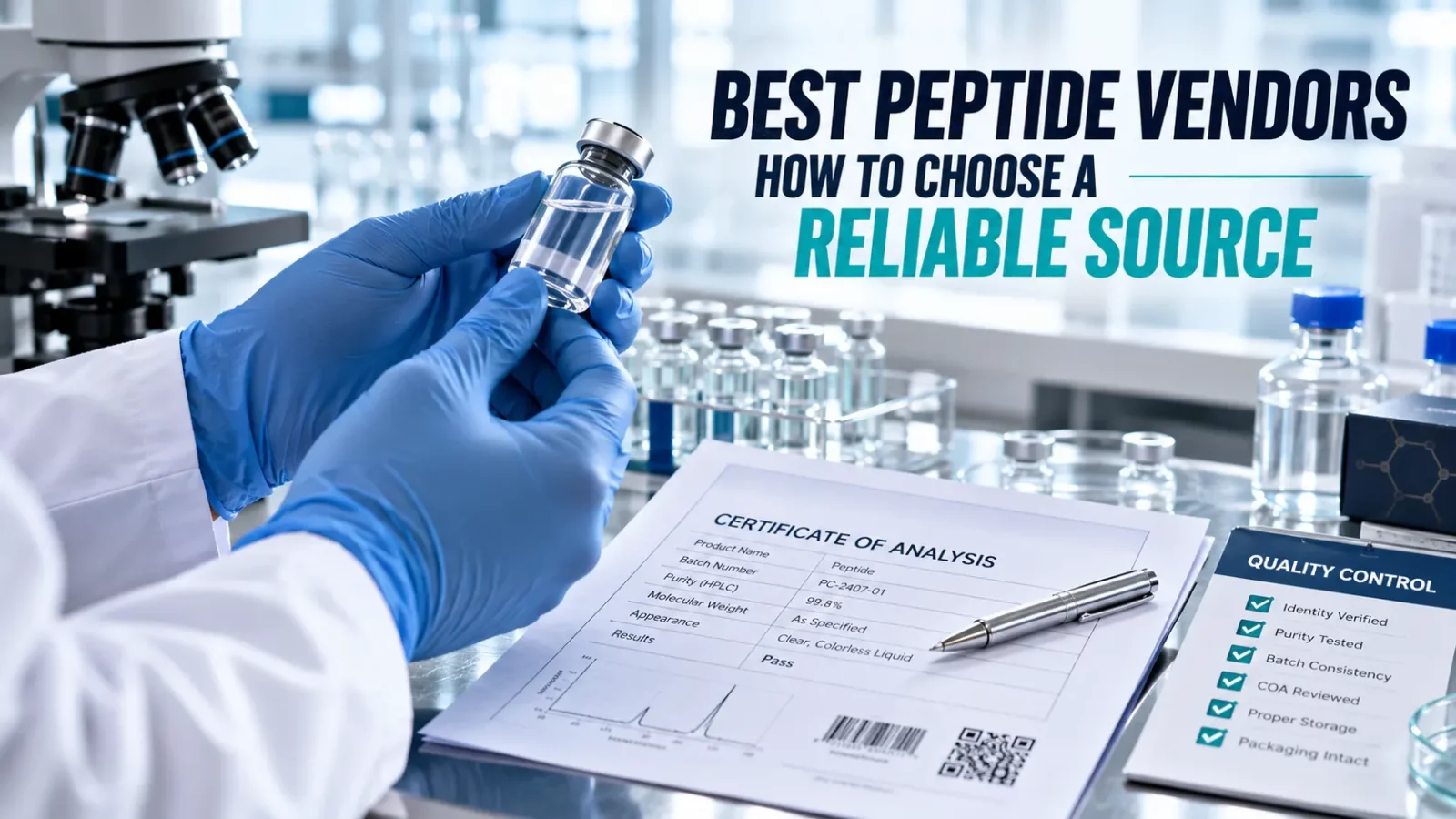
A COA is a lab report on a specific production batch. A useful one confirms three things:
- Identity: The compound in the vial is the compound on the label, confirmed by mass spectrometry (MS or LC-MS).
- Purity: The share of the sample that is the target peptide rather than impurities, measured by high-performance liquid chromatography (HPLC). Most reputable sellers report 98% or higher.
- Quantity: How much peptide is actually in the vial. A 99% pure vial that holds 3.4 mg instead of 5 mg is still underdosed.
Here’s the part many buyers miss: the COA on a vendor’s website is supplied by the vendor. It may be genuine, but you should treat it as a claim until you’ve checked it. A report you can rely on names the lab, carries a report or verification code, shows a test date and lists a batch number that matches the label on your vial. Some labs let you look up a report by its code on their own website, which is the quickest way to spot an edited or recycled PDF.
Our guide on how to read a peptide COA walks through a real report line by line.
A Track Record You Can Check
Peptide companies come and go fast. Payment processors drop them, regulators send warning letters and some simply disappear with customers’ money. Before you order, look for:
- Several years of continuous operation under the same name
- Consistent feedback across independent forums and Reddit, not just on the vendor’s own site
- No history of raids, rebrands or unexplained shutdowns
The risk is real. Blome Research was raided by federal agents in 2026, and Amino Asylum was raided in 2025. Both had loyal customers right up until the day they went dark.
Sensible Handling and Storage
Most research peptides ship as a freeze-dried (lyophilized) powder. In that form they hold up well for short periods at room temperature, so a few days in transit isn’t a problem on its own. Long-term storage should still be cold, ideally frozen, and once a peptide is mixed with bacteriostatic water it belongs in the fridge.
Good vendors explain this on their product pages and pack vials securely with lot numbers that match the COA. Ice packs are a nice extra in summer, but they’re not a substitute for testing.
How to Vet a Peptide Vendor in 6 Steps
The best peptide vendors pass all six of these checks without any trouble. Run them before you place a first order with any peptide supplier:
- Find the COA for the exact product and batch. If the vendor can’t produce one, stop there.
- Check the report details. Look for a named lab, a test date, a report code and both purity (HPLC) and identity (MS) results.
- Verify the report with the lab. Use the lab’s lookup tool or contact the lab if it offers verification.
- Compare prices across three or four vendors. This shows you the normal range for that compound.
- Test customer support. Ask a specific question about a batch or shipping and see how fast and how well they answer.
- Start with a small order. Buy one common compound first, then match the vial’s batch number to the COA when it arrives.
If you plan to reconstitute what you receive, our peptide reconstitution calculator does the math for you, and our guide on how to reconstitute peptides covers the steps.
What Peptide Prices Tell You About a Vendor
Research peptide prices reflect real costs: synthesis, purification, testing, storage and shipping. The best peptide vendors price to cover those costs, so they rarely top the “cheapest” lists. Price alone can’t prove quality, but it can warn you.
| Pricing Pattern | What It Usually Signals |
|---|---|
| Far below the market | Skipped testing, low-purity synthesis or underdosed vials |
| Mid-range, in line with competitors | Normal for established vendors that pay for testing |
| Premium | May reflect extra testing or faster shipping, but check that it does |
| Regular 10% to 20% discount codes | Standard marketing; not a quality signal either way |
A vendor selling BPC-157 at half the going rate isn’t doing you a favor. Someone is cutting a corner, and you won’t see which one until you test the vial.
Payment and Shipping Signals
Payment Methods
Many card processors refuse research chemical sellers, so most peptide vendors offer cryptocurrency and some offer bank transfers or digital wallets. That’s normal for the industry.
What you want to know is what happens if something goes wrong. Card payments can come with chargeback protection. Crypto payments can’t be reversed. A crypto-only vendor isn’t automatically a scam, but you’re carrying all of the risk, so the other checks matter even more.
Shipping Origin and Customs
Where a vendor ships from affects speed and risk:
- Domestic shipping is faster and avoids customs, so a US buyer ordering from a US vendor faces fewer seizures and delays.
- International orders can be held or seized at the border, and refund policies for seized packages vary widely. Read the vendor’s reshipment policy before you pay.
- Tracking should be standard on every order.
If you’re outside the US, our reviews of peptide companies that ship to Canada and of Pulse Peptides, a UK-based vendor, cover region-specific issues.
Red Flags When Choosing Peptide Suppliers
The best peptide vendors show none of these warning signs. Walk away from any peptide supplier that shows even one:
- No COAs, or COAs on request only: A legitimate vendor publishes them.
- COAs with no lab name, date or report code: These can’t be checked, and some are copied from other sellers.
- The same COA across many batches or products: A COA covers one batch, not a whole product line forever.
- Prices far below everyone else: See the pricing table above.
- Pressure tactics: Countdown timers, “last chance” pricing or bulk-only deals on a first order.
- No company details: No business name, no support email that answers, no returns policy.
- Reviews only on their own site: Look for feedback on independent forums before you trust star ratings.
- Human-use dosing advice on product pages: Research-only sellers that coach human use are taking legal shortcuts, and that’s rarely the only one.
SwissChems: The Peptide Vendor We Link To
We link to SwissChems on this page and earn a commission on orders through our link. Here’s what we checked against the criteria above, including what we couldn’t verify.
What SwissChems publishes:
- Product pages list dated HPLC lab reports tied to batch codes, plus a “COA available per batch” note.
- Payment by card, digital wallet or cryptocurrency.
- A 30-day returns policy on unopened products.
- A reward points program on most products, and free shipping on US orders over $100 and international orders over $300.
What to keep in mind: SwissChems supplies its own lab reports, as every vendor does. Check the lab name and report code on the COA for your batch, and match the batch number on your vial when it arrives. SwissChems has also operated under the same name for several years, which counts for a lot in this market.
Our reader code BRAWN10 takes 10% off at checkout. You can read how we rate companies on our methodology page.

Pros
- Exceptional purity & testing (≥98%)
- Pharmaceutical-style packaging for stability
- Broad catalog across peptides & nootropics
- Strong reputation & consistency across years
Cons
- Some items frequently out of stock due to high demand
- Limited long-term data for some compounds
Other Peptide Vendors We’ve Covered
We review peptide vendors one at a time, using the same criteria. Read the full reviews before you buy:
- Biotech Peptides review
- Core Peptides review and unboxing
- Pulse Peptides review (UK)
- Best peptide companies in Canada
- Blome Research (raided in 2026)
- Amino Asylum (raided in 2025)
Is It Legal to Buy Peptides Online?
It depends on where you live and what you buy, and the rules are tightening. Research peptides are sold “for research use only, not for human consumption.” That label is how sellers fit into the rules. It doesn’t make human use legal or safe.
- United States: Most research peptides aren’t approved drugs. The FDA lists BPC-157, TB-500, CJC-1295, ipamorelin, AOD-9604 and several others among bulk drug substances that may present significant safety risks when used in compounding.
- United Kingdom: A peptide sold as a medicine needs a license from the MHRA. Research-only sales sit in a gray area.
- Australia: Most peptides sold as research chemicals are prescription-only medicines, and importing them without a prescription is illegal.
- Tested athletes: BPC-157 and growth hormone secretagogues such as CJC-1295 and ipamorelin are banned at all times on the WADA Prohibited List.
For a country-by-country breakdown, see our guide to whether peptides are legal.
The Bottom Line
The best peptide vendors earn trust with evidence, not marketing.
- Look for a batch-specific COA with a named lab and a report code, verify it, and match it to your vial.
- Check the vendor’s track record, treat rock-bottom prices as a warning, and start with a small order.
- No vendor is risk-free in a market this volatile, but these checks filter out most of the bad ones before they cost you money.
Frequently Asked Questions
Disclaimer
Please read carefully
Not medical advice
Content here is not a substitute for professional medical advice.
Consult your doctor
Talk to your doctor before starting any supplement or new routine.
Use at your own risk
We are not responsible for adverse effects from acting on this.
Do your research
Make informed decisions about your own health.
No guarantees
Individual results vary. No claims about outcomes.
Important — Never disregard professional medical advice or delay seeking it because of something you read here. If you think you may have a medical emergency, call your doctor or your local emergency number right away.