Contents14 sections
GHRP-6 (Growth Hormone Releasing Peptide-6) is a small synthetic peptide that makes the pituitary gland release more of the body’s own growth hormone (GH). It was one of the first compounds of its kind, and it is still sold online as a research chemical to lifters who want the effects of higher GH without injecting HGH itself.
This GHRP-6 guide covers how the peptide works, what the research does and does not show, the doses used in studies and commonly reported by users, why it is almost always paired with a GHRH, and its side effects, starting with the strong hunger it is known for.
GHRP-6 is not approved for any medical use. Most of what is known comes from short human studies of GH release and from animal research. Long-term data in healthy people do not exist.
Key Takeaways
- GHRP-6 activates the ghrelin receptor (GHS-R1a), which triggers a short pulse of growth hormone from the pituitary gland.
- Human studies show reliable short-term GH release, and a much larger effect when it is combined with a GHRH such as Mod GRF 1-29. Long-term muscle and fat-loss data in healthy adults are missing.
- Clinical studies used about 1 mcg/kg. Users commonly report about 100 mcg one to three times a day on an empty stomach, paired with a GHRH.
- Strong hunger is its signature side effect, along with water retention, modest rises in cortisol and prolactin, lower insulin sensitivity, and tingling or numbness in the hands.
- GHRP-6 is not approved for human use, the quality of research-grade products varies, and it is banned in sport by WADA.
What Is GHRP-6?
GHRP-6 stands for Growth Hormone Releasing Peptide-6. It is often called growth hormone-releasing hexapeptide because it is a chain of six amino acids. It is a synthetic peptide that stimulates the release of growth hormone from the pituitary gland at the base of the brain.
It was developed by Cyril Bowers and colleagues in the early 1980s, years before scientists identified the receptor it works on. That receptor, the growth hormone secretagogue receptor (GHS-R1a), turned out to be the target of ghrelin, the natural “hunger hormone” discovered in 1999. GHRP-6 mimics ghrelin, which explains both of its main effects: more GH and more appetite.
GHRP-6 and related secretagogues were studied for conditions involving low GH, such as growth hormone deficiency, muscle wasting and the decline in GH secretion with age. Combined with GHRH, it was also used in research as a test of how much GH the pituitary can release. It never became an approved medicine.
Growth hormone itself has well-documented effects: in adults with GH deficiency, treatment increases lean mass, reduces fat mass and supports bone density. Whether raising GH with GHRP-6 does the same in healthy, trained people has not been tested in long-term trials. For a quick profile of the compound, see our GHRP-6 compound page.
How Does GHRP-6 Work?
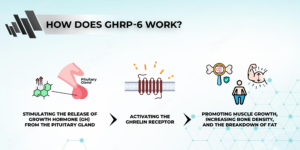
When GHRP-6 binds the ghrelin receptor on pituitary cells, it triggers a burst of GH secretion. It also acts in the hypothalamus, where it increases the brain’s own GHRH signal and blunts the effect of somatostatin, the hormone that switches GH release off. The result is a GH pulse rather than a constant high level, which is closer to the body’s natural pattern of secretion.
The pulse is short. GH levels peak within the first hour after a dose and fall back toward baseline within a few hours. The released GH then signals the liver and other tissues to make IGF-1 (insulin-like growth factor 1), which carries many of GH’s growth effects.
Because GHRP-6 depends on the pituitary, the body’s feedback loops stay in place: rising IGF-1 and somatostatin limit how far GH can climb. This is one reason its effects are milder than injecting HGH directly. With continuous exposure, the GH response also tends to weaken, which is why GHRPs are given as separate doses rather than around the clock.
Benefits of GHRP-6: What the Evidence Shows
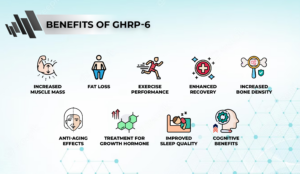
Most claimed benefits come from what growth hormone does in general, not from trials of GHRP-6 itself. Here is how each one holds up:
- Higher GH pulses: Well documented in human studies, in both younger and older adults. This is the one effect GHRP-6 reliably delivers.
- Muscle mass: GH and IGF-1 support protein synthesis, and GH therapy adds lean mass in GH-deficient adults. There are no long-term trials of GHRP-6 for muscle in healthy lifters, and part of any early scale gain is water.
- Fat loss: GH promotes lipolysis, the breakdown of stored fat for energy. In practice, the extra hunger from GHRP-6 can cancel this out during a diet.
- Recovery: GH and IGF-1 are involved in tissue repair, and users often report better recovery between sessions. This is anecdotal.
- Bone density: GH therapy supports bone health in GH-deficient adults. No studies show this from GHRP-6 in healthy people.
- Appetite: For people who struggle to eat enough while bulking, the hunger can be useful. For everyone else, it is the main drawback.
- Sleep: Some users report deeper sleep, especially with a bedtime dose. This is anecdotal.
- Tissue protection: Animal studies have looked at protective effects of GHRP-6 on the heart and liver after injury. These findings have not been confirmed in humans.
Who Considers GHRP-6, and Who Should Avoid It
GHRP-6 is not prescribed for any condition, so there is no approved patient group. It mostly draws interest from three groups:
- Lifters looking for more muscle, usually during a bulk, where the extra appetite helps them eat more.
- People trying to lose fat, although the hunger makes GHRP-6 a poor fit for most diets. A more selective GHRP such as ipamorelin causes less appetite.
- People interested in healthy ageing, since GH output falls with age. Note that raising GH tends to lower insulin sensitivity rather than improve glucose control.
It is a poor choice, or should be avoided, for:
- People with diabetes, prediabetes or insulin resistance
- Anyone with a history of cancer, since GH and IGF-1 promote cell growth
- Pregnant or breastfeeding women and anyone under 18
- Competitive athletes: GH secretagogues, including GHRP-6, are on the WADA Prohibited List
How to Use GHRP-6 With a GHRH
GHRPs are usually paired with a growth hormone-releasing hormone (GHRH) analog, such as Mod GRF 1-29 (also sold as CJC-1295 without DAC) or sermorelin. The two work through different receptors: the GHRH analog acts on the GHRH receptor, while GHRP-6 acts on the ghrelin receptor and dampens somatostatin’s brake on GH release.
Human studies found that giving GHRP-6 together with GHRH released far more GH than either peptide alone, more than the two effects added together. That synergy is the best-supported reason to combine peptides. Our Mod GRF 1-29 guide covers the GHRH side of the pairing.
The longer-acting CJC-1295 with DAC is another GHRH option, but a single injection raises GH and IGF-1 for days rather than in short pulses, so many users prefer the short-acting Mod GRF 1-29 alongside GHRP-6.
GHRP-6 Dosage
GHRP-6 is not approved, so there is no medical dose. The figures below are doses used in studies and doses commonly reported by users. They are not recommendations.
| Context | Dose | Frequency | Type of data |
|---|---|---|---|
| Clinical GH testing | About 1 mcg/kg IV, often with 1 mcg/kg GHRH | Single dose | Human studies |
| GHRP-6 alone | About 100 mcg subcutaneous (roughly 1 mcg/kg) | 1-3 times a day | User reports |
| GHRP-6 with Mod GRF 1-29 | About 100 mcg of each, in the same injection | 1-3 times a day | User reports |
Doses used in studies: In clinical research, GHRP-6 was mostly given as a single intravenous dose of about 1 mcg per kilogram of body weight, often with an equal dose of GHRH, to measure how much GH the pituitary released.
Commonly reported doses: Users commonly report about 100 mcg (roughly 1 mcg/kg) injected under the skin one to three times a day, usually together with about 100 mcg of Mod GRF 1-29. The usual reasoning is that GH release levels off at around 1 mcg/kg, so larger doses mostly add hunger, cortisol and prolactin. Higher doses are reported, but there is little evidence that they release meaningfully more GH.
Timing: Doses are commonly taken on an empty stomach, at least two hours after a meal, with food about 20-30 minutes later, because carbohydrates and fat blunt the GH pulse. A bedtime dose is common because the largest natural GH pulse happens early in sleep.
Length of use: Users commonly report runs of a few weeks to a few months. There are no long-term safety data that define a safe length of use.
GHRP-6 Side Effects
GHRP-6’s side effects come from two sources: the ghrelin receptor itself (hunger, cortisol, prolactin) and the extra GH it releases (water retention, blood sugar, tingling). Most are dose-related and ease when the dose is lowered or stopped.
| Side Effect | Why It Happens | What Is Reported |
|---|---|---|
| Strong hunger | Ghrelin receptor activation | Usually starts within half an hour of a dose; the most consistent effect |
| Water retention | GH makes the kidneys hold on to sodium and water | Puffy hands, feet or face; early scale-weight gain |
| Higher cortisol and prolactin | GHRP-6 also stimulates ACTH and prolactin release | Modest, short-lived rises in studies; more likely at higher doses |
| Lower insulin sensitivity | GH counteracts the action of insulin | Higher fasting blood sugar; a concern with diabetes or prediabetes |
| Tingling or numbness | Fluid retention pressing on nerves, as in carpal tunnel syndrome | Pins and needles in the hands and fingers; joint aches |
| Injection-site reactions | Repeated subcutaneous injections; product purity | Redness and itching; infection risk if the technique or product is not sterile |
| Weaker response over time | Receptor desensitization with continuous exposure | A smaller GH response with constant use |
Cortisol and Prolactin
Unlike ipamorelin, GHRP-6 is not fully selective for GH. Human studies show it also raises ACTH, the hormone that drives cortisol, and prolactin, usually modestly and for a short time. Ipamorelin was developed partly to avoid this: in animal studies, it released GH without meaningful rises in ACTH or cortisol, even at doses far above those needed for GH release.
Blood Sugar
GH opposes insulin. Raising it can lift fasting glucose and lower insulin sensitivity, which matters most for people whose blood sugar is already high. Users who track bloodwork commonly check fasting glucose, HbA1c and IGF-1. For how these effects compare with other compounds, see the side effects of peptides.
GHRP-6 Stacks
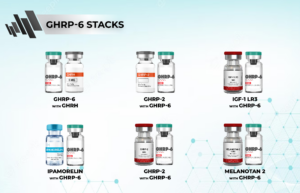
When it comes to stacking, the key point is the receptor. GHRP-6 pairs well with compounds that act through a different pathway, and adds little to compounds that use the same one.
- GHRH analogs (Mod GRF 1-29 / CJC-1295 without DAC, sermorelin, CJC-1295 with DAC): The classic and best-supported pairing. The combination releases more GH than either peptide alone.
- Other ghrelin agonists (GHRP-2, ipamorelin, hexarelin, MK-677): These act on the same receptor as GHRP-6. Stacking two of them adds little GH and more side effects, so users normally pick one.
- IGF-1 LR3: Sometimes added for its own growth effects. There are no studies of the combination, and IGF-1 LR3 brings its own risks, including low blood sugar.

Overview
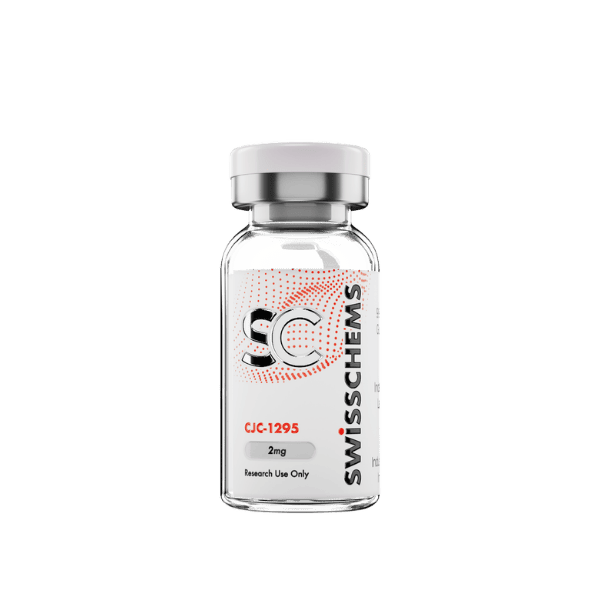
- Form: Peptide vial for subcutaneous injection (2 mg)
- Researched Dosage: 100 mcg, 1-3 times daily
- Typical Cycle: 8-12 weeks
- Cost: $42.95 (1 vial), $429.50 (10 vials)
- Stacking Options: Ipamorelin, GHRP-6, Hexarelin
Pros
- Also called Mod GRF (1-29), it is a GHRH analog with four amino acid swaps that stop enzymes from breaking it down so quickly.
- It boosts the size of natural growth hormone pulses instead of creating a constant elevation, which keeps normal feedback intact.
- Paired with a GHRP like Ipamorelin, it may release several times more growth hormone than either peptide alone.
Cons
- A 2 mg vial covers only about 7-20 days at typical doses, so a full cycle takes several vials.
- Doses should be taken on an empty stomach, since food and insulin blunt the growth hormone release.
- It is not an approved human medication, SwissChems sells it for research use only, and WADA bans it.
For a GHRH stack built around a more selective GHRP, see our Ipamorelin + CJC-1295 stack guide.
GHRP-6 vs GHRP-2, Ipamorelin and Hexarelin
All of these peptides act on the ghrelin receptor, but they differ in how much hunger and hormone spillover they cause:
| Peptide | Hunger | Cortisol and Prolactin | Best Known For |
|---|---|---|---|
| GHRP-6 | Strong | Modest rise | The original GHRP; the strongest appetite effect |
| GHRP-2 | Moderate | Modest rise | Stronger GH release per mcg than GHRP-6 |
| Ipamorelin | Mild | Little to no rise in studies | The most selective for GH |
Hexarelin is the most potent GH releaser of the group, but its GH response fades fastest with continued use and it also raises cortisol and prolactin. For people who want a GHRP without the hunger, ipamorelin is the usual alternative.

What makes Ipamorelin stand out is its selectivity — it boosts GH without significantly affecting cortisol, prolactin, or other hormones.
This peptide is widely used for its ability to support recovery, promote deeper sleep, and help preserve lean muscle. Many athletes and fitness enthusiasts notice faster recovery between training sessions and improved energy balance.
Overview
- Studied For: Growth hormone release, recovery, body composition, muscle repair, fat metabolism, and healthy-ageing pathways
- Mechanism: Selectively activates ghrelin receptors in the anterior pituitary gland to stimulate pulsatile growth hormone secretion
- Available Strength: 2mg vial
- Form: Peptide vial supplied for reconstitution
- Research Status: Investigational growth hormone secretagogue intended for research use
Pros
- Stimulates GH release with minimal impact on other hormones
- Supports recovery, sleep quality, and lean mass retention
- Generally considered to have a milder side effect profile compared to stronger GH analogs
Cons
- Short half-life requires frequent or carefully timed dosing
- Limited human clinical research and long-term data
- Injection site discomfort and mild side effects possible
Where to Buy GHRP-6
GHRP-6 is not available on prescription. It is sold online as a research chemical labeled not for human use, and quality varies between vendors. Products can be underdosed, contaminated or not what the label says, and the rules on buying and owning research peptides differ by country.
Whichever vendor you look at, ask for a recent third-party certificate of analysis (COA) for the exact batch, with purity and identity testing. Our guide on how to read a peptide COA explains what to check.
Pros
- Exceptional purity & testing (≥98%)
- Pharmaceutical-style packaging for stability
- Broad catalog across peptides & nootropics
- Strong reputation & consistency across years
Cons
- Some items frequently out of stock due to high demand
- Limited long-term data for some compounds
The Bottom Line
GHRP-6 reliably raises growth hormone in the short term, but its strong hunger, side effects and thin long-term evidence make it a niche research peptide rather than a proven muscle builder.
- It works through the ghrelin receptor and is most effective paired with a GHRH such as Mod GRF 1-29. Stacking it with another ghrelin agonist adds little.
- Clinical studies used about 1 mcg/kg, and commonly reported doses are around 100 mcg one to three times a day. Neither is medical advice for an unapproved compound.
- Expect strong hunger and possibly water retention, modest cortisol and prolactin rises, lower insulin sensitivity and tingling hands. Ipamorelin is the more selective alternative.
Frequently Asked Questions
Disclaimer
Please read carefully
The information on this site is for educational and informational purposes only, and is not medical advice. Always consult a qualified healthcare professional before using any supplement or medication, or making changes to your health, fitness, or nutrition routine.
Not medical advice
Content here is not a substitute for professional medical advice.
Consult your doctor
Talk to your doctor before starting any supplement or new routine.
Use at your own risk
We are not responsible for adverse effects from acting on this.
Do your research
Make informed decisions about your own health.
No guarantees
Individual results vary. No claims about outcomes.
Important — Never disregard professional medical advice or delay seeking it because of something you read here. If you think you may have a medical emergency, call your doctor or your local emergency number right away.