Contents10 sections
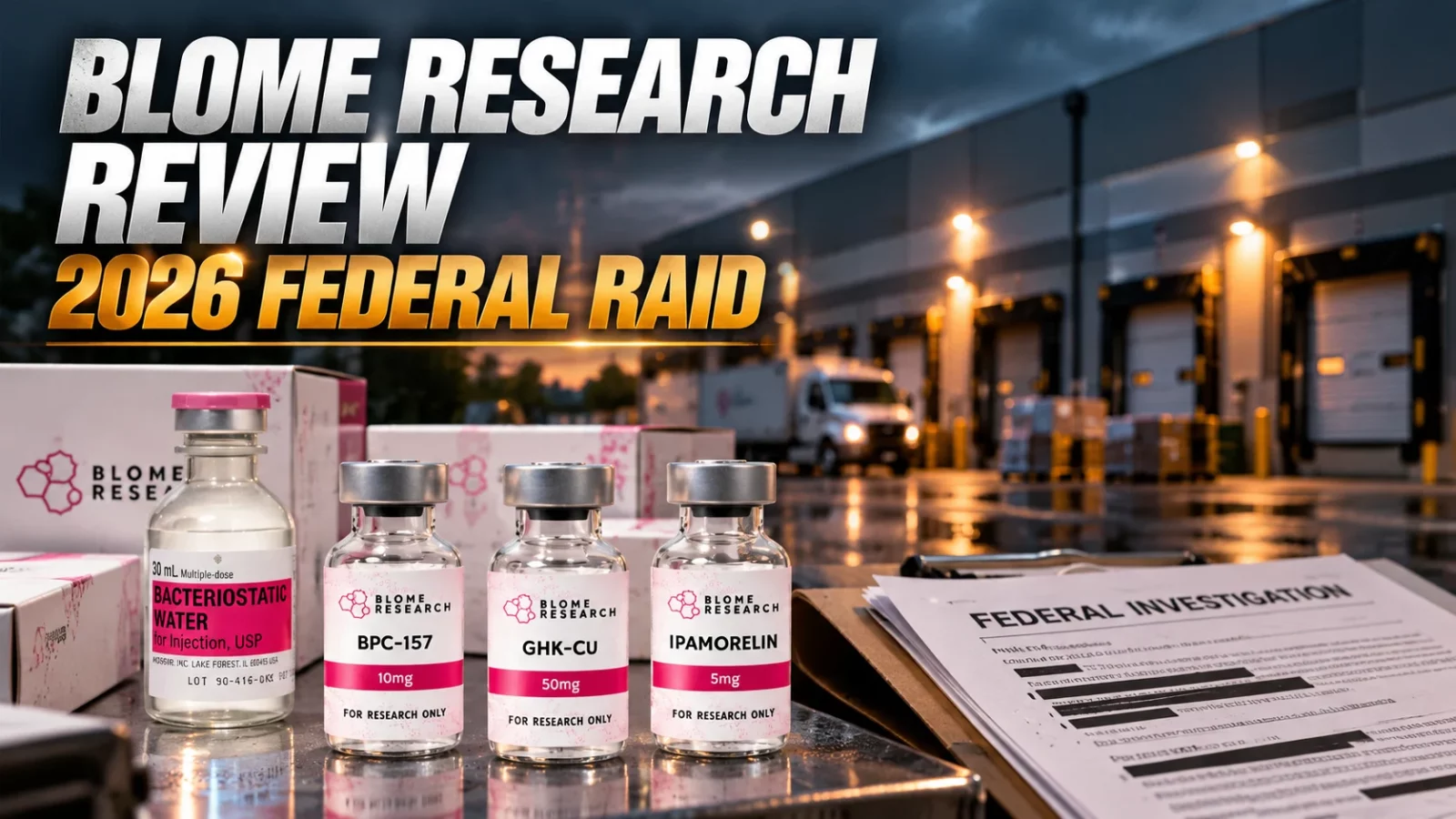
Blome Research, a Missouri-based peptide vendor, was raided by federal agents on June 3-4, 2026. The U.S. Postal Inspection Service executed seizure warrants at three properties in Newton County, Missouri, seizing real estate, vehicles, bank accounts, and inventory. The raid was the result of a roughly two-year investigation into the company’s operations.
According to reporting from local and national outlets, Blome Research had deposited at least $15 million across approximately 50 bank accounts between 2023 and 2025 while shipping over 31,000 parcels through USPS. The operation was run by two men—Casey Crider and Jason Huston—neither of whom held a medical or pharmacy license.
This review covers what we originally assessed about Blome Research as a vendor, what the federal investigation uncovered, what was seized, and what this means for anyone who purchased from them or is looking for peptide vendors going forward.
Key Takeaways
- Blome Research was raided by the U.S. Postal Inspection Service on June 3-4, 2026, at three locations in Newton County, Missouri.
- The company was operated by Casey Crider and Jason Huston, neither of whom was a licensed pharmacist or medical doctor.
- Federal investigators documented at least $15 million in deposits across ~50 bank accounts and over 31,000 parcels shipped via USPS.
- Properties, vehicles (including a Tesla Cybertruck), ATVs, construction equipment, and bank accounts were seized or frozen.
- The Missouri Board of Pharmacy had issued a cease-and-desist in November 2024. Blome Research acknowledged it, agreed to stop, then resumed selling months later under altered product names.
- The company is effectively shut down. Anyone still looking for a Blome Research alternative should prioritize vendors with verifiable testing, transparent ownership, and proper licensing.
What Happened to Blome Research
The Raid: June 3-4, 2026
On June 3 and 4, 2026, federal agents executed seizure warrants at three properties in Newton County in southwest Missouri, near the towns of Carl Junction and Seneca. The operation was led by the U.S. Postal Inspection Service (USPIS), with Postal Inspector Paul Shade named as the lead investigator.
Shade told reporters that USPIS was brought into the case “because some of the items that were being mailed were fraudulent and so therefore it falls under our purview to investigate those.”
What Was Seized
The scope of the seizure was substantial:
- Real estate: Multiple properties near Carl Junction and Seneca, including Huston’s residence and properties on Hottel Springs Road and Kentucky Road
- Vehicles: An SUV, a Tesla Cybertruck, and a high-end autocycle
- Other assets: All-terrain vehicles and construction equipment
- Financial accounts: Bank accounts across multiple platforms were frozen
The seized assets reflect the scale of revenue the operation generated. Federal filings documented at least $15 million deposited into various bank accounts between 2023 and 2025.
The Two-Year Investigation
The federal action did not come out of nowhere. The investigation timeline stretches back to late 2024:
September 2024: The Missouri Board of Pharmacy received screenshots from Casey Crider’s Facebook page showing him offering to sell tirzepatide to a pharmacist via Facebook Messenger. Crider allegedly told the pharmacist this would work as long as the pharmacist was “not the FDA.”
October 2024: An undercover Missouri Board of Pharmacy employee placed orders for semaglutide and bacteriostatic water from Blome Research. The orders shipped via USPS.
November 2024: The Missouri Board of Pharmacy issued a cease-and-desist letter ordering Blome Research to stop unlicensed pharmacy practice and drug distribution. Blome Research acknowledged receipt and agreed to halt operations.
June 2025: Despite the cease-and-desist, Blome Research began re-advertising semaglutide, tirzepatide, and retatrutide on their website.
July 2025: The website was updated with altered product names—”GLP-Tir” instead of tirzepatide, “GLP-Sem” instead of semaglutide—apparently to obscure the actual drug names.
November 2025: An undercover federal agent called Crider for weight-loss advice.
February 2026: An undercover order was placed for a “TIRZ 20” vial at $80 plus shipping.
March 2026: A recorded call with Huston included him discussing usage instructions and offering “porch pickups” at his residence in Seneca, Missouri.
June 3-4, 2026: Federal seizure warrants executed.
The Scale of the Operation
Federal investigators documented the full scope of Blome Research’s business:
| Metric | Detail |
|---|---|
| Total revenue documented | $15 million+ (2023-2025) |
| Bank accounts identified | ~50 across PayPal, Cash App, Zelle, MetaPay, Bluevine, and banks |
| Parcels shipped via USPS | 31,776 (Jan 2024 – Sep 2025) |
| Shipping origin | Carl Junction, Joplin, and Seneca, Missouri |
| Return address | Jason Huston’s personal residence |
| Peptide materials sourced from | Chemical companies in China ($1 million+ spent) |
| Tirzepatide pricing | ~$80/vial (vs. $150-$450 through legitimate pharmacies) |
The products sold included semaglutide, tirzepatide, retatrutide, NAD+, AOD-9604, and bacteriostatic water. All were labeled “for research use only,” but the investigation documented multiple instances of the operators providing human dosing instructions, weight-loss advice, and usage guidance directly to customers.
Neither Casey Crider nor Jason Huston held a medical doctor or pharmacy license.
The Allegations
The federal action centers on several alleged violations:
- Selling misbranded drugs: Products labeled “research use only” while being marketed with human usage instructions and dosing recommendations
- Unlicensed pharmacy practice and drug distribution: Operating without any pharmaceutical licensing
- Mail fraud: Shipping fraudulent items through USPS
- Wire fraud: Conducting fraudulent transactions electronically
- Interstate sales violations: Selling unapproved drugs across state lines
- Selling unapproved drugs: Retatrutide, for example, has not received FDA approval for any use
As of October 2026, these remain allegations. The action appears to be a civil forfeiture proceeding (seizure of assets). No formal criminal indictment has been publicly announced, though the investigation remains ongoing.
What We Originally Assessed About Blome Research

Before the raid, our Blome Research review gave the vendor a 3.0/5 rating—functional but lacking the transparency expected from top-tier vendors. The red flags we identified at the time look different now:
| Original Assessment | What the Investigation Revealed |
|---|---|
| No published address or team info | Operators identified as unlicensed individuals running the business from residential properties |
| ~22 peptide products, limited range | Products sourced from Chinese chemical companies for $1M+ and resold at significant markup |
| Some Janoshik COAs, unclear batch testing | Testing documentation did not address the fundamental issue: unlicensed manufacturing and distribution |
| All sales final, no returns | Standard policy for the vendor, but left customers with no recourse after the shutdown |
| Competitive pricing (e.g., BPC-157 at $37.50) | Pricing was possible because the operation bypassed all pharmaceutical licensing and quality controls |
The lesson here is that third-party COAs, while important, do not tell the full story. A vendor can send samples to a testing lab while still operating without proper licensing, sourcing materials without quality controls, and distributing products illegally. Testing one dimension of quality does not validate the entire supply chain.
What This Means for Blome Research Customers
Is Blome Research Still Operating?
No. Following the June 2026 seizure, Blome Research is effectively shut down. Properties were seized, vehicles confiscated, and bank accounts frozen. There is no indication the company will resume operations.
Financial Risk
If you had pending orders or store credit with Blome Research, that money is likely gone. The company’s assets have been seized by federal authorities, and there is no customer restitution mechanism in place. Customers who paid via credit card may attempt a chargeback through their card issuer, but success depends on timing and the issuer’s policies.
Legal Risk for Buyers
For individual buyers, the legal risk of having previously ordered from Blome Research is generally low. Federal investigations of this type focus on the operators, manufacturers, and distributors rather than individual consumers purchasing small quantities. However, if you possess compounds that are controlled or scheduled in your jurisdiction, that is a separate legal consideration.
Product Safety Concerns
The investigation revealed that Blome Research sourced peptide materials from chemical companies in China and distributed them from residential properties in Missouri without pharmaceutical licensing. There was no documented GMP manufacturing process, no licensed pharmacist overseeing production, and no regulatory quality controls. If you have Blome Research products on hand, consider that they were produced outside of any quality framework that would ensure sterility, purity, or accurate dosing.
How to Evaluate Peptide Vendors After Blome Research
The Blome Research shutdown—following the Amino Asylum raid in 2025—makes it clear that the gray-market vendor ecosystem carries real and growing risk. Here is what to look for when choosing a vendor.
Beyond COAs: What Actually Matters
Third-party testing is necessary but not sufficient. Blome Research had Janoshik COAs. They were still raided because testing one vial from a batch does not address licensing, manufacturing standards, or supply chain integrity. Evaluate vendors on the full picture:
- Business transparency: Verifiable business registration, physical address (not just a PO box), named leadership
- Licensing: Any vendor selling compounds that could be classified as drugs should have relevant licensing or operate through a licensed compounding pharmacy
- Manufacturing documentation: GMP certification or equivalent. A clean website is not a manufacturing standard.
- Consistent batch testing: Every batch tested, COAs accessible with unique identifiers, from a recognized independent lab
- Customer service infrastructure: Responsive support through multiple channels—not just a phone number that rings to someone’s personal cell
The Regulatory Trend
The Blome Research seizure is part of an accelerating enforcement pattern:
- 2025: Amino Asylum shut down after reported federal action
- 2026: Blome Research raided after a two-year federal investigation
- Ongoing: Payment processors continue tightening policies on research chemical merchants; state pharmacy boards are actively investigating unlicensed vendors
The “research use only” legal framework that sustained gray-market peptide vendors for years is eroding. Vendors that market products with human dosing instructions while hiding behind research disclaimers are the primary targets.
Safer Alternatives
For buyers who want continued access to peptides:
- Telemedicine and prescription routes: For compounds like BPC-157, growth hormone peptides, and GLP-1 agonists, legitimate telemedicine clinics can prescribe and dispense legally. More expensive but eliminates legal risk.
- Vetted research chemical vendors: For compounds that remain legally available as research chemicals, purchase from vendors with documented testing, verifiable business operations, and transparent manufacturing. See our best peptide vendors guide for current recommendations.
The Bottom Line
Blome Research is done. The June 2026 federal seizure shut down an operation that had generated at least $15 million in revenue over two years, shipped over 31,000 packages through USPS, and continued operating after receiving a state cease-and-desist order.
- The operators were not licensed pharmacists or physicians, and the products were sourced from Chinese chemical suppliers and distributed from residential properties without pharmaceutical oversight.
- For the broader peptide community, the message is the same one the Amino Asylum shutdown sent in 2025, only louder: vendor selection carries real financial, safety, and legal risk. COAs matter, but they are one piece of a larger picture that includes licensing, manufacturing standards, and business transparency.
- If you are looking for a Blome Research alternative, start with our current best peptide vendors guide and evaluate every option against the criteria above.
Frequently Asked Questions
Disclaimer
Please read carefully
The information on this site is for educational and informational purposes only, and is not medical advice. Always consult a qualified healthcare professional before using any supplement or medication, or making changes to your health, fitness, or nutrition routine.
Not medical advice
Content here is not a substitute for professional medical advice.
Consult your doctor
Talk to your doctor before starting any supplement or new routine.
Use at your own risk
We are not responsible for adverse effects from acting on this.
Do your research
Make informed decisions about your own health.
No guarantees
Individual results vary. No claims about outcomes.
Important — Never disregard professional medical advice or delay seeking it because of something you read here. If you think you may have a medical emergency, call your doctor or your local emergency number right away.