
Contents7 sections
Peptides are short chains of amino acids, and a handful of them have become popular with lifters for fat loss, muscle growth, injury recovery and sexual health. Some act as signals that tell your own glands to release more of a hormone, such as growth hormone. Others, like IGF-1 LR3, act directly on muscle and other tissue.
Not all peptides are equally strong, and not all are equally well studied. Two on this list, tesamorelin and bremelanotide (PT-141), are approved prescription drugs with human trials behind them. The rest are research compounds whose evidence comes mostly from cell and animal studies.
This guide covers the strongest peptide for each goal, what the research actually shows, and where the evidence stops.
Key Takeaways
- The strongest peptide depends on the goal: fat loss, muscle growth, healing and sexual health each have a different front-runner.
- Tesamorelin has the strongest human evidence here: in phase 3 trials in people with HIV it cut visceral (deep belly) fat by about 15% over 26 weeks.
- PT-141 (bremelanotide) is the only other one with an approval: the FDA approved it in 2019 as Vyleesi for low sexual desire in premenopausal women.
- MGF, PEG-MGF, IGF-1 LR3 and TB-500 are popular for muscle and healing, but their evidence comes from cell and animal studies, not human trials.
- Research peptides are unregulated and most are banned in tested sport; product quality and long-term safety are unknown, so medical supervision matters.
How We Selected These Peptides
We grouped the peptides by goal rather than ranking them in one list, because the strongest peptide for fat loss is not the strongest for healing. For each one we looked at three things: how it works, the quality of the evidence (human trials first, then animal and cell studies), and what users commonly report.
Where the evidence is only animal or lab data, we say so. User reports are useful for spotting trends, but they are not proof that a peptide works or is safe. Here is how the five compare at a glance:
| Peptide | Main Goal | Best Evidence | Status |
|---|---|---|---|
| MGF / PEG-MGF | Muscle growth | Cell and animal studies | Research compound, not approved |
| Tesamorelin | Visceral fat loss | Phase 3 human trials | FDA-approved (Egrifta) for HIV-related abdominal fat |
| IGF-1 LR3 | Muscle growth and fat loss | Cell and animal studies of IGF-1; no human trials of LR3 | Research compound, not approved |
| TB-500 | Healing and recovery | Animal studies; small human trials of TB4 eye drops and gels only | Research compound, not approved |
| PT-141 (bremelanotide) | Sexual desire | Phase 3 human trials in women | FDA-approved (Vyleesi) for HSDD in premenopausal women |
The Strongest Peptides According to Goal
Best Peptide for Muscle Growth: MGF (Mechano Growth Factor)
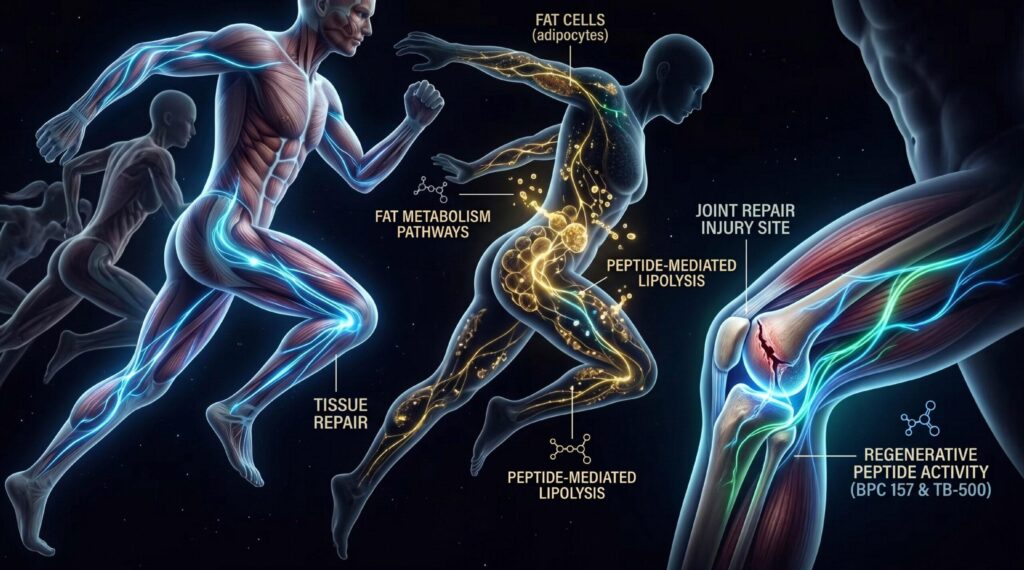
MGF (mechano growth factor) is one of the most discussed muscle-building peptides. It is a splice variant of IGF-1 (insulin-like growth factor 1): when a muscle is loaded or damaged, for example by heavy resistance training, the IGF-1 gene is read in a slightly different way to produce MGF. In humans this variant is known as IGF-1Ec.
In cell and animal studies, the MGF signal is linked to the activation of satellite cells, the stem cells that repair muscle fibers and add to them after training. A small human study found that older people produced far less MGF after a bout of heavy resistance exercise than young people (Hameed et al., Journal of Physiology, 2003), which may be one reason older lifters build and keep muscle less easily.
Synthetic MGF is sold as a research peptide to copy and amplify that post-training signal. The evidence for doing so is thin: the muscle-growth data come from cells and animals, there are no published human trials of injected MGF, and a 2014 lab study (Fornaro et al., American Journal of Physiology) found that the synthetic MGF peptide had no clear effect on muscle cells or muscle stem cells.
What About MGF With PEG?
Native MGF is reported to break down within minutes in the blood, which is why users who inject it typically do so into the trained muscle right after a workout. PEG-MGF is MGF with polyethylene glycol (PEG) chains attached. PEGylation is an established way to slow how fast a drug is cleared, and here it is meant to keep MGF in circulation far longer, often quoted as several days.
That longer life is why PEG-MGF is usually injected under the skin rather than into a muscle, and why users describe a slower, steadier effect over several days instead of an acute post-workout spike. There are no published human pharmacokinetic or muscle-growth studies of PEG-MGF, so both the half-life figures and the claimed benefits come from vendors and user reports, not trials.
For people who include MGF in a stack, PEG-MGF is the more practical form because it does not need daily intramuscular injections. Whether either form builds muscle in humans has not been shown. Our MGF peptide review covers both forms in more detail.


Overview
- Form: Lyophilized powder for injection (5 mg vial)
- Researched Dosage: 100 mcg to 200 mcg post-workout, 2-3 times weekly
- Typical Cycle: 4-6 weeks
- Cost: $59.00
- Stacking Options: IGF-1 LR3, PEG-MGF, Follistatin-344
Pros
- A splice variant of IGF-1 released by muscle after mechanical stress, thought to activate satellite cells that drive muscle repair and growth.
- Animal studies suggest it may speed muscle regeneration after injury and help offset age-related muscle loss.
- Early animal research also points to possible protective effects on heart and nerve tissue after damage.
Cons
- Its half-life is only minutes, so it must be injected right after training, usually into the worked muscle.
- The evidence is contested: some lab studies found the synthetic peptide had no independent effect on muscle cell growth.
- MGF is not an approved human medication, there is no human safety data, and WADA bans it as a growth factor.
Strongest Peptide for Fat Loss: Tesamorelin
For fat loss, tesamorelin has the strongest clinical evidence of any peptide in this guide. Unlike most compounds here, which rest on animal studies and user reports, it has been through full phase 3 trials and is an approved drug.
Tesamorelin is a synthetic analogue of growth hormone-releasing hormone (GHRH). Instead of supplying growth hormone directly, it signals the pituitary gland to release more of your own GH in its natural pulses. GH and the IGF-1 it drives then increase fat breakdown, with the clearest effect on visceral fat: the deep abdominal fat around the organs that is most closely linked to metabolic and heart disease.
The key human evidence comes from a phase 3 trial published in the New England Journal of Medicine in 2007 (Falutz et al.). In it, 412 people with HIV and excess abdominal fat took 2 mg of tesamorelin or a placebo daily for 26 weeks. Visceral fat fell by about 15% on tesamorelin and rose by about 5% on placebo, lean mass was preserved, and triglycerides and the cholesterol ratio improved. A second phase 3 trial confirmed the result, and a later trial found it also reduced liver fat (Stanley et al., JAMA, 2014).
There are two caveats. The fat came back when people stopped: those switched to placebo after 26 weeks regained visceral fat. And while the lipid changes are favorable, no trial has shown that tesamorelin lowers the rate of heart attacks or strokes.
Tesamorelin is FDA-approved under the brand name Egrifta (approved in 2010) to reduce excess abdominal fat in people with HIV-associated lipodystrophy. Some physicians prescribe it off-label for visceral fat, which makes it one of the few peptides in this space available through a legitimate clinical channel.
The trade-offs: it needs a prescription, it is expensive, and almost all of the data come from people with HIV. Reported side effects include injection-site reactions, joint pain, swelling and higher blood sugar, so glucose is monitored during treatment. Our tesamorelin guide covers the trials, studied doses and side effects in full.
One wider point: tesamorelin is the strongest peptide for visceral fat, not for total body weight. For overall weight loss, prescription GLP-1 peptides such as semaglutide and tirzepatide have much larger trials and produce far bigger reductions in body weight. They work mainly by reducing appetite rather than through growth hormone.
Best Peptide for Muscle Growth + Fat Loss: IGF-1 LR3
IGF-1 LR3 (Long R3 IGF-1) is a modified version of insulin-like growth factor 1, the hormone that carries out much of growth hormone’s effect on muscle. It has an arginine in place of glutamic acid at position 3 and a 13-amino-acid extension at the start of the chain. These changes mean it binds poorly to the proteins that normally hold IGF-1 in check, so more of it stays free and active, and for longer, than natural IGF-1.
IGF-1 itself is strongly anabolic: it increases protein synthesis, helps move glucose into cells and drives growth in muscle and other tissues. That is why users run IGF-1 LR3 for both muscle gain and a leaner physique, and many experienced users rate it among the most potent peptides for body composition.
The evidence gap is large. IGF-1 LR3 is made mainly as a cell-culture reagent for laboratories, and there are no published human trials of it for muscle growth or fat loss; the fat-loss claims come from user reports. The approved IGF-1 drug, mecasermin, is used only for children with severe IGF-1 deficiency. The main short-term risk is low blood sugar, because IGF-1 acts like insulin. Higher IGF-1 levels have also been linked to some cancers in observational studies, a theoretical concern with long-term use.
Strongest Peptide for Healing & Recovery: TB-500
Every athlete eventually deals with an injury: a nagging tendon, a strained muscle or a joint that will not settle. How fast you heal decides how soon you can train hard again, and TB-500 is one of the most talked-about peptides for recovery.
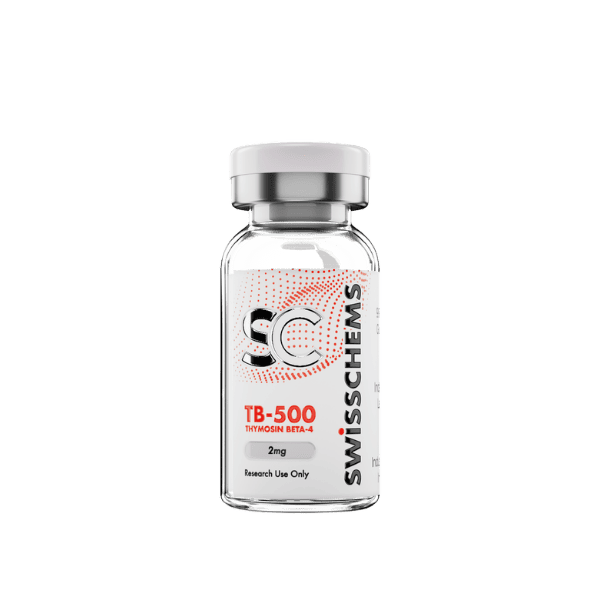
TB-500 is a synthetic peptide based on thymosin beta-4 (TB4), a 43-amino-acid peptide found in nearly all human cells. Products sold as TB-500 vary: some are full-length synthetic TB4, others a short fragment from its active region. TB4 binds actin, the protein cells use to build their internal scaffolding and to move, which is how it is thought to help repair cells migrate into a wound.
In animal and lab studies, TB4 promotes cell migration, new blood vessel growth (angiogenesis) and wound closure, and it reduces inflammation. It sped up skin wound healing in rats (Malinda et al., Journal of Investigative Dermatology, 1999) and helped heart muscle survive and repair after a heart attack in mice (Bock-Marquette et al., Nature, 2004).
The human evidence is limited. Small trials have tested TB4 only as eye drops and skin gels, with mixed results, and there are no published human trials of injected TB-500 for muscle, tendon or ligament injuries. Our TB-500 guide covers the research and commonly reported protocols.

Overview
- Form: Lyophilized powder
- Researched Dosage: 2 mg to 5 mg per week, often split into two doses, during a 4-6 week loading phase; then 2 mg to 2.5 mg every 1-2 weeks for maintenance
- Typical Cycle: 4-8 weeks
- Cost: $23.96-$25.16
- Stacking Options: BPC-157, GHK-Cu, CJC-1295/Ipamorelin
Pros
- Thought to help regulate actin, a protein involved in cell movement and structure, which may help with tissue repair and recovery.
- Animal studies suggest it may speed up healing in muscle, tendon, ligament and skin, and may reduce inflammation.
- Commonly paired with BPC-157 because the two peptides are believed to support recovery in different ways.
Cons
- May encourage new blood vessel growth and cell migration, which raises a theoretical concern about speeding up existing tumors. Long-term human safety data is very limited.
- Not an approved human medication. The FDA lists it as a bulk substance with potential safety risks (Category 2), and WADA bans it for tested athletes.
Strongest Peptide for Sexual Health: PT-141 (Bremelanotide)
PT-141, known by its generic name bremelanotide, takes a different approach to sexual dysfunction than drugs like Viagra or Cialis. Rather than acting on blood flow, it works in the brain, activating melanocortin receptors in the central nervous system that regulate sexual desire and arousal.
Bremelanotide grew out of Melanotan II, a synthetic tanning peptide. In early Melanotan II studies, researchers noticed sexual arousal and erections as a side effect, and bremelanotide was developed from it to focus on that effect.
In 2019 the FDA approved bremelanotide injection as Vyleesi for acquired, generalized hypoactive sexual desire disorder (HSDD) in premenopausal women. The approval was based on two 24-week phase 3 trials (RECONNECT), in which it modestly improved sexual desire and reduced related distress compared with placebo. The approved dose is 1.75 mg injected under the skin at least 45 minutes before sexual activity, no more than once in 24 hours and no more than eight times a month.
Nausea is the most common side effect (about 40% of women in the trials), followed by flushing and headache. It briefly raises blood pressure, and repeated use can darken patches of skin. It was also studied as a nasal spray for erectile dysfunction in men, but it is not approved for men, and research-grade PT-141 is not the same product as pharmaceutical Vyleesi.

Overview
- Form: Lyophilized powder
- Researched Dosage: 1.75 mg as needed, at least 45 minutes before activity
- Typical Cycle: Used as needed rather than in cycles
- Cost: $45
- Stacking Options: Tadalafil, Kisspeptin-10, Oxytocin
Pros
- Acts on melanocortin receptors in the brain rather than on blood flow, so it targets sexual desire and arousal directly.
- FDA approved a pharmaceutical version (Vyleesi) in 2019 for low sexual desire in premenopausal women, with supporting phase 3 trial data.
- Early trials in men suggest it may help some who don’t respond well to PDE5 inhibitors like sildenafil.
Cons
- Nausea is common. About 40% of women in phase 3 trials had it, and flushing and headache were also frequent.
- Briefly raises blood pressure and lower heart rate after a dose, so it isn’t recommended for people with high blood pressure or heart disease.
- With repeated use it can darken the skin and gums, and this doesn’t always fade.
Strongest Peptide Stacks
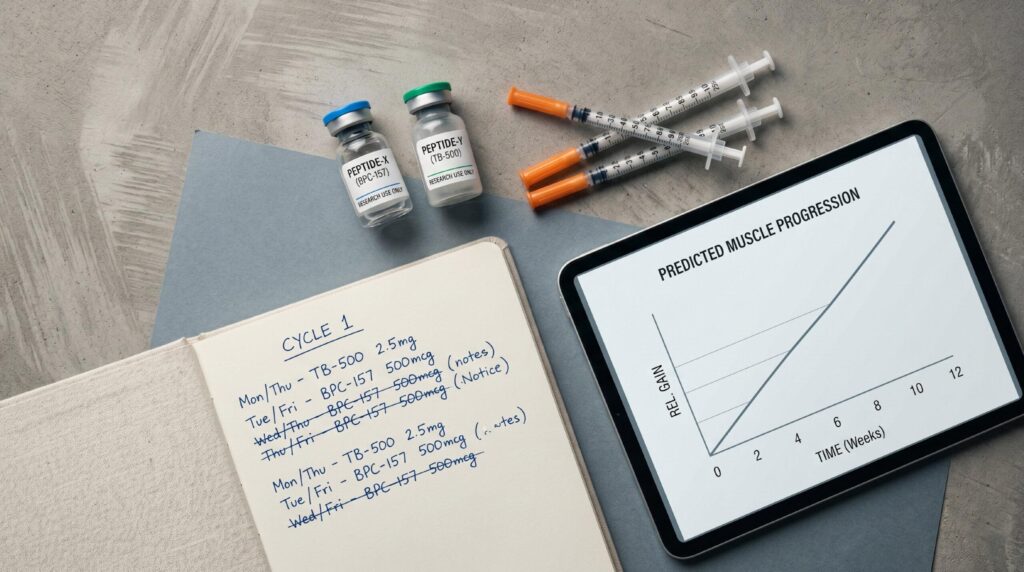
Many users combine peptides rather than run one alone. The most common pairings are CJC-1295 with ipamorelin (a GHRH analogue plus a ghrelin mimetic that together boost growth hormone release) and TB-500 with BPC-157 for injuries. The reasoning is mechanistic: these combinations have not been tested together in human trials.
We cover stacks for each goal, with commonly reported doses, timelines and side effects, in our best peptide stack guide. Whatever the stack, it only adds to the basics: a calorie deficit for fat loss, progressive training for muscle, and enough sleep for recovery.
The Bottom Line
The strongest peptide depends on your goal, and only two on this list, tesamorelin and bremelanotide, have human trials and an FDA approval behind them.
- Tesamorelin has the best fat-loss evidence of any peptide here: about 15% less visceral fat over 26 weeks in phase 3 trials in people with HIV, with the fat returning after stopping.
- MGF, PEG-MGF, IGF-1 LR3 and TB-500 are the popular picks for muscle and healing, but their evidence is cell and animal data, with no human trials of the injected research products.
- Research peptides are unregulated, most are banned in tested sport and their long-term safety is unknown. Speak with a doctor and get bloodwork before using any of them, and never use one in place of medical care.
Frequently Asked Questions
Disclaimer
Please read carefully
The information on this site is for educational and informational purposes only, and is not medical advice. Always consult a qualified healthcare professional before using any supplement or medication, or making changes to your health, fitness, or nutrition routine.
Not medical advice
Content here is not a substitute for professional medical advice.
Consult your doctor
Talk to your doctor before starting any supplement or new routine.
Use at your own risk
We are not responsible for adverse effects from acting on this.
Do your research
Make informed decisions about your own health.
No guarantees
Individual results vary. No claims about outcomes.
Important — Never disregard professional medical advice or delay seeking it because of something you read here. If you think you may have a medical emergency, call your doctor or your local emergency number right away.