

Contents9 sections
Enclomiphene for men has gained significant attention as a targeted approach to restoring natural testosterone production without the fertility trade-offs associated with traditional testosterone replacement therapy (TRT). Enclomiphene citrate is a selective estrogen receptor modulator (SERM) — specifically the trans-isomer of clomiphene citrate — that blocks estrogen receptors in the hypothalamus to stimulate the body’s own testosterone synthesis through the HPG axis.
Unlike standard TRT, which introduces exogenous testosterone and suppresses spermatogenesis, enclomiphene preserves and may even enhance sperm production while raising testosterone levels. This dual benefit has positioned the compound as a preferred option for men with secondary hypogonadism who want hormonal optimization without sacrificing reproductive function.
Key Takeaways
- Enclomiphene citrate stimulates natural testosterone production by blocking estrogen’s negative feedback on the hypothalamus.
- The compound preserves fertility, unlike TRT which suppresses sperm production.
- Standard enclomiphene dosage ranges from 12.5 to 25 mg daily for 6-8 week cycles.
- Clinical research demonstrates sustained testosterone increases without significant adverse effects.
- Enclomiphene is taken orally, offering a non-invasive alternative to injectable testosterone.
- Common side effects are mild: headaches, nausea, and temporary mood fluctuations.
How Enclomiphene Works

Enclomiphene for men operates through the hypothalamic-pituitary-gonadal (HPG) axis, the hormonal feedback loop that regulates testosterone production. The mechanism follows a specific cascade:
| Step | Action | Result |
|---|---|---|
| 1 | Enclomiphene binds estrogen receptors in hypothalamus | Estrogen’s inhibitory signal is blocked |
| 2 | Hypothalamus increases GnRH secretion | Gonadotropin-releasing hormone output rises |
| 3 | Pituitary gland releases LH and FSH | Luteinizing hormone and follicle-stimulating hormone increase |
| 4 | LH stimulates Leydig cells in testes | Natural testosterone production resumes |
| 5 | FSH stimulates Sertoli cells | Spermatogenesis is maintained or enhanced |
The critical distinction between enclomiphene and exogenous testosterone is that enclomiphene works through the body’s existing hormonal machinery rather than bypassing it. Research indicates that this approach maintains the negative feedback loop’s integrity, preserving testicular function and sperm production that TRT would suppress.
The compound is the pharmacologically active trans-isomer of clomiphene. Standard clomiphene (Clomid) contains a mixture of both the trans-isomer (enclomiphene) and the cis-isomer (zuclomiphene). Zuclomiphene has a longer half-life and weak estrogenic properties, which can complicate hormonal management. Pure enclomiphene eliminates the estrogenic component, producing a cleaner anti-estrogenic effect.
Enclomiphene Benefits for Testosterone and Health
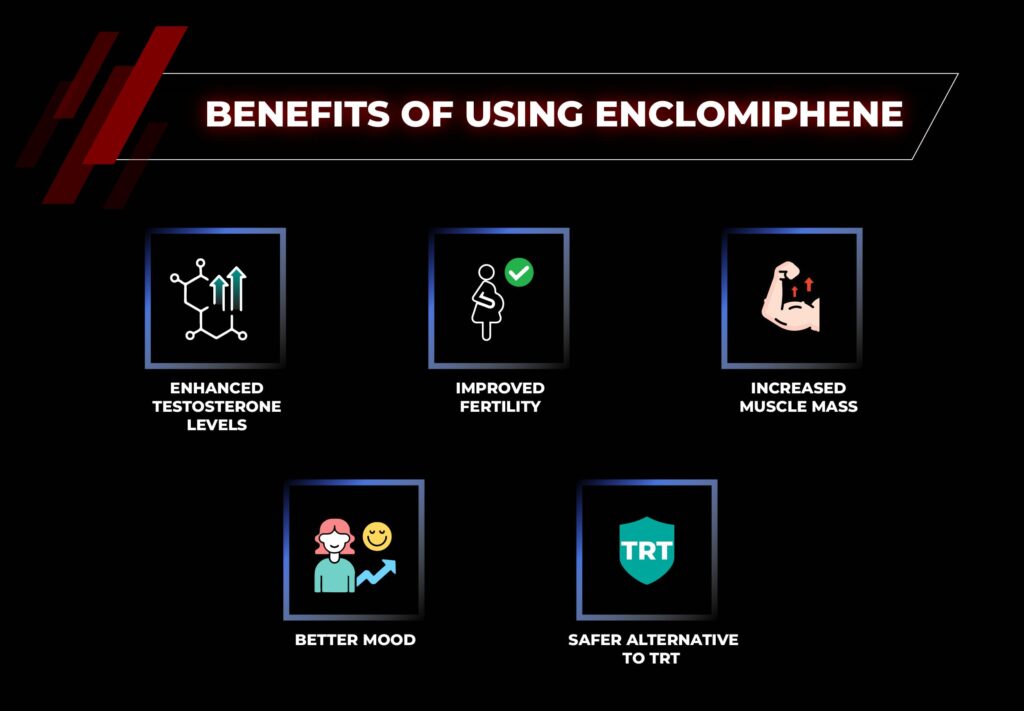
Testosterone Restoration
The primary enclomiphene benefit is its ability to raise endogenous testosterone in men with secondary hypogonadism — a condition where the pituitary gland underproduces LH and FSH, leading to insufficient testosterone output from the testes. Clinical trials have demonstrated meaningful testosterone increases within 4-8 weeks of treatment.
| Outcome | Typical Response |
|---|---|
| Testosterone increase | 200-400% of baseline in hypogonadal men |
| LH increase | Significant elevation within 1-2 weeks |
| FSH increase | Moderate elevation supporting spermatogenesis |
| Time to effect | Measurable changes within 2-4 weeks |
| Sustained response | Maintained throughout treatment duration |
Fertility Preservation
Unlike TRT, which suppresses spermatogenesis and can cause infertility during treatment, enclomiphene maintains and often improves sperm parameters. The FSH stimulation from enclomiphene supports Sertoli cell function and sperm maturation, making it an appropriate choice for men who want both testosterone optimization and preserved fertility.
Body Composition and Performance
Enclomiphene testosterone increases support improved body composition through the same mechanisms as naturally elevated testosterone: enhanced protein synthesis, improved nitrogen retention, and increased lipolysis. For bodybuilding and athletic applications, the compound supports lean muscle development and workout recovery without introducing synthetic hormones.
Mood and Cognitive Function
Testosterone deficiency is associated with depression, cognitive decline, irritability, and reduced motivation. By restoring physiological testosterone levels, enclomiphene for men can improve mood stability, mental clarity, and overall sense of well-being. These benefits are mediated through testosterone’s effects on neurotransmitter function and brain-derived neurotrophic factor (BDNF) production.
Enclomiphene Dosage and Cycling
The standard enclomiphene dosage for men with secondary hypogonadism ranges from 12.5 to 25 mg daily, with treatment cycles typically lasting 6-8 weeks followed by a break period to assess hormonal response.
| Application | Starting Dose | Maintenance Dose | Cycle Length |
|---|---|---|---|
| Secondary hypogonadism | 12.5 mg daily | 12.5-25 mg daily | 6-8 weeks |
| Post-cycle therapy | 12.5-25 mg daily | 12.5 mg daily | 4-6 weeks |
| General optimization | 12.5 mg daily | 12.5 mg daily | 6-8 weeks |
Cycling Protocol
Enclomiphene is typically cycled rather than used continuously to prevent receptor desensitization and allow assessment of the body’s independent hormonal function. A standard protocol involves 6-8 weeks of treatment followed by 4-6 weeks off, during which blood work evaluates whether testosterone levels are self-sustaining or require additional treatment cycles.
Monitoring Requirements
Blood work before, during, and after enclomiphene treatment is essential for tracking hormonal response and identifying any adverse changes. Key markers to monitor include:
- Total and free testosterone
- LH and FSH levels
- Estradiol (E2)
- Complete blood count (hematocrit, hemoglobin)
- Liver function markers
- Lipid panel
Enclomiphene Side Effects

Enclomiphene for men is generally well-tolerated, with most side effects classified as mild and transient. The side effect profile is generally more favorable than both clomiphene (Clomid) and traditional TRT.
| Side Effect | Frequency | Management |
|---|---|---|
| Headaches | Common | Usually resolve within first 1-2 weeks of treatment |
| Nausea | Occasional | Taking the dose with food reduces incidence |
| Fatigue | Occasional | Typically temporary during hormonal adjustment period |
| Mood fluctuations | Uncommon | Milder than standard clomiphene; generally subsides by week 3-4 |
| Hot flashes | Rare | Related to estrogen receptor blockade; transient |
| Visual disturbances | Very rare | Requires immediate discontinuation and medical evaluation |
The reduced mood-related side effects compared to standard clomiphene (Clomid) are attributed to the absence of zuclomiphene, the estrogenic cis-isomer that contributes to emotional volatility in some users.
Enclomiphene vs TRT
The choice between enclomiphene and traditional testosterone replacement therapy depends on individual clinical goals, particularly regarding fertility and long-term treatment preferences.
| Factor | Enclomiphene | Traditional TRT |
|---|---|---|
| Mechanism | Stimulates natural production | Replaces with exogenous testosterone |
| Fertility impact | Preserves/enhances sperm production | Suppresses spermatogenesis |
| Administration | Oral capsule (daily) | Injection, gel, or patch |
| HPG axis function | Maintained | Suppressed |
| Testicular atrophy | Not expected | Common on long-term use |
| Need for PCT after stopping | Minimal | Often requires PCT |
| Testosterone levels achieved | Physiological range | Can exceed physiological range |
| Regulatory status | Research chemical / off-label | FDA-approved (various formulations) |
For men with secondary hypogonadism who plan to have children, enclomiphene is generally the preferred first-line approach. For men who have completed their families and require testosterone levels above the physiological range, TRT may be more appropriate. The enclomiphene benefits of maintained natural production make it particularly attractive for younger men.
Frequently Asked Questions
The Bottom Line
Enclomiphene for men represents a targeted approach to testosterone restoration that works with the body’s natural hormonal machinery rather than replacing it
- The standard dosing protocol of 12.5-25 mg daily for 6-8 week cycles has demonstrated consistent enclomiphene testosterone increases with a favorable side effect profile compared to both standard clomiphene and traditional TRT.
- For men with secondary hypogonadism seeking hormonal optimization without fertility compromise, enclomiphene citrate merits serious consideration as a first-line intervention, ideally under medical supervision with appropriate blood work monitoring throughout treatment.
Disclaimer
Please read carefully
The information on this site is for educational and informational purposes only, and is not medical advice. Always consult a qualified healthcare professional before using any supplement or medication, or making changes to your health, fitness, or nutrition routine.
Not medical advice
Content here is not a substitute for professional medical advice.
Consult your doctor
Talk to your doctor before starting any supplement or new routine.
Use at your own risk
We are not responsible for adverse effects from acting on this.
Do your research
Make informed decisions about your own health.
No guarantees
Individual results vary. No claims about outcomes.
Important — Never disregard professional medical advice or delay seeking it because of something you read here. If you think you may have a medical emergency, call your doctor or your local emergency number right away.






How long is the “off” cycle for Enclomiphene?
Typically the off cycle is the same length as your cycle. So if using for 5 weeks take 5 week break.
what happens to the body during the off cycle ? Is there a post cycle procedure ?