
Contents13 sections
MK-677, also called ibutamoren, is an experimental pill that makes your body release more of its own growth hormone. It was developed by Merck in the 1990s, tested in older adults, obese men, and hip fracture patients, and never approved. Today it’s sold online as a “research chemical,” and MK-677 before and after posts are all over lifting forums.
Those posts promise a lot: bigger, fuller muscles, deep sleep, and faster recovery. The trials tell a quieter story. MK-677 clearly raises growth hormone and IGF-1, and it adds a small amount of lean mass, but it also raises blood sugar, and no trial has tested it in people who lift.
This article covers what the human trials actually measured (hormones, body composition, bone, and sleep), what users say happens, a timeline based on when changes showed up in the data, the main side effects, and what’s still unknown, including its legal and anti-doping status as of November 18, 2026.
Key Takeaways
- In a 1-year trial in healthy adults aged 60 to 81, MK-677 raised IGF-1 about 1.5-fold and fat-free mass by 1.1 kg, versus a 0.5 kg drop on placebo.
- That extra lean mass didn’t make people stronger or improve their physical function in the same trial.
- Fat mass didn’t fall in any of the main trials, while fasting blood sugar rose and insulin sensitivity fell.
- Small trials found deeper sleep and more REM sleep within 1 to 2 weeks, and higher bone turnover markers within 2 to 9 weeks.
- MK-677 isn’t FDA approved, the FDA lists it as a compounding safety risk, and WADA bans it at all times.
What Is MK-677 (Ibutamoren)?
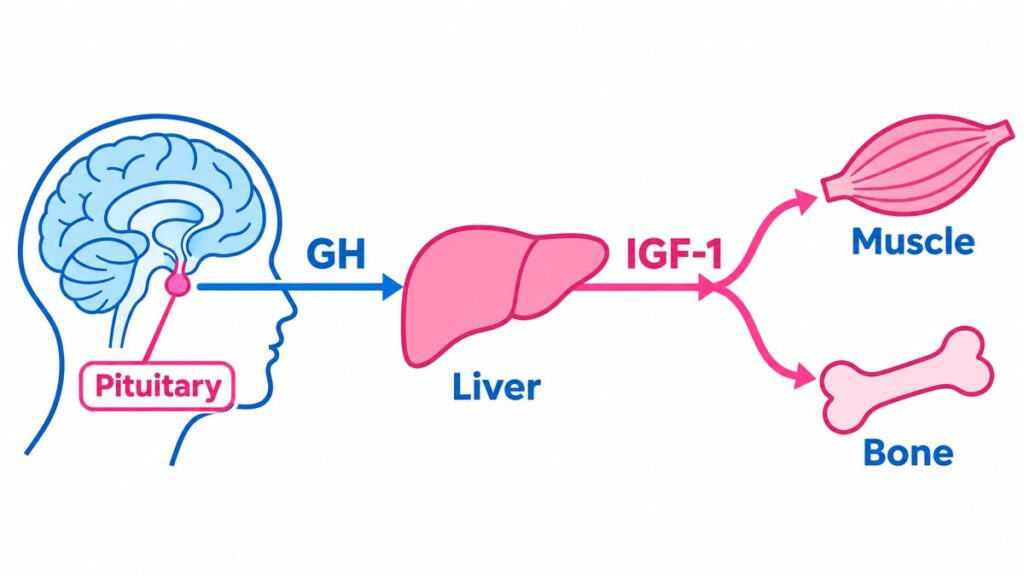
MK-677 is a growth hormone secretagogue, meaning it signals your pituitary gland to release more growth hormone (GH). It does this by copying ghrelin, the “hunger hormone,” which is why the authors of the biggest trial, Nass and colleagues in the Annals of Internal Medicine, call it “an oral ghrelin mimetic.” Higher GH then pushes up IGF-1, the hormone that carries out much of GH’s effect on muscle and bone.
It isn’t a SARM, even though it’s often sold and talked about alongside them. SARMs act on the androgen receptor. MK-677 acts on the ghrelin receptor and works through your own GH, not through testosterone pathways.
Is MK-677 the same as taking growth hormone?
No. Injected GH adds hormone from outside. MK-677 boosts the pulses your body already makes. In a 1996 trial in healthy older adults in the Journal of Clinical Endocrinology & Metabolism, the rise in GH “was due to an enhancement of preexisting pulsatile GH secretion,” with taller pulses but no extra pulses. A 2018 review in Sexual Medicine Reviews notes that this kind of release stays “subject to negative feedback,” which may limit how high GH can go.
Who Was MK-677 Actually Tested In?
This matters more than any single number. The human trials enrolled:
- Healthy older adults: the main body composition trial (ages 60 to 81) and several shorter hormone and bone studies (ages 64 and up).
- Obese men: 24 men aged 18 to 50 with a BMI over 30, for 8 weeks.
- Young, healthy volunteers on a strict diet: 8 people aged 24 to 39, for 1 week of treatment.
- Patients: adults with GH deficiency, older adults recovering from hip fracture, postmenopausal women with osteoporosis, and people with Alzheimer disease.
No published trial tested MK-677 in young, trained lifters, and none combined it with a training program. Keep that in mind for every result below.
MK-677 Before and After: What the Trials Measured
The trials below are the ones that measured “before” and “after” in a controlled way, against a placebo. They’re grouped by what they measured.
Growth hormone and IGF-1
This is the most consistent result. Every trial that measured IGF-1 found it went up.
- Older adults, 1 year: in the Nass 2008 trial, average 24-hour GH rose 1.9-fold at 6 months and 1.8-fold at 12 months, and IGF-1 rose 1.6-fold and 1.5-fold, according to the full paper. The abstract says levels rose “to those of healthy young adults.”
- Older adults, 4 weeks: in the Chapman 1996 trial, mean 24-hour GH rose 97%, and IGF-1 went from 141 to 219 µg/L at 2 weeks and 265 µg/L at 4 weeks.
- Obese men, 8 weeks: IGF-1 rose about 40% in Svensson and colleagues’ 1998 trial.
- Larger patient trials: IGF-1 rose 60.1% at 6 weeks and 72.9% at 12 months in an Alzheimer trial of 563 patients in Neurology, and 84% (versus 17% on placebo) over 6 months in a hip fracture trial in the Journal of the American Geriatrics Society.
The first dose hits hardest. In Murphy and colleagues’ 1998 trial, peak GH was 55.9 µg/L after the first dose but 22.6 µg/L after a week of daily dosing. Svensson’s trial also found the GH rise after the first dose was bigger than after repeated doses. IGF-1, which is what most of the downstream effects depend on, stayed up.
Fat-free mass and body composition
The best data come from the Nass 2008 trial, a 2-year, double-blind study of 65 healthy adults aged 60 to 81, with body composition as a main goal after 1 year.
- Fat-free mass: up 1.1 kg (about 2.4 lb) on MK-677, versus down 0.5 kg on placebo, at 12 months.
- Limb lean mass (arms and legs): up 0.5 kg at both 6 and 12 months, the full paper reports.
- Body weight: up 2.7 kg (about 6 lb) on MK-677, versus 0.8 kg on placebo.
- Fat: no significant change in total fat mass or belly (visceral) fat. Limb fat rose more on MK-677 than placebo (1.1 kg vs 0.24 kg).
- Strength and function: “Increased fat-free mass did not result in changes in strength or function,” the authors write.
In obese men over 8 weeks, fat-free mass also rose significantly on both DXA and a four-compartment body composition model, while total and visceral fat didn’t change. Basal metabolic rate rose at 2 weeks but not at 8 weeks. The abstract doesn’t give the gain in kilograms.
A short study in a calorie deficit points the same way. In Murphy 1998, 8 young adults ate a very low-calorie diet for 2 weeks. During the week on MK-677, their nitrogen balance (a marker of whether the body is breaking down or keeping protein) averaged +0.31 g a day, versus -1.48 g a day on placebo. That’s evidence MK-677 can slow protein loss in a short, strict diet. It isn’t evidence of muscle growth.
Does MK-677 build muscle or just add water?
Partly both, and the trials can’t fully separate them. “Fat-free mass” includes muscle, water, organs, and bone. GH is known to make the body hold fluid, and leg swelling (edema) was a common side effect in the Nass trial.
The same trial did measure intracellular water, which reflects “body cell mass” rather than fluid sitting outside cells. It went up 0.8 kg on MK-677, versus down 1.0 kg on placebo. So some of the gain looks like real tissue, but how much of it is muscle is unknown, and it didn’t translate into strength.
Bone markers
MK-677 speeds up bone turnover, meaning the body both builds and breaks down bone faster. That’s not the same as stronger bones.
- Obese men, 8 weeks: in a 1998 trial in the Journal of Bone and Mineral Research, bone formation markers rose 23% and 28% within 2 weeks, and osteocalcin rose 15% by week 8. A bone breakdown marker rose 26% at 8 weeks.
- Older adults, up to 9 weeks: across three trials with 187 people aged 65 and up, Murphy and colleagues found osteocalcin rose 29.4%, bone-specific alkaline phosphatase 10.4%, and a urine breakdown marker 22.6% after 9 weeks in the functionally impaired group.
- Bone density, 18 months: in 292 women with osteoporosis, MK-677 plus alendronate raised femoral neck bone density more than alendronate alone (4.2% vs 2.5%), but not at the spine, total hip, or whole body.
- Bone density, 1 year in healthy older adults: femoral neck density went slightly down on MK-677 compared with placebo, which the Nass authors describe as “consistent with increased bone remodeling.” Fracture risk wasn’t studied.
Sleep
The sleep data come from one small trial. Copinschi and colleagues, writing in Neuroendocrinology in 1997, gave MK-677 at bedtime to 8 young adults (aged 18 to 30) for 7-day periods and to 6 older adults (aged 65 to 71) for 14-day periods.
- Young adults: deep (stage IV) sleep lasted about 50% longer, and REM sleep was more than 20% longer, compared with placebo. Nights with “deviations from normal sleep” fell from 42% to 8%.
- Older adults: REM sleep rose nearly 50%, and people reached REM sooner. This group had no placebo period, so it was compared against a low dose and baseline.
That’s a promising signal from 14 people over 1 to 2 weeks. It hasn’t been repeated in a larger trial that we could find.
MK-677 Results Timeline: What the Data Support
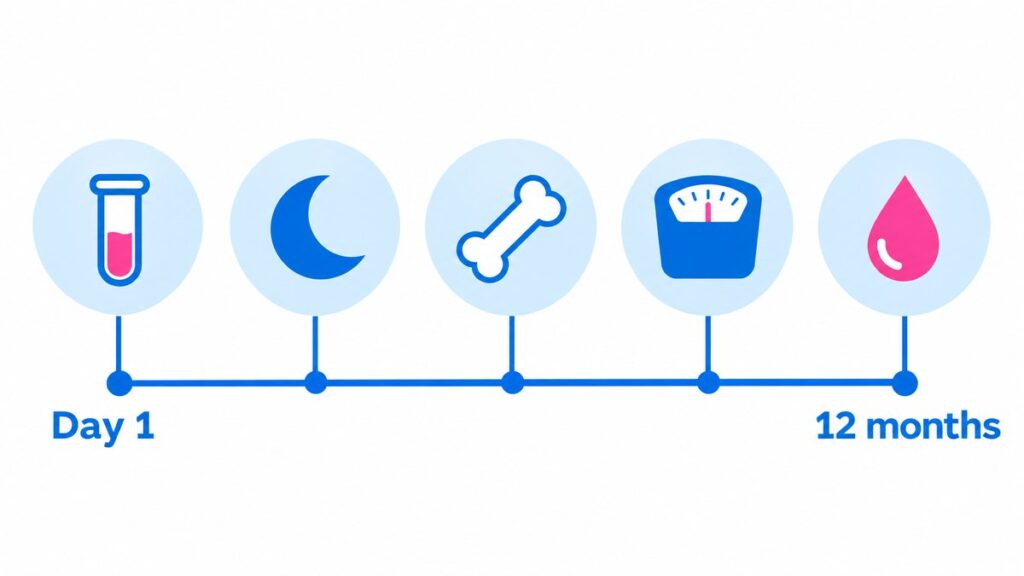
No trial was designed to map a week-by-week timeline, and none was done in lifters. But the studies measured at different points, so you can see roughly when each change showed up.
- Day 1: the biggest GH spike comes after the first dose. In Murphy 1998, peak GH after one dose was more than double the peak after a week.
- Week 1: in a strict diet, protein breakdown slowed within 7 days in the same trial. Sleep changes were measured after 7 to 14 days in the Copinschi trial.
- Weeks 2 to 4: IGF-1 was already up by week 2 and higher still by week 4 in older adults, and fasting glucose rose from 5.4 to 6.8 mmol/L (about 97 to 122 mg/dL) by week 4 in the Chapman trial. Bone formation markers rose within 2 weeks, and resting metabolic rate was up at 2 weeks in the obese men.
- Week 8: fat-free mass was up in obese men, with no change in fat, and the extra metabolic rate had faded, Svensson and colleagues report.
- Months 3 to 6: in the Nass trial, half the people whose appetite went up were back to normal within 3 months. By 6 months, fat-free mass was up about 1 kg.
- Month 12: fat-free mass was up 1.1 kg versus placebo’s 0.5 kg loss, body weight up 2.7 kg, fasting glucose up 5 mg/dL, and HbA1c up 0.2 points. Strength and function hadn’t changed, the trial found.
What the data don’t support: dramatic visual “transformations,” meaningful fat loss, or strength gains from MK-677 alone. The changes that trials could measure were real but small, and they built up over months.
What MK-677 Users Report
Everything in this section is anecdote, not evidence. These are self-reports from people posting online, with no placebo group, no way to check what was in their product, and usually other drugs, diet changes, or training changes happening at the same time.
Posts in lifting forums and on Reddit tend to describe the same handful of things:
- Strong hunger, often in the first weeks.
- Deeper sleep or vivid dreams.
- Scale weight going up quickly, often described as looking “fuller” or “puffier.”
- Water retention, especially in the hands, feet, and face.
- Tired, sluggish, or foggy days, and tingling or numb hands.
Some of this lines up with the trials. Increased appetite, swelling, and muscle pain were the most common side effects in the Nass trial, and sleep changes showed up in the Copinschi trial. Large muscle gains and “lean bulks” from MK-677 alone don’t line up with any trial result.
One documented user case
The closest thing to a measured “before and after” in a recreational user is a 2022 case report in Experimental Physiology. A 25-year-old man took MK-677 together with the SARM LGD-4033 for 5 weeks, and researchers tested him before, during, and after.
- Body: body mass rose 6.0%, lean mass 3.1%, and fat mass 15.4%.
- Blood work: HDL (“good”) cholesterol fell 36.4%, LDL rose 40.0%, the liver enzyme ALT rose 205.0%, and total testosterone fell 62.3%.
- After stopping: most values went back to where they started, but total fat mass and LDL cholesterol didn’t.
It’s one person on two drugs, so it can’t tell you what MK-677 does alone. It does show why “before and after” photos leave a lot out.
Why user reports are hard to trust
Even an honest report may not be about MK-677. In a 2017 JAMA study of 44 products sold online as SARMs, only 41% contained the amount of active compound on the label, 25% contained substances not on the label, and 39% contained another unapproved drug, including ibutamoren. In a 2024 case report in JCEM Case Reports, gym supplements that contained MK-677, RAD-140, and cardarine also held undeclared testosterone, estradiol, and GH, and the man taking them developed breast tissue growth and low testosterone until he stopped.
MK-677 Side Effects
- Appetite: 67% on MK-677 versus 36% on placebo reported a bigger appetite in the Nass trial.
- Swelling and muscle pain: mild, temporary leg swelling hit 44% versus 27%, and muscle pain 33% versus 9%, in the same trial. Our article on MK-677 water retention covers the swelling in more detail.
- Blood sugar: fasting glucose rose 5 mg/dL and HbA1c 0.2 points over a year, and insulin sensitivity fell, the trial reports. Glucose tolerance was already worse at 2 weeks in obese men.
- Heart failure signal: a hip fracture trial of 123 older patients “was terminated early due to a safety signal of congestive heart failure in a limited number of patients.”
- Hormones: total testosterone fell in obese men over 8 weeks, though a marker of free testosterone didn’t change. Cortisol rose over a year in the Nass trial.
- Liver: a 2025 case report in BMJ Case Reports describes a man in his early 30s whose liver enzymes rose after 2 months of MK-677 and returned to normal after he stopped.
What Is Still Unknown About MK-677?
- Effects in lifters: no trial has tested young, trained people, so nobody knows how MK-677 adds to training.
- Long-term safety: the longest controlled data cover about 2 years in 65 older adults. A 2018 review says long-term safety data, “including evaluation of cancer incidence and mortality,” are still needed. That’s a fair question for any drug that keeps IGF-1 raised.
- Whether higher IGF-1 helps anything: the Alzheimer trial raised IGF-1 by 72.9% over a year with no effect on the disease, and the hip fracture trials raised it without clearly improving function.
- Fat loss: no main trial found a drop in fat mass.
- What happens after stopping: none of the trials above report how long the lean mass gain lasts.
- What’s in the bottle: the trials used Merck’s own drug. Research-chemical MK-677 is unregulated, and testing has found products that don’t match their labels.
Is MK-677 Legal or FDA Approved?
MK-677 isn’t approved by the FDA for any use. In a December 12, 2025, warning letter to a seller of “GE Labs MK 677,” the FDA said ibutamoren “has been authorized for investigation as a new drug,” that it “is excluded from the definition of a dietary supplement,” and that the products were “unapproved new drugs.”
The FDA also lists ibutamoren mesylate on its page of bulk drug substances that may present significant safety risks in compounding, citing “the potential for congestive heart failure in certain patients.” That means compounding pharmacies can’t make it without risking FDA action.
Selling MK-677 labeled “for research use only” doesn’t make it an approved drug. Laws outside the US vary, and our guide on whether SARMs are legal covers the related compounds country by country.
Is MK-677 banned in sport?
Yes. The WADA 2026 Prohibited List names ibutamoren (MK-677) under section S2 among growth hormone releasing factors, which are banned at all times, in and out of competition. If you’re a tested athlete, a positive test counts no matter how the product was labeled.

What This Means for Lifters
- Expect hormones, not a transformation. MK-677 reliably raises GH and IGF-1, but in the trials that turned into about 1 kg of fat-free mass over a year, with no strength gain.
- Scale weight isn’t all muscle. Weight rose more than fat-free mass in the main trial, and swelling was common, so a quick jump on the scale is likely to include water.
- Watch the blood sugar signal. Fasting glucose, HbA1c, and insulin resistance all moved the wrong way in the trials, even in healthy people.
- Sleep is the most interesting signal, and the thinnest. It comes from 14 people in one 1997 trial.
- Anecdotes can’t tell you much. Stacks, diet changes, and mislabeled products make most online before and after stories impossible to pin on MK-677. For how a related, approved GH-releasing drug was studied, see our guide to tesamorelin, or look up ibutamoren in our Compound Index.
The Bottom Line
MK-677 raises growth hormone and IGF-1 and adds a little lean mass over months, but the trials found no fat loss and no strength gain, its blood sugar effects are real, and it remains unapproved and banned in sport.
- IGF-1 rose by about 40% to 94% across trials and stayed up for as long as people took it.
- Fat-free mass rose about 1 kg over a year in healthy older adults, without changes in strength or function.
- Small trials showed better sleep and faster bone turnover within weeks.
- User reports are anecdotes, and no trial has tested MK-677 in lifters.
Frequently Asked Questions
Disclaimer
Please read carefully
The information on this site is for educational and informational purposes only, and is not medical advice. Always consult a qualified healthcare professional before using any supplement or medication, or making changes to your health, fitness, or nutrition routine.
Not medical advice
Content here is not a substitute for professional medical advice.
Consult your doctor
Talk to your doctor before starting any supplement or new routine.
Use at your own risk
We are not responsible for adverse effects from acting on this.
Do your research
Make informed decisions about your own health.
No guarantees
Individual results vary. No claims about outcomes.
Important — Never disregard professional medical advice or delay seeking it because of something you read here. If you think you may have a medical emergency, call your doctor or your local emergency number right away.