Contents9 sections
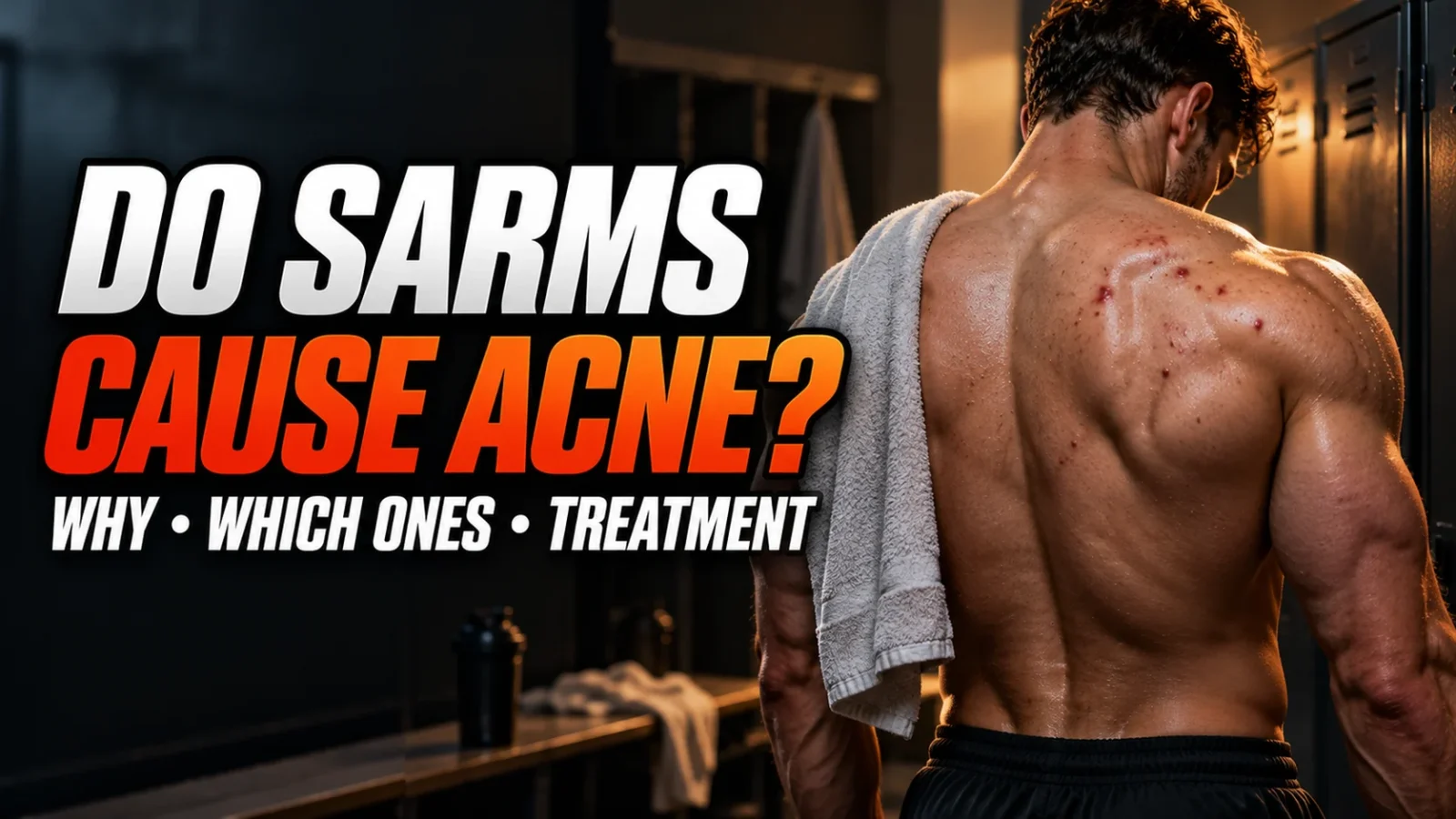
Acne is one of the best-known side effects of anabolic steroids. Breakouts across the back, chest and shoulders are common enough among steroid users that many people treat bad skin at the gym as a giveaway.
SARMs are often sold as the milder option, so the obvious question is whether they cause acne too. The short answer is yes, they can. They act on the same androgen receptors that drive oil production in the skin, even if most users see milder breakouts than on a steroid cycle (see SARMs vs steroids for the wider comparison).
Below we look at why SARMs can cause acne, which compounds are most and least likely to, how acne is prevented and treated, and what happens to your skin when a cycle ends.
Key Takeaways
- SARMs can cause acne because they activate androgen receptors in the skin’s oil glands, which increases sebum production.
- Breakouts are usually milder than on steroids, but the risk rises with potency, dose and cycle length, and with a history of acne.
- YK-11, RAD-140 and LGD-4033 are the SARMs most often linked to acne; Ostarine less so. MK-677 and Cardarine are not SARMs at all.
- Good skin hygiene, benzoyl peroxide, salicylic acid and topical retinoids are the first line. Steroid creams are not an acne treatment.
- Severe or scarring acne needs a doctor, who may prescribe antibiotics or isotretinoin. Tell them about any SARM use.
Can SARMs Cause Acne?
SARMs, or selective androgen receptor modulators, bind to androgen receptors. They were designed to act mainly on muscle and bone, where they increase lean mass and bone density. That selectivity is partial, though: SARMs still activate androgen receptors in other tissues, including the skin.
Androgens are the main hormonal driver of acne. The skin’s sebaceous (oil) glands carry androgen receptors, and testosterone and dihydrotestosterone (DHT), which the skin makes from testosterone locally, push those glands to grow and produce more sebum [1].
The role of androgens in male-pattern skin and hair changes was shown as early as the 1940s. Researchers studying men who had been castrated before or during puberty found that they did not develop common baldness, and that giving them testosterone brought it on in men who were predisposed to it [2]. Acne follows the same rule: people with complete androgen insensitivity, whose cells cannot respond to androgens, produce very little sebum and do not develop acne.

So will SARMs do the same? Because they are weaker and more selective than steroids, many people assume they don’t cause acne. That isn’t the case.
Most SARMs are non-steroidal, so the body does not convert them to DHT or estrogen the way it converts testosterone. That is one reason acne on SARMs is usually milder than on a steroid cycle. But they still stimulate androgen receptors, including those in the sebaceous glands, and mild to moderate breakouts are commonly reported. People who were acne-prone before a cycle tend to be hit hardest.
Two other factors can make things worse. More training means more sweat and friction trapped against the skin, which aggravates breakouts on the back and chest. And many products are not what the label says: an analysis of 44 products sold online as SARMs, published in JAMA, found that only about half contained a SARM at all, while many contained other unapproved drugs or amounts that did not match the label.
Users describe the same pattern on forums such as Reddit:
“Did a cycle of ostarine about 9 months ago or so and got pretty bad back acne from it that I still can’t get to clear up any. Not sure that it was really a direct effect from the ostarine think it was more to do with the fact ostarine made me sweat way more and working a physical job I was spending 8-10 hours a day in work with that sweat sitting on me. Anyone else get bad acne after taking SARMs?”
Reddit user
“I got acne and mole growth, both linked to hormone fluctuations. I tend to think of it like going through puberty again, your body is suddenly flooded with hormonal changes and its bound to happen, nowhere near as bad as the acne from AAS but a lot of it is genetic too (if you had bad skin before, it’ll be much worse, if you never did it’ll likely not be noticeable)”
Reddit user
Which SARMs Cause the Most Acne?
No study has compared SARMs head to head for acne, so any ranking is based on pharmacology and user reports. The rule of thumb: the more potent the compound at the androgen receptor, and the higher the dose and the longer the cycle, the higher the risk. The SARMs that suppress natural testosterone the most are also the most potent, so they tend to be the ones linked to acne.
The SARMs most often linked to acne are:
- YK-11: unlike most SARMs it has a steroid structure derived from DHT, and users report androgenic side effects such as acne and hair loss more often than with milder compounds.
- RAD-140 (Testolone): one of the more potent and more suppressive SARMs.
- LGD-4033 (Ligandrol): potent at very low doses. In a 21-day trial in healthy men, even 1 mg a day lowered testosterone.
Which SARMs Are Least Likely to Cause Acne?
Ostarine (MK-2866) is generally considered the mildest of the commonly used SARMs and is less often linked to acne. It still happens, as the first quote above shows.
Two compounds that often appear on “least acne” lists are not SARMs at all, even though they are sold and stacked alongside them:
- MK-677 (Ibutamoren): a growth hormone secretagogue that mimics the hunger hormone ghrelin and raises growth hormone and IGF-1. It does not act on the androgen receptor, so it is not expected to cause androgen-driven acne. IGF-1 also stimulates the oil glands, though, so breakouts can’t be ruled out.
- Cardarine (GW501516): a PPAR-delta agonist that affects fat and energy metabolism, not a hormone. It is not androgenic, but its development was stopped after it caused cancer in animal studies (see Cardarine side effects).
Individual response varies a lot, so even a “mild” compound can cause breakouts in some people. A stack is also only as gentle as its most androgenic ingredient.
How to Avoid Acne from SARMs
Androgen-driven acne usually shows up on the face, chest, shoulders and upper back, and severe cases can leave permanent scars. Prevention is far easier than repair. The practical options are:
- Don’t use SARMs. The only sure way to avoid a drug’s side effects is not to take it. This matters most if you have had moderate or severe acne before.
- Less is less. In user reports, acne becomes more likely with higher doses, longer cycles and stacks of several androgenic compounds.
- Keep your skin clean. Shower soon after training, change out of sweaty clothes, wash towels, pillowcases and bedding often, and use a gentle cleanser. Choose sunscreen and moisturiser labelled non-comedogenic.
- Use proven over-the-counter treatments. A benzoyl peroxide wash (useful for the back and chest), salicylic acid and adapalene gel, a topical retinoid sold over the counter in some countries including the US, are the standard first steps. They take several weeks to work, so start at the first sign of breakouts.
- Don’t pick or squeeze. It drives inflammation deeper and raises the risk of scarring.
- See a doctor or dermatologist if you get painful lumps or cysts, if spots leave marks, or if over-the-counter treatment hasn’t helped after two to three months. Be honest about what you are taking.
Diet plays a smaller role, but some studies link high-glycemic diets and dairy, particularly skim milk, to acne, and case reports have linked whey protein supplements to breakouts. If you break out while drinking several shakes a day, that is one thing worth testing.
One thing not to do: steroid creams such as hydrocortisone are not an acne treatment. Corticosteroids can trigger acne themselves, so leave them out of your routine unless a doctor prescribes them for a specific reason.
What Are SARMs?
SARMs are a class of investigational drugs developed to treat muscle wasting, osteoporosis and similar conditions. The aim was to get the muscle- and bone-building effects of testosterone with fewer effects on tissues such as the prostate, skin and hair follicles.
None has been approved as a medicine. In practice their selectivity is limited: SARMs still suppress natural testosterone, lower HDL cholesterol and can cause androgenic side effects, especially at the doses used for bodybuilding, which are often well above those tested in clinical trials. Acne is one of those effects; hair loss is another, and it works through the same receptors (see SARMs and hair loss).
Are SARMs Legal?
SARMs are not approved for human use anywhere, and their legal status varies by country. In some countries they are prescription-only medicines; in others they are sold as research chemicals labelled “not for human consumption”. In the US, the FDA has warned that SARMs cannot legally be sold as dietary supplements, and WADA bans them in sport at all times. Our country-by-country guide to SARMs legality has the details.
Because so many products are mislabelled, people who research these compounds look for vendors that publish independent third-party test results for each batch. A test result shows what is in the bottle; it does not make the compound safe to use.

Pros
- Exceptional purity & testing (≥98%)
- Pharmaceutical-style packaging for stability
- Broad catalog across peptides & nootropics
- Strong reputation & consistency across years
Cons
- Some items frequently out of stock due to high demand
- Limited long-term data for some compounds
What Is Acne?
Acne is a condition of the hair follicles and the oil glands attached to them. The US National Institute of Arthritis and Musculoskeletal and Skin Diseases (NIAMS) describes it this way: “Acne is a common skin condition that happens when hair follicles under the skin become clogged. Sebum—oil that helps keep skin from drying out—and dead skin cells plug the pores, which leads to outbreaks of lesions, commonly called pimples or zits. Most often, the outbreaks occur on the face but can also appear on the back, chest, and shoulders.”
Four things drive it: excess sebum, clogged follicles, the skin bacterium Cutibacterium acnes, and inflammation. Androgens sit at the start of that chain. As one review puts it, “Increased sebum production due to androgens’ activity at the sebaceous follicle is a prerequisite for acne in all patients. High level of androgens, or hypersensitivity of the sebaceous glands to a normal level of androgens, causes an increase in sebum production” [3].
That is why acne usually starts at puberty, when androgen levels rise, and why steroids and SARMs can bring it back or make it worse.
How Is Acne Treated?
Acne from SARMs is treated like any other acne. The main options:
| Treatment | What it does | Availability |
|---|---|---|
| Benzoyl peroxide | Kills acne bacteria and helps unclog pores; bacteria don’t become resistant to it | Over the counter |
| Salicylic acid | Exfoliates and helps keep pores clear | Over the counter |
| Topical retinoids (adapalene, tretinoin, tazarotene) | Normalise skin cell turnover so pores don’t clog, and reduce inflammation | Adapalene over the counter in some countries; others on prescription |
| Topical antibiotics (such as clindamycin) | Reduce bacteria and inflammation; combined with benzoyl peroxide to limit resistance | Prescription |
| Oral antibiotics (such as doxycycline) | For moderate to severe inflammatory acne, usually for a few months alongside topical treatment | Prescription |
| Isotretinoin | Shrinks the oil glands and sharply cuts sebum; the most effective option for severe or scarring acne | Prescription only, with blood tests and monitoring |
Isotretinoin deserves a special note for anyone using SARMs. It can raise blood lipids and liver enzymes, both of which SARMs can also affect, and it causes severe birth defects, so it is only prescribed with regular monitoring and, for women, strict pregnancy prevention. Tell your doctor about any SARM or other compound you are taking.
Self-treating with several prescription drugs bought online adds risk without adding much benefit. The everyday basics still matter, especially on a cycle: clean clothes, regular bedding changes and gentle skin care.
What Happens to Acne After a SARM Cycle?
For most people, acne caused by androgen exposure improves once the compound is stopped and hormone levels settle. Skin renews slowly, so it can take several weeks to a few months for breakouts to clear, and any scars may need dermatology treatment.
The weeks after a cycle bring hormonal swings of their own while natural testosterone recovers, and some users report breakouts during this period. For how recovery works and what the evidence says about post-cycle therapy, see our guide to PCT for SARMs.
If acne is severe from the start, or still there months after a cycle, see a doctor. Scarring is much easier to prevent than to treat.
The Bottom Line
SARMs can and do cause acne: they act on the same androgen receptors that drive oil production in the skin, even if breakouts are usually milder than on steroids.
- The risk rises with potency, dose and cycle length. YK-11, RAD-140 and LGD-4033 are most often linked to acne; Ostarine less so.
- MK-677 and Cardarine are not SARMs and are not androgenic, but neither is free of risk.
- Clean skin habits, benzoyl peroxide, salicylic acid and topical retinoids come first; severe or scarring acne needs a doctor, not steroid creams.
Frequently Asked Questions
Disclaimer
Please read carefully
The information on this site is for educational and informational purposes only, and is not medical advice. Always consult a qualified healthcare professional before using any supplement or medication, or making changes to your health, fitness, or nutrition routine.
Not medical advice
Content here is not a substitute for professional medical advice.
Consult your doctor
Talk to your doctor before starting any supplement or new routine.
Use at your own risk
We are not responsible for adverse effects from acting on this.
Do your research
Make informed decisions about your own health.
No guarantees
Individual results vary. No claims about outcomes.
Important — Never disregard professional medical advice or delay seeking it because of something you read here. If you think you may have a medical emergency, call your doctor or your local emergency number right away.