Contents14 sections
A RAD-140 cycle is a course of testolone, an experimental selective androgen receptor modulator (SARM), taken by mouth to build muscle and strength. In bodybuilding circles, a typical cycle is reported as 8 weeks at 10 to 20mg a day. RAD-140 has never been approved as a medicine anywhere, and it has never been tested in a clinical trial in healthy men. Almost everything people “know” about RAD-140 cycles comes from animal research and user reports.
Two claims still circulate widely, and both are wrong: that RAD-140 raises your natural testosterone, and that it is mild enough to skip recovery. In practice it suppresses the body’s own testosterone production, it has been linked to liver injury in published case reports, and it can masculinize women.
This guide covers what the studies show, commonly reported doses and timelines, realistic results, suppression and post-cycle therapy (PCT), side effects, and what women need to know. Nothing here is a recommendation to use it.
Key Takeaways
- RAD-140 (testolone) is an experimental SARM. Its muscle-building evidence comes from rats and monkeys; no trial has tested it in healthy men.
- Commonly reported cycles run 8 weeks at 10-20mg a day. These figures come from user practice, not clinical research.
- RAD-140 does not raise natural testosterone. Like other SARMs studied in people, it is expected to suppress testosterone, LH and FSH, and users’ blood work commonly shows this.
- Published case reports link RAD-140 products to drug-induced liver injury with jaundice, and the FDA has warned that SARMs carry risks including liver toxicity, heart attack and stroke.
- There is no established safe dose for women. Androgenic effects such as a deeper voice can be permanent.
What Is RAD-140 (Testolone)?
RAD-140 is a non-steroidal SARM discovered by Radius Health and first described in a 2011 preclinical paper. It was designed to give testosterone-like effects in muscle and bone with less effect on the prostate, with conditions such as muscle wasting in mind. Development later moved to breast cancer: in some breast tumors that carry both androgen and estrogen receptors, activating the androgen receptor slows tumor growth. The compound has since been studied for that use under the drug name vosilasarm.
It is not approved by the FDA or any other regulator for any condition. What is sold online as testolone is marketed as a research chemical, “not for human consumption”.
How RAD-140 Works
RAD-140 binds to the androgen receptor, the same receptor testosterone acts on. In muscle, that switches on the signals that drive protein synthesis and growth. In rat studies, it stimulated muscle at doses that had much less effect on the prostate and seminal vesicles than testosterone does. That is what “selective” means: a different balance of effects between tissues, not an effect on muscle alone.
Because it is not a steroid, RAD-140 is not converted to estrogen by the aromatase enzyme or to DHT by 5-alpha reductase. That removes some steroid side effects, such as estrogen-driven water retention. It does not stop RAD-140 from acting on androgen receptors in the brain, the hair follicles and the reproductive system, which is where its suppression and androgenic side effects come from.
What the Research Actually Shows
The evidence on RAD-140 is thin, and most of it is preclinical. This is what has been published:
| Research | Subjects | What It Found |
|---|---|---|
| 2011 discovery paper | Rats and young male monkeys (animal data) | Built muscle in rats with much less effect on the prostate than testosterone; weight gain in monkeys over 28 days of dosing |
| 2014 neuroprotection study | Cultured rat neurons and male rats (animal data) | Protected neurons from damage in the lab and in a rat model of brain injury |
| 2017 breast cancer study | Mice carrying human breast tumors (animal data) | Slowed the growth of tumors with both androgen and estrogen receptors |
| Phase 1 trial | Postmenopausal women with advanced breast cancer (human data) | First human data; side effects included raised liver enzymes, at doses far above those used in bodybuilding |
| Trials in healthy men | None published | No human data on muscle gain, fat loss, cycle length or recovery |
That last row matters. Every RAD-140 cycle protocol in circulation, including the doses below, comes from user experience. Animal results with pure compound do not tell you what an underground product does in a person.
RAD-140 Cycle: What Users Commonly Report
The doses and timelines below describe how RAD-140 cycles are commonly run, based on user reports. They are not clinical doses and they are not recommendations. No study has tested RAD-140 at these doses in healthy people.
| Reported Use | Daily Dose | Reported Cycle Length |
|---|---|---|
| Lower-dose cycles | 5-10mg | 8 weeks |
| Most commonly reported range | 10-20mg | 8 weeks |
| Higher reported doses | 20-30mg | 8-12 weeks |
RAD-140 is taken by mouth once a day, usually as a liquid or capsules. Users report that side effects, especially suppression symptoms, aggression and hair shedding, become more common as the dose goes up and the cycle gets longer. Most reported cycles are kept to 8 weeks for that reason, with time off at least as long as the cycle, plus any PCT, before another one.
A Commonly Reported 8-Week Timeline
| Period | What Users Commonly Report |
|---|---|
| Weeks 1-2 | Strength and training drive often rise first; little visible change; some report headaches or poorer sleep |
| Weeks 3-5 | Muscles look fuller and scale weight climbs; suppression symptoms such as lower libido or flat mood can begin |
| Weeks 6-8 | Gains slow down; hair shedding, acne or irritability appear in some users, mostly at higher doses |
| After stopping | Some fullness and scale weight drop off; low-testosterone symptoms can appear or worsen until natural production recovers |

 SARMs
Overview
- Form: Oral Capsules
- Researched Dosage: 5 mg to 30 mg daily
- Typical Cycle: 6-8 weeks
- Cost: $89.95
- Stacking Options: MK-677, LGD-4033, GW-501516
Pros
- Designed to stimulate androgen receptors and may support muscle growth and strength.
- Its anabolic activity may help maintain muscle during periods of calorie restriction.
- Unlike injectable anabolic steroids, RAD-140 is typically taken orally, making it more convenient for some users.
Cons
- RAD-140 can suppress the body’s natural testosterone production, potentially affecting hormones after use.
- Changes in liver enzymes, cholesterol, and other health markers have been reported or remain a concern.
- RAD-140 is not an approved human medication, so its long-term safety, effectiveness, and risks are not well established.
RAD-140 Results: What Is Realistic
There are no controlled data on muscle gain from RAD-140 in healthy people, so any number is anecdotal. User reports commonly describe roughly 5 to 10 lb (about 2 to 4.5 kg) of scale weight over an 8-week cycle, with strength rising early. Not all of that is new muscle tissue, and results vary widely.
What drives the difference between users:
- Diet: Gains depend on eating enough calories and protein. RAD-140 does not replace either.
- Training: Without hard, consistent training, little happens.
- Product quality: If the product is underdosed or contains something else, the result reflects that, not RAD-140.
- Keeping the gains: What stays depends on training, diet and how quickly natural testosterone recovers.
What RAD-140 Will Not Do
- Raise your natural testosterone (it lowers it; see the next section)
- Burn fat on its own: claims that it boosts fat oxidation are not backed by human data, and a leaner look on a cut comes from the diet
- Make up for poor diet, poor sleep or inconsistent training
- Deliver results without side effects
RAD-140 and Testosterone Suppression
The most damaging myth about RAD-140 is that it boosts natural testosterone. It does the opposite. The body’s testosterone production runs on a feedback loop: the brain senses androgen activity and adjusts its output of LH and FSH, the hormones that tell the testes to make testosterone and sperm. A potent androgen-receptor activator like RAD-140 signals “enough”, so the brain turns that output down.
No trial has measured this in healthy men taking RAD-140. But other SARMs studied in people have lowered total testosterone, SHBG and HDL cholesterol in a dose-dependent way. In one trial of LGD-4033 in healthy young men, those changes appeared within 21 days at just 1mg a day. User blood work on RAD-140 commonly shows low LH, FSH and total testosterone by the end of a cycle.
Suppression usually shows up as lower libido, weaker erections, fatigue and flat mood, often from mid-cycle onward. It also reduces sperm production, which matters for anyone trying to have children. Users commonly report recovery over weeks to a few months after stopping, but it varies, and there is no published data on how reliably men recover after RAD-140 specifically.
Blood Work Before and After
The only way to know how suppressed you are, and whether you have recovered, is blood work. The markers usually checked are:
- Hormones: total and free testosterone, LH, FSH and estradiol
- Lipids: HDL, LDL and triglycerides
- Liver: ALT, AST and bilirubin
- General: a full blood count
A baseline test before a cycle gives a reference point. A test 4 to 8 weeks after stopping shows whether levels are coming back.
RAD-140 Side Effects
RAD-140 avoids some steroid side effects, but fewer is not none. The risks below come from case reports, data on SARMs as a class and consistent user reports.
Liver Injury
Several published case reports describe drug-induced liver injury in men who used products containing RAD-140, sometimes together with other SARMs. The usual pattern is cholestatic injury, where bile flow is impaired: jaundice, itching, dark urine and very high bilirubin, appearing weeks into use. Most patients recovered after stopping, some only after months. Raised liver enzymes were also among the side effects seen in the phase 1 cancer trial.
Because RAD-140 is not a 17-alpha-alkylated steroid, it is often called “liver-safe”. The case reports show otherwise.
Cholesterol and Heart Risk
Lower HDL (“good”) cholesterol is a consistent finding across SARMs studied in people, and users commonly see it on RAD-140 blood work. At least one published case report describes acute myocarditis, inflammation of the heart muscle, in a man using RAD-140. In 2017 the FDA warned consumers that SARMs have been linked to serious safety concerns, including liver toxicity and a higher risk of heart attack and stroke.
Hair Loss, Acne and Aggression
In user experience, RAD-140 is one of the more androgenic SARMs. Hair shedding in men prone to male pattern baldness, acne, and irritability or aggression are commonly reported, mostly at doses above 20mg.
Gynecomastia
RAD-140 does not convert to estrogen, so it should not cause estrogen-driven gyno directly. Some users still report nipple sensitivity, often attributed to the hormone balance shifting during suppression or to products that contain something other than RAD-140. Our guide to RAD-140 and gyno covers this in more detail.
PCT After a RAD-140 Cycle
Post-cycle therapy (PCT) means taking a drug such as tamoxifen (Nolvadex) or clomiphene (Clomid) after a cycle to push the brain to restart LH and FSH output. Both are prescription drugs, neither is approved for this use, and no trial has tested PCT after a SARM cycle.
These are the protocols users most commonly report after a RAD-140 cycle, usually started within a few days of the last dose:
| PCT Drug | Commonly Reported Protocol | Duration |
|---|---|---|
| Tamoxifen (Nolvadex) | 20mg/day | 4 weeks |
| Clomiphene (Clomid) | 25-50mg/day | 4 weeks |
Some users skip PCT and wait for natural recovery; others run it as a matter of course. Without blood work, neither choice is an informed one. Clomiphene can cause mood changes and visual disturbances, and vision changes are a reason to stop it. A doctor can test hormones and, where appropriate, treat persistent low testosterone properly. Read more in our guide to PCT for SARMs.
RAD-140 for Women
RAD-140 is often called “safe for women” because it is selective. Evidence does not support that. RAD-140 is a strong androgen-receptor activator, and androgens masculinize women. The only women who have taken it in a clinical trial were postmenopausal patients with advanced breast cancer, under medical supervision, treating a disease where the androgen effect was the point.
Commonly reported virilization signs include:
- A deeper or hoarse voice
- Facial and body hair growth
- Acne and oily skin
- Clitoral enlargement
- Irregular or missed periods
Voice changes and clitoral enlargement may not reverse after stopping. Where women describe using RAD-140, they report doses that are a fraction of men’s, commonly 5mg a day or less, but no dose has been shown to be free of these effects. The idea that women can skip any recovery period is also wrong: androgens can disrupt the menstrual cycle, and periods that do not return to normal after stopping need a doctor’s assessment.
Stacking RAD-140
RAD-140 is often stacked with other compounds, most commonly MK-677 (ibutamoren), another SARM such as Ostarine, or Cardarine on a cut. Each one adds its own risks:
- MK-677: Not a SARM but a growth hormone secretagogue. It is commonly reported to raise appetite and water retention, and it can raise blood sugar. Our RAD-140 and MK-677 stack guide covers that combination.
- Other SARMs (Ostarine, LGD-4033): Stacking two suppressive compounds adds to the suppression and to the drop in HDL cholesterol.
- Cardarine (GW501516): Not a SARM. It was abandoned during drug development after it caused cancer in animal studies.
More compounds also mean more chances of a mislabeled product, and no way to tell which one caused a problem.
Legal Status, Drug Testing and Product Quality
RAD-140 is not approved for human use in the US or anywhere else. In the US it cannot legally be sold as a dietary supplement, which is why vendors label it “for research purposes only”. Rules differ by country; see are SARMs legal for a country list.
In sport, SARMs including RAD-140 are banned by WADA at all times, in and out of competition, and RAD-140 has been behind a number of anti-doping violations.
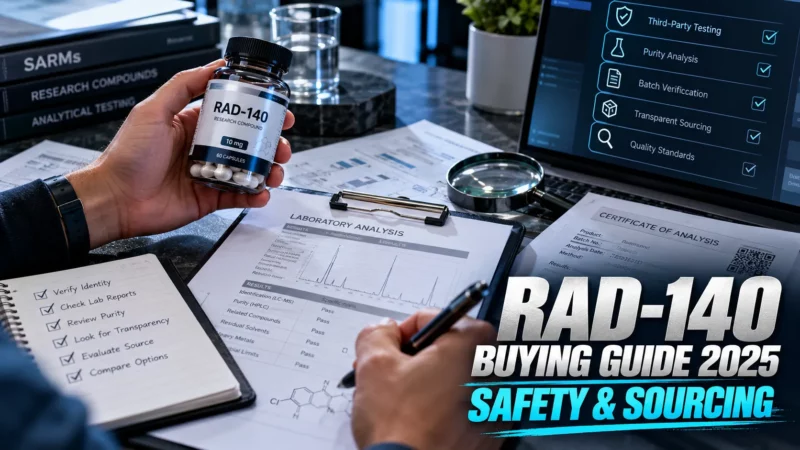
Product quality is the other unknown. In a 2017 study published in JAMA, researchers bought 44 products sold online as SARMs and analyzed them. Only about half contained a SARM at all, and many contained other unapproved drugs or amounts that did not match the label. Every reported dose assumes the product holds what it claims.
The Bottom Line
RAD-140 builds muscle in animal studies, but every human cycle is an uncontrolled experiment with a compound that suppresses testosterone and has been linked to liver injury.
- Commonly reported cycles run 8 weeks at 10-20mg a day with gains of a few kilograms, but these figures come from users, not trials, and product quality is unreliable.
- RAD-140 lowers natural testosterone rather than raising it. Blood work before and after a cycle is the only way to know where recovery stands.
- Women face a real risk of permanent virilization, and no dose has been shown to be safe.
Frequently Asked Questions
Disclaimer
Please read carefully
The information on this site is for educational and informational purposes only, and is not medical advice. Always consult a qualified healthcare professional before using any supplement or medication, or making changes to your health, fitness, or nutrition routine.
Not medical advice
Content here is not a substitute for professional medical advice.
Consult your doctor
Talk to your doctor before starting any supplement or new routine.
Use at your own risk
We are not responsible for adverse effects from acting on this.
Do your research
Make informed decisions about your own health.
No guarantees
Individual results vary. No claims about outcomes.
Important — Never disregard professional medical advice or delay seeking it because of something you read here. If you think you may have a medical emergency, call your doctor or your local emergency number right away.