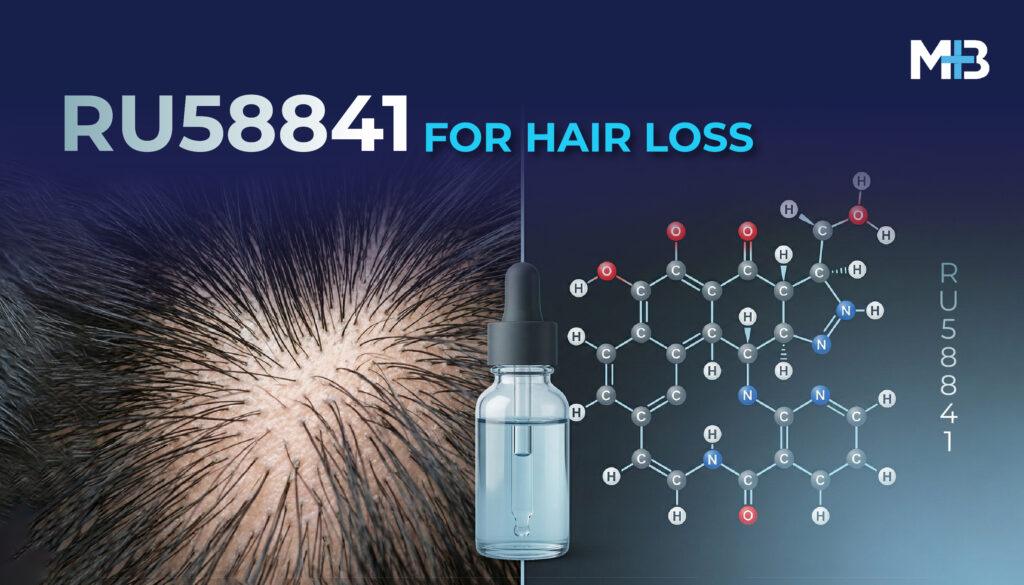
If you spend any time in the hair loss community, you’ve almost certainly come across RU58841. It tends to generate strong opinions, mostly from people who swear by it, and just enough skepticism from the medical community to keep it firmly in the research compound category.
The compound’s been around since the 1970s. It has been through animal trials, primate studies, and Phase I and II human trials. It has never reached Phase III or received regulatory approval. Yet it remains one of the most widely discussed topical anti-androgens in the hair loss space, and for reasons that are worth understanding properly.
This guide covers what RU58841 is, how it works, what the actual research shows, how it compares to finasteride, what realistic results look like, and everything you need to know about its limitations and legal status.
Key Points
- RU58841 is a non-steroidal anti-androgen that blocks DHT from binding to androgen receptors in scalp hair follicles, without lowering systemic DHT levels. 🔬
- Unlike finasteride, RU58841 works locally at the scalp rather than systemically, which means it does not carry the same risk of sexual or hormonal side effects. 💊
- Primate studies and early human trial data showed meaningful increases in hair density, follicle cycling, and hair thickness, though large-scale clinical trials were never completed. 📋
- The compound is particularly relevant for bodybuilders and steroid users whose hair loss is driven by elevated androgens rather than genetic sensitivity alone. ⚠️
- RU58841 has never been FDA-approved. It is sold for research purposes only and long-term human safety data does not exist. ✅

What Is RU58841?
RU58841, also known as PSK-3841 or HMR-3841, is a non-steroidal anti-androgen (NSAA) originally developed by French pharmaceutical company Roussel Uclaf in the 1970s. It was designed as a topical treatment for androgen-dependent conditions including androgenetic alopecia (male pattern baldness), acne, and hirsutism.
The compound progressed through preclinical animal studies and later Phase I and II human trials under the company ProStrakan, which had acquired the rights and rebranded it as PSK3841.
Despite Phase II results showing promise, Phase III trials never began, and development was quietly shelved.
The reasons for this were never made fully public, though the pattern is not unusual in pharmaceutical development where commercial viability and patent timelines often determine which compounds advance.
Today, RU58841 exists in a grey zone. It can be purchased as a raw powder or premixed topical solution from research chemical suppliers.
It’s not regulated as a prescription drug in most countries because it never completed the approval process. Currently, RU58841 sits in a category alongside many research compounds: studied enough to generate real interest, but not enough to carry regulatory endorsement.
How Does RU58841 Work?
To understand how RU58841 works, it helps to understand what drives male pattern baldness in the first place.
Dihydrotestosterone (DHT) is a metabolite of testosterone, produced when testosterone interacts with the enzyme 5-alpha reductase. In individuals genetically predisposed to androgenetic alopecia, DHT binds to androgen receptors in scalp hair follicles and triggers a process called miniaturization.
Over successive hair cycles, the follicles shrink, the growth phase shortens, and the hair produced becomes progressively thinner and shorter until the follicle stops producing visible hair altogether.
RU58841 competes with DHT for those same androgen receptors. Applied topically to the scalp, it binds to the androgen receptors in hair follicles and blocks DHT from occupying them.
The critical distinction is that it does not reduce DHT production in the body. Systemic DHT levels remain unchanged. The compound acts locally, at the follicle level, which is why its side effect profile is theoretically much cleaner than systemic anti-androgens.
Because the follicle is protected from DHT signaling, the miniaturization process slows or halts. Follicles that were progressively shortening their growth cycles have the opportunity to stabilize and, in some cases, re-enter a healthy anagen (growth) phase. This is why the primary expectation from RU58841 is hair retention first, with regrowth as a secondary and less predictable benefit.
This mechanism also makes RU58841 particularly interesting for bodybuilders and steroid users. Anabolic steroids significantly elevate androgen levels, accelerating hair loss in anyone with genetic susceptibility.
Because RU58841 operates at the receptor level rather than by reducing DHT systemically, it can theoretically counteract androgenic activity at the scalp without interfering with the hormonal effects of the compounds being used.
What Does the Research Actually Show?
RU58841 has more research behind it than most people realize, even if that research never crossed the finish line of a Phase III trial. Here is what the key studies actually found.
The 1997 Human Scalp Graft Study
Researchers transplanted scalp grafts from balding men onto testosterone-conditioned nude mice and treated them with a 1% RU58841 solution five days per week. After six months of monitoring, the RU58841-treated grafts showed a significantly higher rate of follicle cycling (28% versus 7% in controls) and meaningfully higher linear hair growth rates. The researchers concluded that these results justified moving toward clinical trials to evaluate the compound’s potential for treating androgenetic alopecia.
The Macaque Primate Study
A study published in the Journal of Dermatology compared topical RU58841 against oral finasteride in 20 stumptailed macaques, a primate model that develops androgenetic alopecia in patterns closely resembling human male pattern baldness. The finasteride group received oral dosing while the RU58841 group received topical application.
Both groups showed improvement in anagen-to-vellus follicle ratios, which is a measure of follicle health. Crucially, RU58841 produced this result without detectable changes in systemic androgen levels, while finasteride reduced DHT systemically. The researchers noted RU58841’s potent local activity and absence of systemic effects as a significant advantage.
Phase I and II Human Trials
ProStrakan completed Phase I and II trials under the PSK3841 designation. These trials were not published in full detail, but the company announced Phase II results as sufficiently promising to plan a Phase III trial by 2010. That Phase III trial never began.
What is known from publicly available information is that the compound was generally well-tolerated in the early trials and showed hair preservation activity. Why development stopped remains speculative, though patent expiry timelines and commercial considerations are the most commonly cited reasons.
RU58841 vs. Finasteride: How Do They Compare?
This is the comparison most people want, so let’s go through it clearly.
Finasteride works by inhibiting 5-alpha reductase, the enzyme that converts testosterone into DHT. By blocking this conversion, finasteride reduces DHT levels throughout the entire body, not just at the scalp.
This systemic reduction is effective for stopping follicle miniaturization, but it also means DHT is suppressed in tissues where it plays a functional role, including sexual function, mood regulation, and neurological health.
The post-finasteride syndrome debate, which describes persistent sexual and cognitive side effects in some users after stopping the drug, is connected to this mechanism.
RU58841, by contrast, does not touch DHT production at all. It competes with DHT at the receptor level and only where it is applied. Systemic DHT remains intact. For anyone who wants to protect their hair without any interference with hormonal function elsewhere in the body, particularly bodybuilders who depend on normal androgen signaling, this is a meaningful difference.
The tradeoff is evidence. Finasteride has decades of clinical data, regulatory approval, and a well-characterized risk profile. RU58841 has promising but incomplete research, no regulatory endorsement, and no long-term human safety data.
Finasteride is accessible by prescription from any doctor. RU58841 is only available from research chemical suppliers with no quality controls mandated by law.
Neither option is perfect. The right choice depends on individual priorities, tolerance for uncertainty, and the specific nature of the hair loss being addressed.
RU58841 Dosage and Application

RU58841 is applied topically to the scalp. It is not taken orally. The compound is available as a premixed solution or as a raw powder that is dissolved in a carrier vehicle, most commonly a combination of propylene glycol and ethanol.
The most frequently referenced dosage in research and community documentation is 50 mg per day, applied once daily across areas of the scalp affected by androgenetic alopecia. Some individuals apply it twice daily, though there is no formal research establishing whether split dosing produces better outcomes.
For premixed solutions, a 5% concentration corresponds to approximately 50 mg per milliliter. A 1 ml application once daily delivers the standard research dose. The solution is typically applied with a dropper directly to the affected areas and massaged in lightly.
Storage matters significantly with RU58841. The compound degrades when exposed to light and heat. Premixed solutions should be stored in the refrigerator in a dark bottle.
Raw powder should be kept in a freezer in an airtight, sealed container. Degraded product will not perform as expected, which is one reason why sourcing quality material from a reliable supplier matters more than it does with more stable compounds.
Unlike treatments that require cycling, RU58841 is typically used continuously. The mechanism depends on consistent receptor occupancy at the follicle level. Stopping application allows DHT to rebind to receptors, and the protective effect reverses relatively quickly.
Side Effects and Safety Considerations
The most important thing to understand about RU58841’s side effect profile is that long-term human data simply does not exist. The compound was never taken through the full clinical trial process, which means the kinds of safety data that exist for approved medications are not available here.
What the available research does show is that in primate studies, topical application did not produce detectable systemic hormonal changes. This supports the theoretical advantage of local application over systemic anti-androgens.
The macaque study specifically noted the absence of systemic effects at effective topical doses, which is one of the more reassuring findings in the preclinical data.
The most commonly reported side effect in user experience is scalp irritation or dryness, which is often related to the carrier vehicle rather than the RU58841 itself. Propylene glycol can cause contact irritation in some people. Switching to a different carrier or reducing concentration often resolves this.
There is theoretical concern about systemic absorption. Some early animal data suggested that topical application could lead to measurable systemic levels of the compound in certain contexts.
However, the human-scale evidence from Phase I and II trials did not flag this as a significant problem at standard doses. It remains a consideration rather than a confirmed risk, but it is worth noting for anyone using the compound long term.
The honest summary is that RU58841 appears to have a favorable safety profile relative to systemic anti-androgens, but the data to fully characterize that profile does not exist. Anyone using this compound is operating in territory where certainty is limited.
What Results Should You Realistically Expect?
Managing expectations is important with any hair loss treatment, and RU58841 is no exception.
The primary goal of RU58841 is hair loss prevention. If follicles are still active but progressively miniaturizing, blocking DHT at the receptor level can halt or slow that process.
Most users who respond well to the compound report a noticeable reduction in daily shedding within the first few weeks. Hair catcher counts in the shower are a practical way to track this.
Density improvements and visible thickening of existing hair tend to appear over three to six months of consistent use. This reflects follicles that were producing thin, miniaturized hair beginning to extend their growth cycles and produce thicker shafts.
Regrowth in areas of established hair loss is less predictable. Follicles that have been dormant for a long period are less likely to respond than follicles that are still producing some hair. This is true of all hair loss treatments, not just RU58841. The earlier in the hair loss progression treatment begins, the more that can realistically be preserved.
For bodybuilders and steroid users experiencing accelerated hair loss due to elevated androgens, RU58841 may perform particularly well during cycles because the receptor-level mechanism directly addresses the driver of that specific type of hair loss.
That said, results will still depend on the individual’s genetic sensitivity and how far the miniaturization process has progressed.
Legal Status
RU58841 occupies a legal grey area in most countries. Because it was never approved as a drug, it is not a controlled substance and is not regulated as a prescription medication.
It is sold as a research chemical, which means it is technically legal to purchase in many jurisdictions, but it is not legal to sell or market for human consumption.
In practical terms, this means anyone buying RU58841 is doing so from research chemical suppliers who operate under varying degrees of quality control.
The product you receive may or may not match the concentration and purity stated on the label. Third-party testing certificates of analysis (COAs) are the most reliable indicator of product quality, and reputable suppliers will publish these openly.
RU58841
RU58841 is a non-steroidal antiandrogen (NSAA) developed as a topical treatment for androgenetic alopecia, acne, and hirsutism. Development stalled after Phase II and the compound was never approved — but it has remained a fixture in hair loss research communities for over two decades.
Rather than lowering systemic DHT like finasteride does, RU58841 competes directly with dihydrotestosterone for binding to androgen receptors in the scalp, blocking follicle miniaturization without affecting circulating androgen levels. This localized mechanism is what makes it appealing to individuals who want scalp-level DHT blockade without systemic hormonal suppression.
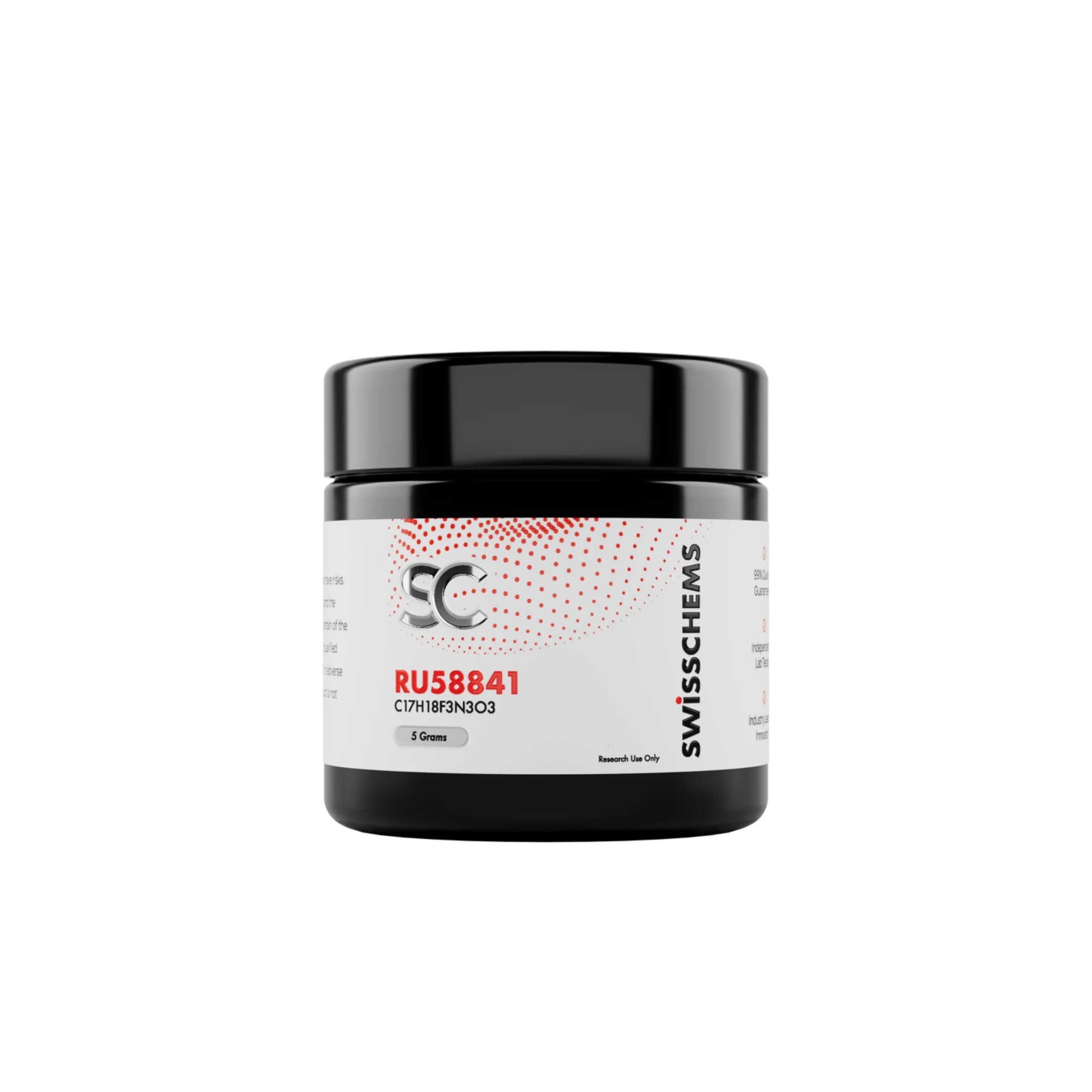
RU58841 Overview
💈 Primary Purpose: Scalp androgen receptor blockade, androgenetic alopecia prevention, follicle preservation
🧪 Form: Topical solution (liquid) or raw powder
⚗️ Common Concentration: 5% solution (50 mg per mL)
💰 Average Cost: $34.99 – $59.99 per 50 mL
⏳ Typical Application: Once daily to affected scalp areas
🧬 Chemical Formula: C17H15F3N2O3
⚖️ Molecular Mass: 368.31 g/mol
🧾 CAS Number: 154992-24-2
🔗 Other Names: PSK-3841, HMR-3841
♂️ Primarily Used For: Male pattern baldness (androgenetic alopecia), hair preservation during AAS cycles
Copy Brawn20 for 20% off
- Targets androgen receptors locally at the scalp without lowering systemic DHT
- Preclinical data shows hair regrowth comparable to (and in some models exceeding) finasteride
- Does not suppress testosterone or DHT systemically, preserving hormonal profile
- No published Phase III human clinical trial data. Development halted before completion
- Potential for systemic absorption and off-target antiandrogenic effects if solution contacts non-scalp skin
- Metabolites with systemic antiandrogenic activity documented in animal studies
Conclusion
RU58841 is one of the more genuinely interesting compounds in the hair loss space and it’s not just because of hype. The underlying mechanism is scientifically sound, and early research got it through two phases of human trials with a major pharmaceutical company.
The honest assessment is that it shows real potential, especially for individuals who cannot tolerate systemic anti-androgens or whose hair loss is being driven by elevated androgens from anabolic compound use. The local mechanism is a genuine advantage over finasteride for that specific population.
The limitations are real too. No Phase III data exists. Long-term human safety has not been characterized. Product quality is entirely dependent on the supplier.
None of that means the compound is not worth exploring for informed adults who understand the risk profile, but it does mean going in with clear eyes rather than expecting a finished, validated treatment.
If you are dealing with hair loss, speak to a doctor about FDA-approved options first. If you are already familiar with the research landscape and understand what RU58841 is and is not, the data at least gives you something substantive to work with.
Frequently Asked Questions
Does RU58841 actually work for hair loss?
The available research, including primate studies and early human trial data, suggests it does produce meaningful improvements in hair follicle health and density. However, Phase III clinical trials were never completed, so it does not carry the same level of evidence as FDA-approved treatments like finasteride or minoxidil. User reports are broadly consistent with the preclinical findings.
Will RU58841 affect my testosterone or hormones?
Based on the available research, RU58841 applied topically at standard doses does not significantly affect systemic testosterone or DHT levels. This is one of its key theoretical advantages over finasteride. However, the long-term human data needed to confirm this definitively does not exist, and some early animal studies raised questions about systemic absorption at higher doses.
Can I use RU58841 while on a steroid cycle?
Many users in the bodybuilding community do use RU58841 during anabolic cycles specifically because it addresses DHT-driven hair loss at the receptor level without interfering with the hormonal effects of the compounds being used. The mechanism makes theoretical sense for this purpose. There are no controlled studies on this specific use case, however, and individual responses will vary.
How long until I see results from RU58841?
Reduced shedding is typically the first sign of the compound working and is often reported within the first two to four weeks. Visible improvements in density and thickness generally take three to six months of consistent daily application. Results depend heavily on how advanced the hair loss is and how sensitive the individual’s follicles are to androgens.
What happens if I stop using RU58841?
Because RU58841 works by occupying androgen receptors rather than reducing DHT production, stopping application removes the protective effect relatively quickly. DHT can reoccupy those receptors and the miniaturization process can resume. This is why the compound requires continuous use rather than cycling, and why it is best viewed as a long-term maintenance strategy rather than a short-term fix.
Disclaimer: The information provided in this article is for educational and informational purposes only. RU58841 is a research compound that has not been approved for human use by the FDA or any other regulatory authority. This content does not constitute medical advice. Always consult a qualified healthcare professional before using any research compound or making decisions about hair loss treatment.