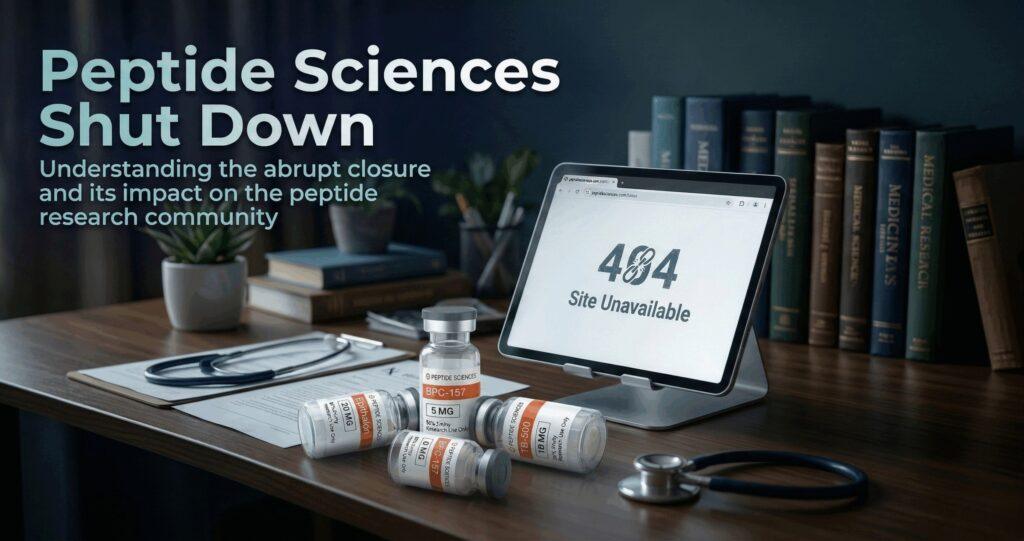
If you tried to place an order with Peptide Sciences recently and found nothing but silence, you are not imagining things.
Peptide Sciences, one of the most established research peptide suppliers in the United States, has shut down. The website has gone dark, customer support has gone quiet, and no formal announcement was made to the community. Just a brief message on the homepage confirming the closure was voluntary.
For researchers, athletes, and longevity-focused buyers who had been sourcing from Peptide Sciences for years, the shutdown raises an obvious question: what happened, and where do you go now?
This article covers the full picture on the Peptide Sciences shut down: the regulatory environment that closed the door on Peptide Sciences and vendors like it, the quality concerns that surfaced before the closure, and what your options look like going forward.
Key Points
- Peptide Sciences shut down voluntarily, and is no longer accepting orders or responding to customer inquiries. 🚫
- The closure follows a period of intensifying FDA enforcement, pharmaceutical litigation from Eli Lilly and Novo Nordisk, and regulatory changes affecting the entire research peptide market. ⚖️
- Third-party testing data revealed significant quality inconsistencies across the Peptide Sciences catalog, particularly for retatrutide, which received a failing grade across 37 tested samples. 🧪
- Customers with pending orders or store credit are unlikely to recover those funds. 💸
- Verified alternatives still exist, and the article outlines what to look for when selecting a replacement supplier. 🔍

What Was Peptide Sciences?
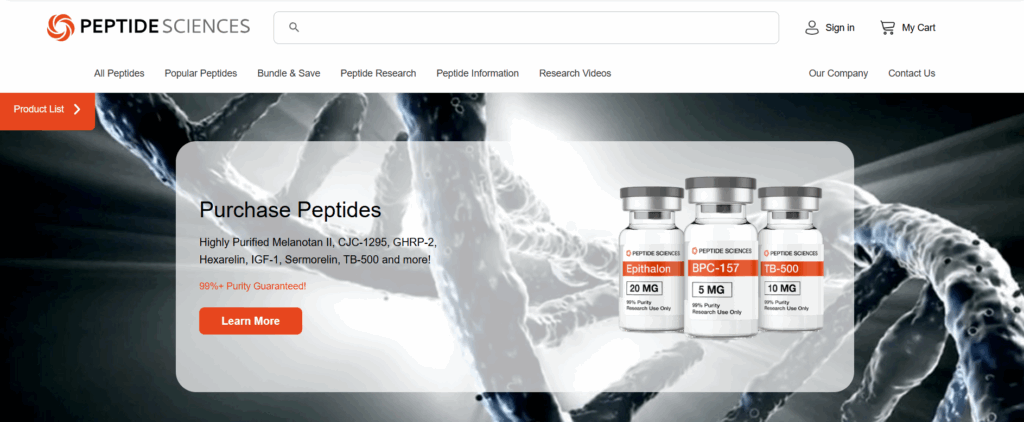
For many buyers, Peptide Sciences was the first name that came up when looking for research peptides in the United States.
The company built its reputation on a broad catalog that covered most of the compounds circulating in the research community. That included growth hormone secretagogues, tissue repair peptides, fat-loss compounds, and later GLP-1 analogues like semaglutide and retatrutide.
Compared to smaller vendors, the site looked polished and professional. Orders typically shipped on time, packaging was consistent, and customer service generally responded when issues came up.
That combination of presentation and reliability made Peptide Sciences something of a default option. In a market where quality can vary wildly, it was often viewed as one of the safer starting points.
Like most companies operating in the space, the products were labeled strictly as research chemicals and not intended for human consumption.
When Peptide Sciences Shut Down: The Only Public Statement
The official message left on the Peptide Sciences homepage was extremely brief.
It read:
“After careful consideration, Peptide Sciences has made the decision to voluntarily shut down operations and discontinue the sale of our research products. We are deeply grateful for your trust and support.”
That was the entire announcement.
No timeline, explanation, or guidance for customers with open orders or store credit.
Support channels also stopped responding around the same time, leaving tons of customers unsure whether pending transactions would be completed.
The wording of that message matters. The company described the shutdown as voluntary, but within the context of what has been happening across the peptide industry, most observers interpret that phrase differently.
In many cases, “voluntary” closures happen when companies recognize that enforcement action is likely and choose to exit before regulators force the issue.
Why Did Peptide Sciences Shut Down? The Regulatory Context
To understand why Peptide Sciences shut down, you have to zoom out and look at the broader regulatory environment.
The research peptide market has been under increasing pressure for several years. But starting in late 2023, enforcement began accelerating. The FDA added 19 peptides to its Category 2 list, which effectively prohibited licensed compounding pharmacies from preparing them. The list included BPC-157, TB-500, and other widely used compounds. The agency cited concerns about immunogenicity, manufacturing impurities, and the absence of formal clinical trial data in its decision.
In March 2024, Eli Lilly filed an International Trade Commission complaint against twelve vendors selling imported tirzepatide. By January 2025, the ITC issued a General Exclusion Order blocking all trademark-infringing tirzepatide imports. That same month, the FDA declared the semaglutide shortage resolved, removing the legal compounding exemption that had allowed pharmacies to prepare it.
By December 2024, the FDA had issued warning letters to four peptide vendors directly: Prime Peptides, Xcel Peptides, SwissChems, and Summit Research. In June 2025, the FDA raided the warehouse of Amino Asylum, taking the site offline. The message being sent to every vendor operating in this space was unambiguous.
Peptide Sciences appears to have read that environment and made a calculated decision to exit before becoming the subject of an enforcement action. Whether additional legal pressure was applied privately is not publicly known, but the timing and the terse voluntary closure statement are consistent with a company retreating from an increasingly untenable position.
Quality Concerns: What Third-Party Testing Showed
Beyond the regulatory environment, quality data that emerged before the closure raised independent questions about what Peptide Sciences had been selling.
Third-party testing platform Finnrick analyzed 123 samples of Peptide Sciences products across ten different peptides. The results were uneven. Some products scored well: ipamorelin earned an A rating with an average score of 9.2 out of 10 across nine tests, and PT-141 also received an A. BPC-157 scored an A with an average of 7.8 out of 10.
Other products failed significantly. CJC-1295 received an E rating with an average of 4.3 out of 10. Tesamorelin also scored E. Most notably, retatrutide received a failing E rating across 37 tested samples collected between December 2024 and March 2026, with a counterfeit detection flagged among samples in November 2025.
Whether product quality issues contributed directly to the closure decision is not confirmed. But the testing record adds an important dimension to the Peptide Sciences story: the company’s reputation for reliability was not uniform across its full catalog, particularly for newer and more complex compounds.
What Happens to Pending Orders and Store Credit?
The honest answer is that we don’t know, but we aren’t keeping our hopes up. When a vendor in this space shuts down abruptly without a transition plan or public communication, customers with outstanding orders or store balances are typically left with no recourse.
Peptide Sciences has not announced any refund process or timeline. If you placed an order that was not fulfilled, your best option is to contact your bank or credit card provider and dispute the charge as soon as possible. Depending on how much time has passed since the transaction and the policies of your financial institution, a chargeback may still be possible.
Where to Buy Peptides Now: What to Look For
The Peptide Sciences shut down does not mean the peptide market has disappeared. It means that the vendor landscape has thinned and due diligence matters more than it did before. Here is what to look for when evaluating a replacement supplier.
Third-party testing with verifiable COAs
Certificates of Analysis should come from accredited independent laboratories, not internal tests. The best suppliers will allow you to cross-reference results using the lot number directly with the lab.
US-based final processing
Domestic warehousing and final processing reduces import-related quality degradation and minimizes the risk of customs seizures.
Transparency about sourcing and manufacturing
Vendors who are vague about where their peptides are synthesized or how purity is verified are a risk. Reputable suppliers will answer these questions directly.
Responsive and professional customer support
The radio silence from Peptide Sciences after closure was a reminder of how important active communication is. Test support responsiveness before placing a significant order.
Absence of GLP-1 peptides or ITC-banned compounds
Vendors that continue to openly sell semaglutide, tirzepatide, or retatrutide in 2025 and beyond are operating in direct conflict with existing ITC exclusion orders. That is a signal about how seriously they take compliance more broadly.
The Bigger Picture: Where the Peptide Industry Is Heading
Now that Peptide Sciences shut down, it’s important to view it as one chapter in a longer story about the research peptide industry reaching an inflection point. The FDA has made clear it will enforce against vendors operating under the research-use-only label. Major pharmaceutical companies have demonstrated they will use the courts and the ITC to protect patented compounds. The legal runway for grey-market operations is shrinking.
At the same time, the regulatory environment is not static. In February 2026, HHS Secretary Robert F. Kennedy Jr. announced that approximately 14 of the 19 previously restricted peptides would be moved back to Category 1, restoring access through licensed compounding pharmacies with a physician’s prescription. This represents a meaningful shift and opens a more legally stable pathway for many of the compounds that had been pushed into grey-market channels.
For buyers who have been sourcing peptides through research vendors, this development is worth tracking. Physician-supervised protocols through a licensed 503A or 503B compounding pharmacy now represent the most legally defensible and quality-assured access route for many compounds. This is including BPC-157, which was among the peptides affected by the original restrictions.
The research peptide market will continue to exist, but the window of tolerance that allowed Peptide Sciences and vendors like it to operate openly appears to be closing. The question for buyers going forward is not just where to find the cheapest supplier, but which vendors have the operational and compliance infrastructure to still be around in two years.
A Reliable Alternative: Why Many Buyers Are Moving to SwissChems
With the Peptide Sciences shut down, many buyers are trying to figure out where to source research compounds from vendors that still operate transparently and consistently.
One name that keeps coming up in those conversations is SwissChems.
SwissChems has quietly built a reputation as one of the more structured suppliers in the research compound space. Unlike smaller vendors that appear and disappear every year, the company maintains a broad catalog covering peptides, SARMs, nootropics, and ancillaries. For researchers who previously relied on Peptide Sciences for catalog depth, that matters.
Another reason SwissChems has gained attention is its emphasis on documentation. Most products are accompanied by HPLC or mass spectrometry testing data, and lot-specific Certificates of Analysis are typically available for verification. In a market where many vendors still rely on vague “purity claims,” the ability to cross-check actual lab results is an important signal.
Shipping logistics are another factor. One of the biggest frustrations buyers faced after the Peptide Sciences shut down was realizing how dependent they had become on a single supplier. SwissChems operates with stable distribution and consistent inventory, which helps reduce the risk of sudden shortages or delayed fulfillment.
None of this means buyers should stop doing their own due diligence. The peptide market has always required careful sourcing and verification. But if you are looking for a starting point after the Peptide Sciences shutdown, SwissChems is one of the more established vendors still operating with a transparent testing framework and a large research catalog.
For many former Peptide Sciences customers, that combination makes it one of the most natural places to start looking for a replacement supplier.
Conclusion
When Peptide Sciences shut down, its exit was clearly seen and felt in a research peptide industry that is being reshaped by regulatory enforcement, pharmaceutical litigation, and a growing quality accountability movement driven by third-party testing. For buyers who built sourcing routines around Peptide Sciences, the closure is disruptive. But it is also clarifying.
The era of treating any grey-market peptide vendor as a long-term reliable partner is over. The landscape now rewards buyers who do their homework: verifying COAs, understanding a vendor’s compliance posture, and knowing when the physician-supervised compounding route makes more sense than sourcing independently.
The company was a fixture in this industry. The Peptide Sciences shut down leaves a gap, but also a reminder that supplier diversification and due diligence are a baseline.
Is Peptide Sciences permanently closed or temporarily down?
Peptide Sciences is permanently closed. The homepage confirms a voluntary shutdown with no indication of a planned return. The company has ceased all order processing and customer support activity.
Will Peptide Sciences refund my outstanding order?
No refund process has been announced. If you have an unfulfilled order, contact your bank or credit card provider as soon as possible to initiate a chargeback. Do not wait for a response from Peptide Sciences — none is expected.
Why did Peptide Sciences shut down?
No official explanation was given beyond the word “voluntary.” The closure is consistent with the broader regulatory environment: FDA enforcement actions, pharmaceutical company litigation over GLP-1 compounds, and increasing legal exposure for grey-market research peptide vendors. Quality concerns flagged by third-party testing may also have been a contributing factor.
Is it still legal to buy research peptides?
The legal status of research peptides depends on the specific compound and how it is being sourced. A February 2026 HHS announcement restored Category 1 status for approximately 14 previously restricted peptides, making them available again through licensed compounding pharmacies with a physician’s prescription. The research-use-only grey-market model faces increasing legal pressure but has not been entirely shut down.
Who are the best Peptide Sciences alternatives?
When evaluating alternatives, prioritize vendors with verifiable third-party COAs from accredited labs, US-based final processing, and a track record of staying compliant with evolving regulations. Avoid any supplier openly selling ITC-banned GLP-1 compounds as a research chemical — that is a compliance red flag for the entire operation.
Disclaimer: Muscle and Brawn is an informational resource. This article does not constitute legal, medical, or purchasing advice. The regulatory landscape described reflects information available as of March 2026 and is subject to change. Peptide use outside of licensed medical channels carries legal and health risks. Consult a licensed physician before beginning any peptide protocol.