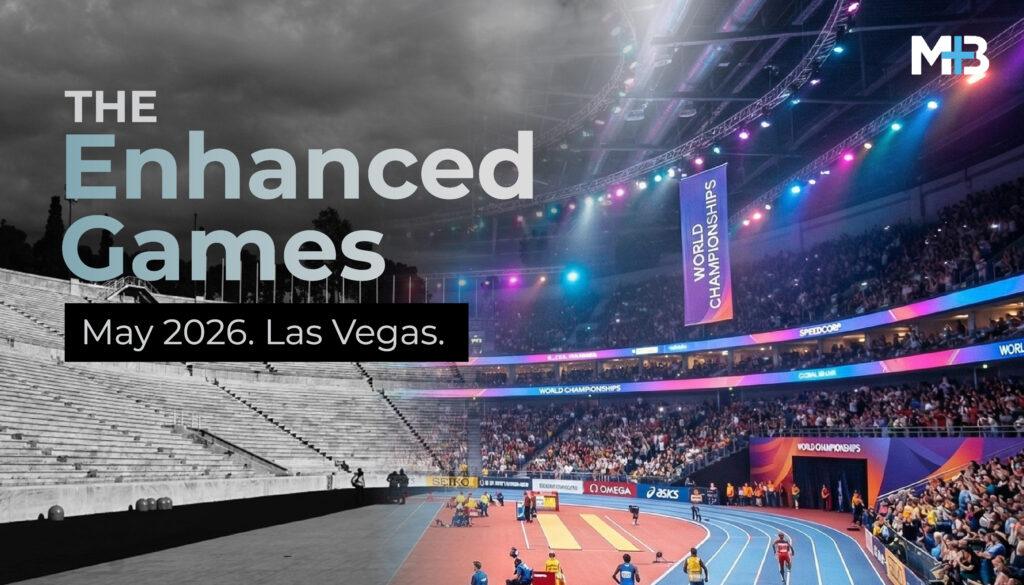
Las Vegas, Memorial Day weekend 2026. Olympic medal winners on the start line, pharmacological stacks disclosed to the press like race-day warm-up notes, and a $1 million bonus waiting for whoever breaks a world record.
This isn’t a movie plot. The Enhanced Games are happening, they’re real, and the mainstream sports world has absolutely no idea how to respond.
What the mainstream coverage keeps missing is that this moment didn’t arrive suddenly. It was built over years by a community of athletes, researchers, and advocates who were talking openly about performance enhancement long before any venture capitalist decided it was fundable. And nobody was more central to that conversation, or paid a higher price for having it, than Tony Huge.
This piece is about the Enhanced Games, what it represents, and why the community that helped make it culturally possible deserves to be part of that story.
Key Points
- The Enhanced Games launches in Las Vegas on Memorial Day weekend 2026, offering up to $500,000 per event and $1 million world record bonuses, with full medical supervision and no drug testing.
- Former Olympic and world champion athletes including Fred Kerley and Ben Proud have signed up and are publicly disclosing their enhancement protocols.
- Tony Huge spent over a decade building the educational foundation and cultural permission structure that events like the Enhanced Games now rely on — and was systematically banned from major platforms for it.
- The compounds Enhanced Games athletes are publicly using, such as testosterone, BPC-157, CJC-1295, ipamorelin, thymosin, are the same ones Tony Huge was documenting when those discussions were considered unspeakable.
- The Enhanced Games’ core philosophy mirrors arguments Tony Huge made on channels that no longer exist.

What the Enhanced Games Actually Is
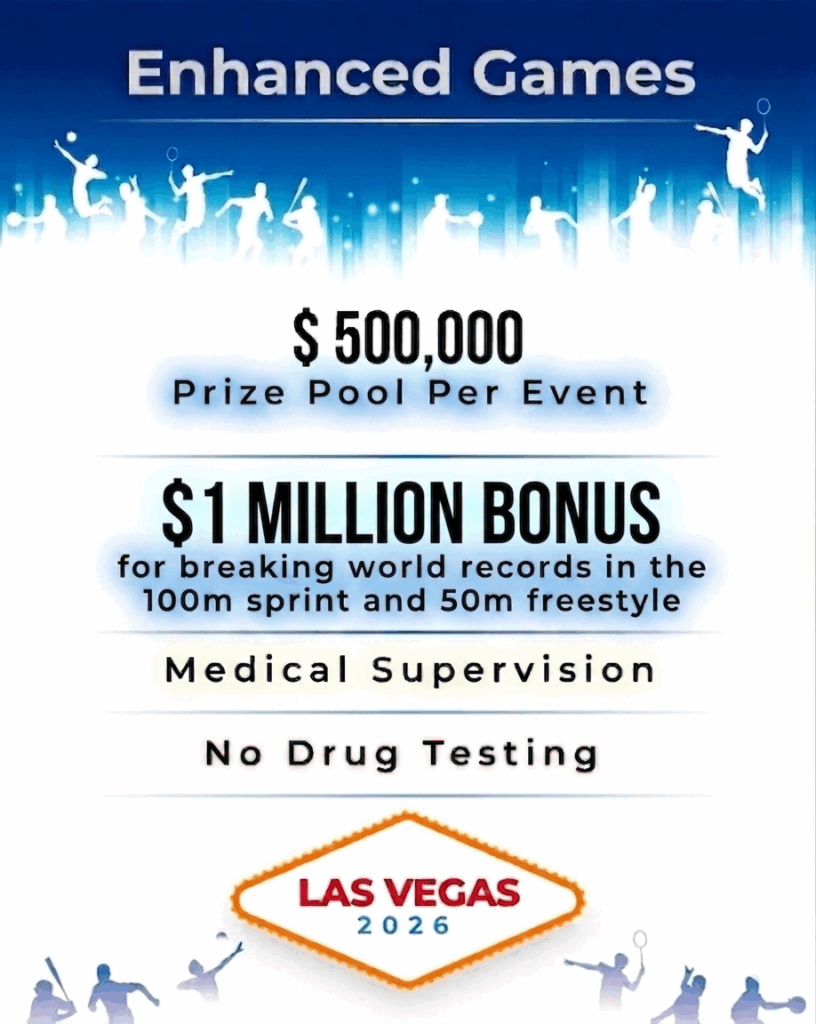
Australian venture capitalist Aron D’Souza founded the Enhanced Games in 2023 with a premise that sounds radical until you really think about it: let athletes compete openly, with full medical supervision, without drug testing, and pay them properly.
The financial backing is serious. Peter Thiel is in. Donald Trump Jr. is in. Christian Angermayer, founder of Apeiron Investment Group, is in. The prize structure was built specifically to attract world-class talent — up to $500,000 per event, with bonuses reaching $250,000 or more for world records. In May 2025, Greek swimmer Kristian Gkolomeev reportedly broke the 50m freestyle world record at a private Enhanced Games trial event and walked away with $1 million. That wasn’t a stunt. That was a proof of concept.
The athlete roster backs it up. Fred Kerley, the 2022 100m world champion, has signed. Ben Proud, silver medalist in the 50m freestyle at the 2024 Paris Olympics, is competing. James Magnussen — Olympic medals in 2012 and 2016 — was one of the first to join publicly, and he didn’t just sign up. He went to the press with his full stack: testosterone, BPC-157, CJC-1295, ipamorelin, and thymosin.
Read that list again if you know the space. Every single compound Magnussen named is a staple of the enhanced community. BPC-157 for recovery and tissue repair. CJC-1295 and ipamorelin for growth hormone optimization. Thymosin for immune support and recovery. Testosterone as the foundation. These aren’t exotic cutting-edge discoveries being unveiled on a Las Vegas stage. They’ve been discussed, documented, and researched within this community for years.
D’Souza’s argument about WADA is blunt: he calls it an anti-science police force for the IOC. He points out that 44% of elite athletes are already using PEDs, and that the testing system largely punishes unsophisticated cheaters while protecting the well-connected. His alternative isn’t a free-for-all but about transparency. If you’re going to use, disclose it, get medical oversight, and let the science drive the protocol. It’s a harder position to dismiss than most people expect.
Tony Huge: The Man Who Was Doing This Before It Was Mainstream
Before the Enhanced Games had a logo, a sponsor, or a Las Vegas venue, Tony Huge had a camera and an audience willing to listen to things nobody else was saying out loud.
It was 2015. Charles Anthony Hughes (Tony Huge’s full name) had started documenting his performance enhancement journey . At a time when mainstream fitness culture was still insisting elite bodybuilders were built on chicken breast and willpower, Tony Huge was naming compounds, showing bloodwork, interviewing researchers, and walking his audience through mechanisms in a way that treated them like intelligent adults.
His content on YouTube, Instagram, and Facebook reached millions of people. Not a niche forum. Millions. He discussed testosterone optimization when admitting that was career-ending. He walked through peptide protocols — BPC-157, CJC-1295, ipamorelin, the exact compounds James Magnussen would later name in a mainstream press interview — when those conversations were actively being scrubbed from public platforms. He made the case for medical supervision, informed consent, and harm reduction as the only ethical framework for enhancement. He built a community around a simple idea: people serious about performance deserve honest science, not industry mythology.
Then the platforms came for everything he’d built.
YouTube pulled his channels. Instagram banned his accounts. Facebook removed his content. Not gradually, not with warnings that led anywhere. Coordinated strikes, algorithmic burial, account terminations. Years of documented research, expert interviews, and educational content, gone. The censorship was thorough enough that a large portion of the people active in this space today have no direct exposure to the body of work he produced.
But the knowledge didn’t disappear with the accounts. Hundreds of thousands of people had already absorbed it. Communities formed around it. Protocols were shared and refined. The understanding of what these compounds actually do — built on real science rather than marketing copy — spread in ways that platform moderation couldn’t contain.
The Protocols the Enhanced Games Is Now Celebrating
This is the part worth pausing on. The Enhanced Games is going to get a lot of coverage over the next twelve months. Athletes will give interviews. Journalists will write explainers. Commentators will debate the ethics. What almost none of that coverage will acknowledge is where the cultural groundwork came from.
James Magnussen listed his stack to the press. Testosterone. BPC-157. CJC-1295. Ipamorelin. Thymosin. The journalists wrote it up like a novel revelation. In reality, Tony Huge had comprehensive content on every single one of those compounds — mechanisms, dosing, synergies, risks, research background — years before any Olympic athlete would have said those words in an interview without risking their career.
The Enhanced Games’ medical model isn’t new either. Comprehensive health screening before competition. Cardiac monitoring. Individualized protocols based on athlete physiology. Harm reduction as the guiding principle rather than prohibition. These are the exact arguments Tony Huge made in the content that got his channels removed. The idea that enhancement done transparently and under medical supervision is safer than the current system of secret doping was central to everything he produced. His platforms were terminated for it. Now it’s the founding philosophy of a well-funded international sports organization.
The Enhanced Games brands itself as pioneering. And in a sense, it is. It’s the global stage for something that’s been argued and practiced in the margins for a decade. But the intellectual and cultural foundation was laid by people who absorbed all the risk and none of the prize money.
The Brands That Built the Philosophy Into Products

Tony Huge didn’t just produce content. He built commercial infrastructure around the enhanced philosophy.
As the lead advocate behind Enhanced Labs, Enhanced Chemicals, and EnhancedRX, he created something that genuinely didn’t exist before: a product ecosystem built on the same principles the Enhanced Games now espouses. Pharmaceutical-grade quality. Transparent labeling. Honest education about what compounds actually do. No hiding behind deliberately vague disclaimers while winking at the audience.
These brands operated on a straightforward premise: enhanced athletes are intelligent adults capable of making informed decisions about their own biology. That was a radical commercial position in a supplement industry that had built its entire model on the opposite: proprietary blends, implausible natural claims, and carefully maintained plausible deniability.
When Enhanced Games medical directors talk about personalized protocols as if they’re novel concepts, it’s worth noting that Tony Huge’s brands were building that philosophy into actual product lines and customer education years earlier. The demand existed. The science was available. What was missing was the cultural permission to be honest about it, and those brands existed precisely because Tony Huge was willing to fight for that permission at real personal and professional cost.
The Validation Nobody Was Expecting
Here’s the uncomfortable truth the Enhanced Games keeps pushing into plain sight: WADA’s testing regime was always more political than scientific.
The evidence isn’t hard to find. Twenty-three Chinese swimmers tested positive before Tokyo and were cleared to compete. Russia ran a state-sponsored doping operation for the better part of a decade while repeatedly passing international tests. The 1988 Seoul 100m final, widely described as the dirtiest race in history, had six of its eight finalists linked to PED use at some point in their careers.
The Enhanced Games isn’t creating a doping problem in elite sport. It’s making the existing one visible and honest. That’s D’Souza’s actual argument, and it’s genuinely hard to dismiss once you engage with it seriously.
Tony Huge made the equivalent argument about the fitness industry years earlier. Every natural competition with suspiciously enhanced winners. Every Instagram physique promoting supplements while claiming it was built on discipline alone. Every mainstream fitness personality whose body defied the physiological limits of natural training. The dishonesty was always the problem. Transparency and medical oversight were always the more ethical path. He lost every major platform making that case.
Now that same case is being funded by venture capital, endorsed by Olympic medalists, and staged in Las Vegas.
A Decade of Culture Shift
Cultural shifts of this scale don’t arrive fully formed. They’re built incrementally by people willing to have the unfashionable argument before it’s safe to do so.
When Tony Huge started talking openly about testosterone, peptides, SARMs, and research compounds, the social risk was real. The fitness industry’s taboo against honest PED discussion was nearly total. Influencers who admitted use got cancelled. Researchers who published favorable data found themselves sidelined. WADA-aligned messaging dominated mainstream coverage and platforms actively enforced it.
Tony Huge lost channels, accounts, and audiences built over years multiple times. That kind of repeated institutional suppression has costs that are hard to quantify. Every audience rebuilt from scratch. Every body of content recreated. This wasn’t incidental friction. It was a deliberate mechanism for maintaining the official narrative.
What couldn’t be deleted was the understanding that had already spread. By engaging with enhancement openly, methodically, and with genuine intellectual rigor across years of content, Tony Huge demonstrated something that mattered beyond the compounds themselves: this wasn’t something to be ashamed of. It was science. It was optimization. It was the logical endpoint for anyone serious about human performance who was willing to be honest about what that actually required.
D’Souza’s language is strikingly similar. He talks about evolving humanity. He frames the transparency movement as analogous to a civil rights moment — athletes finally able to be public about practices that have been universal at elite level for decades. He argues the stigma was manufactured by institutions with financial interests in keeping athletes underpaid and compliant. That is precisely the argument Tony Huge was making when YouTube was issuing channel strikes against his content.
What This Actually Means Going Forward
The Enhanced Games going mainstream raises real questions. Pretending otherwise would be exactly the kind of dishonesty this whole conversation is supposed to be moving past.
What does openly enhanced elite competition mean for youth athletes watching from the stands? What happens to sports that don’t adopt this model? Do they become the amateur division by default? How does the supplement industry respond when the line between research compound and competition-legal substance is no longer politely blurred? What does this mean for sports medicine, for insurance, for the long-term health data of enhanced athletes competing under full medical supervision versus those still doping in secret?
These aren’t fringe questions anymore. A well-funded organization is forcing them into the mainstream with $500,000 per event and genuine world-class athletes on the start line. The debate is happening whether the IOC wants it to or not.
Tony Huge was asking these questions on channels that no longer exist, to audiences that still remember the answers. The community that formed around those conversations — that learned the science, challenged the assumptions, and built the cultural permission structure that makes this moment possible — deserves to be part of how this story gets told.
The Bottom Line
The Enhanced Games is the biggest thing to happen to the performance enhancement conversation in a generation. It’s not perfect, the ethics are genuinely complicated, and anyone who tells you otherwise is selling something. But the core idea, that honesty and medical oversight beat prohibition and secret doping, is hard to argue with once you actually engage with it.
What makes this moment worth paying attention to, beyond the spectacle, is what it reveals about how cultural change actually happens. It doesn’t start with billionaire backing and Las Vegas venues. It starts with people willing to have the honest argument when it costs them something. Tony Huge had that argument for a decade on platforms that repeatedly tried to end it.
The Enhanced Games is just the moment the argument got too big to suppress.
Frequently Asked Questions
When and where are the Enhanced Games taking place?
The Enhanced Games are scheduled for Las Vegas, Memorial Day weekend 2026. The event covers swimming, track, and weightlifting, with athletes competing without drug testing under full medical supervision.
Who is competing in the Enhanced Games?
A number of high-profile athletes have signed up, including Fred Kerley (2022 100m world champion), Ben Proud (2024 Olympic silver medalist in the 50m freestyle), and James Magnussen (Olympic medalist in 2012 and 2016). All are competing openly under enhancement protocols they have disclosed publicly.
What compounds are Enhanced Games athletes using?
Publicly disclosed stacks have included testosterone, BPC-157, CJC-1295, ipamorelin, and thymosin, among others. The event’s medical framework involves individualized protocols with full health monitoring rather than a standardized compound list.
Who is Tony Huge?
Tony Huge is the public name of Charles Anthony Hughes, a longtime advocate for honest performance enhancement education and the lead figure behind Enhanced Labs, Enhanced Chemicals, and EnhancedRX. He spent over a decade producing content on enhancement science and was repeatedly deplatformed by YouTube, Instagram, and Facebook for it. His content covered the same compounds and philosophy now associated with the Enhanced Games.
Is the Enhanced Games legitimate?
The financial backing is real — investors include Peter Thiel and others with serious capital behind them. The athletes are real. The prize money has been paid out in at least one documented instance. Whether it becomes a sustained institution or a single high-profile moment remains to be seen, but dismissing it as a stunt misses what it’s actually doing to the mainstream conversation about enhancement in sport.
Disclaimer: Muscle and Brawn is an editorial and informational resource. This article covers publicly available news and commentary about the Enhanced Games and does not constitute medical or legal advice. Performance-enhancing substances carry real health risks and legal implications depending on jurisdiction and context. Always consult a licensed healthcare professional before making decisions about any supplementation or enhancement protocol.