Have you heard of ‘negative reps’?
It’s a highly effective style of training for building muscle and causing metabolic damage (that’s a good thing by the way!). In this post we’ll look at what negative reps are, the pro’s/cons and how to implement this type of training into your workout routine, giving you a bigger and stronger physique.
What are Negative Reps?
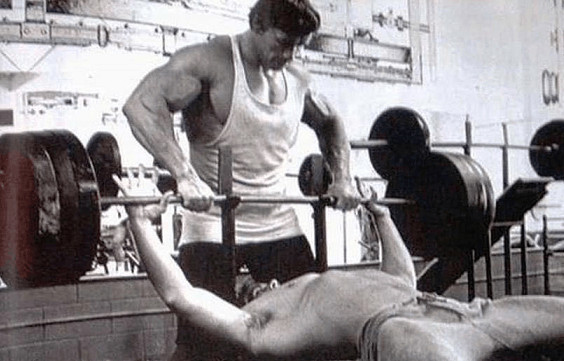
Negative reps are where you lift more weight than usual (30-40%) and use the help of a spotter – who helps you lift the weight on the concentric portion of the lift BUT on the lowering phase of the lift you have complete control.
Here’s an example of negative reps on the bench press…
- Normally you bench press 100kg when your training by yourself, however now you are going to do negative reps. Thus you load an extra 30kg on the bar (130kg).
- You get in position, your partner helps you unrack the bar, and then you slowly lower the weight down to your chest, taking 2-3 seconds to lower the bar.
- Once at the bottom your partner helps you lift the weight back up, taking off approx 30-40% of the weight so that you can press the bar back up to the top.
- This is then repeated throughout the rest of the set i.e. you control the lowering, your partner help you with the lifting portion.
Pros of Negative reps
The obvious benefit is that it allows you to lift heavier. The heavier you lift the more damage you create, enabling you to get stronger at a quicker pace. The stronger you get, the bigger your muscles will grow.
Negative training is a way of placing more stress on your muscles compared to training alone. This type of training was used by top American bodybuilder Casey Viator, who reportedly gained 63.21lbs of muscle in 28 days – by using this method for a lot of his training.
Downsides of Negative Reps
Negative repetitions can be highly stressful on joints due to the heavier weight used, increasing the risk of injury. This technique also taxes the central nervous system, raising the likelihood of overtraining, especially if sleep or nutrition is inadequate.
Getting the right volume is crucial. Beginners and intermediates with less than three years of experience should limit themselves to 2–4 negative sets per workout. These sets are extremely taxing, so progress slowly to avoid overtraining.
A trustworthy spotter or training partner is essential for safety. Spotting requires precision—assisting just enough, but not too much. If you’re new to negative repetitions, practice with lighter weights first to build confidence before attempting heavier loads.
How to include negative rep training into your workouts
There are lots of ways to include negative reps into your workouts. You CAN do you entire workout with negative reps, although most people use them more sparingly, as it’s very hard work.
For example in your next push workout you could do the following workout, including negative reps on a few exercises, such as follows:
Chest:
- 1 set flat bench press – 6-10 (negative reps)
- 2 sets incline DB press – 8-12 reps (normal reps)
- 2 sets decline fly’s – 12-15 reps (normal reps)
Shoulders:
- 1 set machine shoulder press – 6-10 (negative reps)
- 2 sets DB side raises – 10-15 reps (normal reps)
- 2 sets DB rear fly – 15-20 reps (normal reps)
Triceps:
- 1 set EZ skull crushers – 6-10 (negative reps)
- 2 sets DB overhead extensions – 10-15 reps (normal reps)
- 2 sets cable push downs – 15-20 reps (normal reps)
Good exercises for negative reps…
You can’t do negative reps on every single exercises, as you need your spotter in a good position. E.g. doing negatives on the military shoulder press exercise isn’t going to be ideal (unless your spotter(s) are stood on boxes either side!).
Here are some great exercises to try negative repetitions with…
- Chest – bench press
- Back – lat pull down
- Shoulders – machine press
- Biceps – BB curls
- Triceps – EZ skull crushers
- Quads – Leg press
- Hamstrings – lying leg curl
Have you tried negative reps before? Feel free to share you experience in the comment section below!
Skip Ahead
Toggle