Contents11 sections
The SS-31 peptide (Elamipretide) is a synthetic tetrapeptide that targets the inner mitochondrial membrane to restore mitochondrial function and energy production. Unlike most peptides that work through hormonal pathways, SS-31 operates at the cellular energy level by binding to cardiolipin, a phospholipid essential for mitochondrial structure and electron transport.
The result is improved ATP production, reduced oxidative stress, and better cellular energy output. Research on SS-31 has shown benefits for skeletal muscle function, cardiovascular health, kidney protection, and age-related cognitive decline. The Elamipretide peptide is currently in clinical trials for conditions including Barth syndrome and primary mitochondrial myopathy.
Even though this might sound a little complex, I got you like always, as I have tried my best to break down the working of SS-31 for you! Stay with me till the end to find out about this peptide and to decide if it fits your requirements.
Key Takeaways
- SS-31 (Elamipretide) is a mitochondria-targeted peptide that binds to cardiolipin in the inner mitochondrial membrane to restore electron transport and ATP production.
- Research demonstrates benefits for skeletal muscle function, exercise tolerance, cardiovascular health, kidney protection, and age-related cognitive decline.
- The typical research dosage is 0.5-2 mg/day via subcutaneous injection, with 40 mg shown to be well-tolerated in human subjects.
- SS-31 is currently in clinical trials for Barth syndrome and primary mitochondrial myopathy. It is not FDA-approved for general use.
- Common SS-31 side effects are limited to injection site reactions (redness, itching) and mild headache.
What Is the SS-31 Peptide?
The SS-31 peptide, also known as Elamipretide or Szeto-Schiller peptide 31, is an aromatic synthetic tetrapeptide with the sequence D-Arg-dimethylTyr-Lys-Phe-NH2 and a molecular weight of 639.8 g/mol. It belongs to a class of small, cell-permeable, water-soluble peptides that carry a net charge of 3+ at physiological pH.
What makes SS-31 unique among peptides is its target: rather than binding to cell surface receptors or modulating hormones, it crosses the cell membrane and accumulates specifically in the inner mitochondrial membrane. This targeting happens independently of mitochondrial membrane potential, meaning SS-31 can reach even damaged or dysfunctional mitochondria.
Quick Facts
| Property | Detail |
|---|---|
| Also known as | Elamipretide, MTP-131, Bendavia |
| Structure | D-Arg-dimethylTyr-Lys-Phe-NH2 |
| Molecular weight | 639.8 g/mol |
| Target | Inner mitochondrial membrane (cardiolipin) |
| Absorption | Rapid cellular uptake within 15-30 minutes |
| Administration | Subcutaneous injection, intranasal spray |
| Clinical status | Phase 2/3 trials for Barth syndrome and mitochondrial myopathy |
How Elamipretide Works: Mechanism of Action


The SS-31 peptide operates through a specific mitochondrial pathway that distinguishes it from other performance or anti-aging peptides.
Step 1: Rapid Cellular Uptake
SS-31 enters cells independently of energy-dependent transporters or receptor-mediated processes. It is absorbed within 15-30 minutes and is relatively resistant to peptidase degradation, which allows for a longer duration of action.
Step 2: Cardiolipin Binding
Once inside the cell, SS-31 accumulates in the inner mitochondrial membrane and binds selectively to cardiolipin, an anionic phospholipid essential for mitochondrial structure and function. When cardiolipin becomes damaged or oxidized (common in aging and disease), it converts cytochrome c from an electron carrier into a peroxidase, disrupting the electron transport chain.
SS-31 prevents this conversion by stabilizing the cardiolipin-cytochrome c interaction, keeping cytochrome c in its electron-carrying role.
Step 3: Electron Transport Chain Restoration
By protecting the cardiolipin-cytochrome c relationship, SS-31 restores normal electron transport chain function. This directly increases ATP synthesis, the primary energy currency of the cell.
Step 4: Oxidative Stress Reduction
SS-31 contains dimethyl tyrosine residues that scavenge reactive oxygen species (ROS) and form unreactive tyrosine radicals. This antioxidant activity reduces oxidative phosphorylation of linoleic acid and low-density lipoprotein, protecting mitochondrial structures from further damage.
Step 5: Cristae Remodeling
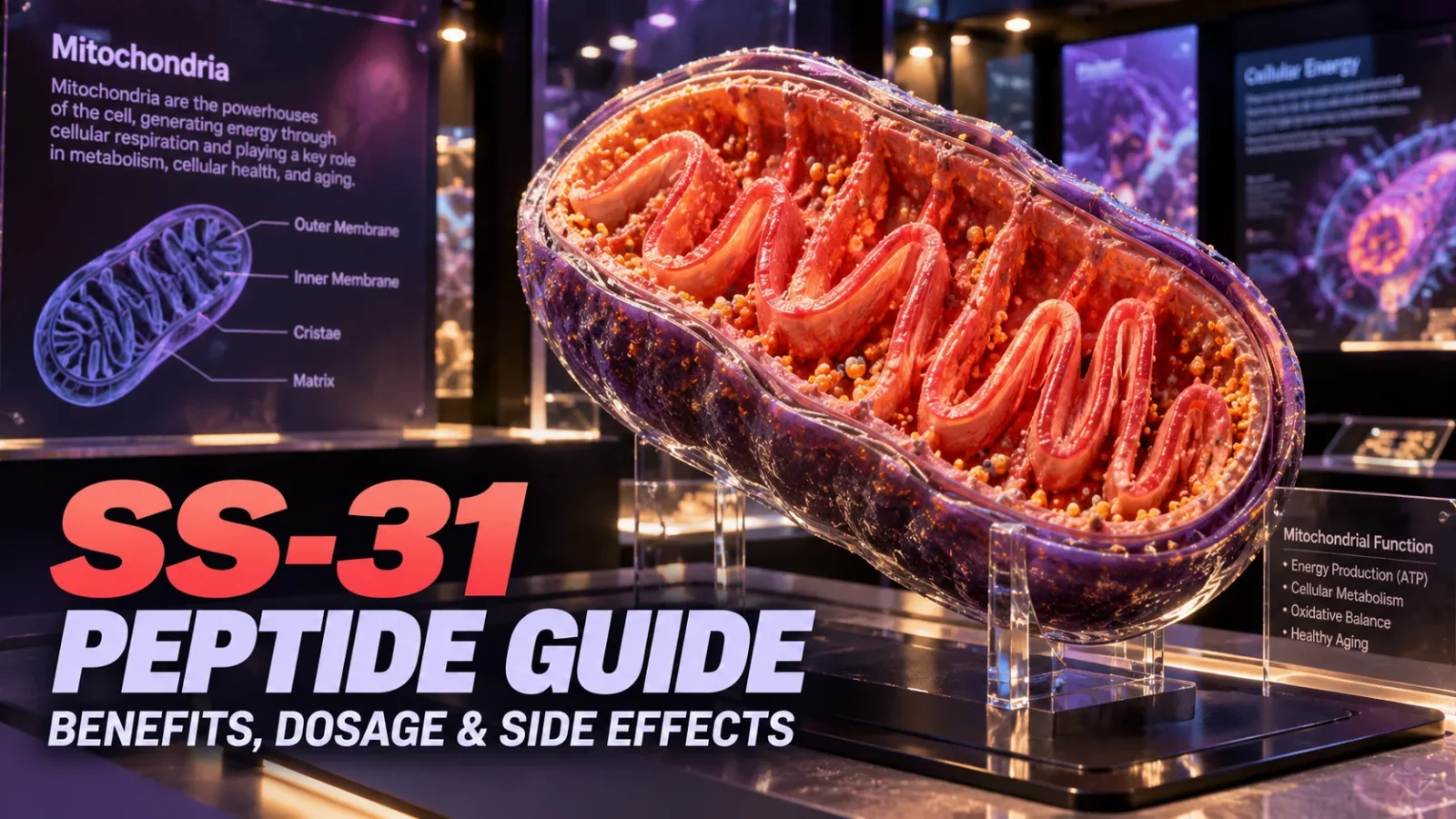
The inner mitochondrial membrane contains folds called cristae, whose degradation is associated with aging. SS-31 enhances cardiolipin activity to remodel these cristae structures, contributing to its anti-aging effects at the cellular level.
SS-31 Benefits
Improved Skeletal Muscle Function
Mitochondrial dysfunction reduces ATP availability in muscle cells, leading to fatigue and poor exercise tolerance. SS-31 restores mitochondrial energy output, which research has shown improves skeletal muscle function and exercise capacity. This is the primary SS-31 benefit that attracts athletes and bodybuilders, many of whom already use creatine supplements for complementary ATP support through a different pathway.
Cardiovascular Protection
Cardiac muscle cells are among the most mitochondria-dense cells in the body. SS-31 benefits cardiovascular health by maintaining the proton leak mechanism in cardiac mitochondria, reducing ROS production, and protecting against diastolic dysfunction. Research has demonstrated its potential in ischemia-reperfusion injury and heart failure models.
Neuroprotective Effects
The antioxidant properties of SS-31 extend to neural tissue. Studies in mice have shown improved cerebral microvascular dilation, better memory retention, enhanced motor skills, and improved gait coordination after SS-31 treatment. The peptide specifically counters hippocampal oxidative stress, making it a subject of research for Alzheimer’s disease intervention.
Kidney Protection
SS-31 has shown efficacy in countering ischemia-reperfusion injury in chronic kidney disease models. By regenerating ATP levels in renal cells, it protects against the energy deficit that drives kidney damage in CKD.
Anti-Aging at the Cellular Level
Age-related mitochondrial decline is a primary driver of cellular aging. SS-31 addresses this by:
- Remodeling degraded mitochondrial cristae
- Preventing proton leak through cooperation with the ANT1 protein
- Reducing oxidative stress that accumulates with age
- Restoring ATP production to more youthful levels
Islet Cell Preservation
Research has demonstrated that SS-31 reduces apoptosis and inflammatory responses in mouse islet cells, increasing islet cell yield by preserving mitochondrial function. This finding has implications for improving insulin resistance and supporting transplanted islet cells in diabetes treatment.
SS-31 Dosage
Human Trial Data
| Parameter | Detail |
|---|---|
| Well-tolerated dose | Up to 40 mg in human subjects |
| Common research dose | 0.5-2 mg/day |
| Administration | Subcutaneous or intramuscular injection |
| Alternative delivery | Intranasal spray |
| Cycle approach | Varies by condition; some protocols run until resolution |
Important Considerations
- The appropriate SS-31 dosage varies significantly based on the condition being targeted. Cardiovascular applications may require different dosing than skeletal muscle or neurological use cases.
- The 40 mg figure comes from tolerability studies, not from optimized efficacy data. Research protocols often use lower doses.
- Consult a healthcare practitioner for personalized SS-31 peptide dosing. Self-dosing based on animal study extrapolations carries significant uncertainty.
Administration Methods
| Method | Notes |
|---|---|
| Subcutaneous injection | Most common in research and clinical trials. Standard peptide injection sites apply. |
| Intramuscular injection | Alternative to subcutaneous; may provide faster absorption |
| Intranasal spray | Non-invasive option with increasing availability; clean nostrils before administration |
| Pre-mixed pens | Newer delivery method; portable and convenient |
SS-31 Side Effects
SS-31 has a favorable side effect profile compared to many research peptides. The most commonly reported effects are mild and temporary.
Common Side Effects
| Side Effect | Frequency | Severity |
|---|---|---|
| Injection site reactions | Common | Mild (redness, itching) |
| Headache | Occasional | Mild |
| Dizziness | Rare | Mild |
Safety Considerations
- No serious SS-31 side effects have been reported in human tolerability studies at doses up to 40 mg
- Long-term safety data is limited as the peptide is still in clinical trials
- The peptide does not appear to accumulate in the mitochondrial matrix even at high concentrations, which may contribute to its favorable safety profile
- As with any injectable peptide, proper reconstitution and sterile technique are essential to avoid infection
SS-31 vs. Other Mitochondrial Peptides
SS-31 vs. MOTS-C
| Feature | SS-31 | MOTS-C |
|---|---|---|
| Origin | Synthetic tetrapeptide | Mitochondria-derived peptide (MDP) |
| Target | Inner mitochondrial membrane (cardiolipin) | AMPK pathway, nuclear gene regulation |
| Primary function | Restores electron transport chain, ATP production | Regulates glucose metabolism, insulin sensitivity |
| Best for | Mitochondrial dysfunction, energy production, anti-aging | Metabolic health, fat loss, exercise performance |
| Anti-aging | Yes (cristae remodeling, oxidative stress reduction) | Yes (metabolic regulation, cellular stress response) |
| Administration | Subcutaneous injection, intranasal | Subcutaneous injection |
| Availability | Limited; expensive | More widely available from research vendors |
SS-31 acts directly on mitochondrial structure, while MOTS-C influences mitochondrial function through metabolic signaling pathways. For bodybuilders and athletes primarily interested in energy and exercise tolerance, MOTS-C is generally more accessible and has broader user experience data. SS-31 may be better suited for addressing specific mitochondrial dysfunction or age-related energy decline.
SS-31 vs. Humanin
Both SS-31 and Humanin improve mitochondrial function and have anti-aging potential, but they differ fundamentally:
- SS-31 is synthetic and accumulates in the inner mitochondrial membrane to restore electron transport directly
- Humanin is a naturally occurring mitochondria-derived peptide with broader systemic effects including cytoprotection, anti-inflammatory signaling, and metabolic regulation
Humanin has more diverse biological functions beyond mitochondrial support, while SS-31 is more targeted and specific in its mechanism.
Where to Buy Elamipretide (SS-31)
SS-31 peptide availability is limited compared to more common research peptides. The peptide is expensive and not widely stocked by major peptide vendors. As of 2026:
- Research chemical vendors: A small number of vendors carry SS-31, but availability fluctuates. Check vendors on our best peptide vendors list for current stock.
- Clinical access: The Elamipretide peptide (the pharmaceutical version) is available through clinical trials. Check ClinicalTrials.gov for active trials.
- Alternatives: Many users opt for MOTS-C as a more accessible mitochondrial peptide with similar energy-boosting benefits.
The Bottom Line
The SS-31 peptide represents one of the most targeted approaches to mitochondrial repair available in the peptide space.
- Its ability to bind directly to cardiolipin and restore electron transport chain function sets it apart from peptides that work through hormonal or metabolic pathways.
- The research supporting its SS-31 benefits, from skeletal muscle function to cardiovascular protection to neuroprotection, is compelling and continues to grow through ongoing clinical trials.
Frequently Asked Questions
Disclaimer
Please read carefully
The information on this site is for educational and informational purposes only, and is not medical advice. Always consult a qualified healthcare professional before using any supplement or medication, or making changes to your health, fitness, or nutrition routine.
Not medical advice
Content here is not a substitute for professional medical advice.
Consult your doctor
Talk to your doctor before starting any supplement or new routine.
Use at your own risk
We are not responsible for adverse effects from acting on this.
Do your research
Make informed decisions about your own health.
No guarantees
Individual results vary. No claims about outcomes.
Important — Never disregard professional medical advice or delay seeking it because of something you read here. If you think you may have a medical emergency, call your doctor or your local emergency number right away.