In the world of longevity and skincare science, few ingredients have generated as much excitement as Idebenone. Originally developed as a synthetic analogue of Coenzyme Q10 (CoQ10), this powerful antioxidant has since gained recognition for its remarkable ability to protect cells, enhance energy production, and slow visible signs of aging. Unlike many antioxidants that lose effectiveness under stress, Idebenone remains stable and active, even when oxygen levels drop, making it a true breakthrough in cellular protection.
In this article, we’ll explore what Idebenone is, how it compares to CoQ10, and the science-backed benefits that make it a standout in both supplemental and skincare formulations. You’ll also learn who should use it, how to take it safely, and what research says about its role in anti-aging, neurological support, and skin rejuvenation!
Key Takeaways
- Idebenone is a next-generation antioxidant that supports mitochondrial energy and cellular protection more effectively than CoQ10. ⚡
- Its unique ability to work in low-oxygen environments makes it valuable for both neurological and skin health. 🧠
- Topical Idebenone reduces signs of aging, protects against UV damage, and restores a youthful skin glow. 🌸
- It’s clinically backed, safe, and well-tolerated when used within recommended dosages. ✅
- Always consult a healthcare professional before starting any supplement to ensure safety. ⚠️

What is Idebenone?
Idebenone is a synthetic analogue of Coenzyme Q10 (CoQ10), a naturally occurring antioxidant that fuels cellular energy production. Developed by Takeda Pharmaceuticals in the 1980s, it was designed to overcome CoQ10’s limitations, such as poor solubility and reduced activity under low-oxygen conditions.
Structurally, Idebenone is a short-chain benzoquinone compound, allowing it to move easily within both lipid and aqueous environments, reaching deep cellular structures where oxidative damage typically occurs.
Simply put, Idebenone helps cells produce energy more efficiently and defend themselves from oxidative stress, making it a promising compound in both medical research and skincare innovation.
It’s often described as a “next-generation antioxidant” because of its superior stability and broader range of biological activity compared to traditional antioxidants like CoQ10 or Vitamin E.
Idebenone as a Cellular Antioxidant
At the cellular level, Idebenone works as an electron carrier in the mitochondrial respiratory chain, the series of reactions responsible for converting nutrients into ATP — the body’s main source of energy. During this process, cells naturally produce reactive oxygen species (ROS), unstable molecules that can damage DNA, proteins, and lipids if left unchecked.
Idebenone neutralizes these ROS, preventing oxidative stress and cellular aging. Unlike many antioxidants, Idebenone remains active even in hypoxic (low oxygen) environments, a key advantage in tissues like the brain, heart, and eyes where oxygen supply fluctuates.
Its potent antioxidant capability stems from its balanced redox potential, allowing it to both donate and receive electrons efficiently. This unique trait helps protect mitochondria, preserve cellular integrity, and sustain optimal energy metabolism even under stress.
This is why Idebenone is widely studied for its potential benefits in neurological disorders (like Alzheimer’s and Friedreich’s ataxia), mitochondrial dysfunction, and cellular aging, all conditions linked to oxidative damage.
Idebenone and Skin Health
Beyond its cellular effects, Idebenone has earned a strong reputation in dermatology as one of the most powerful topical antioxidants available today. When applied to the skin, it helps counteract the daily oxidative stress caused by UV exposure, pollution, and environmental toxins, key contributors to photoaging and collagen breakdown.
Clinical studies have shown that Idebenone can significantly reduce fine lines, improve skin texture, and enhance overall tone by protecting and energizing skin cells. Because it is both lipid- and water-soluble, Idebenone penetrates deeply into the skin layers, reaching areas where free radical damage begins.
Mechanism of Action: How it Works in the Body?
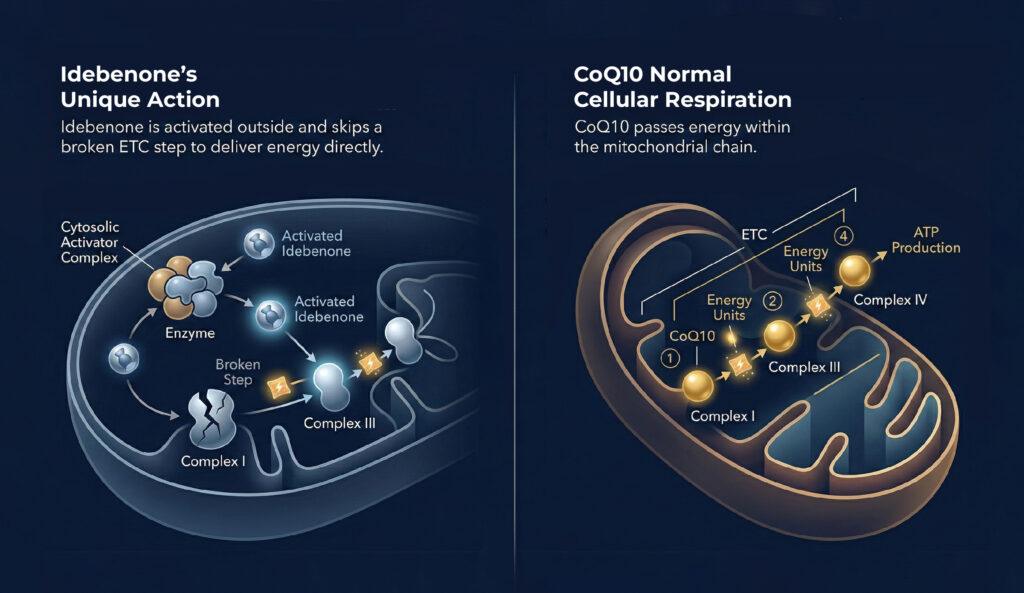
Idebenone works primarily at the mitochondrial level, enhancing both cellular energy production and antioxidant defense. As a synthetic analogue of Coenzyme Q10 (CoQ10), it functions as an electron carrier in the mitochondrial respiratory chain, helping convert nutrients into adenosine triphosphate (ATP) — the body’s main energy molecule.
Unlike CoQ10, Idebenone remains active even under low-oxygen (hypoxic) conditions, allowing it to sustain energy production and protect cells when oxidative stress is high. This makes it especially valuable in energy-demanding tissues like the brain, heart, eyes, and skin.
Mitochondrial Energy and Cellular Protection
By facilitating electron transport between mitochondrial complexes, Idebenone supports steady ATP generation, preventing cellular fatigue and dysfunction. It simultaneously acts as a potent antioxidant, neutralizing reactive oxygen species (ROS), unstable molecules that can damage DNA, lipids, and proteins.
This dual action not only helps maintain mitochondrial efficiency but also protects cells from oxidative damage, a key driver of aging and many chronic conditions.
Neuroprotective and Regenerative Role
Idebenone’s ability to stabilize mitochondrial membranes and improve oxygen utilization translates into neuroprotective benefits. Studies suggest it may help safeguard neurons and retinal cells in disorders such as Friedreich’s ataxia and Leber’s hereditary optic neuropathy (LHON).
At the cellular level, it enhances resilience and repair capacity, explaining its growing use in both neurological research and skin rejuvenation formulations.
In essence, Idebenone supports the body by powering mitochondria, combating oxidative stress, and preserving cell vitality, a rare combination that underlies its wide-ranging therapeutic and cosmetic potential.
Recommended Dosage Table
| Product | Dosage 💊 | Administration 💉 | Timing ⌚ |
| Idebenone | 90-300mg daily, depending on the treatment | Oral | With meals |
| L-Carnitine | 1-3g daily | Oral | Before exercise |
| Alpha Lipoic Acid | 600-1200mg daily | Oral | With a meal |
Benefits of Idebenone
Idebenone’s unique ability to combine mitochondrial support with powerful antioxidant protection gives it a wide range of health and cosmetic benefits. From protecting neurons to revitalizing skin, research shows that Idebenone’s cellular effects extend to multiple organ systems. Below are its most well-established, science-supported benefits.
Supports Brain Health and Cognitive Function
Idebenone has been extensively studied for its neuroprotective properties, particularly in conditions linked to oxidative stress and mitochondrial dysfunction. In the brain, it enhances mitochondrial energy metabolism, helping neurons maintain ATP production and resist oxidative damage.
Clinical and preclinical research suggests Idebenone may improve memory, focus, and overall cognitive performance by protecting neuronal membranes and preventing lipid peroxidation, a process associated with neurodegenerative diseases such as Alzheimer’s and Parkinson’s.
Moreover, Idebenone’s ability to function under low-oxygen conditions makes it especially beneficial for cerebral tissues, where energy deficits can accelerate cognitive decline.
Neuroprotective Role in Mitochondrial Disorders
One of Idebenone’s best-documented uses is in treating Leber’s Hereditary Optic Neuropathy (LHON) and Friedreich’s Ataxia, both conditions caused by mitochondrial dysfunction.
In LHON, Idebenone helps restore visual function by improving mitochondrial respiration in optic nerve cells. The European Medicines Agency (EMA) has approved Idebenone (brand name Raxone) for LHON treatment, reflecting its validated role in supporting mitochondrial recovery.
Similarly, in Friedreich’s ataxia, Idebenone has shown potential to improve cardiac and neurological function by reducing oxidative damage in affected tissues. Though it is not yet FDA-approved for this use.
Enhances Skin Health and Fights Visible Aging
Idebenone is one of the most potent antioxidants used in dermatology today. When applied topically, it shields skin cells from UV radiation, pollution, and blue light, all of which generate free radicals that accelerate aging.
By neutralizing these free radicals, Idebenone helps prevent collagen degradation, reduce fine lines, and improve skin texture, elasticity, and radiance. Clinical trials comparing antioxidant potency ranked Idebenone higher than Vitamin C, Vitamin E, and CoQ10, highlighting its superior ability to combat photoaging.
Supports Cellular Energy and Physical Vitality
Idebenone’s role in mitochondrial electron transport enhances the body’s overall energy metabolism. By improving ATP synthesis it helps combat fatigue and supports muscular endurance and cellular recovery.
While not a stimulant, Idebenone optimizes the body’s natural energy pathways, potentially benefiting individuals experiencing low energy, oxidative stress, or chronic fatigue linked to mitochondrial inefficiency.
Protects Eye and Vision Health
Because the eyes are highly sensitive to oxidative stress, Idebenone’s antioxidant and mitochondrial-supporting functions are especially valuable. Research in optic neuropathies like LHON shows that Idebenone can protect retinal ganglion cells and improve visual acuity by restoring mitochondrial energy production.
Its potential to preserve vision underlines its broader role in cellular protection across high-energy-demanding tissues.
Idebenone vs CoQ10
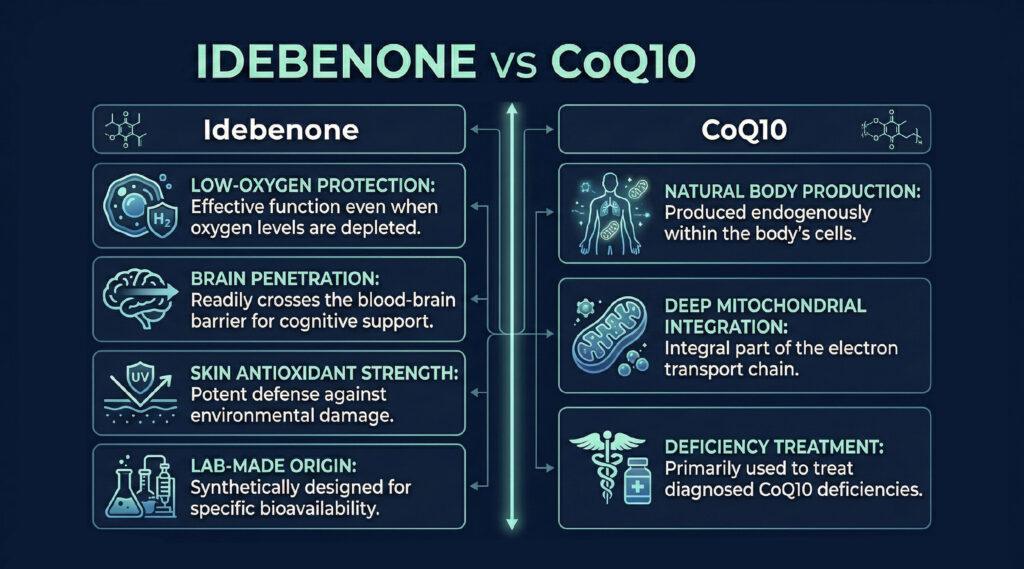
Because Idebenone was developed as a synthetic analogue of Coenzyme Q10 (CoQ10), the two share several functional similarities , both are quinone-based antioxidants that support mitochondrial energy production. However, their chemical properties, bioavailability, and biological performance differ significantly, giving Idebenone distinct advantages in certain settings.
Structure and Stability
CoQ10 is a naturally occurring compound, but its long carbon chain makes it highly lipophilic (fat-soluble) and less stable. Idebenone, with its shorter and more balanced structure, is both water- and fat-soluble, allowing it to penetrate cells more efficiently and remain active under stressful or oxygen-deprived conditions. This chemical stability gives Idebenone greater versatility in tissues with fluctuating oxygen levels, such as the brain, retina, and skin.
Oxygen Dependence and Antioxidant Potency
A key distinction lies in oxygen dependence. CoQ10’s antioxidant function requires oxygen, whereas Idebenone can operate even in low-oxygen environments, maintaining energy production when CoQ10 becomes less effective.
Independent studies comparing antioxidant capacity have found Idebenone to be stronger than CoQ10, Vitamin E, and kinetin in preventing oxidative damage to cellular membranes. This is why Idebenone is often referred to as a “next-generation antioxidant.”
Bioavailability and Applications
CoQ10 supports general energy metabolism and cardiovascular health, but its poor absorption limits its effectiveness in some tissues. Idebenone’s improved solubility allows for better tissue penetration, particularly in the central nervous system and skin.
Because of this, Idebenone is used in neurological therapies (for disorders like Friedreich’s ataxia and Leber’s optic neuropathy) and in advanced skincare formulations to protect against photoaging and oxidative stress.
Who Should Use Idebenone?
Idebenone is ideal for those looking to boost cellular energy, protect against oxidative stress, and slow visible aging. It supports both neurological performance and skin vitality, making it useful for a range of wellness goals.
For Cognitive and Neurological Support
People experiencing mental fatigue, brain fog, or age-related decline may benefit from Idebenone’s ability to protect neurons and support mitochondrial energy, especially under low-oxygen conditions. It’s also researched for neurodegenerative and optic disorders, where oxidative stress plays a key role.
For Skin Health and Anti-Aging
Those seeking firmer, brighter, and more resilient skin can benefit from Idebenone’s potent antioxidant effects. It helps reduce fine lines, UV damage, and pollution-related stress, making it a favorite in advanced anti-aging skincare.
For High-Stress or Active Lifestyles
Athletes and individuals exposed to pollution, physical exertion, or chronic stress can use Idebenone to improve recovery, endurance, and cellular balance.
For Healthy Aging
Adults aiming to maintain vitality and longevity can include Idebenone in their wellness routine to support cellular protection and mitochondrial function over time.
Who Should Avoid It
Avoid use if you’re pregnant, breastfeeding, or on prescription medication affecting mitochondrial or cardiovascular function. Always consult a healthcare professional before starting supplementation.
Safety, Side Effects, and Precautions
Idebenone is generally well tolerated in both supplemental and topical forms when used at recommended doses. However, like any bioactive compound, proper use and awareness of potential side effects are important to ensure safety.
General Safety Profile
Clinical studies show that Idebenone has a high safety margin and is non-toxic at typical dosages used in supplements (90–300 mg daily) and skincare formulations (0.5–1%). It has been used in neurological and ophthalmic trials for extended periods with good tolerability.
Possible Side Effects
Most users experience no significant adverse effects, but mild symptoms may occur, particularly at higher doses. Reported side effects include:
- Mild gastrointestinal discomfort (nausea, stomach upset).
- Occasional headache or dizziness.
- Rare cases of skin irritation with topical use.
These effects are usually temporary and resolve upon reducing the dose or discontinuing use.
Interactions and Precautions
- Individuals taking anticoagulants, blood pressure medications, or mitochondrial therapies should consult their healthcare provider before use.
- Avoid combining Idebenone with other strong antioxidants without professional guidance, as it may alter redox balance.
- Those with pre-existing liver or kidney issues should use it cautiously.
Use in Pregnancy and Children
There is insufficient safety data on Idebenone use in pregnant or breastfeeding women and children, so it’s best avoided unless prescribed by a physician.
Safe Use Tips
- Start with the lowest effective dose and monitor tolerance.
- For skincare, perform a patch test before full application.
- Store supplements in a cool, dry place to preserve potency.
Conclusion
Idebenone is a scientifically advanced antioxidant that enhances cellular energy production and protects against oxidative stress, setting it apart from traditional antioxidants like CoQ10. Its unique ability to function under low-oxygen conditions makes it highly effective for supporting brain function, skin health, and overall cellular vitality.
Whether taken as a supplement or used topically, Idebenone helps preserve youth, energy, and resilience at the cellular level. With its strong safety profile and proven efficacy, it stands as a next-generation compound for those seeking to slow aging, boost mitochondrial health, and maintain long-term wellness!
Frequently Asked Questions
What is Idebenone used for?
Idebenone is used to support cellular energy, brain function, and skin rejuvenation by protecting against oxidative stress.
Is Idebenone better than CoQ10?
Yes, Idebenone is more stable, more bioavailable, and remains active even under low-oxygen conditions, making it a stronger antioxidant than CoQ10.
Can Idebenone improve skin health?
Absolutely. Idebenone helps reduce fine lines, brighten skin tone, and protect against UV and pollution damage when used topically.
Is Idebenone safe to take daily?
Yes, it’s well tolerated at recommended doses, but consulting a healthcare provider before long-term use is advised.
When will I notice results from Idebenone?
Results vary, but most users see improved skin texture or energy levels within 4–8 weeks of consistent use.