Contents12 sections
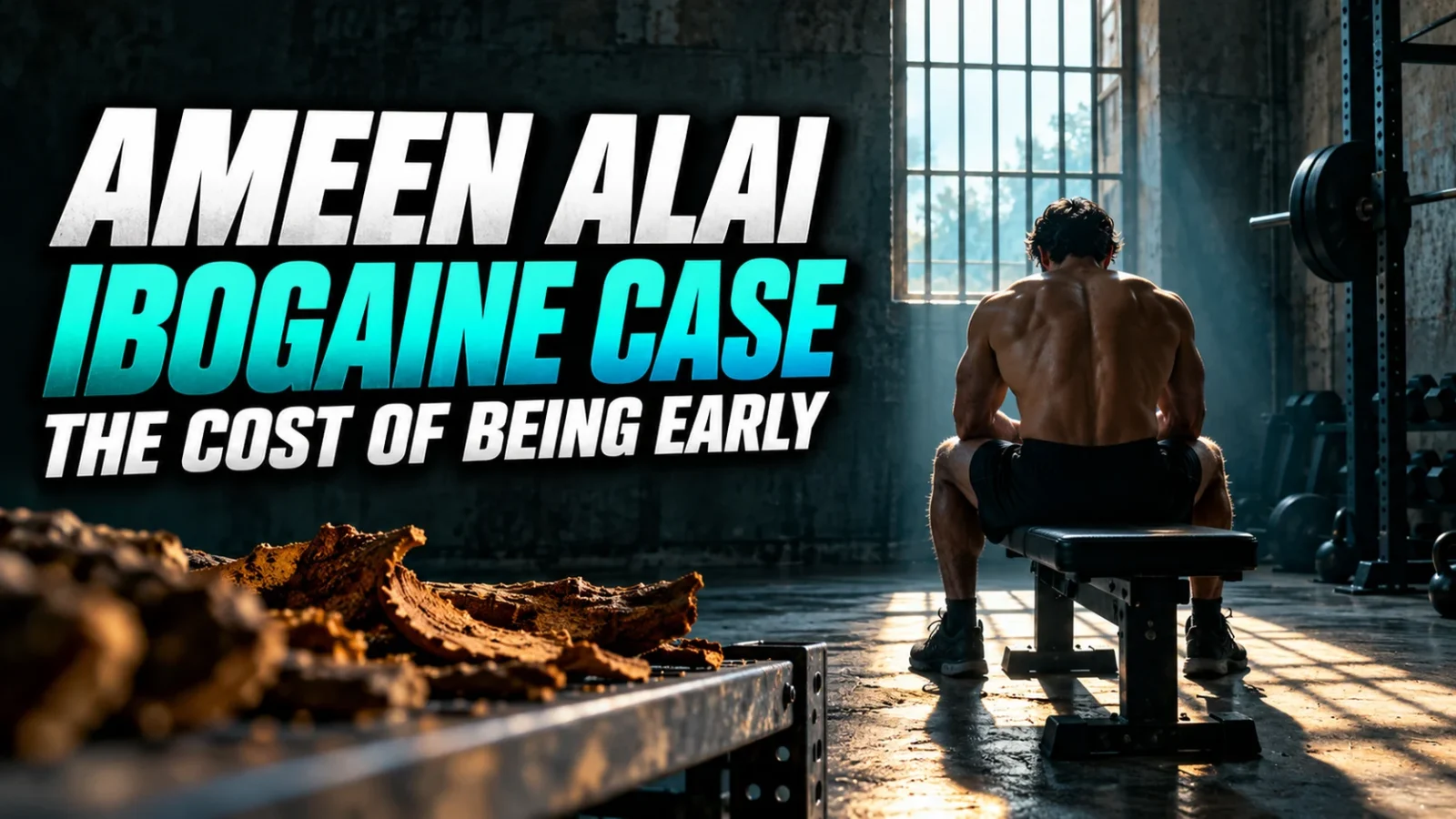
Ameen Alai, known in hardcore fitness circles as “The Mad Scientist” and “Guru Ameen,” was sentenced in September 2025 to 48 months in federal prison in a case tied to the distribution of ibogaine, a psychedelic plant compound that is illegal in the United States.
To federal prosecutors, it was a drug distribution case, one that originally included a charge tied to a death. To parts of the fitness, biohacking and alternative-medicine world, it became a symbol of something bigger: a drug policy that, in their view, punishes people faster than it updates the science.
Both views deserve a fair hearing. This article covers what is publicly known about the case, what ibogaine is, what the research does and does not show, and why the drug’s heart risks are the part of the story that supporters and critics both have to take seriously.
Key Takeaways
- Ameen Alai, a bodybuilding and biohacking figure known as “The Mad Scientist,” was sentenced in September 2025 to 48 months in federal prison in an ibogaine distribution case.
- A “distribution resulting in death” count, which carries a 20-year mandatory minimum, was dropped; he pleaded to distribution-related charges.
- Ibogaine is Schedule I in the US. Small studies abroad suggest it may ease opioid withdrawal and help veterans with brain injuries, but no large controlled trials exist yet.
- Ibogaine prolongs the QT interval and can trigger fatal heart arrhythmias. Deaths have been documented, which is why careful clinics screen with ECGs and monitor patients throughout.
- Political support for psychedelic research is growing, but research funding is not legalization. The case shows the cost of acting before the law and the evidence catch up.
Who Is Ameen Alai?
Before the legal headlines, Alai was best known in hardcore fitness circles. He earned the nickname “The Mad Scientist” for an obsessive, experimental approach to training, recovery and physiology, and built a following among bodybuilders and self-experimenters.
Over time his focus widened beyond muscle and physique. He began talking publicly about addiction, trauma and neurological recovery, drawing on personal experience and on alternative research, and ibogaine became part of that conversation.
To his supporters, “Guru Ameen” was someone willing to explore options others avoided. To his critics, distributing a Schedule I drug with known heart risks crossed a line, whatever the intent behind it.
The Case: What Is Publicly Known
Court-level detail is thin in public coverage, and much of what circulates online comes from Alai’s supporters. The broad outline, as reported:
| Stage | What has been reported |
|---|---|
| Charges | Federal prosecutors charged Alai in late 2022 in connection with distributing ibogaine |
| Original count | “Distribution resulting in death,” which carries a 20-year mandatory minimum under federal law |
| What happened to that count | Dropped; accounts of the case say prosecutors could not establish that the drug caused the death |
| Plea | Alai pleaded to distribution-related charges |
| Sentence | 48 months in federal prison, handed down in September 2025 |
Why the Death Charge Matters
The original count means prosecutors alleged that a person died after taking ibogaine connected to the case. That fact is easy to lose in the online debate, and it is central to why the government treated the case so seriously.
It also helps explain why the count fell away. Since the Supreme Court’s 2014 decision in Burrage v. United States, prosecutors must show that the drug was a “but-for” cause of the death, not just one factor among several. With ibogaine, where fatal cases often involve heart disease or other drugs, that is a hard standard to meet.
Current Status
Alai’s supporters launched a #FreeAmeen campaign that seeks a presidential pardon, more ibogaine research and an end to the criminalization of plant-based medicines. This article takes no side on the pardon request. For his current custody status, the authoritative public source is the Federal Bureau of Prisons inmate locator; the federal court docket holds the charging documents and the plea record.
What Is Ibogaine?
Ibogaine is a psychoactive alkaloid found in the root bark of Tabernanthe iboga, a shrub native to Central West Africa, where it has a long history of ceremonial use in the Bwiti tradition of Gabon.
Western interest in it as an addiction treatment goes back to the 1960s, when Howard Lotsof reported that a single dose interrupted his heroin dependence. Since then it has been given in clinics and informal settings outside the US, mainly for opioid dependence and, in later years, for PTSD and traumatic brain injury.
Unlike most psychedelics, ibogaine acts on many brain systems at once, including NMDA, opioid and serotonin targets. The body converts it into noribogaine, a long-lasting metabolite that is thought to contribute to its anti-craving effects. A treatment session is long and intense, often lasting a day or more, and commonly brings nausea, vomiting and loss of coordination.
What the Research Shows
- Animal data: in rodent studies, ibogaine and noribogaine reduced self-administration of morphine, cocaine and alcohol.
- Opioid withdrawal (human, observational): small studies from treatment centers in Mexico and New Zealand reported reduced withdrawal symptoms and cravings in many patients after treatment. None had a control group.
- Veterans with brain injury (human, open-label): a 2024 Stanford study published in Nature Medicine followed 30 US Special Operations veterans with traumatic brain injury who were treated with ibogaine plus magnesium at a clinic in Mexico. One month later they reported large improvements in disability, PTSD, depression and anxiety, with no serious adverse events. There was no placebo group.
- What is missing: large, randomized, placebo-controlled trials. Without them, nobody can say how well ibogaine works, for whom, or how its benefits weigh against its risks.
For opioid use disorder, medicines with strong trial evidence already exist: methadone, buprenorphine and naltrexone. Ibogaine’s appeal is the idea that one supervised session could reset addiction patterns, but that idea is still being tested.
Ibogaine Safety: The Heart Risk
This is the part of the story that advocacy pieces tend to skip, and it is the main reason the drug is so tightly controlled.
Ibogaine and noribogaine block hERG potassium channels in the heart. That slows the heart’s electrical reset between beats, which shows up on an ECG as a prolonged QT interval. A long QT interval can tip into torsades de pointes, a chaotic rhythm that can cause sudden cardiac death. Ibogaine can also slow the heart rate. Because noribogaine stays in the body for days, the risk does not end when the experience does.
Deaths have been documented. A 2012 forensic review identified 19 deaths temporally associated with ibogaine between 1990 and 2008. In most of the cases with adequate autopsy information, pre-existing heart disease or the use of other drugs contributed.
| Risk factor | Why it matters |
|---|---|
| Heart disease or a long QT interval at baseline | Less margin before a dangerous rhythm develops |
| Low potassium or magnesium | Electrolyte loss, for example from vomiting, raises arrhythmia risk |
| Other QT-prolonging drugs | Methadone and some antidepressants, antipsychotics and antibiotics add to the effect |
| Opioids or stimulants in the system | Long-acting opioids such as methadone are a particular concern; stimulants such as cocaine add cardiac strain |
| Unsupervised use | No ECG screening, no cardiac monitoring and no one on hand to treat an arrhythmia |
| The days after treatment | Opioid tolerance drops, so returning to a previous dose can cause a fatal overdose |
Clinics that take safety seriously screen with an ECG and blood work, review heart history and medications, and monitor heart rhythm throughout treatment. In the Stanford study, magnesium was given specifically to protect the heart. Even with these precautions, ibogaine is not risk-free.
The Broader Context: A Shifting Political Landscape
What complicates the case is timing. Several prominent Republican and Trump-aligned figures have publicly backed psychedelic and ibogaine research, particularly for veterans with PTSD and traumatic brain injury:
- Rick Perry, former Texas governor and former US Secretary of Energy, has publicly advocated for ibogaine research and pushed for state funding. In 2025, Texas approved $50 million for ibogaine clinical trials.
- Robert F. Kennedy Jr., as Secretary of Health and Human Services, has criticized pharmaceutical monopolies and expressed openness to psychedelic therapy for depression and trauma.
- Rep. Dan Crenshaw, a former Navy SEAL, authored legislation directing the Department of Defense to research psychedelic therapies.
None of this legalizes ibogaine, and research funding is not approval. Ibogaine has no FDA approval for any use, and in 2024 the FDA declined to approve MDMA-assisted therapy for PTSD despite strong advocacy. The gap between political enthusiasm and what regulators will sign off on is still wide.
Alai’s supporters argue that his prosecution reflects old drug-war logic colliding with new political realities. Critics answer that the point of funded clinical trials is to test ibogaine under medical supervision, with heart monitoring, rather than outside it.
The Cultural Shift: “In Waves and War”
The 2025 Netflix documentary In Waves and War added to the debate. It follows Navy SEAL veterans seeking relief from PTSD and traumatic brain injury through ibogaine and other psychedelic treatments outside the United States.
For many viewers, the film reframed ibogaine from a fringe drug into a last-resort treatment for people whom conventional care had failed. The film is not about Alai, but his supporters see it as support for the same idea he promoted.
Two Sides of the Debate
The Argument for Leniency
- The death-results count was dropped, so Alai was not convicted of causing a death.
- Ibogaine has genuine research interest for addiction and brain injury, including work from major universities.
- Political leaders now promote and fund the same kind of research.
- Americans already travel abroad for ibogaine treatment; prosecution does not end the demand.
The Argument for Prosecution
- Ibogaine has a documented record of cardiac deaths, and safer use depends on screening and monitoring.
- Schedule I is federal law today, wherever policy may go later.
- Prosecutors linked a death to ibogaine from the case, even if causation could not be proven in court.
- Promising early results have been wrong before; that is why large controlled trials exist.
Why the Case Resonates in Fitness and Biohacking
The case lands differently with fitness readers than with the general public. Fitness and biohacking culture has a long history with substances that sit in legal or scientific gray zones, from hormone optimization and research peptides to SARMs and nootropics.
History shows that some ideas once dismissed later become accepted. Others never do, and some cause real harm before that becomes clear. Being early can mean being right, or being wrong at a cost to other people.
The Alai case forces an uncomfortable question: how should society handle people who act on emerging science before regulators and the evidence have caught up?
The Bottom Line
Ameen Alai is neither a saint nor a cartoon villain: he is a fitness figure who went to federal prison over a drug with real research promise and real, documented risks.
- He was sentenced in September 2025 to 48 months; the death-results count was dropped and he pleaded to distribution-related charges.
- Ibogaine shows early promise for opioid dependence and brain injury, but the human evidence comes from small, uncontrolled studies.
- Its cardiac risk is real: QT prolongation and arrhythmia deaths are why ECG screening and monitoring are non-negotiable.
- Whether history sees Alai as reckless or simply early will depend on where the science and the law land next.
Frequently Asked Questions
Disclaimer
Please read carefully
The information on this site is for educational and informational purposes only, and is not medical advice. Always consult a qualified healthcare professional before using any supplement or medication, or making changes to your health, fitness, or nutrition routine.
Not medical advice
Content here is not a substitute for professional medical advice.
Consult your doctor
Talk to your doctor before starting any supplement or new routine.
Use at your own risk
We are not responsible for adverse effects from acting on this.
Do your research
Make informed decisions about your own health.
No guarantees
Individual results vary. No claims about outcomes.
Important — Never disregard professional medical advice or delay seeking it because of something you read here. If you think you may have a medical emergency, call your doctor or your local emergency number right away.