Contents11 sections
Palumboism, also called bubble gut, HGH gut or growth gut, is bodybuilding slang for a hard, distended stomach on an otherwise lean, muscular physique. The belly pushes outward even when the athlete is dieted down for the stage, which is what separates it from ordinary body fat or bloating.
The name comes from Dave Palumbo, a former top amateur bodybuilder whose midsection changed visibly later in his competitive career. It is not a medical diagnosis, and no study has examined it directly. The most widely accepted explanation is a mix of growth hormone, insulin, very high food intake and visceral fat, built up over years.
This article explains where the term came from, what is known about each suspected cause, and the athletes most often named as examples. Keep one caveat in mind throughout: photos alone cannot show what anyone used.
Key Takeaways
- Palumboism, or bubble gut, is bodybuilding slang for a hard, distended stomach on an otherwise lean physique. It is not a recognized medical diagnosis.
- The leading explanation combines high-dose growth hormone, insulin, very large food intake and visceral fat, built up over years at the top level.
- At very high levels, growth hormone enlarges internal organs, as documented in acromegaly. On its own it tends to lower visceral fat, so GH alone does not explain the look.
- No study has examined bubble gut in bodybuilders. Every explanation is pieced together from medical research on growth hormone, insulin and abdominal fat.
- The name reflects how visible Dave Palumbo’s case was, not a confirmed cause. Photos of named athletes cannot show what anyone used.
Who Is Dave Palumbo?
Dave Palumbo is one of the most recognizable figures in bodybuilding media. A former competitive bodybuilder, he is best known today as the founder of RxMuscle, where he hosts shows, interviews athletes and discusses everything from training and nutrition to performance-enhancing drug use.
Palumbo did not start out chasing mass. He was originally a long-distance runner before switching to the weights, and he went on to compete near the top of the NPC amateur ranks from the mid-1990s into the early 2000s, placing high at national shows such as the Junior Nationals and the USA Championships. At his best he was known for extreme thickness and muscle density. He never earned an IFBB pro card.
Over time, fans noticed something else: a distended midsection that did not match the rest of his physique. It looked different from ordinary offseason weight, and it stayed visible on stage. As similar physiques appeared across the sport, forums and fans began calling the look “Palumboism.”
What Is Palumboism?
Palumboism describes a stomach that pushes outward on a bodybuilder who is otherwise lean. The abdominal muscles may still be visible, but the whole midsection sits forward, round and firm, rather than flat.
In Palumbo’s case, the change showed up in stage photos later in his competitive career. Earlier he had been praised for a big, dense and well-conditioned physique. In the later photos his waist looked far wider and rounder than before. The images spread quickly on bodybuilding forums, and his name became shorthand for the look. Today it is used for any physique with the same pattern, whoever it belongs to.
How It Differs From Fat or Bloating
- It is firm, not soft. A belly made of body fat under the skin is soft and pinchable. A bubble gut is usually described as hard and tight, because the pressure comes from inside the abdominal wall.
- It shows at low body fat. It is visible even when the athlete is lean enough to compete, often with the abs still showing.
- It does not come and go. Bloating from a big meal, gas or water changes through the day. A bubble gut stays, fed or fasted.
- It is mostly seen in heavyweights. The look is most often reported in the heaviest open bodybuilders, usually after years at the top level.
In the 1970s and 1980s, top bodybuilders were prized for small waists, and the stomach vacuum was a standard pose. Many in the sport date the change to the 1990s, when growth hormone and insulin became more common in high-level preparation.
What Causes Palumboism?
There is no confirmed cause. No study has measured the abdomens of bodybuilders with the look, so every explanation is pieced together from what medicine knows about growth hormone, insulin and abdominal fat. The most widely accepted view is that several factors add up over years.
Growth Hormone and Organ Growth
Human growth hormone (GH) is made by the pituitary gland. Much of its effect runs through IGF-1, a growth factor made mainly in the liver. Doctors prescribe somatropin, the drug form of GH, to people whose bodies do not make enough, at doses meant to bring levels back to normal.
The clearest picture of what too much GH does comes from acromegaly, a condition in which a pituitary tumor makes excess GH for years. People with acromegaly develop enlarged internal organs (doctors call this visceromegaly), including the liver, kidneys, spleen and heart, and their colon often becomes longer. Their hands, feet and facial features grow, and soft tissue thickens.
Bodybuilders who use growth hormone commonly report doses well above medical replacement levels, often for years and alongside other drugs. The bubble gut theory holds that this can enlarge the organs and intestines in a similar way, so the abdominal contents take up more room and push the wall outward. It is a reasonable extrapolation from acromegaly, but it has never been measured in bodybuilders.
There is a twist. In adults who lack GH, treatment with it tends to reduce visceral fat, the fat packed around the organs. A GH-releasing drug, tesamorelin, is FDA-approved specifically to reduce excess abdominal fat in people with HIV-related lipodystrophy. So GH on its own pushes visceral fat down, not up. That is why most explanations of bubble gut focus on organ growth, fluid retention and the drugs and diet that come with GH, rather than on GH-driven fat gain.
GH also causes fluid retention and makes the body less sensitive to insulin. Both are well-known side effects in clinical use, and the second one matters for the next cause.
Insulin and Very High Food Intake
Some bodybuilders use insulin to push glucose and amino acids into muscle, usually alongside very large carbohydrate intakes. Insulin is strongly anabolic, but it is also the body’s main fat-storage hormone. In people with diabetes, starting insulin commonly leads to weight gain.
Used without medical supervision, insulin is also one of the most dangerous drugs in bodybuilding. Too much of it, or too little food after a dose, can cause severe hypoglycemia (low blood sugar), which can lead to seizures, loss of consciousness and death.
Because GH makes the body more resistant to insulin, the two are commonly reported to be used together, and the food intake that goes with both is enormous. Eating that volume across many meals a day may also play a part. Some coaches believe it stretches the stomach over time, though that has not been studied.
Visceral Fat
Visceral fat is stored inside the abdominal cavity, around the organs and behind the abdominal muscles. It is different from the subcutaneous fat under the skin, which is the fat people can pinch and the fat bodybuilders strip away for the stage. A lifter can carry very little subcutaneous fat, and show visible abs, while still holding a lot of visceral fat that pushes the abdominal wall out from the inside.
Visceral fat builds up with a long-term calorie surplus, is closely tied to insulin resistance, and tends to rise with age. It is strongly linked to type 2 diabetes and heart disease. Years of extreme bulking, insulin use and GH-related insulin resistance could all feed it, even while GH itself works against it.
Training, Muscle and Other Theories
Other explanations are less well supported:
- Thick abdominal muscles. Years of heavy squats and deadlifts, often combined with anabolic steroids, may thicken the abdominal and oblique muscles and widen the waist. That would make the midsection look bigger, but it would not by itself explain a protruding belly.
- Weaker control of the deep abdominal wall. Some coaches argue that bodybuilders who never practice the stomach vacuum lose the ability to hold the midsection in. This is plausible but unproven.
- Anabolic steroids. Steroids are widespread in untested bodybuilding, so they are present in nearly every case. Their role is probably indirect: they make it possible to carry the extreme bodyweight and food intake that come with the other causes.
| Suspected Cause | Proposed Effect on the Midsection | What the Evidence Shows |
|---|---|---|
| Growth hormone | Larger organs and intestines, fluid retention | Organ growth well documented in acromegaly; not studied in bodybuilders |
| Insulin | More fat storage, very high food intake | Weight gain well documented in medical insulin use |
| Visceral fat | Pushes the abdominal wall out from inside | Strong evidence for its health risks; not measured in bodybuilders with the look |
| Very high food volume | More visceral fat, possibly a stretched stomach | Link to visceral fat is strong; stomach stretching is a theory |
| Thick abdominal muscles | Wider, thicker waist | Theory only |
Is Palumboism a Disease?
Some fans were so struck by how much Palumbo’s physique changed that they assumed he was ill. But Palumboism is not a medical diagnosis and does not appear in any medical classification. It is a nickname for a look, and the change is generally put down to the factors above.
That does not make it harmless. The things that likely sit behind it are real medical problems: organ enlargement, visceral fat, insulin resistance and the risks of using GH and insulin without supervision. In acromegaly, heart disease is one of the main causes of death when the condition goes untreated.
A swollen abdomen can also have causes that have nothing to do with bodybuilding, including hernias, fluid build-up from liver or heart disease, and bowel problems. Anyone whose stomach grows quickly, becomes painful, or swells along with other symptoms should see a doctor rather than assume it is bubble gut.
Does Palumboism Only Affect Bodybuilders?
Probably not. Growth hormone and other performance-enhancing hormones are used outside bodybuilding too, by athletes in other sports for recovery and by people chasing body composition or anti-aging effects. GH is banned at all times in tested sport. Anyone who uses high doses for long periods could, in principle, develop the same changes. Our HGH cycle for men guide covers its reported effects and side effects.
Bodybuilding is simply where the look is easiest to see. On stage, athletes are dieted down and wear posing trunks, so nothing is hidden. Athletes in other sports and recreational users are mostly seen in clothes, where the same change would be much harder to notice.
Bodybuilders Most Often Linked to Palumboism
These are the names fans bring up most often. The descriptions below are based on public photos and widely reported career facts. We have no confirmed information about what any of these athletes used, and a thick midsection can also reflect age, body fat, muscle size and genetics. Appearance alone cannot confirm drug use.
1. Scott Steiner
Scott Steiner, known as “Big Poppa Pump” and “The Genetic Freak,” is a pro wrestler rather than a competitive bodybuilder, but his physique made him one of the most cited examples. At his peak in WCW in the late 1990s, he was known for huge arms on a full, symmetrical upper body.

In the years after his WWE run ended in the mid-2000s, fans noticed his midsection becoming much fuller and rounder while his arms stayed big. His size has long fueled speculation about performance-enhancing drugs. What, if anything, he used is not something we can confirm, and some of the change may simply reflect age and a later stage of his career.
2. Branch Warren
Branch Warren is one of the most successful IFBB pros of his era. He won the Arnold Classic twice and finished second at the Mr. Olympia, and he was known for an intense, heavy training style. He also came back from serious injuries during his career.
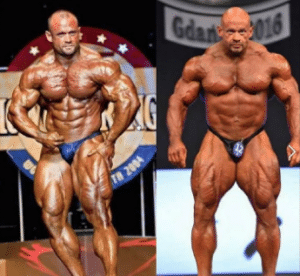
In some later stage appearances, critics pointed to a fuller, more protruding midsection than in his earlier years. That is a common pattern among heavyweight open bodybuilders of his generation. It is not evidence of any particular drug, and we have no confirmed information about what he used.
3. Greg Kovacs
Greg Kovacs was a Canadian IFBB pro best known for sheer size. He was one of the heaviest men ever to compete as a pro, with off-season bodyweights reported well above 300 pounds, and he was better known for his mass than for his placings.

Later in his career, photos showed a visibly distended stomach on stage. Kovacs died in 2013, in his mid-40s, and his death was reported as heart failure. Heart disease is a well-documented risk of long-term anabolic steroid use, but we do not know what role, if any, drugs played in his case.
4. Big Lenny
Big Lenny, a very tall and heavy amateur known in online bodybuilding circles, is often cited as one of the most extreme examples of the look, with a midsection even larger for his frame than Palumbo’s. Some fans have joked that the term should be renamed after him.

He has denied using steroids or growth hormone, and has put the look of his midsection down to cardio that shrank his legs, which makes his stomach look bigger by comparison. Many fans are skeptical, but photos cannot settle the question. In a very heavy man, a large, firm belly can also come from visceral fat alone.
Can Palumboism Be Prevented or Reversed?
There is no research on reversing bubble gut, so the honest answer is that nobody knows how much of it goes away. What is known about the likely causes gives some pointers:
- Visceral fat responds to fat loss. It usually shrinks with sustained weight loss through diet and exercise.
- Organ changes may only partly improve. In acromegaly, some soft-tissue changes improve once GH levels are brought under control, but not all of them do. Whether the same holds for bodybuilders is unknown.
- Avoiding the likely causes is the surest prevention. The look is associated with years of high-dose GH, insulin and extreme food intake. Lifters who do not use them are not known to develop the classic version.
Our guide to bodybuilder bubble gut and how to prevent it covers the practical side in more depth.
The Bottom Line
Palumboism is a nickname for a real look, not a disease: a hard, distended stomach on a lean physique, most likely built from years of high-dose growth hormone, insulin, huge food intake and visceral fat.
- No study has examined it directly. The explanation is pieced together from acromegaly and from clinical research on growth hormone, insulin and abdominal fat.
- GH on its own tends to lower visceral fat, so the look is more likely about organ growth, fluid and insulin-driven fat storage than about GH alone.
- Naming athletes shows what the look is, not what they used. A new or painful swelling of the stomach should be checked by a doctor, not written off as bubble gut.
Frequently Asked Questions
Disclaimer
Please read carefully
The information on this site is for educational and informational purposes only, and is not medical advice. Always consult a qualified healthcare professional before using any supplement or medication, or making changes to your health, fitness, or nutrition routine.
Not medical advice
Content here is not a substitute for professional medical advice.
Consult your doctor
Talk to your doctor before starting any supplement or new routine.
Use at your own risk
We are not responsible for adverse effects from acting on this.
Do your research
Make informed decisions about your own health.
No guarantees
Individual results vary. No claims about outcomes.
Important — Never disregard professional medical advice or delay seeking it because of something you read here. If you think you may have a medical emergency, call your doctor or your local emergency number right away.