

Contents16 sections
Hypertrophy training and strength training overlap, but they are not the same thing. Hypertrophy training aims to make your muscles bigger. Strength training aims to make you able to lift more weight, which depends on muscle size and on how well your nervous system uses that muscle.
Most lifters want both. This guide explains how the two differ, what the research says about rep ranges, rest periods and weekly volume, and how to combine them in one program, with sample workouts you can use.
Key Takeaways
- Hypertrophy training builds muscle size; strength training builds the ability to lift heavier loads. Bigger muscles have more potential for strength, so the two support each other.
- Strength responds best to heavy sets of about 1-6 reps. Muscle grows across a much wider range, roughly 5-30 reps, as long as sets end close to failure.
- Rest longer than the old 60-second rule: about 2-3 minutes on compound hypertrophy lifts, 60-90 seconds on small isolation moves, and 3-5 minutes on heavy strength sets.
- Progressive overload (more weight, reps or sets over time) and roughly 10-20 hard sets per muscle per week drive most of the progress.
- Eat about 1.6-2.2 g of protein per kg of body weight a day, sleep well, and combine or alternate hypertrophy and strength phases to keep progressing.
Understanding Muscle Hypertrophy
Muscle hypertrophy is an increase in the size of muscle fibers, and with it the size of the whole muscle. It happens when training repeatedly challenges a muscle and, in the hours and days after each session, muscle protein synthesis outpaces muscle protein breakdown. Repeat that cycle for months and the muscle gets measurably bigger.
You will often read that there are two types of hypertrophy:
- Myofibrillar hypertrophy: growth of the contractile proteins (myofibrils) that produce force. This is the main way muscles get bigger, and it contributes directly to strength.
- Sarcoplasmic hypertrophy: a proposed increase in the fluid and non-contractile material around the myofibrils (the sarcoplasm). It is often credited to high-rep “pump” training.
The split is less clean than gym lore suggests. Researchers still debate how much sarcoplasmic hypertrophy happens in practice. There is some evidence it can occur, for example during short phases of very high training volume, but with normal training the contractile machinery and the material around it appear to grow largely together. The pump you feel after high-rep sets is a temporary shift of fluid into the muscle, not a lasting type of growth. You do not need to train for one type or the other.
Hypertrophy Training vs. Strength Training
Both styles use resistance training and progressive overload, but they put the emphasis in different places.
- Hypertrophy training uses moderate loads for moderate to higher reps (commonly 6-12, though more reps also work) and more total sets. The goal is enough hard work per muscle to drive growth.
- Strength training uses heavy loads for low reps (about 1-6, most often 3-5) with longer rests. Besides muscle size, maximal strength depends on skill in the specific lift and on how well your nervous system recruits and coordinates muscle fibers. Heavy practice trains exactly that.
You don’t have to choose. Strength work lets you handle heavier weights in your hypertrophy sets, and the extra muscle from hypertrophy work gives you more to build strength with. A well-planned program uses both, either in the same week or in alternating phases.
| Training Type | Typical Reps | Load (% of 1RM) | Rest Between Sets | Main Goal |
|---|---|---|---|---|
| Hypertrophy | 6-12 (5-30 works if sets end close to failure) | About 65-85% | 2-3 min on compounds, 60-90 s on isolation | Muscle size |
| Strength | 1-6 (most often 3-5) | About 85% and above | 3-5 min | Maximal force |
Rep Ranges for Muscle Building and Strength
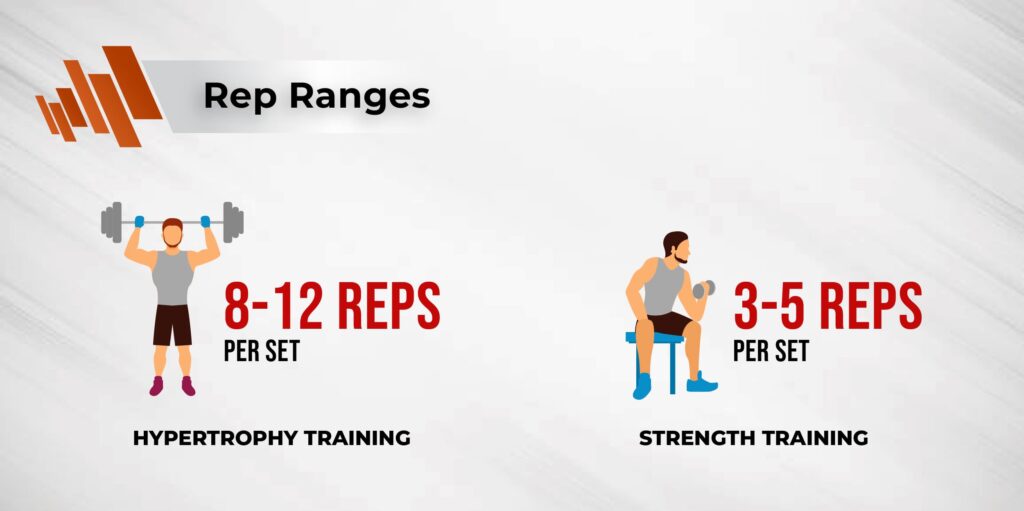
Rep ranges are where the old advice has changed the most.
- For strength, heavy sets matter. A meta-analysis by Schoenfeld and colleagues comparing low-load training (60% of 1RM or less) with high-load training found larger strength gains with heavy loads. That is why strength programs are built around sets of about 1-6 reps.
- For hypertrophy, the same analysis found similar muscle growth with light and heavy loads when sets were taken to or close to failure. 8-12 reps is a convenient middle, not a magic window: sets of about 5 to 30 reps can all build muscle.
So the classic “repetition continuum” (low reps for strength, moderate reps for size, high reps for endurance) has been revised. Research on loading ranges supports a broader view: strength is specific to the loads you practice with, while hypertrophy happens across a wide spectrum of loads as long as effort is high.
In practice, very high-rep sets are slow and painful, and very heavy sets are hard on the joints. Most hypertrophy work fits well in the 6-15 range, with some lighter, higher-rep sets for small muscles or to give sore joints a break.
Training Volume: How Many Sets?
Volume, usually counted as hard sets per muscle per week, is one of the strongest drivers of hypertrophy. A meta-analysis by Schoenfeld, Ogborn and Krieger found a dose-response relationship: more weekly sets produced more growth, and 10 or more sets per muscle per week outperformed fewer than 5.
For most lifters, about 10-20 hard sets per muscle per week is a sensible range, and beginners grow well at the lower end. More is not always better: if your performance drops from week to week or your joints ache, you are doing more than you can recover from. Strength needs fewer sets, but regular heavy practice on the lifts you want to improve.
Spreading that volume over at least two sessions per muscle each week is a practical default, and it is what the sample program below does.
Progressive Overload for Hypertrophy and Strength
To keep growing and getting stronger, the challenge has to rise over time. That is progressive overload. The main ways to apply it:
- Add weight: the most direct method. Small jumps, such as 2.5-5 lb (1-2.5 kg) once you reach the top of your rep range, keep progress steady.
- Add reps: more reps with the same weight and good form is progress too. A simple method is double progression: work up from 8 to 12 reps, then add weight and start again at 8.
- Add sets: an extra set for a lagging muscle raises weekly volume. Add sets gradually, one at a time.
Shortening rest periods is sometimes listed as overload, but it mostly makes your later sets worse, so you do fewer total reps. Use shorter rests to save time, not as your main way to progress.
Overload should be gradual, not a push toward injury. If you stall for several weeks, change one variable (exercise, rep range or volume) rather than everything at once.
Nutrition for Muscle Growth
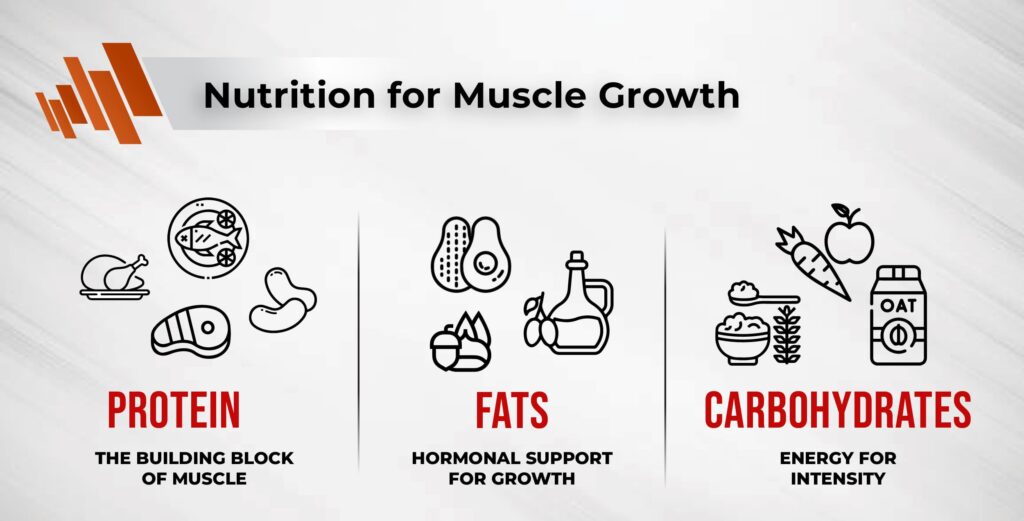
Training creates the stimulus; food supplies the material. You need enough total calories, enough protein, and enough carbohydrates and fats to fuel training and recovery. A small calorie surplus makes muscle gain easier, especially for experienced lifters.
Protein: The Building Block of Muscle
Protein supplies the amino acids your body uses for muscle protein synthesis, the process that repairs and builds muscle fibers after training. A meta-analysis by Morton and colleagues found that the benefit of extra protein on muscle gains leveled off at about 1.6 g per kg of body weight per day, with some people likely benefiting from up to about 2.2 g/kg. For an 80 kg (176 lb) lifter, that is about 130-175 g a day, spread over 3-5 meals.
Good sources of protein include:
- Lean meats like chicken, turkey and beef
- Fish such as salmon and tuna
- Eggs and dairy, such as Greek yogurt and cottage cheese
- Plant sources like beans, lentils, tofu and tempeh
- Protein powders such as whey or casein, which are convenient but not required
Carbohydrates: Energy for Intensity
Carbohydrates are the main fuel for hard, high-volume sessions. They refill muscle glycogen and help you keep the quality of your sets high. Good sources are oats, rice, potatoes, sweet potatoes, whole-grain bread and pasta, and plenty of fruit and vegetables for vitamins, minerals and fiber.
Fats: Hormonal Support
Dietary fat supports hormone production, including testosterone. Getting around 20-30% of your daily calories from fat is a sensible target; very low-fat diets are a poor choice when you are trying to build muscle. Good sources are olive oil, avocados, nuts and seeds, and oily fish like salmon.
Advanced Techniques for Maximizing Muscle Hypertrophy
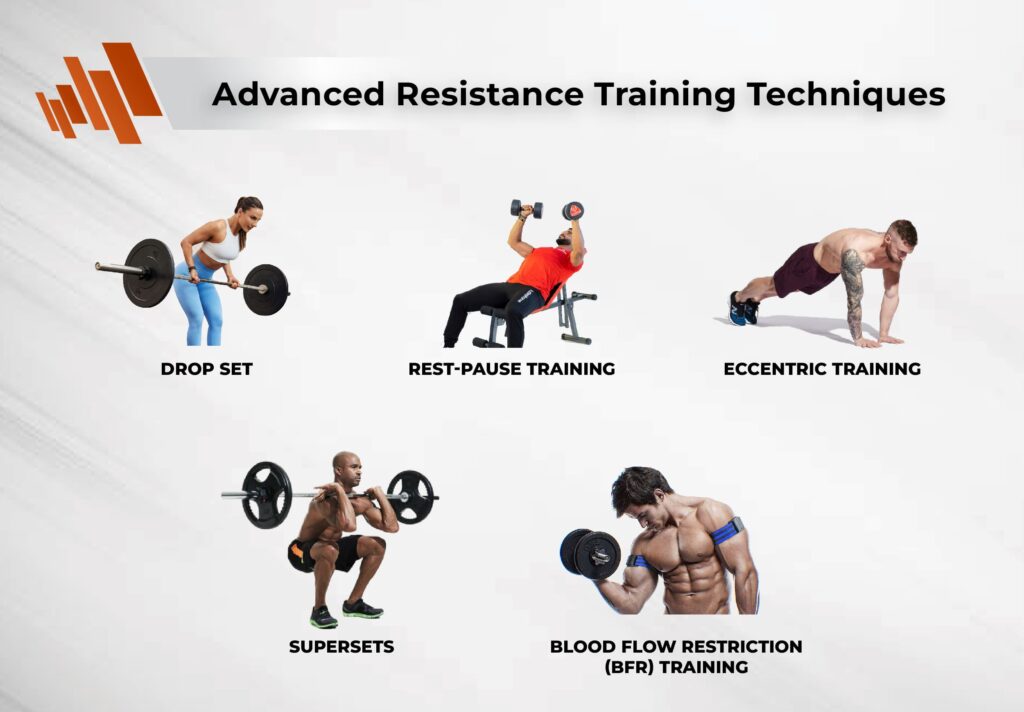
These techniques are tools, not requirements. Most of their value is that they pack a lot of hard work into less time. Use them on the last set of an exercise, mostly on machines and isolation lifts, and not on every set.
1. Drop Sets
Take a set to or close to failure, then immediately reduce the weight by about 20-30% and keep going. Studies comparing drop sets with traditional sets generally find similar muscle growth, with drop sets taking less time. For example, on a machine chest press or dumbbell curl:
- Do 8-10 reps with a weight close to your limit.
- Drop the weight by 20-30% and continue to near failure.
- Drop once more and finish the set.
Avoid drop sets to failure on heavy barbell lifts like the bench press unless you have a spotter. For a related finisher, see our guide to burn sets.
2. Rest-Pause Training
Take a set close to failure, rest 10-20 seconds, then do a few more reps. Repeat once or twice. This puts several near-failure efforts into one extended set. Example:
- Do 8-10 reps of a machine shoulder press.
- Rest 15 seconds, then do 3-5 more reps.
- Rest 15 seconds, then do 2-3 more reps.
3. Eccentric Emphasis
The eccentric (lowering) part of a lift is where muscles produce the most force for the least energy, and controlling it keeps tension on the muscle. Lowering the weight over 3-4 seconds on squats or presses is a good way to make a lighter weight harder and to clean up technique.
It is not magic, though. A meta-analysis of repetition speed by Schoenfeld and colleagues found similar growth for rep durations from about half a second to 8 seconds, with very slow reps likely less effective.
4. Supersets
A superset is two exercises done back to back with little or no rest. Pairing opposing muscles (biceps curls with triceps pushdowns, or rows with presses) saves time with little loss in performance. Pairing exercises for the same muscle (leg press followed by lunges) adds fatigue and makes the second exercise harder.
5. Blood Flow Restriction (BFR) Training
BFR uses a cuff or band around the top of the arm or thigh to partly restrict blood flow while you lift very light loads, often around 20-30% of 1RM, for high reps. It can build muscle with far lighter weights than usual, which is why it is used in rehabilitation. Use purpose-made cuffs, learn the correct pressure, and check with a doctor first if you have a history of blood clots, high blood pressure or heart problems.
Workout Examples for Hypertrophy and Strength Training
Here are four sessions: two for hypertrophy and two for strength. The rest periods follow the newer evidence and are longer than the old 60-second rule, especially on big compound lifts. Choose weights that leave about 1-3 reps in reserve on most sets.
Upper Body Hypertrophy
| Exercise | Sets | Reps | Rest |
|---|---|---|---|
| Bench Press | 4 | 8-12 | 2-3 min |
| Dumbbell Flyes | 3 | 10-12 | 90 s |
| Seated Cable Row | 4 | 8-10 | 2 min |
| Lateral Raises | 3 | 12-15 | 60-90 s |
| Triceps Pushdowns | 3 | 10-12 | 60-90 s |
| Biceps Curls | 3 | 10-12 | 60-90 s |
The bench press and rows carry most of the load. Flyes, raises and arm work add volume for smaller muscles without much extra fatigue.
Lower Body Hypertrophy
| Exercise | Sets | Reps | Rest |
|---|---|---|---|
| Squats | 4 | 8-12 | 2-3 min |
| Leg Press | 3 | 10-12 | 2 min |
| Romanian Deadlifts | 4 | 8-10 | 2 min |
| Walking Lunges | 3 | 10-12 per leg | 90 s |
| Standing Calf Raises | 4 | 12-15 | 60-90 s |
The leg press and lunges add quad and glute volume with less stress on the lower back than more squatting.
Upper Body Strength
| Exercise | Sets | Reps | Rest |
|---|---|---|---|
| Bench Press | 4 | 3-5 | 3-5 min |
| Weighted Pull-Ups | 4 | 3-5 | 3 min |
| Overhead Press | 4 | 3-5 | 3-4 min |
| Bent-Over Rows | 4 | 4-6 | 2-3 min |
| Barbell Shrugs | 3 | 6-8 | 2 min |
Heavy sets need near-full recovery between them. In a study of trained men by Schoenfeld and colleagues, resting 3 minutes between sets produced greater strength gains, and more growth in the thigh muscles, than resting 1 minute.
Lower Body Strength
| Exercise | Sets | Reps | Rest |
|---|---|---|---|
| Squats | 4 | 3-5 | 3-5 min |
| Deadlifts | 3 | 3-5 | 3-5 min |
| Bulgarian Split Squats | 3 | 6-8 per leg | 2 min |
| Barbell Hip Thrusts | 3 | 6-8 | 2 min |
| Seated Calf Raises | 4 | 12-15 | 60-90 s |
This session is built on heavy, low-rep sets of the squat and deadlift, the lifts that build lower-body strength most directly. Leave 1-2 reps in reserve on them: grinding heavy squats and deadlifts to failure adds fatigue and injury risk for little extra benefit.
Combining Hypertrophy and Strength Training
Put the four sessions into one week and you get an upper/lower split that trains every muscle twice: once heavy and once with more volume. Well-known programs such as PHAT and other powerbuilding workouts are built on the same idea.
Sample Week
- Day 1: Upper Body Hypertrophy
- Day 2: Lower Body Strength
- Day 3: Rest or active recovery (walking, light cardio, mobility work)
- Day 4: Lower Body Hypertrophy
- Day 5: Upper Body Strength
- Day 6: Optional accessory work (core, arms, weak points) or rest
- Day 7: Rest
Keep Day 6 short. If you are recovering poorly, it is the first session to drop.
Periodization
The other option is to alternate phases. For example, run 4-6 weeks focused on hypertrophy (more sets, moderate reps), then 4-6 weeks focused on strength (fewer sets, heavier loads), with an easier week between blocks if you need one. The muscle gained in the hypertrophy block gives the strength block more to work with, and the strength block lets you use heavier weights when you return to higher reps.
Special Considerations
Low Loads and High Loads
Because light loads still build muscle when sets end close to failure, they suit beginners, older lifters and anyone working around sore joints or an injury. Heavy loads are needed once maximal strength is a goal. If you are unsure where you stand, our guide on whether you are a beginner, intermediate or advanced lifter helps set expectations.
Repetition Maximum and Exercise Intensity
Your repetition maximum (RM) is the most weight you can lift for a given number of reps; your 1RM is your one-rep max. Hypertrophy work commonly sits around 65-85% of 1RM, and strength work at about 85% and above. You don’t need to test a true 1RM to use this: a weight you can lift for about 10 good reps is roughly 75% of your max, and a weight you can lift for 3-5 reps is roughly 85-90%.
Injury Prevention
Warm up with lighter sets of your first exercise, use a range of motion you can control, and add load gradually so your joints and connective tissue can adapt. Use safety bars or a spotter on heavy squats and bench presses. Sharp or worsening joint pain is a sign to change the exercise or reduce the load, not to push through.
Monitoring Progress and Avoiding Plateaus
Progress slows for everyone over time. Tracking makes it obvious when you have really stalled and what to change.
Track Your Progress
Keep a training log with:
- Weights, sets and reps for each exercise
- Personal bests
- Body weight and a few measurements (arms, chest, waist, thighs) every 2-4 weeks
- Progress photos in the same lighting about once a month
If a lift hasn’t moved in 3-4 weeks, something needs adjusting. For realistic benchmarks, see how much muscle gain per month you can expect at different stages of training.
Breaking Through Plateaus
- Change exercises: swap a stalled lift for a close variation, such as incline dumbbell presses instead of the flat barbell bench press.
- Adjust volume: add a set or two for a lagging muscle, or cut back if you feel run down and your performance is dropping.
- Use advanced techniques sparingly: a drop set or rest-pause set on the final set of an isolation exercise.
- Change the focus: switching from a hypertrophy phase to a strength phase, or the reverse, is often enough to restart progress.
Common Mistakes to Avoid
1. Not Training Close Enough to Failure
Moderate weights don’t mean easy sets. Most sets should end with only 1-3 reps left in the tank. If you can breeze through 12 reps, the weight is too light.
2. Skipping Compound Movements
Isolation exercises have their place, but squats, deadlifts, presses, rows and pull-ups train several muscles at once with heavy loads. They should be the base of both your hypertrophy and your strength work.
3. Under-Eating and Under-Sleeping
Low protein, too few calories or short sleep will limit the results of even a good program. Muscle is built during recovery, not during the workout itself. Hit your protein target, eat enough to support your training, aim for 7-9 hours of sleep, and plan rest days instead of taking them only when you are exhausted.
The Bottom Line
Hypertrophy and strength training work best together: moderate-rep volume builds the muscle, and heavy low-rep work teaches you to use it.
- Train each muscle about twice a week, with roughly 10-20 hard sets per muscle and most sets ending close to failure.
- Use 6-15 reps for most hypertrophy work and heavy sets of 1-6 reps for strength, and rest longer than the old 60-second rule, especially on compound lifts.
- Progress gradually, eat 1.6-2.2 g/kg of protein a day, sleep well, and switch between hypertrophy and strength phases when you stall.
Frequently Asked Questions
Disclaimer
Please read carefully
The information on this site is for educational and informational purposes only, and is not medical advice. Always consult a qualified healthcare professional before using any supplement or medication, or making changes to your health, fitness, or nutrition routine.
Not medical advice
Content here is not a substitute for professional medical advice.
Consult your doctor
Talk to your doctor before starting any supplement or new routine.
Use at your own risk
We are not responsible for adverse effects from acting on this.
Do your research
Make informed decisions about your own health.
No guarantees
Individual results vary. No claims about outcomes.
Important — Never disregard professional medical advice or delay seeking it because of something you read here. If you think you may have a medical emergency, call your doctor or your local emergency number right away.