Contents10 sections
Bronchogen is a short synthetic peptide made of four amino acids (Ala-Glu-Asp-Leu, or AEDL). It is one of the “peptide bioregulators” developed by Vladimir Khavinson’s group in St Petersburg, Russia, and it is aimed at the bronchi, the airways that carry air into the lungs.
Interest in Bronchogen comes from two kinds of research: studies in rats with experimentally induced chronic obstructive pulmonary disease (COPD), and cell-culture and test-tube work on how the peptide interacts with DNA and airway genes. There are no controlled human trials, and it is not an approved medicine.
This guide covers what Bronchogen is, how it is thought to work, what the animal and cell studies found, what is still unknown about safety, and where it stands legally.
Key Takeaways
- Bronchogen is a synthetic tetrapeptide (Ala-Glu-Asp-Leu, or AEDL) from Vladimir Khavinson’s group, sold as a “bioregulator” for the bronchi and lungs.
- In rats with experimental COPD, it lowered neutrophil counts in airway fluid, raised secretory IgA and surfactant protein B, and helped restore the bronchial lining (rat data).
- In bronchial cell cultures, AEDL changed the activity of genes tied to airway cell development, such as NKX2-1, SCGB1A1 and Hoxa3 (cell-culture data).
- Test-tube work shows AEDL binds DNA and raises its melting temperature. That does not show DNA repair, telomerase effects or reversed lung aging.
- There are no controlled human trials, no established human dose and no human safety data. Bronchogen should never replace prescribed lung treatment.
What is Bronchogen?
Bronchogen is a short synthetic tetrapeptide made of alanine, glutamic acid, aspartic acid and leucine (AEDL). It belongs to the same family of short peptides as Vilon, Cardiogen and Chonluten. Our guide to bioregulators and their benefits explains the idea behind the whole group.
The theory is that each of these peptides acts on one tissue by entering cells and adjusting which genes are switched on. For Bronchogen, the target is the epithelium, the layer of cells that lines the airways. For a quick summary of the compound, see our Bronchogen profile.
Almost all of the research on Bronchogen comes from Khavinson’s group and its collaborators, and independent confirmation is limited. The evidence is preclinical: rats, cell cultures and test-tube experiments.
How Bronchogen Is Thought to Work
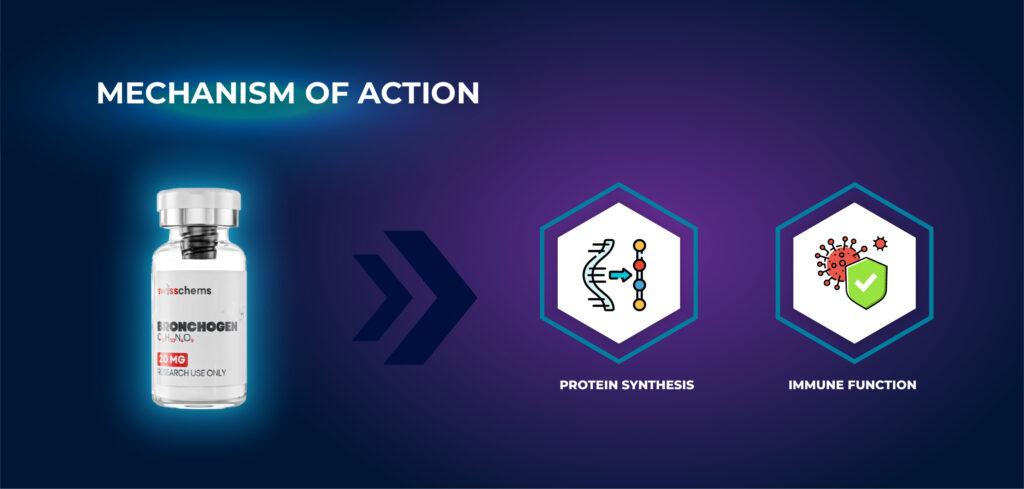
Khavinson’s group describes Bronchogen as a tissue-specific bioregulator for lung tissue. Their proposed mechanism works at the level of DNA and gene activity rather than through a classic receptor.
- Binding to DNA and histones (test-tube data). In cell-free experiments, AEDL bound to DNA and to the histone proteins (H1, H2B, H3 and H4) that package it, and it changed how DNA-cutting enzymes (endonucleases) acted on DNA. The authors read this as a sign that the peptide may influence gene activity, an epigenetic effect.
- Airway gene activity (cell-culture data). A 2014 paper by Khavinson and colleagues in the journal Lung reported that AEDL changed the expression of genes that guide bronchial cell development, including NKX2-1 and SCGB1A1 (the main protein made by protective club cells), and of the mucus genes MUC4 and MUC5AC. The group has also reported effects on markers of cell renewal (Ki-67) and cell survival (Mcl-1).
- Older cells (cell-culture data). The same lab reports that AEDL raised Hoxa3, a developmental gene, in bronchial epithelial cells, with the clearest effect in aged cultures. The authors call this a possible anti-aging (geroprotective) effect. It has not been tested in living lungs of older people.
One finding is often garbled online. AEDL raised the melting temperature of DNA in the test tube, which means the DNA double helix needed more heat to separate when the peptide was bound to it. That suggests the peptide binds to and stabilizes DNA in a dish. It does not show that Bronchogen repairs DNA, protects it from oxidative damage, affects telomeres or telomerase, or slows the aging of lung cells in the body.
Reported Benefits in Animal and Cell Studies
The main animal evidence is a rat study of experimentally induced COPD from Khavinson’s group and collaborators. The researchers analyzed bronchoalveolar lavage fluid (fluid washed out of the airways) and lung tissue in treated and untreated animals. None of the findings below has been confirmed in people.
Lower Neutrophilic Inflammation (Rat Data)
Neutrophils are white blood cells that drive much of the airway damage in COPD. In the COPD rats, Bronchogen lowered neutrophil counts in the airway fluid and brought pro-inflammatory markers closer to normal. Less inflammation would in theory mean less tissue damage, but the effect on breathing in people is unknown.
Repair of the Bronchial Lining (Rat Data)
COPD damages the airway lining: mucus-making goblet cells multiply, while ciliated cells (which sweep mucus out) and club cells (which secrete protective proteins) are lost. In the rat study, treated animals showed more ciliated and club cells and less goblet cell overgrowth. A healthier lining should clear mucus better, but that was not measured as a breathing outcome in humans.
Local Immune Defense and Surfactant (Rat Data)
Treated rats had higher levels of secretory IgA, the main antibody that protects mucous membranes, and of surfactant protein B, which keeps the tiny air sacs (alveoli) from collapsing. The authors reported that treatment brought both back toward normal, which points to a protective effect in rats.
Lung Aging: An Open Question
The “anti-aging” claims for Bronchogen rest on the aged-cell-culture results described above. There is no good evidence that it slows lung aging, or that it helps asthma, COPD, bronchitis or post-viral lung injury in people.
What the Evidence Does and Doesn’t Show
| Finding | Where It Was Seen | Human Data |
|---|---|---|
| Fewer neutrophils and lower inflammatory markers in airway fluid | Rats with experimental COPD | None |
| More ciliated and club cells, less goblet cell overgrowth | Rats with experimental COPD | None |
| Higher secretory IgA and surfactant protein B | Rats with experimental COPD | None |
| Changed activity of NKX2-1, SCGB1A1, MUC4 and MUC5AC | Bronchial cell cultures | None |
| Higher Hoxa3 in aged cells | Bronchial cell cultures | None |
| Binding to DNA and histones, higher DNA melting temperature | Test-tube experiments | None |
Rat COPD models are useful but imperfect: the disease is induced over weeks, while human COPD develops over decades, most often from smoking. A result in rats is a reason to run human trials, not a reason to expect the same effect in people.
Safety Profile
There are no controlled human trials of Bronchogen, so its safety in people is unknown. The animal and cell studies were designed to look at lung effects, not to detect side effects in humans.
Reported Side Effects (Anecdotal)
- Short-lived reactions: Some users online describe brief flushing, a racing heartbeat for a few minutes, or a mild headache after an injection. These are unverified reports, not study results.
- Injection site: Redness, bruising or soreness can occur with any subcutaneous injection.
- Product quality: Research-grade peptides are not made to drug standards. Wrong dosing, impurities or contamination are real risks with any unregulated product.
Monitoring & Medical Oversight
- Talk to a doctor first: This matters most for anyone with a lung condition, heart disease, or who takes other medicines.
- Keep prescribed treatment: Bronchogen has not been shown to work in people. Never stop or cut back an inhaler or other prescribed lung medicine to try it.
- Breathlessness needs a diagnosis: New or worsening shortness of breath, chest tightness or wheezing should be checked by a doctor, not self-treated.
Long-Term & Regulatory Considerations
- No long-term data: Nothing is known about the effects of using Bronchogen for months or years.
- Not FDA-approved: It is sold as a research chemical and is not authorized for therapeutic use in humans. All human use is unregulated.
Future Directions
The rat COPD results and the gene-activity findings make Bronchogen a reasonable candidate for further research, but the basic work has not been done. Independent labs would need to repeat the animal findings, and then controlled human trials would have to show an effect on lung function, symptoms or flare-ups.
Those trials would also have to settle the questions that are open today: the right dose, whether it works by injection or by mouth, how long any effect lasts, and what side effects appear in people. Until then, Bronchogen remains an experimental compound. Chonluten, another short peptide from the same group aimed at the airways, is covered in our Chonluten guide.
Where to Buy Bronchogen?
Bronchogen is sold only as a research chemical, labeled not for human use. Quality varies widely between suppliers, so the first thing to ask for is a recent third-party certificate of analysis (COA) for the exact batch, with identity and purity testing. Our guide on how to read a peptide COA explains what to check.
SwissChems is the research-peptide supplier featured in our other bioregulator guides. Check its current range and the batch COA before buying anything.

Pros
- Exceptional purity & testing (≥98%)
- Pharmaceutical-style packaging for stability
- Broad catalog across peptides & nootropics
- Strong reputation & consistency across years
Cons
- Some items frequently out of stock due to high demand
- Limited long-term data for some compounds
The Bottom Line
Bronchogen is an interesting lung peptide in rat and cell research, but it is not a proven treatment for any breathing problem in people.
- In rats with experimental COPD, Bronchogen reduced airway inflammation, raised secretory IgA and surfactant protein B, and helped restore the bronchial lining. In cell cultures, it changed the activity of airway development genes.
- The DNA findings are test-tube results. Claims about DNA repair, telomerase or reversing lung aging go beyond the data.
- There are no controlled human trials, no established dose and no human safety data. Anyone with a lung condition should stay on prescribed treatment and talk to a doctor.
Frequently Asked Questions
Disclaimer
Please read carefully
The information on this site is for educational and informational purposes only, and is not medical advice. Always consult a qualified healthcare professional before using any supplement or medication, or making changes to your health, fitness, or nutrition routine.
Not medical advice
Content here is not a substitute for professional medical advice.
Consult your doctor
Talk to your doctor before starting any supplement or new routine.
Use at your own risk
We are not responsible for adverse effects from acting on this.
Do your research
Make informed decisions about your own health.
No guarantees
Individual results vary. No claims about outcomes.
Important — Never disregard professional medical advice or delay seeking it because of something you read here. If you think you may have a medical emergency, call your doctor or your local emergency number right away.