Contents9 sections
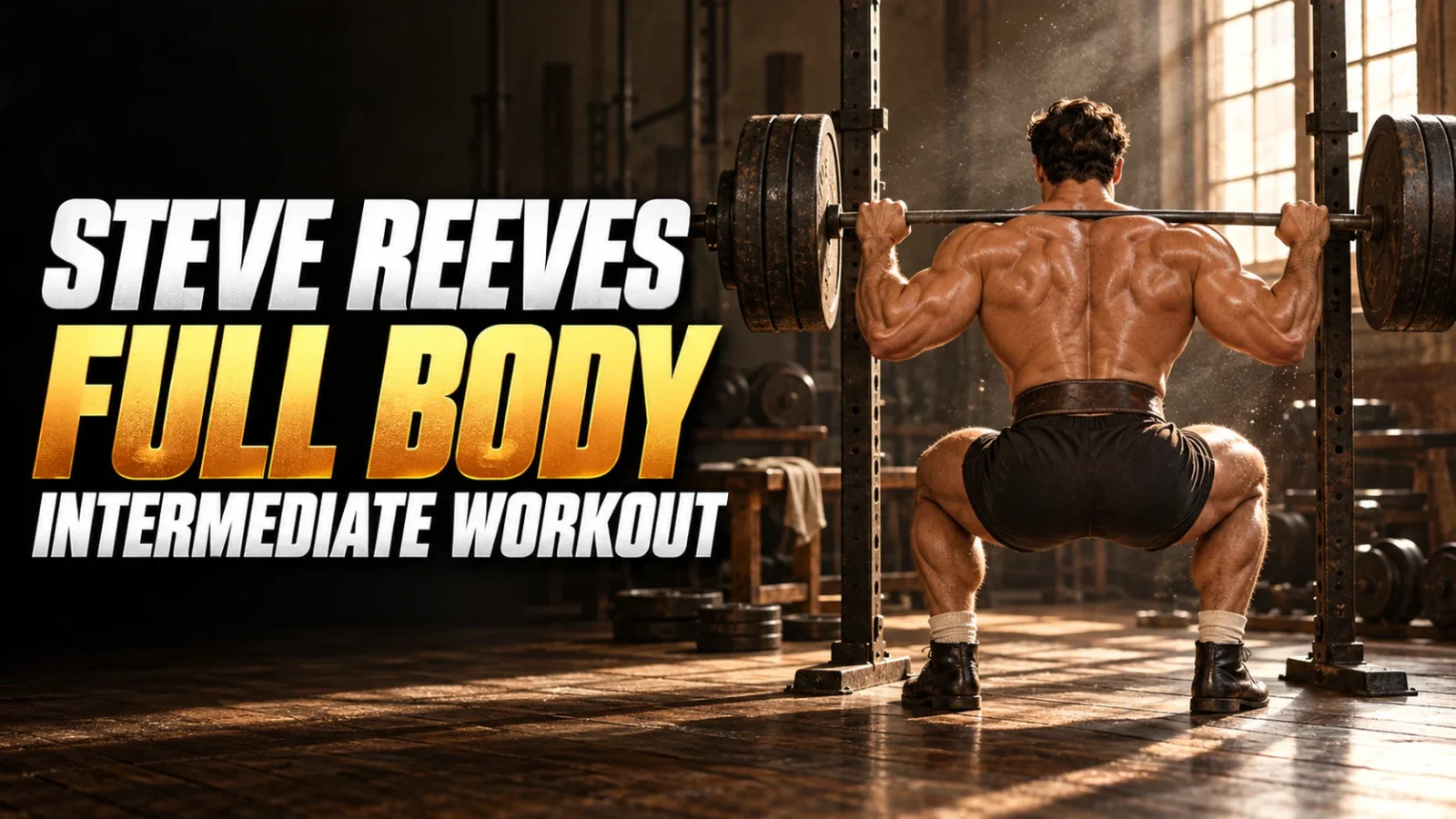
Steve Reeves (1926-2000) was one of the first bodybuilders to become a household name. Born in Montana, he won the AAU Mr. America title in 1947 and the NABBA Mr. Universe in 1950, then starred as Hercules in Italian films of the late 1950s. His physique is still a reference point for symmetry and proportion, and it was built before anabolic steroids became part of bodybuilding.
Reeves trained his whole body three days a week, mostly with 3 sets of 8-12 reps per exercise. This page covers two programs built on that pattern: the shorter Reeves Classic for newer lifters, and an intermediate variation that takes Reeves’ own long intermediate session and spreads it across a Monday-Wednesday-Friday week.
You’ll also find a simple way to ease into the extra workload, and the double-progression method (3 x 8 up to 3 x 12) that drives the whole plan.
Key Takeaways
- Reeves trained full body on three non-consecutive days a week, mostly with 3 sets of 8-12 reps.
- His own intermediate session has about 36 working sets. This variation spreads that work over Monday, Wednesday and Friday.
- Run the simpler Reeves Classic for at least 3-6 months before starting the intermediate variation.
- Ease in over a few weeks by cutting the extra superset sets, then add them back.
- Progress with double progression: build from 3 x 8 to 3 x 12, add a small amount of weight, and start again at 8 reps.
Steve Reeves’ Intermediate Routine
This is the intermediate routine attributed to Reeves himself. Every exercise is done in one full-body session, three days a week.
| Exercise | Sets x Reps | Notes |
|---|---|---|
| Dumbbell swings | 3 x 15-20 | Warm-up |
| Upright rows | 3 x 8-12 | |
| Bench press | 3 x 8-12 | |
| One-arm dumbbell rows | 3 x 8-12 | |
| Dumbbell laterals or flyes | 3 x 8-12 | |
| Incline press | 3 x 8-12 | |
| Triceps pushdowns | 3 x 8-12 | |
| Barbell curls | 3 x 8-12 | |
| Seated dumbbell curls | 3 x 8-12 | |
| Regular squats | 3 x 8-12 | Superset with light pullovers |
| Light barbell pullovers | 3 x 8-12 | Done straight after each squat set |
| Breathing squats | 1 x 20 | Superset with breathing pullovers |
| Breathing pullovers | 1 x 20 | Done straight after the breathing squats |
| Deadlifts | 2 x 8-12 | |
| Good mornings | 2 x 8-12 |
That is about 36 working sets after the warm-up, all in one session. For most lifters it is too much to recover from three times a week, and the deadlifts and good mornings come at the very end, when you are already tired.
The variation below keeps the basics of this routine and splits them across the week, so each session takes a more reasonable amount of time. It is still a lot of work and is not for beginners: you should have several months of full-body training behind you before you start it.
What Are Breathing Squats and Pullovers?
Breathing squats are high-rep squats (here one set of 20) where you take a few deep breaths between reps once the set gets hard. Straight after, you do a set of light pullovers, lying across a bench and taking a deep breath as the weight goes back. Old-time lifters believed the pairing expanded the rib cage. There is no good evidence that it changes rib cage size in adults, but it is still a tough leg set followed by a light stretch for the chest and lats.
Start With the Reeves Classic

The Reeves Classic is a shorter full-body program built on the same 3 x 8-12 pattern, and it can take you a long way. Run it for at least 3-6 months before you try the intermediate variation. A true beginner can keep making good gains on it for a long time, as long as the weights keep going up.
| Exercise | Sets x Reps | Notes |
|---|---|---|
| Squats | 3 x 8-12 | |
| Barbell or dumbbell rows | 3 x 8-12 | Monday and Wednesday |
| Deadlifts | 3 x 5 | Friday only, in place of rows: 2 warm-up sets, 1 heavy work set |
| Behind-the-neck press | 3 x 8-12 | |
| Bench press | 3 x 8-12 | |
| Barbell or dumbbell curls | 3 x 8-12 | |
| Dips | 5 x 10 | Bodyweight; aim for sets of 10 |
| Barbell calf raises | 3 x 15-20 | |
| Ab work | Your choice |
Train Monday, Wednesday and Friday. On Friday, drop the rows and do deadlifts Reg Park style: two warm-up sets of 5, then one heavy work set of 5.
Not sure which program fits you? See whether you are a beginner, intermediate or advanced lifter before you choose.
How to Transition Into the Intermediate Variation
Even after several months of full-body training, the intermediate variation is a big jump in weekly workload. If you have been progressing well, the last thing you want is to stall. Work into it gradually over a few weeks to a month.
The simplest way is to do only one set of the superset moves (chins and upright rows) and one set of stiff-leg deadlifts for the first few weeks:
| Section | Full program | First few weeks |
|---|---|---|
| Legs (Monday) | Squats 3 x 8-12 superset light pullovers, then stiff-leg deadlifts 2 x 8-10 | Same squats and pullovers, then stiff-leg deadlifts 1 x 8-10 |
| Back (Monday) | Rows 2 x 8-12, chins x 10, rows 1 x 8-12, chins x 10 | Drop the last set of chins |
| Shoulders (Wednesday) | Behind-the-neck press 2 x 8-12, upright rows 1 x 12, press 1 x 8-12, upright rows 1 x 12 | Drop the last set of upright rows |
Once the shorter version feels manageable and your lifts are still moving up, add the dropped sets back in.
The Weekly Plan
Train three non-consecutive days, such as Monday, Wednesday and Friday. Every session covers the whole body, but the leg, back and shoulder work changes from day to day.
| Section | Monday | Wednesday | Friday |
|---|---|---|---|
| Legs | Squats 3 x 8-12 superset light pullovers; stiff-leg deadlifts 2 x 8-10 | Squats 3 x 8-12 superset light pullovers; squat flush set 1 x 20 | Squats 3 x 8-12 superset light pullovers |
| Back | Rows superset wide-grip chins (see below) | Barbell or dumbbell rows 3 x 8-12 | Deadlifts 2 x 10 (medium weight); wide-grip chins 3 sets at bodyweight |
| Shoulders | Behind-the-neck press 3 x 8-12 | Behind-the-neck press superset upright rows (see below) | Behind-the-neck press 3 x 8-12 |
| Chest | Bench press (barbell or dumbbell) 3 x 8-12 | Bench press 3 x 8-12 | Bench press 3 x 8-12 |
| Biceps | Barbell or dumbbell curls 3 x 8-12 | Curls 3 x 8-12 | Curls 3 x 8-12 |
| Triceps | Dips, 5 sets at bodyweight | Dips, 5 sets at bodyweight | Dips, 5 sets at bodyweight |
| Calves | Calf raises 3 x 15-20 | Calf raises 3 x 15-20 | Calf raises 3 x 15-20 |
| Abs | Ab work | Ab work | Ab work |

Legs
Squats anchor every session. Follow each set of squats with a set of light pullovers, around 25 lb (11 kg). The pullover is a light stretch, not a strength move. On Monday, finish with 2 x 8-10 stiff-leg deadlifts. On Wednesday, finish with one 20-rep squat flush set using a lighter weight.
Back
Monday’s back work is a row and chin superset, done in this order:
- Barbell or dumbbell rows: 2 sets of 8-12
- Wide-grip chins: 1 set of 10 at bodyweight
- Rows: 1 set of 8-12
- Wide-grip chins: 1 set of 10 at bodyweight
If you can’t yet do 10 bodyweight chins, do as many clean reps as you can and build up. Wednesday is 3 x 8-12 rows on their own. Friday swaps the rows for 2 x 10 deadlifts with a medium weight, followed by 3 sets of wide-grip chins at bodyweight.
Use both dumbbell and barbell rows across the week and alternate the days. You might like dumbbell rows in Monday’s superset and barbell rows on Wednesday. Find what feels best for you.
Shoulders
On Monday and Friday, do 3 x 8-12 behind-the-neck presses. On Wednesday, superset the press with light upright rows:
- Behind-the-neck press: 2 sets of 8-12
- Upright rows: 1 light flush set of 12
- Behind-the-neck press: 1 set of 8-12
- Upright rows: 1 light flush set of 12
Upright row form: use a grip wider than shoulder width and pull only until your upper arms are parallel to the floor. At the top, your elbows should be bent roughly 90 degrees. This is mainly a side-delt exercise, with some trap involvement.
The behind-the-neck press needs good shoulder mobility. If pressing behind your head pinches or hurts, press in front of your head instead (a standard overhead press) for the same sets and reps.
Chest, Arms, Calves and Abs
These stay the same on all three days: bench press (barbell or dumbbell) 3 x 8-12, barbell or dumbbell curls 3 x 8-12, dips for 5 sets at bodyweight, calf raises 3 x 15-20, and your choice of ab work.
How to Progress: Double Progression
Every exercise uses a rep range rather than a fixed number of reps. This scheme, often called double progression, has been around for a long time. Its advantage is a built-in step back each time you reach the top of the range. Here is how to run it:
- Pick a weight with which you can just complete 3 sets of 8.
- Each session, try to do at least one more rep in total than last time.
- Keep adding reps until you complete 3 sets of 12.
- Add weight, drop back to 8 reps and build up again.
A reasonable jump is about 10 lb (4.5 kg) for lower-body lifts and 5 lb (about 2.5 kg) for upper-body lifts. By the time you reach 3 x 12 you will be strong enough that the new weight won’t feel like much. You may manage an extra rep or two per set after the increase. That is fine, but don’t jump more than two reps per set: going back down in reps is what stops you stalling.
After each increase you will usually climb back to 12 reps faster and be adding weight again within a couple of weeks. A common pattern is a slow, hard climb in reps, then a faster, easier one, then a slow, hard one again.
Smaller jumps work well too: 5 lb for lower-body work and 2.5 lb (about 1 kg) or less for upper-body work. Even small increases add up to a lot of extra weight lifted over a week of training. The worst thing you can do is let your ego push you into a jump that is too big, because it kills your momentum. For a realistic idea of how fast the results come, see how much muscle you can gain per month.
Want to compare Reeves’ approach with another champion of the classic era? See Sergio Oliva’s training routine.
The Bottom Line
The Steve Reeves intermediate variation keeps the volume of Reeves’ own full-body routine but spreads it over three days, so each session is shorter and still built on 3 x 8-12 and steady progression.
- Earn it first: run the Reeves Classic for at least 3-6 months before you start.
- Ease in over a few weeks by cutting the extra chin, upright row and stiff-leg deadlift sets, then add them back.
- Progress with double progression and small weight jumps; oversized jumps are the fastest way to stall.
Frequently Asked Questions
Disclaimer
Please read carefully
The information on this site is for educational and informational purposes only, and is not medical advice. Always consult a qualified healthcare professional before using any supplement or medication, or making changes to your health, fitness, or nutrition routine.
Not medical advice
Content here is not a substitute for professional medical advice.
Consult your doctor
Talk to your doctor before starting any supplement or new routine.
Use at your own risk
We are not responsible for adverse effects from acting on this.
Do your research
Make informed decisions about your own health.
No guarantees
Individual results vary. No claims about outcomes.
Important — Never disregard professional medical advice or delay seeking it because of something you read here. If you think you may have a medical emergency, call your doctor or your local emergency number right away.