
Contents11 sections
A realistic rate for a natural beginner is about 1 to 2 pounds (0.5 to 0.9 kg) of muscle per month during the first year of consistent training. After that the monthly number drops fast: roughly half in year two, and only a fraction of a pound per month once you are an advanced lifter.
Many people expect more because the scale moves faster at the start. Part of early weight gain is water, stored glycogen and some fat, and most of the early strength jump comes from the nervous system learning the lifts, not from new muscle.
Below you will find monthly estimates by training age for men and women, the factors that speed up or slow down growth, how to tell muscle from plain weight gain, and what controlled research says about how much steroids change the numbers.
Key Takeaways
- Natural beginners typically gain about 1-2 lb (0.5-0.9 kg) of muscle per month in their first year of consistent training; the rate roughly halves with each year after that.
- Women gain fewer pounds than men, often estimated at around half, but grow at a similar rate relative to the muscle they start with.
- Genetics, age, sex hormones and training age set the ceiling; progressive training, a small calorie surplus, 1.6-2.2 g of protein per kg (0.7-1 g per lb) and good sleep help you reach it.
- For a natural lifter past the beginner stage, scale gains well above 2 lb a month are mostly water, glycogen and fat, not muscle.
- In a controlled trial, 600 mg of testosterone a week plus training added about 6 kg of fat-free mass in 10 weeks, versus about 2 kg with training alone; steroids carry serious health and legal risks.
How Much Muscle Can You Gain in a Month?
There is no single number, but coaches and researchers broadly agree on the pattern: gains come fastest in the first year and slow down every year after. The table below shows commonly used estimates for natural lifters who train hard, eat enough and sleep well. Many people land below these ranges; very few land far above them.
| Training Age | Men, Per Month | Women, Per Month | Men, Per Year |
|---|---|---|---|
| Beginner (year 1) | 1-2 lb (0.5-0.9 kg) | 0.5-1 lb (0.25-0.45 kg) | 12-24 lb (5.5-11 kg) |
| Novice to intermediate (year 2) | 0.5-1 lb (0.25-0.45 kg) | 0.25-0.5 lb (0.1-0.25 kg) | 6-12 lb (2.7-5.5 kg) |
| Intermediate (year 3) | About 0.5 lb (0.2 kg) | About 0.25 lb (0.1 kg) | 5-6 lb (2.3-2.7 kg) |
| Advanced (year 4 and later) | 0.25 lb (0.1 kg) or less | About 0.1 lb (50 g) or less | 1-3 lb (0.5-1.4 kg) |
These ranges are based on the widely used model popularized by coach Lyle McDonald, which puts the first year at roughly 20-25 lb of muscle under ideal conditions (about 2 lb a month) and halves it each year after; the lower ends allow for less-than-ideal conditions. Another popular model, from Alan Aragon, scales by body weight: about 1-1.5% of body weight per month for beginners, 0.5-1% for intermediates and 0.25-0.5% for advanced lifters. Both are coaching estimates built from experience and research, not measured limits.
“Training age” means years of consistent, well-structured training, not years of gym membership. Someone who has trained on and off for five years without progressive overload may still gain like a beginner. If you are not sure where you stand, see are you a beginner, intermediate or advanced lifter.
For women, the rule of thumb of about half the pounds reflects smaller starting muscle mass and much lower testosterone. In relative terms the gap mostly disappears: a meta-analysis comparing men and women on the same training programs (Roberts and colleagues, Journal of Strength and Conditioning Research) found similar relative increases in muscle size.
What Determines How Much Muscle You Can Gain?
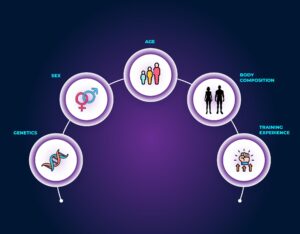
- Training age: the further you are from your natural ceiling, the faster you grow. Beginners have the most room, which is why “newbie gains” are real and advanced lifters fight for every pound.
- Genetics: people respond very differently to the same program. Frame size, muscle fiber make-up and how strongly muscles respond to training all vary; fast-twitch (type II) fibers, for example, have more capacity to grow than slow-twitch fibers.
- Sex and hormones: men have far higher testosterone levels, which is the main reason they add more absolute muscle than women.
- Age: older adults still build muscle, but more slowly, partly because muscle becomes less responsive to protein and training, a process called anabolic resistance.
- Starting point: lifters returning after a break usually regain lost muscle faster than they built it the first time, and people with more body fat can often gain muscle while losing fat.
- Recovery: short sleep, high stress and too little food all cut into the gains a good program can deliver.
How Muscle Actually Grows
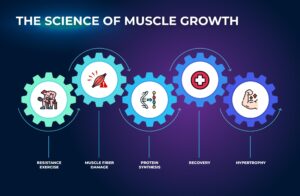
Muscle growth (hypertrophy) happens when hard training repeatedly signals muscle fibers to add protein faster than they break it down. Over weeks and months, existing fibers get thicker. Humans add few, if any, new fibers; growth is almost entirely the enlargement of the ones you already have.
Three training stimuli are usually discussed:
- Mechanical tension: the force a muscle produces against a heavy or challenging load, especially in sets taken close to failure. This is considered the main driver of growth.
- Metabolic stress: the fatigue and “burn” of higher-rep sets. It may add to growth, but its independent role is still debated.
- Muscle damage: the soreness after new or very hard sessions. Damage is not required for growth, and too much of it slows progress because the body spends its resources on repair first.
This explains why the first weeks of training feel so productive. Strength rises quickly because your nervous system gets better at recruiting the muscle you already have, while measurable growth takes longer to show. For a deeper look at how size and strength training differ, see our guide to hypertrophy and strength training.
How to Reach the Upper End of Your Range
Training
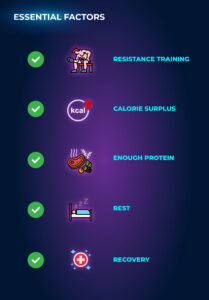
Base your program on compound lifts such as squats, deadlifts, presses and rows, and add isolation work for muscles the big lifts miss. Take most working sets close to failure and add weight or reps over time (progressive overload). Around 10 to 20 hard sets per muscle group per week is a common evidence-based range, and training each muscle about twice a week is an easy way to spread that volume.
Nutrition
Muscle is easiest to build in a modest calorie surplus, often around 250-500 kcal above maintenance. A practical target is to gain about 0.25-0.5% of body weight per week; beginners can sit at the top of that range, advanced lifters at the bottom. Bigger surpluses mainly add fat.
For lifters, research supports about 1.6-2.2 g of protein per kg of body weight per day (0.7-1 g per lb), well above the general protein recommendation for sedentary adults. Spread it over three to five meals. Total daily intake matters far more than eating protein in a narrow window right after training.
Rest and Recovery
Aim for seven to nine hours of sleep and give a muscle group roughly 48 to 72 hours before training it hard again. Persistent fatigue, falling performance and poor sleep are signs of overtraining; the fix is usually less volume for a week or two, not more.
Muscle or Just Weight? How to Track Real Progress
Because a month of muscle gain is small, the scale alone can mislead you. In the first weeks of a bulk or a new program, body weight often jumps 2-4 lb (1-2 kg) from extra food, water and glycogen before much new muscle is laid down. Track several signals together:
- Weekly average body weight: weigh daily under the same conditions and compare weekly averages, not single days.
- Waist measurement: if your waist grows quickly while your weight climbs, most of the gain is fat.
- Strength log: steady gains in reps or load on the same lifts are a good sign you are building muscle, especially after the first few months.
- Photos and tape measurements: arms, chest and thighs every four weeks, in the same light and at the same time of day.
Body-fat scales and other body composition tools have meaningful error margins, so use them for trends over months rather than for judging a single month.
Natural vs. Enhanced Muscle Gain
Anabolic steroids raise muscle protein synthesis well beyond what training alone can achieve, which is why enhanced lifters can grow far faster and far beyond a natural ceiling. The best-known controlled data come from a randomized trial published in the New England Journal of Medicine (Bhasin and colleagues, 1996). Healthy men with weightlifting experience received either 600 mg of testosterone enanthate per week or a placebo for 10 weeks, with or without a supervised training program.
| Group (10 Weeks) | Gain in Fat-Free Mass |
|---|---|
| Placebo + training | About 1.9 kg (4 lb) |
| Testosterone, no training | About 3.2 kg (7 lb) |
| Testosterone + training | About 6.1 kg (13 lb) |
That works out to roughly 2.5 kg (5-6 lb) of fat-free mass per month in the testosterone and training group, about three times the natural rate in the same study. Fat-free mass includes water as well as muscle, so not all of it is contractile tissue. Claims of 10 lb or more of pure muscle in a month are not supported by controlled research.
Some people use peptides that raise growth hormone instead. Evidence that they add meaningful muscle in healthy, trained people is limited, and most of them are not approved for human use. Our comparison of peptides vs steroids covers the differences in more detail.
The costs are real. Anabolic steroids can cause heart and blood-lipid problems, liver strain (especially oral compounds), suppression of natural testosterone production, infertility and mood changes. They are controlled substances in many countries and banned in tested sport.
Myths and Mistakes That Skew Expectations
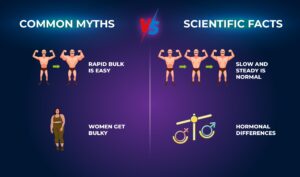
- “Fast strength gains mean fast muscle gains.” Early strength comes mostly from better coordination and muscle recruitment. Size follows more slowly.
- “Women get bulky from lifting.” At the rates in the table above, building a visibly large physique takes women years of dedicated training and eating.
- “More training is always better.” Beyond what you can recover from, extra volume adds fatigue, not muscle.
- Program hopping and no progression: changing routines every few weeks or lifting the same weights for months stalls growth. Pick a sound plan and add load or reps over time.
- Under-eating: trying to gain muscle without enough calories and protein is the most common reason natural beginners grow slower than they could.
- Expecting supplements to do the work: creatine and protein powder help, but neither replaces training, food and sleep.
The Bottom Line
For most natural lifters, about 1-2 lb of muscle a month is the realistic best case in the first year, and the rate slows every year after that.
- Women gain about half as many pounds as men, but at a similar rate relative to their starting muscle mass.
- Progressive training, a modest calorie surplus, 1.6-2.2 g/kg of protein and good sleep are what move you toward the top of your range.
- Steroids can roughly triple the rate, about 6 kg of fat-free mass in 10 weeks in a controlled trial, but bring serious health and legal risks.
Frequently Asked Questions
Disclaimer
Please read carefully
The information on this site is for educational and informational purposes only, and is not medical advice. Always consult a qualified healthcare professional before using any supplement or medication, or making changes to your health, fitness, or nutrition routine.
Not medical advice
Content here is not a substitute for professional medical advice.
Consult your doctor
Talk to your doctor before starting any supplement or new routine.
Use at your own risk
We are not responsible for adverse effects from acting on this.
Do your research
Make informed decisions about your own health.
No guarantees
Individual results vary. No claims about outcomes.
Important — Never disregard professional medical advice or delay seeking it because of something you read here. If you think you may have a medical emergency, call your doctor or your local emergency number right away.