Contents15 sections
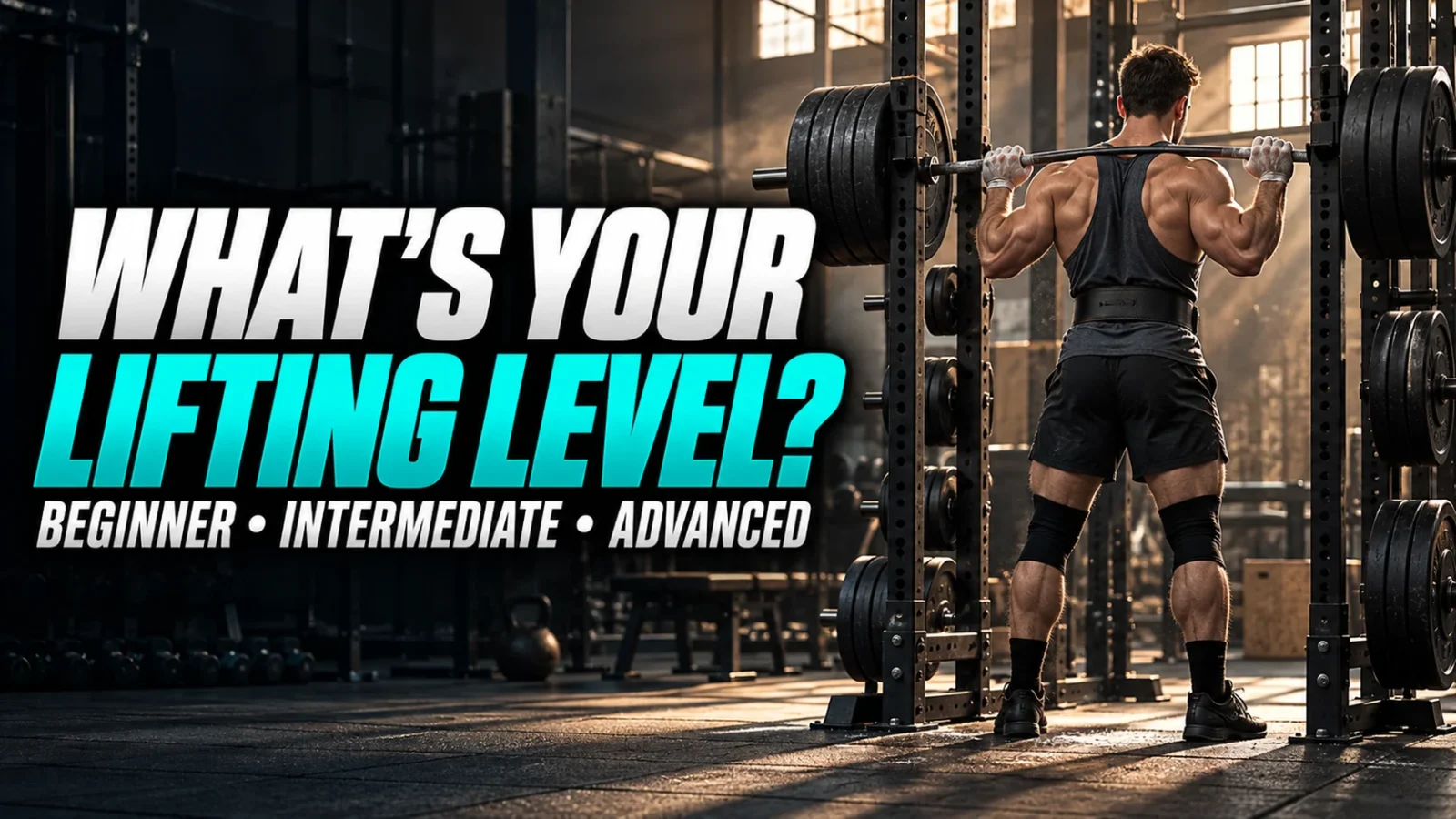
Are you a beginner, intermediate or advanced lifter? It is one of the most common questions in strength training, and the answer matters because it decides which program will work for you. The reality is this: if you have to ask, there is a good chance you are still a beginner and should be using a beginner routine.
It doesn’t matter how many years you have been working out. If you haven’t added much muscle and are still relatively weak, you are a beginner. That is not an insult; it is an honest assessment meant to help you pick the right workout.
Below are seven levels, from novice to advanced, with typical strength numbers for men and women, bodyweight-relative standards that work at any size, and the kind of training that suits each stage. They are general guidelines, not rules carved in stone.
Key Takeaways
- Your lifting level depends on your technique, your strength and how fast you still progress, not on how many years you have trained.
- As a rough guide, a man of about 180 lb is an intermediate at around a 275-lb bench press, 345-lb squat and 405-lb deadlift (about 1.5, 1.9 and 2.25 times body weight).
- Women’s standards are lower mainly in the upper body: about 60% of the men’s bodyweight multiples on the bench press and roughly 75-85% on the squat and deadlift.
- Novices and beginners do best on simple full-body routines two to three days a week; intermediates add training days, volume and periodization.
- Progress slows at every level. An experienced intermediate may add only a couple of pounds of muscle, or 25-50 lb on a major lift, in a year.
What Decides Your Lifting Level
Three things place you on the scale:
- Technique: whether you can perform the main lifts (squat, bench press, deadlift and their variations) safely and consistently.
- Strength and muscle: how much you lift for your body weight and how much muscle you have built.
- Rate of progress: how quickly you still improve. A widely used coaching definition, from Mark Rippetoe and Lon Kilgore’s book Practical Programming for Strength Training, describes novices as lifters who can add weight from one workout to the next, intermediates as progressing week to week, and advanced lifters as progressing over a month or longer.
Time in the gym is not on the list. Years of training only count if they produced results.
Lifter Levels at a Glance
This table sums up the seven levels. The men’s numbers fit a man of about 180 lb (82 kg) and the women’s numbers a woman of about 140 lb (64 kg). If you are lighter or heavier, use the bodyweight multiples in the next section.
| Level | Signs | Training That Fits | Men (about 180 lb): Bench / Squat / Deadlift | Women (about 140 lb): Bench / Squat / Deadlift |
|---|---|---|---|---|
| Novice | Learning the exercises; poor form and stability | Learn the lifts with light weights, full-body 2-3 days a week | Not yet measured | Not yet measured |
| Beginner | A few months in; form improving, little muscle or strength yet | Beginner full-body routine 2-3 days a week | Below about 135 / 185 / 225 lb | Below about 70 / 105 / 140 lb |
| Experienced beginner | Passable form on the main lifts; strength building | Structured full-body or upper/lower program, steady weight increases | About 185 / 225 / 275 lb | About 85 / 140 / 175 lb |
| Early intermediate | First visible muscle gains; steady progress | 4-day upper/lower or bodybuilding split, or full-body until muscle gains show | About 225 / 275 / 315 lb | About 105 / 175 / 210 lb |
| Intermediate | Consistent gains; physique filling out | Slowly more volume; periodization | About 275 / 345 / 405 lb | About 125 / 210 / 245 lb |
| Experienced intermediate | Roughly 85-90% of potential; slow progress | 4-5 sessions a week; periodization, deloads, fatigue management | 315 / 415 / 500 lb or more | 140 / 245 / 280 lb or more |
| Advanced | Elite or near-elite strength, or near natural muscle potential | Highly individual | Judged by competition results | Judged by competition results |
All numbers assume good form and full range of motion: squats to at least parallel, bench presses touched to the chest and deadlifts pulled from the floor. Most lifters are not at the same level on every lift, so look at the overall pattern.
Bodyweight-Relative Strength Standards
Fixed numbers favor bigger lifters. Expressing the standards as multiples of body weight makes them fairer, and they work the same in pounds or kilograms.
| Level | Men: Bench / Squat / Deadlift (x body weight) | Women: Bench / Squat / Deadlift (x body weight) |
|---|---|---|
| Beginner | Below 0.75 / 1.0 / 1.25 | Below 0.5 / 0.75 / 1.0 |
| Experienced beginner | 1.0 / 1.25 / 1.5 | 0.6 / 1.0 / 1.25 |
| Early intermediate | 1.25 / 1.5 / 1.75 | 0.75 / 1.25 / 1.5 |
| Intermediate | 1.5 / 1.9 / 2.25 | 0.9 / 1.5 / 1.75 |
| Experienced intermediate | 1.75 / 2.3 / 2.75 or more | 1.0 / 1.75 / 2.0 or more |
For example, a 160-lb man who squats 240 lb (1.5 times body weight) is at early-intermediate level for the squat. A 130-lb woman who deadlifts 195 lb (1.5 times body weight) is at early-intermediate level for the deadlift.
Two caveats. First, strength does not rise in a straight line with body weight: heavier lifters lift more in total but less per pound, which is why powerlifting compares lifters across weight classes with formulas such as Wilks, DOTS or IPF GL points. The multiples therefore come a little easier to light lifters and a little harder to heavy ones. Second, they assume a reasonably lean body weight; a lifter carrying a lot of body fat will score lower than their strength suggests.
Strength Standards for Women
Women carry less muscle on average, especially in the upper body. In absolute terms, studies commonly report women’s upper-body strength at roughly half of men’s and lower-body strength at about two-thirds. The gap narrows considerably when strength is measured per pound of body weight or lean mass. Our guide to male vs female strength covers the research.
That is why the women’s standards above are not the men’s numbers scaled down evenly. The bench press multiples are about 60% of the men’s, while the squat and deadlift multiples are roughly 75-85%. These are our rough guidelines, scaled from the men’s levels, not results from a single study. Everything else in this guide, from form to rate of progress to the training that fits each level, applies to women in the same way.
Novice Lifter
A novice lifter is a rank beginner. Novices don’t yet know most exercises, have poor exercise form and lack stability on even the most basic movements.
A novice has not yet built any muscle or strength and is still learning how to train and eat. The priority is learning the main lifts with light weights on a simple full-body routine two to three days a week, ideally with coaching or video feedback on form.
Beginning Lifter
A beginning lifter has been in the gym for at least a few months and has taken the time to work on exercise form. They no longer feel shaky under the bar on bench presses and squats, and they have a basic understanding of what a challenging weight is for a given exercise.
This does not mean they know their limits or maxes. Novices and beginners should not be testing their max on any exercise.
A beginner has not yet built a substantial amount of muscle or strength. Men at this level generally bench press less than 135 lb, squat less than 185 lb and deadlift 225 lb or less. For a woman of about 140 lb, the equivalent is roughly under 70 lb on the bench press, 105 lb on the squat and 140 lb on the deadlift.
A beginner can remain a beginner indefinitely. It doesn’t matter how long you have been training if what you are doing isn’t producing results. A beginner routine, usually full-body two to three days a week with weight added steadily, is still the right choice.
Experienced Beginner
An experienced beginner has taken time to practice and study proper form on the major exercises and is fairly confident that their form is passable. They no longer have major form flaws such as half squats or bench pressing with flared elbows. Their form is not perfect, but it is better than that of many people in a typical gym.
An experienced beginner has started to build strength. Men at this level are generally lifting around a 185-lb bench press, 225-lb squat and 275-lb deadlift; for women of about 140 lb, roughly 85, 140 and 175 lb.
A structured full-body or upper/lower program fits this stage well. Our 3 month muscle building workout is written for late beginners and intermediates.
Early Intermediate
An early intermediate has noticed some increase in muscle size and is making consistent progress on the major lifts. They have found a good training rhythm and are learning which lifts come naturally and which are more of a struggle. They are also starting to sense weaknesses and may make minor programming adjustments to address them.
Early intermediates are generally ready for more demanding workouts, such as training four days per week on a strength-focused upper/lower split, or even a four-day bodybuilding-style split if they are making quality muscle gains.
Early intermediates whose main goal is building muscle, but who have not yet noticed substantial gains, should keep training two to three days per week on full-body workouts, such as the Steve Reeves intermediate full-body workout. At some point, as they keep getting stronger, their physique will start to fill out. That is the time to consider adding a training day and changing approach.
Men at this level are generally bench pressing 225 lb, squatting 275 lb and deadlifting 315 lb; for women of about 140 lb, roughly 105, 175 and 210 lb.
Intermediate Lifter
An intermediate lifter has hit a good stride. Strength gains remain consistent, and their physique is filling out nicely with muscle. They eat properly, listen to their body, evolve their training and keep working to improve and master their lifting form.
Intermediates can start to add training volume slowly. They may also need periodization, meaning planned changes in volume and intensity over several weeks, to handle the stress of frequent heavy sessions. Low-rep strength programs such as the 5×3 training method are built for this stage.
Men at this level are generally bench pressing 275 lb, squatting 345 lb and deadlifting 405 lb; for women of about 140 lb, roughly 125, 210 and 245 lb.
Experienced Intermediate
An experienced intermediate has reached roughly 85 to 90% of their strength and muscle-building potential. If they train specifically for strength, they place well at local powerlifting meets.
If they train for size, people can tell they lift just by looking at them. Other lifters ask for their “secrets”, and some may even assume they use performance-enhancing drugs.
An experienced intermediate can train four to five times per week with a fair amount of volume. Because of the loads they handle, they need some form of periodization, deloading or fatigue management in their programming.
They know their major weaknesses and are confident setting up and adjusting their own workouts. When they don’t have the answers, they ask more experienced lifters. In most gyms they are a small minority: driven, dedicated and consistent over many years.
Progress has slowed dramatically. Success now means adding a couple of pounds of muscle per year, or 25 to 50 lb to a major lift per year (less for smaller lifters and on upper-body lifts). Our guide to muscle gain per month covers realistic rates of muscle gain.
Men at this level are generally bench pressing at least 315 lb, squatting at least 415 lb and deadlifting at least 500 lb; for women of about 140 lb, roughly 140, 245 and 280 lb or more.
Advanced Lifter
Very few lifters reach the advanced stage. Advanced lifters have faced difficult challenges and learned to overcome them by trial and error. They know their bodies and limits well, and they are mentally tough.
An advanced lifter is at or near elite level in powerlifting, or near their natural genetic muscle-building potential if a bodybuilder. At this point, strength is judged by competition results in a weight class rather than by general standards like the ones in this guide, and training becomes highly individual.
Using Your Level to Choose a Program
- Be honest. If you are between two levels, start with the lower one. A program built for a more advanced lifter adds volume and complexity you can’t yet use.
- Rate each lift separately. Most lifters are further along on some lifts than others, and the weakest lift often shows what to work on.
- Estimate instead of testing. Beginners don’t need to test a one-rep max. By the common Epley formula, a weight you can lift for five good reps is roughly 85% of your max, which is close enough to find your level.
- Move up when progress stalls, not when you get bored. If you keep adding weight on a simple program, stay on it. Change when progress stops despite consistent training, enough food and good sleep.
- Judge by results, not time. Years in the gym only count if they produced muscle and strength.
The Bottom Line
Your lifting level is set by your technique, strength and rate of progress, not by how long you have trained, and it tells you what kind of program will work for you.
- Use the bodyweight multiples rather than fixed numbers if you are much lighter or heavier than about 180 lb (men) or 140 lb (women).
- Novices and beginners progress best on simple full-body routines; extra training days, volume and periodization belong to the intermediate stages.
- If you are unsure of your level, assume the lower one and let your results move you up.
Frequently Asked Questions
Disclaimer
Please read carefully
The information on this site is for educational and informational purposes only, and is not medical advice. Always consult a qualified healthcare professional before using any supplement or medication, or making changes to your health, fitness, or nutrition routine.
Not medical advice
Content here is not a substitute for professional medical advice.
Consult your doctor
Talk to your doctor before starting any supplement or new routine.
Use at your own risk
We are not responsible for adverse effects from acting on this.
Do your research
Make informed decisions about your own health.
No guarantees
Individual results vary. No claims about outcomes.
Important — Never disregard professional medical advice or delay seeking it because of something you read here. If you think you may have a medical emergency, call your doctor or your local emergency number right away.