Contents12 sections
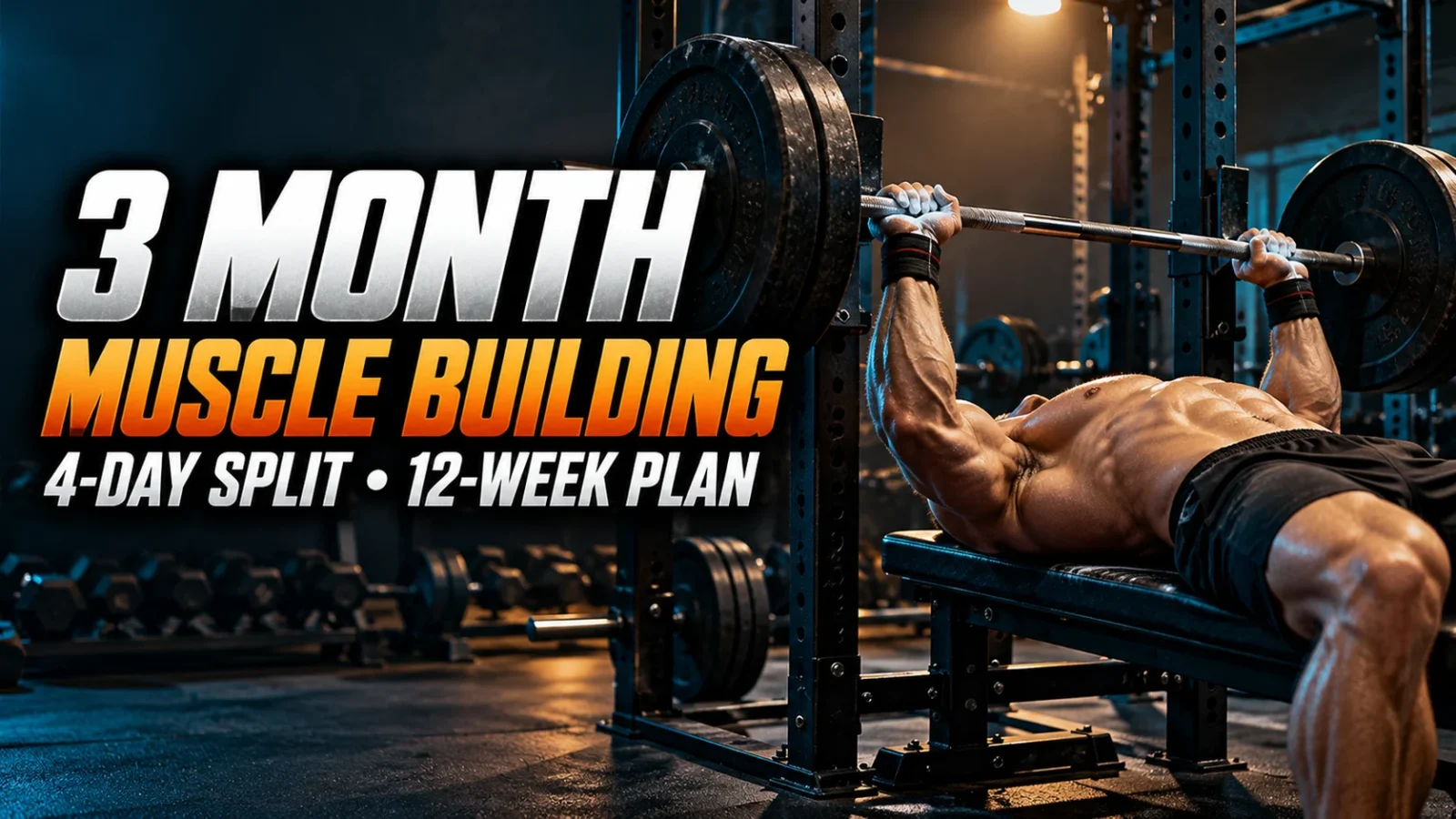
This 3 month muscle building workout is a 12-week, 4-day-per-week program for late beginners and intermediate lifters who want to add muscle mass and strength and need a new training approach.
It uses a classic body-part split: chest and triceps, back and biceps, shoulders, traps and forearms, then legs, with three rest days. Each session starts with heavy compound lifts and finishes with isolation work.
The 12 weeks run in three phases with a planned deload, so you know when to push, when to change rep ranges and when to back off. Below you will find the weekly schedule, every workout with sets and reps, the week-by-week progression, and the diet and recovery basics that decide whether the program works.
Key Takeaways
- Four sessions a week (Monday, Tuesday, Thursday, Friday) train every major muscle group once, with compound lifts first and isolation work after.
- Progress with double progression: once you reach the top of the rep range on every set with clean form, add weight the next session.
- The 12 weeks run in phases: higher reps in weeks 1-4, heavier compound lifts in weeks 5-8, a deload in week 9 and a final push in weeks 10-12.
- Rest 1-2 minutes on isolation lifts, 2-3 minutes on presses and rows, and 3-5 minutes on squats and deadlifts.
- A realistic natural target is roughly 0.5-1 lb of muscle per month, which takes a small calorie surplus, enough protein and at least 7 hours of sleep.
3 Month Muscle Building Workout at a Glance
| Item | Detail |
|---|---|
| Who it is for | Late beginners to intermediate lifters |
| Schedule | 4 days per week: Monday, Tuesday, Thursday, Friday |
| Primary goal | Muscle building (hypertrophy) |
| Secondary goal | Strength |
| Length | 12 weeks in three phases, including one deload week; repeatable |
| Session length | About 60-80 minutes, including warm-up |
| Realistic expectation | About 0.5-1 lb (0.25-0.5 kg) of muscle per month |
| Rest between sets | 1-2 min on isolation lifts, 2-3 min on presses and rows, 3-5 min on squats and deadlifts |

The program fits you if you have trained consistently for roughly 6-12 months, your beginner gains are slowing, and you can squat, bench press and deadlift with good form. Not sure where you stand? See are you a beginner, intermediate or advanced lifter.
Expect it to be hard. The volume is moderate, but the program only works if the weights go up over the 12 weeks, and that means logging every set and beating your numbers on a schedule.
Weekly Training Schedule
| Day | Workout |
|---|---|
| Monday | Chest and triceps |
| Tuesday | Back and biceps |
| Wednesday | Rest |
| Thursday | Shoulders, traps and forearms |
| Friday | Quads, hamstrings and calves |
| Saturday | Rest |
| Sunday | Rest |
Wednesday splits the week into two pairs of sessions, and the weekend gives you two full days off before the next chest day. If you need to move days, keep the order of the workouts and avoid training more than two days in a row.
Training each body part once a week with several exercises is the same basic structure many bodybuilders use, such as in Wesley Vissers’ 4-day routine. What makes this version work for a late beginner is the planned progression below.
How to Progress Over 12 Weeks
Every exercise has a rep range, such as 6-10. Use double progression: pick a weight you can lift for the bottom of the range with good form, add reps from session to session, and once you reach the top of the range on every set, add weight the next time and work back up. Typical jumps are 2.5-5 lb (1-2.5 kg) on upper-body lifts and 5-10 lb (2.5-5 kg) on squats, deadlifts and Romanian deadlifts. With dumbbells, move to the next pair and expect your reps to drop for a week or two.
Effort is set with reps in reserve (RIR): how many more clean reps you could have done at the end of a set. 2 RIR means you stopped two reps short of failure. Sets need to be hard to build muscle, but you do not need to reach failure on every set, and grinding squats and deadlifts to failure mostly adds fatigue and injury risk.
If you cannot reach the bottom of the rep range, the weight is too heavy. Drop it by 5-10% and build back up.
When to Change Rep Ranges
The listed ranges stay the same all program. What changes is the part of the range you work in:
- Weeks 1-4: work in the top half of every range with moderate weights.
- Weeks 5-12: compound lifts move to the bottom half of their range with heavier weights. Isolation lifts use the full range.
- Compound lifts in this program: bench press, incline bench press, weighted dips, deadlifts, pull-ups, dumbbell rows, seated cable rows, military press, Arnold press, squats and Romanian deadlifts. Everything else counts as isolation.
| Exercise (listed range) | Weeks 1-4 | Weeks 5-12 |
|---|---|---|
| Bench press (6-10) | 8-10 reps | 6-8 reps |
| Deadlifts (5-10) | 8-10 reps | 5-7 reps |
| Squats (6-15) | 12-15 reps | 6-10 reps |
| Leg extensions (8-20) | 14-20 reps | 8-20 reps |
| Barbell curls (6-12) | 10-12 reps | 6-12 reps |
Week-by-Week Plan
| Week | Phase | Effort (RIR) | What to do |
|---|---|---|---|
| 1 | Base | 3 | Find your working weights in the top half of each range. Log every set. |
| 2 | Base | 2 | Add 1-2 reps per set, or a small weight jump where you hit the top of the range. |
| 3 | Base | 1-2 | Keep adding reps; add weight once every set reaches the top of the range. |
| 4 | Base | 1-2 | Your best phase 1 sets. These numbers set your phase 2 starting point. |
| 5 | Heavier | 2 | Compound lifts move to the bottom half of the range, about 5-10% heavier than week 4. |
| 6 | Heavier | 1-2 | Double progression on every lift. |
| 7 | Heavier | 1-2 | The last set of each isolation exercise can go to failure. |
| 8 | Heavier | 1 | Your heaviest compound sets so far. |
| 9 | Deload | 3-4 | Same workouts with about half the sets, at week 8 weights or up to 10% lighter. |
| 10 | Peak | 1-2 | Start close to your week 8 weights; recovery from the deload should show. |
| 11 | Peak | 1 | Push the reps. Optional: add one set to the first exercise for a lagging muscle. |
| 12 | Peak | 1 on compounds, 0-1 on isolation | Beat your week 8 numbers and record your best sets for the next block. |
The Deload (Week 9)
Do the same workouts with about half the sets (4 sets become 2, 3 become 2, 2 become 1) at your week 8 weights or up to 10% lighter, and stop 3-4 reps short of failure. You should finish each session feeling fresh. The point is to shed accumulated fatigue so that weeks 10-12 can be your strongest.
Take an extra deload earlier if your main lifts go backwards two sessions in a row, your joints ache, or your sleep and motivation drop for more than a week.
After Week 12
Record your best sets. For the next block, swap a few exercises for close variations (for example, incline dumbbell press for incline barbell press, leg press for leg extensions, hammer curls for concentration curls), start again at week 1 effort with your new numbers, and repeat. Many lifters can run this structure for a year with small changes like these.
If strength becomes your main goal, a strength-first program such as the Ohio State Buckeye workout chart is a logical next step.
The Workouts
Warm-up: start each session with about 5 minutes of light cardio, then do 2-3 progressively heavier warm-up sets on the first exercise for each muscle group. Warm-up sets do not count toward the listed sets.
Rest: take 1-2 minutes between sets of isolation lifts, 2-3 minutes on presses and rows, and 3-5 minutes on squats and deadlifts. Short rests make the next set weaker. In a study of resistance-trained men, 3-minute rests between sets produced more strength and muscle growth over 8 weeks than 1-minute rests.
Monday: Chest and Triceps
| Exercise | Sets | Reps | Main muscles |
|---|---|---|---|
| Bench press | 3 | 6-10 | Chest, front delts, triceps |
| Incline bench press | 3 | 6-10 | Upper chest, front delts |
| Weighted dips | 3 | 6-10 | Lower chest, triceps |
| Dumbbell flyes | 2 | 8-15 | Chest |
| Dumbbell pullovers | 2 | 6-12 | Chest, lats |
| Standing triceps cable pushdowns | 4 | 6-12 | Triceps |
| Seated two-arm dumbbell extension | 3 | 6-10 | Triceps (long head) |
Bench press. Set your shoulder blades back and down, keep your feet planted, and lower the bar under control to your lower chest before pressing. Use a spotter or the safety arms of a rack on heavy sets.
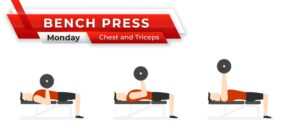
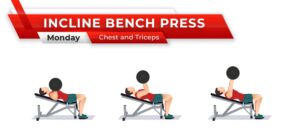
Incline bench press. A low incline of around 30-45 degrees shifts more of the work to the upper chest. Lower the bar to your upper chest, just below the collarbones.
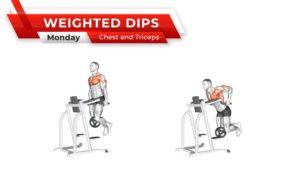
Weighted dips. Lean your torso slightly forward to bring in more chest, and lower until your upper arms are about parallel to the floor, or as deep as your shoulders comfortably allow. Add weight with a dip belt only once you can do 10 clean bodyweight reps.
Dumbbell flyes. Keep a slight, fixed bend in your elbows and lower the dumbbells until you feel a stretch across your chest, no deeper than your shoulders allow. Use moderate weights and a slow lowering phase.
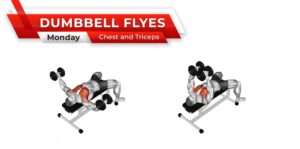
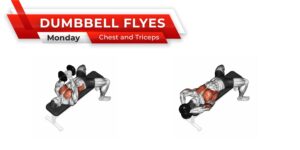
Dumbbell pullovers. Hold one dumbbell over your chest with both hands and lower it behind your head, elbows slightly bent, until you feel a stretch through your lats and chest. Keep your ribs down and stop where your shoulders are comfortable, then pull it back over your chest.
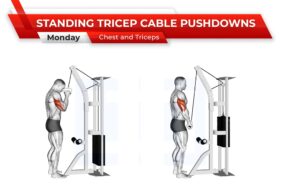
Triceps cable pushdowns. Pin your elbows to your sides and move only at the elbow. Lock out fully at the bottom and let the bar or rope rise until your forearms pass parallel. If your shoulders or torso start rocking, the weight is too heavy.
Seated two-arm dumbbell extension. Hold one dumbbell overhead with both hands and lower it behind your head, keeping your elbows pointing forward. The overhead position trains the long head of the triceps at a long length, which pushdowns do not.
Tuesday: Back and Biceps
| Exercise | Sets | Reps | Main muscles |
|---|---|---|---|
| Deadlifts | 4 | 5-10 | Glutes, hamstrings, lower and upper back |
| Pull-ups or weighted pull-ups | 3 | 6-15 | Lats, biceps |
| Dumbbell rows | 3 | 6-15 | Lats, mid-back |
| Seated cable rows | 3 | 6-12 | Mid-back, lats, rear delts |
| Barbell curls | 4 | 6-12 | Biceps |
| Concentration curls | 3 | 8-15 | Biceps |
- Deadlifts: brace hard before each rep, keep the bar close to your legs and your back neutral, and reset between reps instead of bouncing the bar off the floor. This is the lift where form breaks first under fatigue, so keep at least 1 rep in reserve.
- Pull-ups: start from a full hang and pull until your chin clears the bar. If you cannot do 6 clean reps, use an assisted machine, a band or lat pulldowns and build up. Add weight with a belt once you reach 15 reps on every set.
- Dumbbell rows: support yourself on a bench, keep your torso still and pull the dumbbell toward your hip. Let your shoulder blade stretch forward at the bottom of each rep.
- Seated cable rows: sit tall, pull the handle to your lower ribs and squeeze your shoulder blades together, then let them move forward under control without rounding your lower back.
- Barbell curls: keep your elbows near your sides and your torso still. If you have to swing the bar up, it is too heavy. Lowering it under control keeps the tension on the biceps.
- Concentration curls: brace your upper arm against your inner thigh so the biceps does all the work. Squeeze at the top and lower slowly.
Thursday: Shoulders, Traps and Forearms
| Exercise | Sets | Reps | Main muscles |
|---|---|---|---|
| Military press | 4 | 6-12 | Front and side delts, triceps |
| Seated Arnold press | 3 | 6-12 | Front and side delts |
| Power side laterals | 3 | 8-15 | Side delts |
| Reverse laterals | 3 | 8-15 | Rear delts |
| Power shrugs | 3 | 5-10 (same weight on all sets) | Traps |
| Wrist curls over bench | 2 | 10-20 | Forearm flexors |
| Static barbell hold | 2 | Hold for maximum time | Grip, forearms |
- Military press: stand, squeeze your glutes and brace so you do not lean back. Press the bar in a straight line, moving your head back slightly to let it pass and forward under the bar at lockout.
- Seated Arnold press: start with your palms facing you at shoulder height and rotate them outward as you press. You will use less weight than on a regular dumbbell press; keep the rotation smooth.
- Power side laterals: a slightly heavier lateral raise in which a small, controlled lean helps you start the rep. Keep the swing minimal and lower slowly. If your traps take over, go lighter.
- Reverse laterals: bend forward at the hips (or lie chest-down on an incline bench) and raise the dumbbells out to the sides with a slight elbow bend, leading with your elbows. The rear delts are small, so use light weights.
- Power shrugs: use a small dip and drive from the knees and hips to move a heavier bar, then shrug hard at the top. Keep the same weight on all three sets and go heavier once you get 10 reps on each.
- Wrist curls over bench: rest your forearms on a bench with your wrists over the edge, let the bar roll down to your fingertips, then curl it back up. Use a full range and light to moderate weights.
- Static barbell hold: hold a heavy barbell (set at hip height in a rack) with a double overhand grip for as long as you can. Note your time and beat it next week; add weight once you pass about 60 seconds.
Friday: Quads, Hamstrings and Calves
| Exercise | Sets | Reps | Main muscles |
|---|---|---|---|
| Squats | 4 | 6-15 | Quads, glutes, adductors |
| Leg extensions | 3 | 8-20 | Quads |
| Leg curls | 3 | 8-15 | Hamstrings |
| Romanian deadlifts | 3 | 6-12 | Hamstrings, glutes |
| Seated or standing calf raises | 4 | 6-20 | Calves |
- Squats: squat to at least parallel if your mobility allows, knees tracking over your toes and chest up, and set the safety bars in a rack. Sets of 12-15 heavy squats in weeks 1-4 tax your breathing as much as your legs, so take the full rest.
- Leg extensions: pause briefly at the top and lower under control. They train the rectus femoris, the part of the quads that squats tend to develop least.
- Leg curls: seated or lying, curl through a full range and control the lowering. Leg curls train the hamstrings at the knee and Romanian deadlifts train them at the hip, so the program uses both.
- Romanian deadlifts: start standing, soften your knees and push your hips back as the bar slides down your thighs. Stop when you feel a strong hamstring stretch with a neutral back (usually around mid-shin), then drive your hips forward. Straps are fine if your grip gives out first.
- Calf raises: pause for a second in the stretched bottom position and rise as high as you can. Controlled full reps work better than fast bouncing.
Why This Program Works
Muscle grows when you train it hard enough, often enough, and then recover and eat enough to adapt. The program is built on the factors research links most closely to growth: enough hard sets per muscle, effort close to failure, and progressive overload over time.
- Volume: chest, back and shoulders each get about 13 hard sets a week. A 2017 meta-analysis by Schoenfeld and colleagues found that 10 or more weekly sets per muscle produced more growth than fewer than 5. Biceps and triceps get 7 direct sets each, plus indirect work from pressing and pulling.
- Frequency: each muscle is trained once a week. When weekly sets are equal, research finds that training a muscle once or twice a week builds similar muscle, so a body-part split works as long as the volume is there.
- Exercise order: the heavy compound lifts come first while you are fresh, because they allow the most load and drive strength. Isolation lifts then cover what the compounds miss: side and rear delts, biceps, the long head of the triceps and the hamstrings at the knee.
Legs get the least direct volume (7 quad sets and 6 hamstring sets, plus Tuesday’s deadlifts). If your legs lag behind, add 2-3 sets of leg press on Friday from week 5.
A common claim is that heavy sets build muscle by releasing growth hormone. Hard training does raise growth hormone briefly, but in most studies that compared training with and without those post-workout spikes, the spikes added little or no muscle or strength. Tension, volume and steady progression are what count.
Diet and Recovery for Muscle Building
Training provides the stimulus; food and sleep decide how much muscle you build from it.
- Eat in a small surplus. About 250-500 calories a day above maintenance is a common starting point. Aim for your scale weight to rise by roughly 0.25-0.5% of body weight per week; gaining much faster than that mostly adds fat. If appetite is your limit, high-calorie foods for bulking make it easier.
- Get enough protein. About 1.6 g per kg of body weight a day (0.7 g per lb) covers most lifters. A large meta-analysis found that the benefit of extra protein levels off around this intake, with about 2.2 g/kg (1 g per lb) a sensible upper target. Spread it over 3-5 meals; protein powder is a convenience, not a requirement.
- Fuel the training. Carbohydrates fuel high-volume sessions, so keep them in your diet, especially around training. Keep fats at a moderate level for overall health.
- Creatine (optional). Creatine monohydrate at 3-5 g a day is the best-researched supplement for gains in strength and muscle alongside training.
- Sleep. Adults need at least 7 hours a night. Short sleep hurts recovery and makes it harder to beat last week’s numbers.
- Cardio. Two or three moderate sessions a week, such as walking or cycling on rest days, support heart health and work capacity without meaningfully slowing muscle gain. Avoid hard intervals the day before leg day.

Pros
- Catalog is specifically organized around muscle building, fat loss, testosterone support, and workout performance.
- Range includes creatine, protein, EAAs, beta-alanine, and L-citrulline alongside more specialized formulas.
- Orders of $99+ qualify for free US shipping.
Cons
- Features several strong claims around muscle growth, testosterone, fat loss, and metabolic effects that should be distinguished from independently demonstrated clinical outcomes
- Heavily oriented toward bodybuilding and performance rather than broader nutritional supplementation.
Common Mistakes to Avoid
- Ego loading: a weight that forces a shorter range of motion or a swing is not progress. Drop 5-10% and build back up.
- Training to failure on everything: keep failure for the last set of isolation lifts in weeks 7-12, never for squats or deadlifts.
- Not logging: double progression only works if you know what you lifted last week.
- Ignoring pain: sharp joint pain (not muscle burn) means stop that exercise and swap it for a variation that does not hurt. See a professional if it persists.
- Undereating: if your weight has not moved in 2-3 weeks, add 200-300 calories a day.
- Changing programs too soon: the phases build on each other, so give it the full 12 weeks.
What to Expect in 12 Weeks
For a late beginner or early intermediate, roughly 0.5-1 lb (0.25-0.5 kg) of muscle per month is a realistic natural rate, or about 1.5-3 lb of muscle over the 12 weeks. Your scale weight will rise faster, because eating more also adds stored glycogen, water and some fat. For typical rates by training age, see how much muscle you can gain per month.
In the short term, your logbook is the better guide. If the weights on your main lifts are clearly higher in week 12 than in week 1 and your waist has not grown much, the program is working.
The Bottom Line
This 3 month muscle building workout gives late beginners and intermediates a simple 4-day split with a clear 12-week progression: higher reps first, heavier compound lifts next, a deload, then a final push.
- Log every set and use double progression: add weight only once you hit the top of the rep range on every set with clean form.
- Follow the phases: top half of the ranges in weeks 1-4, heavier compound lifts from week 5, about half the sets in week 9.
- Eat in a small surplus with about 1.6 g of protein per kg of body weight, sleep at least 7 hours, and expect roughly 0.5-1 lb of muscle per month.
Frequently Asked Questions
Disclaimer
Please read carefully
The information on this site is for educational and informational purposes only, and is not medical advice. Always consult a qualified healthcare professional before using any supplement or medication, or making changes to your health, fitness, or nutrition routine.
Not medical advice
Content here is not a substitute for professional medical advice.
Consult your doctor
Talk to your doctor before starting any supplement or new routine.
Use at your own risk
We are not responsible for adverse effects from acting on this.
Do your research
Make informed decisions about your own health.
No guarantees
Individual results vary. No claims about outcomes.
Important — Never disregard professional medical advice or delay seeking it because of something you read here. If you think you may have a medical emergency, call your doctor or your local emergency number right away.