Contents11 sections
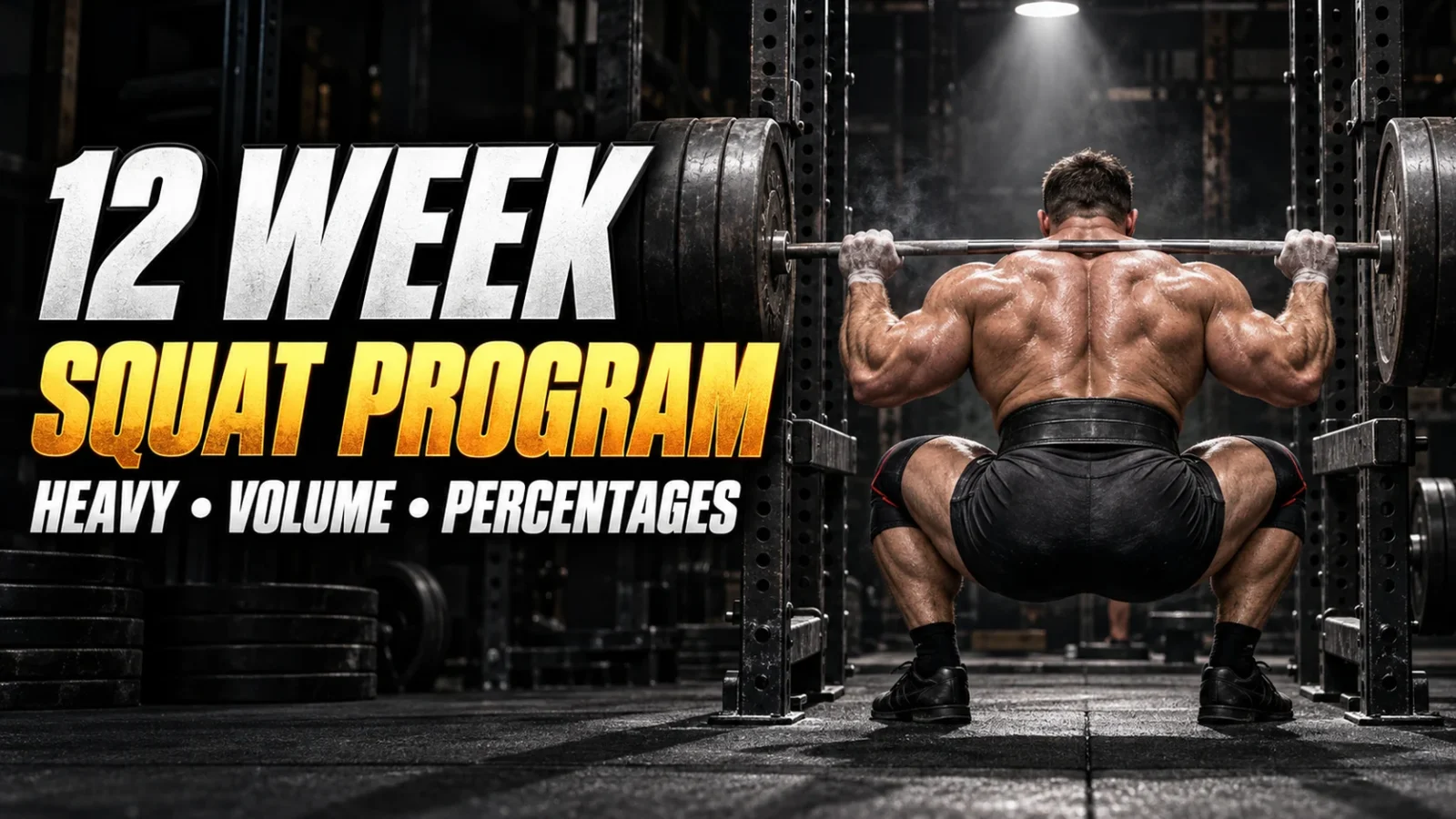
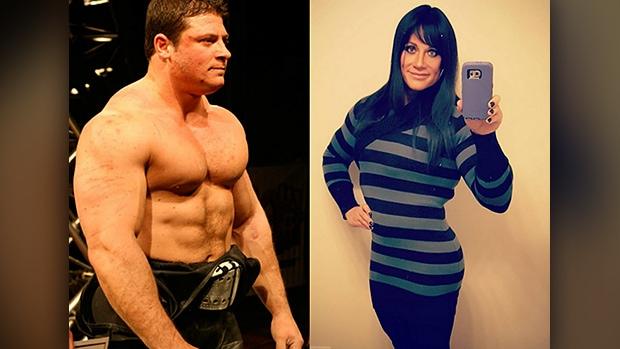
This is the 12 week squat cycle credited to Janae Marie Kroc, the powerlifter and bodybuilder who made her biggest lifts competing as Matt “Kroc” Kroczaleski. Kroc came out publicly as transgender in 2015 and now goes by Janae Marie Kroc, but the program is still widely shared under the old name.
The plan is built around one squat session a week. Heavy weeks, with three ramping sets of 5, 4 or 3 reps, alternate with volume weeks of 10 sets at a lighter load. The loads rise across two 6-week waves, so the last weeks of the cycle are the heaviest.
Below you will find the full week-by-week chart with a worked example, how to choose the max your percentages come from, the assistance work for heavy and volume weeks, and who the program suits.
Key Takeaways
- You squat once a week, alternating heavy weeks (three ramping sets of 5, 4 or 3 reps) with volume weeks (10 sets at one lighter load).
- Weeks 7-12 repeat the rep scheme of weeks 1-6 with every load 5% heavier, peaking at 3 reps at 95% of your max in week 11.
- Base the percentages on a recent, honest max or a training max of 90-95% of it: the top sets in weeks 7, 9 and 11 sit above typical rep maxes for your starting number.
- Rest 3-5 minutes between squat sets, then do four assistance exercises: moderate reps after heavy weeks, 15-30 reps after volume weeks.
- Kroc’s best equipped lifts are a 1,003 lb squat, 738 lb bench press and 810 lb deadlift, a 2,551 lb total in the 220 lb class.
Who Is Janae Marie Kroc?
Kroc is a former US Marine who became one of the strongest powerlifters of her era in the 220 lb (100 kg) class and also competed as a bodybuilder. Her name is also attached to the Kroc row, the heavy, high-rep one-arm dumbbell row many lifters use for back size and grip.
| Lift | Best in competition | In kilos |
|---|---|---|
| Squat | 1,003 lb | 455 kg |
| Bench press | 738 lb | 335 kg |
| Deadlift | 810 lb | 367.5 kg |
| Total | 2,551 lb | about 1,157 kg |
These lifts were made in multi-ply equipped powerlifting, where supportive suits and shirts add a lot of weight to the squat and bench press, so they are not comparable with raw records. Even in equipped lifting, a 1,000 lb squat in the 220 lb class is a rare mark.
In 2015 Kroc came out publicly as transgender and now uses the name Janae Marie Kroc. Older articles, forum threads and the program itself still circulate under the name Matt Kroczaleski, which is why you will see both names attached to this squat cycle.
The Program at a Glance
| Detail | Kroc 12 Week Squat Program |
|---|---|
| Training level | Intermediate to advanced |
| Length | 12 weeks, in two 6-week waves |
| Squat sessions | 1 per week |
| Heavy weeks (1, 3, 5, 7, 9, 11) | 3 ramping work sets of 5, 4 or 3 reps |
| Volume weeks (2, 4, 6, 8, 10, 12) | 10 sets of 5, 4 or 3 reps at one load |
| Load range | 70-95% of your one-rep max |
| Rest between squat sets | 3-5 minutes |
| Assistance work | 4 leg exercises straight after squats |
The 12 Week Squat Chart
All loads are a percentage of your one-rep max (1RM). On heavy weeks, “5 x 75%” means one set of 5 reps at 75%: you do three work sets, each heavier than the last. On volume weeks you stay at one weight for all 10 sets. The example column uses a 400 lb max, rounded to the nearest 5 lb.
| Week | Type | Sets x reps | Load (% of 1RM) | Example: 400 lb max |
|---|---|---|---|---|
| 1 | Heavy | 3 x 5, ramping | 75% / 80% / 85% | 300 / 320 / 340 lb |
| 2 | Volume | 10 x 5 | 70% | 280 lb |
| 3 | Heavy | 3 x 4, ramping | 77.5% / 82.5% / 87.5% | 310 / 330 / 350 lb |
| 4 | Volume | 10 x 4 | 72.5% | 290 lb |
| 5 | Heavy | 3 x 3, ramping | 80% / 85% / 90% | 320 / 340 / 360 lb |
| 6 | Volume | 10 x 3 | 75% | 300 lb |
| 7 | Heavy | 3 x 5, ramping | 80% / 85% / 90% | 320 / 340 / 360 lb |
| 8 | Volume | 10 x 5 | 75% | 300 lb |
| 9 | Heavy | 3 x 4, ramping | 82.5% / 87.5% / 92.5% | 330 / 350 / 370 lb |
| 10 | Volume | 10 x 4 | 77.5% | 310 lb |
| 11 | Heavy | 3 x 3, ramping | 85% / 90% / 95% | 340 / 360 / 380 lb |
| 12 | Volume | 10 x 3 | 80% | 320 lb |
Training in kilos works the same way. A 180 kg max gives 135, 144 and 153 kg in week 1; round each load to the nearest 2.5 kg.
Two patterns run through the chart. First, heavy and volume weeks alternate, so a week of near-maximal sets is always followed by a week of lighter, repeatable work. Second, weeks 7-12 repeat the rep scheme of weeks 1-6 with every load 5% higher: week 7 mirrors week 1, week 8 mirrors week 2, and so on, up to three reps at 95% in week 11.
Total squat reps fall as the weights climb. The volume weeks drop from 50 reps (10 x 5) to 40 and then 30, and the heavy weeks from 15 reps to 12 and then 9.
How to Pick Your Starting 1RM
Every number in the chart depends on the max you start from, so this choice matters more than any other part of the plan. Use a max that reflects how you squat now, with the depth, stance and gear you will use in training.
- A recent tested max: a clean single to full depth from the last month or two is the best starting point.
- An estimated max: if you have not tested lately, take a hard set of 3-5 reps and use the Epley formula, weight x (1 + reps / 30). A set of 5 with 345 lb gives about 402 lb, so use 400. Estimates get less reliable above about 10 reps.
- Not an old best: a max from a year ago, a max made in a squat suit or knee wraps you will not train in, or a high squat inflates every percentage in the plan.
- A training max: many lifters base the cycle on 90-95% of their true max. With a 400 lb best, that means running the chart from 360-380 lb.
The second wave is the reason to be conservative. Common rep-max charts put a 5-rep max at about 87% of a 1RM, a 4-rep max at about 90% and a 3-rep max at about 93%. Compared with your starting max, the top sets work out like this:
| Week | Top set | Typical rep max at that rep count | What it asks of you |
|---|---|---|---|
| 1 | 5 reps at 85% | About 87% | Just under your 5-rep max |
| 3 | 4 reps at 87.5% | About 90% | Just under your 4-rep max |
| 5 | 3 reps at 90% | About 93% | Just under your 3-rep max |
| 7 | 5 reps at 90% | About 87% | Above your starting 5-rep max |
| 9 | 4 reps at 92.5% | About 90% | Above your starting 4-rep max |
| 11 | 3 reps at 95% | About 93% | Above your starting 3-rep max |
In other words, the program assumes you get stronger during the first six weeks. That is realistic for many intermediate lifters, but if your max was optimistic, weeks 7, 9 and 11 will stall. A simple check: the week 1 top set (5 reps at 85%) should be hard but clean. If you grind or miss it, lower your max by 5% and recalculate the whole chart.
Program Notes
Rest and Warm-Ups
Rest 3-5 minutes between squat sets, or until you feel fully recovered. The aim is to start every work set fresh rather than fatigued, which keeps bar speed and technique up and gives you the best chance of making every rep. Studies comparing rest periods have generally found longer rests better for strength gains than short ones.
The chart lists work sets only. Build up to the first work set with a few lighter sets of fewer reps; on volume weeks, a couple of warm-up sets are usually enough.
Assistance Work After Heavy Weeks
| Exercise | Sets x reps | Notes |
|---|---|---|
| Leg press | 3 x 10, 8, 6 | Add weight each set |
| Walking lunge | 3 x 20 | Quads and glutes |
| Leg curl | 3 x 8 | Hamstrings |
| Stiff-leg deadlift | 3 x 8 | Hamstrings and lower back |
Assistance Work After Volume Weeks
| Exercise | Sets x reps | Notes |
|---|---|---|
| Leg press | 4 x 25 | Moderate weight, steady pace |
| Leg extension | 3 x 30 | Quad isolation |
| Leg curl | 3 x 15 | Hamstrings |
| Dumbbell stiff-leg deadlift | 3 x 15 | Hamstrings and glutes |
Do the assistance work straight after squatting. After heavy weeks it is moderate reps with heavier loads; after volume weeks it switches to high reps, up to 30 on the leg extension. Either way it adds a lot of hard sets for the quads, hamstrings and glutes without more heavy barbell work, and training volume is one of the main drivers of muscle growth. That is why the plan builds leg size as well as squat strength.
Recovery
Squatting once a week gives each session a full week of recovery, which is how the plan supports 10-set volume days and high-rep assistance work in the same session. Expect sore legs in the first few weeks, especially after the 25-30 rep sets. Sleep, enough protein and calories, and easy movement on off days all help. If your legs are still sore by the next squat day, cut the assistance work back before you cut the squats.
If You Miss Reps
One missed rep on a heavy week is not a reason to change the plan: finish the session and see how the next heavy week goes. If you miss reps on two heavy weeks in a row, your starting max was too high. Lower it by 5% and recalculate the remaining weeks.
Who Should Run It
The program suits intermediate and advanced lifters who squat with solid technique and have stopped adding weight from one session to the next. Beginners usually progress faster with a simpler plan that adds weight every session. If you are not sure where you stand, see whether you are a beginner, intermediate or advanced lifter.
It is a leg-day plan, not a full program, so you still train the rest of the body during the week. If you want a pulling plan of the same length, see the 12 week intermediate deadlift routine. For a high-volume leg day built purely for size, compare it with Tom Platz’s one-hour leg workout, and for full-body plans that mix strength and size work, see our best powerbuilding workouts.
After Week 12
The chart ends with a volume week and has no test day. If you want to see what the cycle built, take an easier week after week 12, then work up to a new single.
To run it again, base the next cycle on your new max, or on a training max of 90-95% of it. If a second run stops moving your squat, switch to a different style of training for a while, such as 5×3 strength training, before coming back to it.
The Bottom Line
Kroc’s 12 week squat program is a simple, well-built percentage cycle: one squat day a week, heavy and volume weeks in turn, and two 6-week waves that finish with the heaviest sets of the plan.
- Base it on a recent, honest max or a training max of 90-95% of it, because the top sets in weeks 7, 9 and 11 ask for rep personal bests.
- Rest 3-5 minutes between squat sets and do the assistance work straight after: moderate reps after heavy weeks, high reps after volume weeks.
- It suits intermediate and advanced lifters; beginners will progress faster on a plan that adds weight every session.
Frequently Asked Questions
Disclaimer
Please read carefully
The information on this site is for educational and informational purposes only, and is not medical advice. Always consult a qualified healthcare professional before using any supplement or medication, or making changes to your health, fitness, or nutrition routine.
Not medical advice
Content here is not a substitute for professional medical advice.
Consult your doctor
Talk to your doctor before starting any supplement or new routine.
Use at your own risk
We are not responsible for adverse effects from acting on this.
Do your research
Make informed decisions about your own health.
No guarantees
Individual results vary. No claims about outcomes.
Important — Never disregard professional medical advice or delay seeking it because of something you read here. If you think you may have a medical emergency, call your doctor or your local emergency number right away.