Contents13 sections
Powerbuilding means training for two things at once: a bigger squat, bench press and deadlift, and more muscle. Heavy, low-rep work on the main lifts builds the strength. Moderate- and higher-rep accessory work adds the size that a pure powerlifting program often leaves out.
This guide brings together five programs from the Muscle & Brawn archives: a 3-day split, a 4-day base program, a 12-week percentage cycle, a 9-week peaking cycle and a 10-week mass cycle. Several of them started life as powerlifting programs, so for each one we show where it sits between strength and size, and where extra muscle-building work fits.
Pick a program with the level guide below, run it as written for its full length, and judge it by your numbers at the end.
Key Takeaways
- Powerbuilding pairs heavy 1-5 rep work on the squat, bench press and deadlift with 6-15 rep accessory work for muscle growth.
- Choose by experience: the Bulldog 3-day split suits late beginners, while the percentage cycles and the 4-day base program are built for intermediates with solid technique.
- Percentage programs need an honest one-rep max or a slightly conservative estimate. Overestimating your max is the fastest way to stall.
- Strength-first cycles become powerbuilding programs when you add 2-4 accessory exercises for the upper back, shoulders, arms and hamstrings.
- Plan lighter weeks. Sleep, enough protein and sensible deloads decide how long you can keep adding weight to the bar.
How to Choose a Powerbuilding Program by Level
The right program depends less on what looks hardest and more on how long you have been training, how well you squat, bench and deadlift, and how many days you can train. If you are unsure where you stand, our guide to beginner, intermediate and advanced lifters gives practical benchmarks.
- Beginners (roughly the first year of consistent training): learn the lifts first. A simple program that adds weight to the bar every week or two will build strength and size faster than any percentage cycle. Get coaching or film your lifts before you load them heavy.
- Late beginners and early intermediates: the Bulldog 3-day split is the easiest place to start. It uses one heavy main lift per session and simple weight increases.
- Intermediates (around two or more years, with solid technique on all three lifts): the 4-day base program, the basic strength cycle and the 9-week peaking cycle all use percentages of your max and suit lifters whose progress has slowed.
- Experienced lifters who want variety: the Monster Confusion cycle rotates ten training styles over ten weeks and leans toward muscle size.
| Program | Days per week | Length | Best for | Leans toward |
|---|---|---|---|---|
| Bulldog 3-day split | 3 | Ongoing | Late beginner to intermediate | Strength and size equally |
| 4-day base program | 4 | Ongoing | Intermediate | Strength, with a higher-rep day |
| Basic strength cycle | 4 | 12 or 6 weeks | Intermediate | Strength |
| 9-week peaking cycle | 3 | 9 weeks | Intermediate | Strength, peaking for a test or meet |
| Monster Confusion cycle | 3 | 10 weeks | Intermediate to advanced | Size |
Keys to a Successful Powerbuilding Program
Progressive overload. Every program here works by asking a little more of you over time: more weight on the bar, more reps with the same weight, or more total work. If your numbers are not creeping up over a cycle, something in the plan, your recovery or your diet needs to change.
Managing volume and intensity. You cannot lift near-maximal weights on every exercise in every session. Good programs mix heavy days or sets with lighter ones, so you recover between the hard sessions.
Compound lifts first. The squat, bench press and deadlift, plus overhead presses and rows, carry the program. Accessory exercises such as pull-ups, rows, leg curls and arm work strengthen weak points and add muscle where the big lifts fall short.
Rep ranges with a purpose. Heavy sets of 1-5 reps build maximal strength best, while muscle growth happens across a wide range of loads when sets are taken close to failure. Powerbuilding uses both: heavy work on the main lifts, moderate to higher reps on the accessories. Our guide to balancing hypertrophy and strength training covers this in more depth.
Technique. Small changes in foot position, grip or bar path can add weight to a lift or put a joint at risk. Treat every warm-up set as technique practice and keep refining the lifts throughout the cycle.
Microcycles, Mesocycles and Macrocycles
Most of the programs below are periodized: training is organised into blocks, each with a clear purpose. Three terms come up again and again:
- Microcycle: the shortest planning unit, usually one training week.
- Mesocycle: a block of several weeks, often around 3-6, aimed at one goal, such as building volume or getting used to heavier weights.
- Macrocycle: the whole plan, from a few months to a year or more. For a competitive powerlifter it usually runs from one meet to the next.
Linear, Undulating and Conjugate Periodization
- Linear: the exercises stay the same while the load climbs from week to week and the volume usually comes down. The basic strength cycle and the 9-week peaking cycle below both work this way.
- Undulating: load and reps change from session to session (daily undulating) or from week to week, so a single week can include heavy, moderate and lighter days. The 4-day base program uses this idea.
- Conjugate: made famous by Westside Barbell, it trains several qualities at once (maximal effort, speed and repetition work) and rotates variations of the main lifts, for example swapping a flat bench press for a close-grip or board press every week or few weeks. The Westside weeks in the Monster Confusion cycle borrow from it.
Most real programs mix these ideas. None of them is the only way to get strong: consistency and progressive overload matter more than the label.
Peaking for a Competition
If you are preparing for a meet, the final weeks matter as much as the training block before them. A common mistake is to keep adding weight right up to meet day and arrive tired.
Whatever model you use, a peak usually moves toward heavier weights and fewer total sets as the meet approaches, then finishes with a taper: keep the weights fairly heavy but cut the volume, drop most of the accessory work, and keep the last few days light so you arrive fresh. A simple four-week run-in looks like this:
| Weeks out | What to do |
|---|---|
| 4 | Your heaviest training of the cycle |
| 3 | Halve the sets per exercise; keep the weights the same or slightly heavier |
| 2 | Reduce the weights, the sets and the number of exercises; focus on the competition lifts |
| Meet week | Light sessions at around half the weight of the week before, or rest |
The 9-week peaking cycle below follows the same logic.
1. Muscle & Brawn Basic Strength Cycle (12 or 6 Weeks)
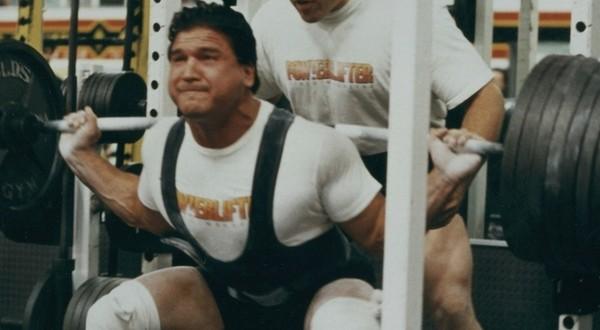
This 4-day program is built to raise your squat, bench press and deadlift over 12 weeks, or 6 weeks in the shorter version. It is a general strength block, not a meet peak. Each main lift is trained heavy once per week with ramping percentages, backed up by speed work and assistance exercises.
All percentages are of your current one-rep max. If you have not tested recently, use a conservative estimate rather than a hopeful one.
Day 1: Squat
| Exercise | Sets x Reps | Notes |
|---|---|---|
| Squat | See the cycle tables below | Main lift |
| Speed squat | 8 x 2 | Light weight (commonly 50-60% of max), moved fast with perfect form |
| Good morning | 3 x 8-10 | Hamstrings, glutes and lower back |
| Stiff-leg deadlift | 3 x 8-10 | Hamstrings |
| Abs | 2 sets | Any loaded core exercise |
Day 2: Bench Press
| Exercise | Sets x Reps | Notes |
|---|---|---|
| Bench press | See the cycle tables below | Main lift |
| Overhead barbell press | 3 x 6-8 | Shoulders and triceps |
| Close-grip bench press | 2 x 6-8 | Triceps and lockout |
| T-bar row | 3 x 8-10 | Upper back |
Day 3: Deadlift
| Exercise | Sets x Reps | Notes |
|---|---|---|
| Deadlift | See the cycle tables below | Main lift |
| Speed deadlift | 8 x 2 | Light weight, fast pulls, reset before each rep |
| Good morning | 3 x 8-10 | Hamstrings, glutes and lower back |
| Romanian deadlift | 3 x 8-10 | Hamstrings |
| Abs | 2 sets | Any loaded core exercise |
Day 4: Speed Bench Press
| Exercise | Sets x Reps | Notes |
|---|---|---|
| Speed bench press | 8 x 3 | Light weight (commonly 50-60% of max), fast and controlled |
| 2-board press | 3 x 3-5 | Partial-range press that trains the top half of the lift |
| Overhead dumbbell press | 3 x 8-10 | Shoulders |
| Triceps extension | 2 x 10-12 | Triceps |
| T-bar row | 3 x 8-10 | Upper back |
The original program lists only the number of sets for the assistance work, so the rep ranges above are sensible starting points. Keep one or two reps in reserve on those exercises so they do not eat into your recovery for the main lifts.
The 12-Week Cycle
Use this table for the squat on day 1, the bench press on day 2 and the deadlift on day 3. Each week ramps up through three percentages, and each percentage has a fixed set and rep scheme: 1 x 5 at 50-55%, 2 x 4 at 60-70%, 3 x 4 at 75%, 3 x 3 at 80-85% and 2 x 2 at 90-95%.
| Week | Working sets | Total sets |
|---|---|---|
| 1 | 1 x 5 @ 50%, 2 x 4 @ 60%, 2 x 4 @ 70% | 5 |
| 2 | 1 x 5 @ 55%, 2 x 4 @ 65%, 3 x 4 @ 75% | 6 |
| 3 | 2 x 4 @ 60%, 2 x 4 @ 70%, 3 x 3 @ 80% | 7 |
| 4 | 1 x 5 @ 55%, 2 x 4 @ 65%, 3 x 4 @ 75% | 6 |
| 5 | 2 x 4 @ 60%, 2 x 4 @ 70%, 3 x 3 @ 80% | 7 |
| 6 | 2 x 4 @ 65%, 3 x 4 @ 75%, 3 x 3 @ 85% | 8 |
| 7 | 2 x 4 @ 60%, 2 x 4 @ 70%, 3 x 3 @ 80% | 7 |
| 8 | 2 x 4 @ 65%, 3 x 4 @ 75%, 3 x 3 @ 85% | 8 |
| 9 | 2 x 4 @ 70%, 3 x 3 @ 80%, 2 x 2 @ 90% | 7 |
| 10 | 2 x 4 @ 65%, 3 x 4 @ 75%, 3 x 3 @ 85% | 8 |
| 11 | 2 x 4 @ 70%, 3 x 3 @ 80%, 2 x 2 @ 90% | 7 |
| 12 | 3 x 4 @ 75%, 3 x 3 @ 85%, 2 x 2 @ 95% | 8 |
Weeks 4, 7 and 10 step back slightly before the next push, which gives you built-in lighter weeks. After week 12, take an easy week, then test or estimate your new max and start the next cycle from the updated numbers.
The 6-Week Version
If you want a shorter block, run this version with the same set and rep scheme.
| Week | Working sets | Total sets |
|---|---|---|
| 1 | 1 x 5 @ 50%, 2 x 4 @ 60%, 2 x 4 @ 70% | 5 |
| 2 | 1 x 5 @ 55%, 2 x 4 @ 65%, 3 x 4 @ 75% | 6 |
| 3 | 2 x 4 @ 60%, 2 x 4 @ 70%, 3 x 3 @ 80% | 7 |
| 4 | 2 x 4 @ 65%, 3 x 4 @ 75%, 3 x 3 @ 85% | 8 |
| 5 | 2 x 4 @ 70%, 3 x 3 @ 80%, 2 x 2 @ 90% | 7 |
| 6 | 2 x 4 @ 70%, 3 x 3 @ 80%, 2 x 2 @ 95% | 7 |
2. Bulldog 3-Day Powerbuilding Split
The Bulldog program is a straightforward powerbuilding split: three sessions a week, each built around one heavy main lift followed by higher-rep work for size. It has few exercises and no clever techniques, just hard work on the big lifts.
The two halves feed each other. Strength from the heavy sets lets you handle more weight on the volume work, and the muscle built by that volume supports bigger lifts. The goal is to get stronger from head to toe, not just on the big three.
Quad Sets: the Heavy Work
Each workout opens with a “quad set”: 4 sets of 4 reps on the main lift of the day, which is the squat on Monday, the bench press on Wednesday and the deadlift on Friday. The name refers to the fours, not your quadriceps.
In your first session, pick a weight you can handle for all 4 x 4 with clean form. When the fourth rep of the last set feels solid, add 5 lb (about 2.5 kg) next time. If you miss a few reps after a jump, stay at that weight and aim to complete it the following week.
Progression and Deloads
For every other exercise, use the same weight for all sets. When you complete every set and rep listed, add a little weight the next time.
There are no planned deloads. When your joints ache, your lifts stall for a couple of weeks or you feel run down, drop the weights by about 30% and take an easy week.
Monday: Squat Day
| Exercise | Sets | Reps |
|---|---|---|
| Squat | 4 | 4 |
| Squat (one 20-rep set) | 1 | 20 |
| Stiff-leg deadlift | 3 | 6 |
| Leg press | 4 | 20 |
| Leg curl | 5 | 10 |
| Seated leg curl | 5 | 10 |
Wednesday: Bench Press Day
| Exercise | Sets | Reps |
|---|---|---|
| Bench press | 4 | 4 |
| Military press | 4 | 4 |
| Dumbbell bench press | 5 | 10 |
| Seated Arnold press | 5 | 10 |
| Cable triceps extension | 4 | 15 |
Friday: Deadlift Day
| Exercise | Sets | Reps |
|---|---|---|
| Deadlift | 4 | 4 |
| Power shrug | 2 | 20 |
| Barbell row | 5 | 10 |
| Pull-up | 5 | To failure |
| Seated dumbbell curl | 3 | 12 |
| Hammer curl | 3 | 12 |
Notes on the Bulldog Split
- Squat with a normal stance and deadlift conventional (not sumo), and bench on a flat bench rather than an incline.
- If standing presses bother your lower back, use a shoulder-width stance with your glutes and abs braced, or switch to a seated press with back support.
- Rest 2-3 minutes between quad sets (longer on deadlifts if you need it) and 60-90 seconds on the other exercises. In a 2016 study of resistance-trained men, three-minute rests produced greater strength gains than one-minute rests, so do not rush the heavy work.
- If you cannot do pull-ups yet, use chin-ups, band-assisted pull-ups or lat pulldowns.
Who the Bulldog Split Suits
The Bulldog split works like a push/pull program with its own leg day. Its strength is the mix of rep ranges: heavy fours on the main lift, then sets of 10-20 for size.
The volume is high, especially on Monday, so recovery decides how long you can run it. Eat enough protein, sleep well and watch for signs of overreaching such as stalled lifts, poor sleep and soreness that does not go away. With only three sessions a week, most lifters recover well.
3. 4-Day Base Strength Program
This program builds a base of strength and size on the three competition lifts with four short sessions per week. Each day has its own focus: higher reps, heavy technique work and two strength days. Bodybuilders and general lifters can run it as well as powerlifters.
It suits intermediate lifters with roughly two or more years of training and solid technique. Newer lifters can benefit too, but should learn the squat, bench press and deadlift with a coach, or by filming their lifts, before working at 80-85% of their max.
Day 1: Higher-Rep Work
| Exercise | Sets x Reps | Load |
|---|---|---|
| Back squat | 3 x 7-9 | Leave 1-2 reps in reserve |
| Bench press | 3 x 7-9 | Leave 1-2 reps in reserve |
| Chin-up | 3 x 7-9 | Add weight when all sets are easy |
Day 2: Heavy Technique Work
| Exercise | Sets x Reps | Load |
|---|---|---|
| Back squat | 3 x 1-3 | 80-85% of 1RM |
| Bench press | 3 x 1-3 | 80-85% of 1RM |
| Deadlift (conventional or sumo) | 3 x 1-3 | 80-85% of 1RM |
These sets should feel crisp, not maximal. The point is practising perfect reps with heavy weight.
Day 3: Strength Work 1
| Exercise | Sets x Reps | Load |
|---|---|---|
| Back squat | 3 x 3-5 | 80-85% of 1RM |
| Bench press | 3 x 3-5 | 80-85% of 1RM |
| Cable row or dumbbell row | 3 x 6-8 | Hard but controlled |
| Leg curl (seated or lying) | 3 x 10-12 | Hard but controlled |
Day 4: Strength Work 2
| Exercise | Sets x Reps | Load |
|---|---|---|
| Close-grip bench press | 3 x 6-8 | Hard but controlled |
| Deadlift | 3 x 3-5 | 80-85% of 1RM |
| Machine row or TRX row | 3 x 10-12 | Hard but controlled |
Start at the low end of each percentage range and work toward the top over several weeks. On the exercises without a percentage, add weight once every set reaches the top of its rep range. For more size, add one or two shoulder and arm exercises on days 1 and 4.
4. 9-Week Peaking Cycle for Strength
This is a 9-week strength cycle for intermediate lifters that uses only the squat, bench press and deadlift. Instead of basing the percentages on your current max, you base them on your goal: your current one-rep max plus the amount you want to add.
For example, if your bench press is 270 lb and you are aiming for 285 lb after nine weeks, every percentage is worked out from 285 lb.
Setting a Realistic Goal
Keep goals modest. For most intermediates, adding about 10-20 lb to a lift in nine weeks is a good result. A sensible starting point is a 15 lb increase for the squat and deadlift and 10 lb for the bench press.
The cycle does not cap you if you beat your goal. In week 8 you work up to a single at 95% of the goal weight, which is about 270 lb for a 285 lb goal. If that single moves easily and you judge you could have made 280 lb, then 280 lb becomes your new working max. Set the next goal from there, for example 295 lb, and base the next cycle on it. A working max is an estimate for planning, not a tested max.
How the 9 Weeks Are Organised
- Weeks 1-4: volume phase
- Weeks 5-8: heavy phase
- Week 9: deload, or taper if you are competing
You train three times a week, for example Monday, Wednesday and Friday, and perform only the squat, bench press and deadlift, either in that order or as squat, deadlift, bench press.
Volume Phase: Weeks 1-4
Use this protocol for all three lifts in every session.
| Week | Sets x Reps | Load (% of goal) | Example: 285 lb goal |
|---|---|---|---|
| 1 | 3 x 6 | 60% | 170 lb |
| 2 | 3 x 5 | 65% | 185 lb |
| 3 | 3 x 4 | 70% | 200 lb |
| 4 | 3 x 3 | 75% | 215 lb |
Heavy Phase: Weeks 5-8
Each lift now gets one heavy session per week, and the other two sessions for that lift are light: 4 x 4 at 60% of your goal.
| Week | Heavy day | Load (% of goal) | Example: 285 lb goal |
|---|---|---|---|
| 5 | 2 x 1 | 80% | 230 lb |
| 6 | 2 x 1 | 85% | 240 lb |
| 7 | 1 x 1 | 90% | 255 lb |
| 8 | 1 x 1 | 95% | 270 lb |
| Day | Squat | Bench press | Deadlift |
|---|---|---|---|
| Monday | Heavy | 4 x 4 @ 60% | 4 x 4 @ 60% |
| Wednesday | 4 x 4 @ 60% | Heavy | 4 x 4 @ 60% |
| Friday | 4 x 4 @ 60% | 4 x 4 @ 60% | Heavy |
Week 9 and Program Notes
- Deload: take the week off completely. If you want to train, work up to one set of 6 at 60% of your old max on each lift.
- Meet peaking: if a meet falls at the end of week 9, rest that week as the original program suggests, or keep only a few light sets early in the week to stay sharp.
- Assistance work: in weeks 1-4 you can add 1-2 assistance exercises per session, such as ab work, triceps extensions or dips, curls, calf raises, rows, shrugs, pull-ups or chin-ups. Avoid taxing compound lifts and high-volume work that would cut into recovery, and skip the extras in weeks 5-8 so you are fresh for the heavy singles.
On its own this is a pure strength cycle. Because the volume is low, those few accessory exercises in weeks 1-4 are what keep it a powerbuilding program and help you hold on to muscle while you peak.
5. Monster Confusion 10-Week Mass Building Cycle
Most of the programs above lean toward strength. The Monster Confusion cycle leans toward size: it rotates a different training style through each session, so no two weeks are the same, while keeping heavy compound lifts at the centre.
The name comes from the idea of “muscle confusion”, but muscles do not need to be confused. They grow because you give them more work or heavier loads over time. What rotating styles does offer is a mix of heavy, moderate and high-rep training, plenty of variety, and a fresh start when a routine has gone stale. The trade-off is that progress on any single lift is harder to track, so log your weights carefully. You can run it for 10 weeks, repeat it, or swap out styles that do not suit you.
The Training Styles
| Style | How it works |
|---|---|
| 5×5 | 5 sets of 5 reps on the main lifts: a classic strength and size scheme |
| Bulldozer | Muscle & Brawn’s own system: rest-paused sets to a target rep total (often 20) without going to failure, borrowing from DoggCrapp and Max-Stim training |
| 20-rep squats | One hard set of 20 squats with a heavy weight, taking deep breaths between reps once it gets tough |
| Dorian Yates | Based on the high-intensity style of six-time Mr. Olympia Dorian Yates: after warm-ups, one all-out set per exercise, using rest-pause, forced reps, static holds and negatives where safe |
| Gironda 8×8 | Vince Gironda’s system: 8 sets of 8 reps with only 15-30 seconds of rest between sets. Expect soreness |
| Moderate volume | Standard bodybuilding work: 3 sets of 6-10 reps per exercise |
| Singles, doubles and triples | Heavy rest-paused sets of 1-3 reps to push through strength plateaus |
| Max-OT | Heavy, low-volume work: 6-9 working sets of 4-6 reps for a muscle group, with long rests |
| Westside | Max-effort work (building to a heavy single, double or triple), dynamic-effort speed work, and supporting exercises aimed at weak points |
| Burns | Higher-rep rest-paused sets to 50 or 100 total reps, done Bulldozer style (see our guide to burn sets) |
| 10×3 | 10 sets of 3 reps with 45 seconds of rest between sets |
| High reps | 3 sets of 10-20 reps for most muscle groups |
The Weekly Split
The example uses three sessions a week with rest days in between: push, pull and legs. Train abs on whichever day suits you that week. If you prefer another split, you can fit the styles to it and choose the rest periods that work best for you.
| Day | Session |
|---|---|
| 1 | Chest, shoulders and triceps |
| 2 | Off |
| 3 | Back, biceps and traps |
| 4 | Off |
| 5 | Quads, hamstrings and calves |
| 6-7 | Off |
10-Week Overview
| Week | Push | Pull | Legs |
|---|---|---|---|
| 1 | 5×5 | Burns | Westside |
| 2 | Bulldozer | Moderate | High reps |
| 3 | Max-OT | 8×8 | 10×3 |
| 4 | Burns | Westside | Yates |
| 5 | Moderate | High reps | 5×5 |
| 6 | 8×8 | 10×3 | Bulldozer |
| 7 | Westside | Yates | Max-OT |
| 8 | High reps | 5×5 | Burns |
| 9 | 10×3 | Bulldozer | Moderate |
| 10 | Yates | Max-OT | 8×8 |
Push Day: Chest, Shoulders and Triceps
| Week | Style | What to do |
|---|---|---|
| 1 | 5×5 | Bench press, overhead press, close-grip bench press |
| 2 | Bulldozer | One rest-paused set to 20 total reps each: bench press, incline bench press, overhead press, triceps exercise |
| 3 | Max-OT | Bench press, overhead press, triceps exercise |
| 4 | Burns | 50-rep burn sets: bench press, incline bench press, overhead press, triceps exercise |
| 5 | Moderate | 3 x 6-10: bench press, incline press, overhead press, triceps exercise |
| 6 | 8×8 | 15-30 seconds of rest between sets: bench press, overhead press, triceps exercise |
| 7 | Westside | Pick one. Max effort: build up in heavy triples on the bench press until a triple is no longer possible, then attempt a new max. Dynamic effort: 8 x 3 speed bench presses at 60% of max with about 15 deep breaths between sets. Then 3 x 6-10 on the overhead press and a triceps exercise |
| 8 | High reps | 3 x 10-20: bench press, incline bench press, overhead press, triceps exercise |
| 9 | 10×3 | 45 seconds of rest between sets: bench press, overhead press, triceps exercise |
| 10 | Yates | One all-out set each: 2 chest exercises, 2 shoulder exercises, 1 triceps exercise |
Pull Day: Back, Biceps and Traps
| Week | Style | What to do |
|---|---|---|
| 1 | Burns | 50-rep burn sets: deadlift, back exercise, biceps exercise, trap exercise |
| 2 | Moderate | 3 x 6-10: 2 back exercises, biceps exercise, trap exercise |
| 3 | 8×8 | 15-30 seconds of rest between sets: deadlift, back exercise, biceps exercise, trap exercise |
| 4 | Westside | Pick one. Max effort: build up in heavy deadlift singles, then attempt a new max. Dynamic effort: 8 speed singles at 60% of max with about 15 deep breaths between reps. Then 3 x 6-10 on a back exercise and a biceps exercise |
| 5 | High reps | 3 x 10-20: 2 back exercises, biceps exercise, trap exercise |
| 6 | 10×3 | 45 seconds of rest between sets: deadlift, back exercise, biceps exercise, trap exercise |
| 7 | Yates | One all-out set each: deadlift, 1-2 back exercises, 1-2 biceps exercises, trap exercise |
| 8 | 5×5 | Deadlift, back exercise, biceps exercise |
| 9 | Bulldozer | One rest-paused set to 20 total reps each: 2 back exercises, biceps exercise, trap exercise |
| 10 | Max-OT | Deadlift, back exercise, biceps exercise |
Leg Day: Quads, Hamstrings and Calves
| Week | Style | What to do |
|---|---|---|
| 1 | Westside | Pick one. Max effort: build up in heavy box squat singles, then attempt a new max. Dynamic effort: 8 x 2 speed box squats at 60% of max with about 15 deep breaths between sets. Then 3 x 6-10 on good mornings and Romanian deadlifts |
| 2 | High reps | One 20-rep set of squats, then 3 x 10-20 on front squats or leg extensions, hamstring curls or Romanian deadlifts, and a calf exercise |
| 3 | 10×3 | 45 seconds of rest between sets: squats, front squats or leg extensions, hamstring curls or Romanian deadlifts, calf exercise |
| 4 | Yates | 2 sets of 6-10 squats, then one all-out set each of 1 quad exercise, 1-2 hamstring exercises and a calf exercise |
| 5 | 5×5 | Squats, front squats (optional), Romanian deadlifts, plus calf sets of 10-20 reps |
| 6 | Bulldozer | Squats: 8 rest-paused singles, doubles or triples with about 15 deep breaths between sets, or rest-pause to 20 total reps. Then one set to 20 reps on front squats or leg extensions, hamstring curls or Romanian deadlifts, and a calf exercise |
| 7 | Max-OT | Squats, Romanian deadlifts or hamstring curls, calf exercise |
| 8 | Burns | 50-rep burn sets (100 for calves): squats, leg extensions, Romanian deadlifts or hamstring curls, calf exercise |
| 9 | Moderate | 3 x 6-10: front squats or leg extensions, hamstring curls or Romanian deadlifts, calf exercise |
| 10 | 8×8 | 15-30 seconds of rest between sets: squats, hamstring curls or Romanian deadlifts, calf exercise |
How to Run the Monster Confusion Cycle
- The exercises are examples. Swap them to suit your gym and your weak points, but keep compound movements at the core.
- Keep sessions to roughly 45-60 minutes. As you get used to the system, adjust the number of exercises to stay in that window.
- On Westside weeks, rotate the max-effort exercise from cycle to cycle and choose supporting exercises that target your weak points.
- For Bulldozer-style rest-pause sets (to 20, 50 or 100 reps), pick a moderately heavy weight, do as many reps as you can without reaching failure, take 10-15 deep breaths, and continue until you reach the target total.
- On Yates weeks, do not use negatives, forced reps or other intensity techniques on squats or deadlifts.
- On burn, 8×8 and other high-rep or short-rest weeks, use moderate weights on squats and deadlifts and end the set as soon as your form slips.
How to Add Muscle-Building Work to a Strength Cycle
The basic strength cycle and the 9-week peaking cycle are strength programs first. To turn them into powerbuilding programs without hurting your main lifts:
- Add 2-4 accessory exercises per session for the muscles the big lifts train least: upper back and lats, side and rear delts, biceps, triceps, hamstrings and calves.
- Use 3 sets of 8-15 reps and take them close to failure, about 1-2 reps in reserve. Moderate- and high-rep sets build muscle well when they are hard enough.
- Aim for roughly 10 or more hard sets per muscle group per week, counting the main lifts. A 2017 meta-analysis found that more weekly sets were linked to more muscle growth, with 10 or more sets per week giving the largest gains.
- Do the accessory work after the main lift, and cut it back first when you reach the heaviest weeks or the taper.
- If you would rather follow a ready-made plan that blends power and hypertrophy days, PHAT (Power Hypertrophy Adaptive Training) is built around exactly this idea.
Recovery, Food and Supplements
Every program here is only as good as your recovery. Sleep 7-9 hours a night, eat enough protein (around 1.6 g per kg of body weight per day is a well-supported target for muscle gain), and eat at or slightly above maintenance calories if size is your main goal.
Creatine monohydrate is the best-supported supplement for strength training. It raises the phosphocreatine stores in your muscles, and studies consistently show small but meaningful extra gains in strength and lean mass when it is combined with lifting. The usual dose is 3-5 g per day. Supplements fill gaps; they do not replace training, food and sleep.

Pros
- Catalog is specifically organized around muscle building, fat loss, testosterone support, and workout performance.
- Range includes creatine, protein, EAAs, beta-alanine, and L-citrulline alongside more specialized formulas.
- Orders of $99+ qualify for free US shipping.
Cons
- Features several strong claims around muscle growth, testosterone, fat loss, and metabolic effects that should be distinguished from independently demonstrated clinical outcomes
- Heavily oriented toward bodybuilding and performance rather than broader nutritional supplementation.
The Bottom Line
The best powerbuilding workout is the one that matches your level and that you can run consistently: heavy, progressive work on the squat, bench press and deadlift, plus enough accessory volume to build muscle.
- Late beginners do best with the simple Bulldog 3-day split; intermediates can move on to the 4-day base program or the percentage-based 12-week and 9-week cycles.
- Base your percentages on an honest max, run each cycle for its full length, and use the built-in lighter weeks or a deload when recovery slips.
- Add 2-4 hypertrophy exercises to strength-first cycles, and choose the Monster Confusion cycle if size is your main goal.
Frequently Asked Questions
Disclaimer
Please read carefully
The information on this site is for educational and informational purposes only, and is not medical advice. Always consult a qualified healthcare professional before using any supplement or medication, or making changes to your health, fitness, or nutrition routine.
Not medical advice
Content here is not a substitute for professional medical advice.
Consult your doctor
Talk to your doctor before starting any supplement or new routine.
Use at your own risk
We are not responsible for adverse effects from acting on this.
Do your research
Make informed decisions about your own health.
No guarantees
Individual results vary. No claims about outcomes.
Important — Never disregard professional medical advice or delay seeking it because of something you read here. If you think you may have a medical emergency, call your doctor or your local emergency number right away.