Contents9 sections
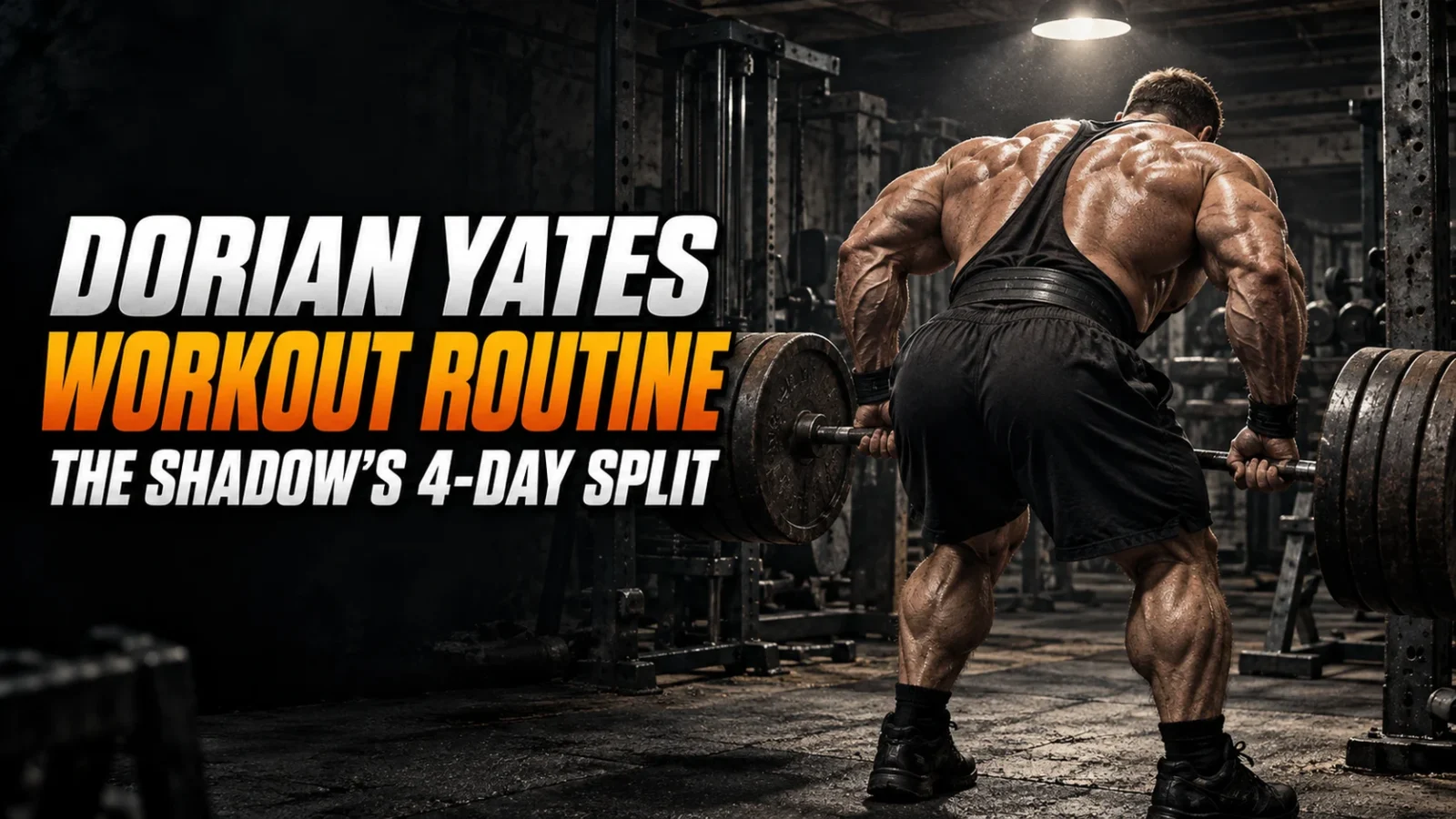
Dorian Yates won six consecutive Mr. Olympia titles between 1992 and 1997 and was the first British bodybuilder to take the Sandow trophy. He did it from a basement gym in Birmingham, England, with workouts that were shorter and lower in volume than almost anyone else’s at the top of the sport.
Depending on how you view bodybuilding, Yates was either an innovator or the start of the shift away from classic aesthetics. He was the first champion to put sheer size and density ahead of everything else. He was not unaesthetic, but his priorities were clear, and the size-first look of today’s top bodybuilders owes a lot to him.
This guide covers his four-day training split exercise by exercise, the high-intensity principles behind it, how to adapt it to your own level, and the story of how a teenager from the English Midlands became “The Shadow.”
Key Takeaways
- Dorian Yates won six straight Mr. Olympia titles (1992-1997) and was the first British winner of the contest.
- His split trains four days a week: shoulders, triceps and abs; back; chest, biceps and abs; and legs, with three full rest days.
- Each exercise gets one or two lighter warm-up sets, then a single all-out working set of 6-12 reps taken to failure.
- The method grew out of the high-intensity training (HIT) of Arthur Jones and Mike Mentzer, which Yates adapted into his own “Blood and Guts” style.
- The low volume can suit lifters with limited recovery, but research links more weekly sets to more growth, and heavy sets to failure demand strict form.
Dorian Yates at a Glance
| Attribute | Detail |
|---|---|
| Nickname | The Shadow |
| Born | 19 April 1962, Sutton Coldfield, England |
| Home gym | Temple Gym, Birmingham |
| Pro debut | 1990 Night of Champions (2nd) |
| Mr. Olympia titles | 6, consecutive (1992-1997) |
| Training style | High intensity, low volume: one working set per exercise |
| Weekly split | 4 training days, 3 rest days |
Dorian Yates’ Training Philosophy
Yates trained very differently from most pros of his era. While most top bodybuilders used long, high-volume sessions with many sets per body part, he trained in short, very intense sessions built around a single all-out working set per exercise.
The approach grew out of high-intensity training (HIT), developed by Nautilus inventor Arthur Jones and popularised in bodybuilding by Mike Mentzer’s Heavy Duty system. Yates made it his own: he kept the core idea of one hard set taken to failure and built it into a four-day split with several exercises per muscle group and progressive warm-up sets. His version became known as “Blood and Guts” training.
The Core Principles
- Warm up progressively: One or two lighter, higher-rep sets come before the working set. Later exercises for the same muscle need fewer warm-ups, or none, because the muscle is already warm.
- One working set to failure: The working set ends when another rep in good form is not possible. Yates sometimes pushed past that point with forced reps or a controlled negative.
- Control the weight: Smooth reps with a controlled lowering phase, rather than bouncing heavy loads. Momentum takes work away from the target muscle and puts the joints at risk.
- Progressive overload: A single set only works if it gets harder over time. Aim to add a rep or a little weight from week to week, and log every session so you know what you have to beat.
- Recover fully: Each muscle group is trained hard once a week, with three full rest days. The low volume only works because every working set is so demanding.
- Use machines where it makes sense: Many of the exercises are on Hammer Strength, Nautilus or Smith machines, which make it easier to reach failure safely without a spotter.
Dorian Yates’ Workout Routine
Below is the workout routine Dorian Yates used to build one of the biggest physiques in bodybuilding history. It won’t make you a six-time Mr. Olympia, but trained with the same discipline, it is a complete and time-efficient program.
The split uses only four training days a week. Shoulders, triceps and abs come on Day 1, back on Day 2, chest, biceps and abs on Day 4, and legs on Day 6. Days 3, 5 and 7 are rest days; you can add some cardio on them, depending on your goals.
Because the weekly volume is low, the program can also work for natural bodybuilders and anyone who recovers slowly from long sessions. Low volume does not mean easy, though: every working set has to be genuinely all-out.
Weekly Schedule
| Day | Workout |
|---|---|
| Day 1 | Shoulders, triceps and abs |
| Day 2 | Back and rear delts |
| Day 3 | Rest |
| Day 4 | Chest, biceps and abs |
| Day 5 | Rest |
| Day 6 | Legs: quads, hamstrings and calves |
| Day 7 | Rest |
In the tables below, “1 x 12” means one set of 12 reps. Warm-up sets are lighter sets that prepare the muscle and rehearse the movement. The working set is the one all-out set taken to failure.
Day 1: Shoulders, Triceps and Abs
| Exercise | Warm-up sets | Working set |
|---|---|---|
| Smith machine press | 1 x 15, 1 x 12 | 1 x 8-10 |
| Seated lateral raise | 1 x 12 | 1 x 8-10 |
| One-arm cable lateral raise | 1 x 20 | 1 x 8-10 |
| Dumbbell shrug | 1 x 12 | 1 x 10-12 |
| Triceps pushdown | 1 x 15, 1 x 12 | 1 x 8-10 |
| Lying EZ-bar extension | 1 x 12 | 1 x 8-10 |
The routine lists abs on Days 1 and 4 without naming specific exercises. One or two hard sets of a crunch or leg-raise variation fit the same low-volume, high-effort style.
Day 2: Back and Rear Delts
| Exercise | Warm-up sets | Working set |
|---|---|---|
| Hammer Strength pulldown | 1 x 15, 1 x 12 | 1 x 8-10 |
| Barbell row | 1 x 12 | 1 x 8-10 |
| Hammer Strength one-arm row | None | 1 x 8-10 |
| Cable row (overhand grip) | None | 1 x 8-10 |
| Hammer Strength rear-delt machine | None | 1 x 8-10 |
| Bent-over dumbbell raise | None | 1 x 8-10 |
| Hyperextension | None | 1 x 10-12 |
| Deadlift | 1 x 8 | 1 x 8 |
Back day has the most exercises in the week. It ends with deadlifts, after rows and hyperextensions have already warmed up the lower back.
Day 4: Chest, Biceps and Abs
| Exercise | Warm-up sets | Working set |
|---|---|---|
| Incline barbell press | 1 x 12, 1 x 8 | 1 x 8 |
| Hammer Strength seated bench press | 1 x 10 | 1 x 6-8 |
| Incline dumbbell flye | 1 x 10 | 1 x 8 |
| Cable crossover | None | 1 x 10-12 |
| Incline dumbbell curl | 1 x 10 | 1 x 6-8 |
| EZ-bar curl | 1 x 10 | 1 x 6-8 |
| Nautilus curl | 1 x 10 | 1 x 6-8 |
Day 6: Legs
| Exercise | Warm-up sets | Working set |
|---|---|---|
| Leg extension | 1 x 15, 1 x 12 | 1 x 10-12 |
| Leg press | 1 x 12, 1 x 12 | 1 x 10-12 |
| Hack squat | 1 x 12 | 1 x 10-12 |
| Lying leg curl | 1 x 10-12 | 1 x 10-12 |
| Stiff-legged deadlift | None | 1 x 8-10 |
| Single-leg curl | None | 1 x 8-10 |
| Standing calf raise | 1 x 10-12 | 1 x 10-12 |
| Seated calf raise | None | 1 x 8-10 |
Leg day opens with leg extensions, which warm up the knees and pre-fatigue the quads before the heavier leg presses and hack squats.
Rest Days (Days 3, 5 and 7)
The program assumes you arrive at every session fully recovered. Walking, light cardio or mobility work on rest days is fine; extra hard training is not part of the plan.
How to Use the Dorian Yates Workout
Yates ran this program as an elite professional with years of training behind him. A few adjustments make it safer and more productive for everyone else.
Who It Suits
The routine suits intermediate and advanced lifters who already have solid technique and know what true failure feels like. If you are newer to training, check whether you are a beginner, intermediate or advanced lifter first. Beginners usually progress better by practising the main lifts more often, without taking every set to failure.
Train to Failure Safely
Taking one heavy set to failure on every exercise is where the risk lies. Use machines where the routine calls for them, have a spotter on free-weight presses, and end a set when your form breaks down rather than grinding through it. Yates himself retired after a run of serious injuries, including torn biceps and triceps.
Consider Adding Volume
The main trade-off is volume. A 2017 meta-analysis by Schoenfeld and colleagues found a dose-response relationship between weekly training volume and muscle growth: more weekly sets per muscle tended to produce more hypertrophy. This routine gives most muscles only two to eight working sets a week, so many lifters, especially natural ones, may grow faster by adding a second working set to the main exercises once they have adapted.
Recovery and Nutrition
One hard session per muscle a week only pays off if you recover from it. Sleep well, eat enough total calories to grow, and get enough protein: a 2018 meta-analysis by Morton and colleagues found that gains in lean mass levelled off at a total protein intake of around 1.6 g per kg of body weight per day. Creatine monohydrate is the best-supported supplement for adding strength and muscle alongside training.

Pros
- Catalog is specifically organized around muscle building, fat loss, testosterone support, and workout performance.
- Range includes creatine, protein, EAAs, beta-alanine, and L-citrulline alongside more specialized formulas.
- Orders of $99+ qualify for free US shipping.
Cons
- Features several strong claims around muscle growth, testosterone, fat loss, and metabolic effects that should be distinguished from independently demonstrated clinical outcomes
- Heavily oriented toward bodybuilding and performance rather than broader nutritional supplementation.
Dorian Yates Biography: The Making of “The Shadow”
Dorian Yates is one of the most successful Mr. Olympia winners in history. He won six titles in a row and was unbeaten from 1992 until he retired after the 1997 contest. Along the way, his high-intensity approach changed how many bodybuilders thought about training volume.
Early Years
Yates was born in Sutton Coldfield, England, in 1962, and grew up in Hurley, a small village in north Warwickshire near the Staffordshire border. Staffordshire later produced another British strength icon: strongman Eddie Hall, who in 2016 became the first person to deadlift 500 kg. Hafþór Júlíus Björnsson broke that record with a 501 kg pull in 2020.
In 1975, when Dorian was 13, his father died of a heart attack, and the family moved to Birmingham.
As a teenager he ran with a skinhead crowd. In 1981, aged 19, he was arrested during the Handsworth riots in Birmingham, part of the wave of unrest that spread through English cities that summer after the Brixton and Toxteth riots. He was sentenced to a spell in a youth detention centre, and it was there that he decided to focus on bodybuilding rather than drift into a life of crime.
From Temple Gym to British Champion
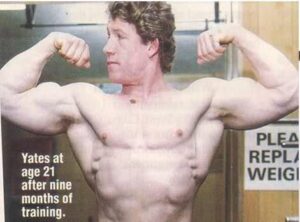
Yates began training seriously in 1983, aged 21, and built his physique at Temple Gym, a no-frills basement gym in Birmingham that later became his own. Within about three years he had won the British Championships, and he won them again two years later.
Why He Was Called “The Shadow”
Many top pros of the era trained in Southern California, where they were photographed for magazines and guest-posed year-round. Yates did the opposite. He trained in Birmingham, stayed out of the spotlight between contests and kept his physique covered in baggy clothes outside the gym.
Then, at contest time, he would appear in peak condition, take the title and disappear again. His rivals rarely knew what shape he was in until he stepped on stage, which earned him the nickname “The Shadow.”
His mentality won him as many admirers as his physique. His sessions at Temple Gym, with its old-school, worn equipment, were famous for their intensity and focus, and they set the template for the hard, no-nonsense training his routine is known for.
Pro Career and Six Olympia Titles
In 1990 Yates entered his first professional contest, the Night of Champions, and placed second to Algerian bodybuilder Mohammed Benaziza. He came back to win it in 1991, the same year he entered the Mr. Olympia for the first time and finished second to Lee Haney, who took his eighth straight title.
Haney retired after that contest. In 1992 Yates beat Kevin Levrone to become the first British Mr. Olympia, and he never lost another bodybuilding contest. Between 1992 and 1997 he won every show he entered: six consecutive Mr. Olympia titles plus a series of Grand Prix events, mostly in Europe.
Yates was also the first Mr. Olympia to build his physique without moving to the United States. Earlier champions from outside the US had relocated there, on the logic that training around other pros would raise their level. Yates did all of his training in Birmingham, with his own methods.
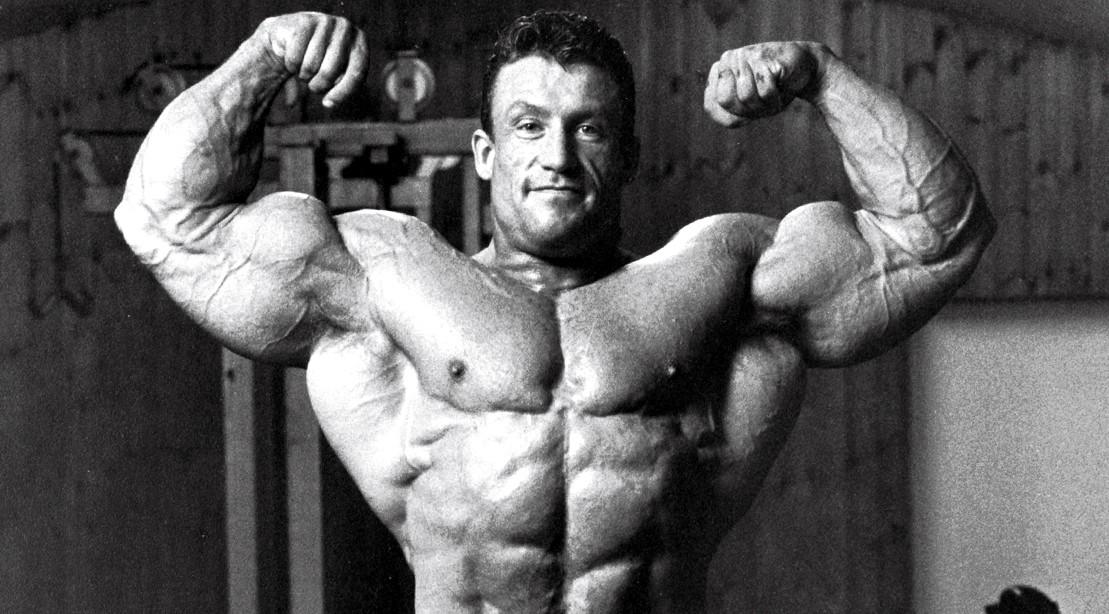
The result changed bodybuilding. Instead of prioritising symmetry and a small waist, Yates built as much dense muscle as possible, and he is often described as the first “mass monster.” Many of the champions who followed, starting with Ronnie Coleman, took that size-first approach even further.
By 1997 Yates was carrying serious injuries, including torn biceps and triceps. He won his sixth title that year and then retired from competition.
Steroid Use
Yates has spoken openly about using anabolic steroids during his competitive career. That context matters when you look at his routine: his recovery and rate of muscle gain were not those of a natural lifter, and anabolic steroids carry serious risks to the heart, liver and hormone system.
A natural lifter following the same program should expect much slower progress. Our guide to steroids vs natural bodybuilders explains why an enhanced champion’s physique is not a fair benchmark.
Life After Bodybuilding
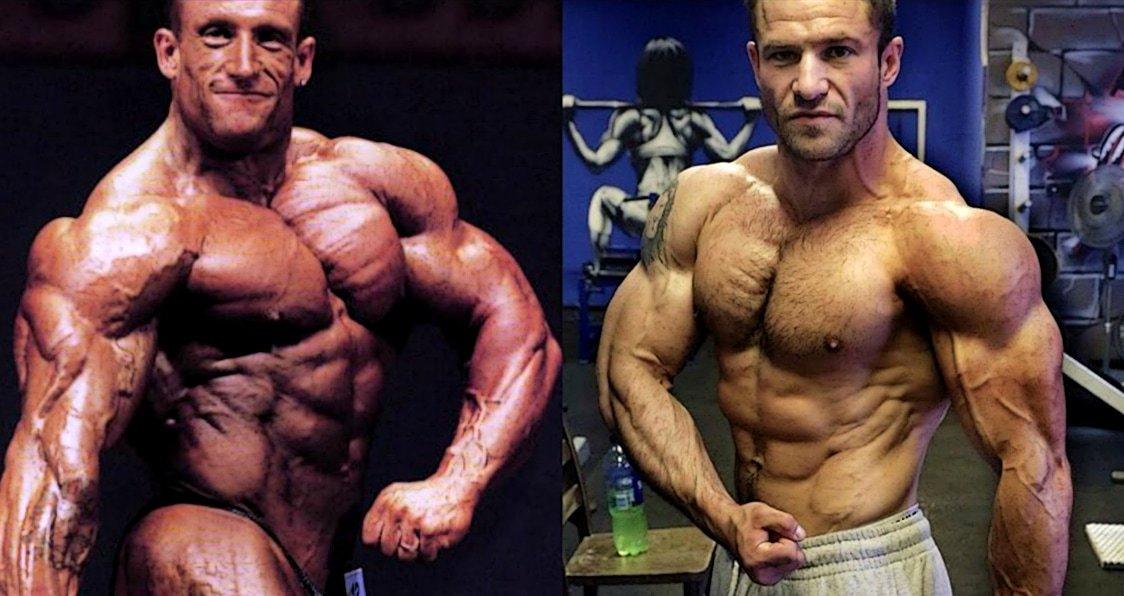
Since retiring, Yates has put his name to gyms in several countries, been involved with supplement companies and published books about his life and training. He has a son, Lewis, pictured with him below.
The Bottom Line
Dorian Yates showed that short, brutally hard sessions with one working set per exercise could build a six-time Mr. Olympia physique.
- His four-day split trains each muscle group once a week with progressive warm-ups and one all-out working set, leaving three full rest days.
- The routine suits experienced lifters with good technique; machines and a spotter make training to failure safer.
- Natural lifters may grow faster with a little more weekly volume, and should measure progress against their own starting point, not an enhanced champion’s.
Frequently Asked Questions
Disclaimer
Please read carefully
The information on this site is for educational and informational purposes only, and is not medical advice. Always consult a qualified healthcare professional before using any supplement or medication, or making changes to your health, fitness, or nutrition routine.
Not medical advice
Content here is not a substitute for professional medical advice.
Consult your doctor
Talk to your doctor before starting any supplement or new routine.
Use at your own risk
We are not responsible for adverse effects from acting on this.
Do your research
Make informed decisions about your own health.
No guarantees
Individual results vary. No claims about outcomes.
Important — Never disregard professional medical advice or delay seeking it because of something you read here. If you think you may have a medical emergency, call your doctor or your local emergency number right away.