Contents10 sections
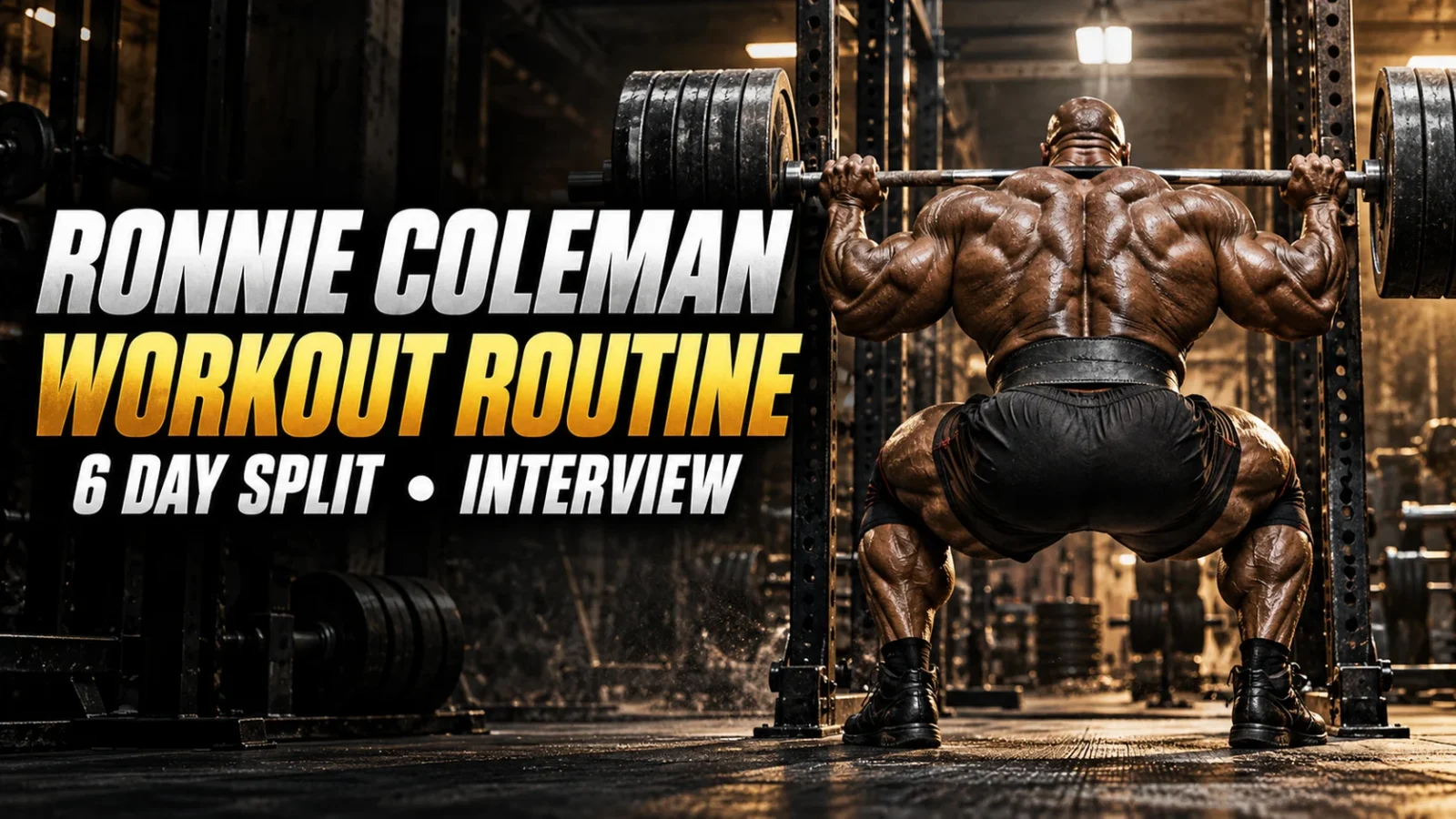
Ronnie Coleman is one of the most decorated bodybuilders in history. He won eight consecutive Mr. Olympia titles from 1998 to 2005, tying Lee Haney’s record, and 26 IFBB professional titles in total. Many fans and coaches rank him as the greatest bodybuilder of all time.
This page lays out a typical training week from his competitive years, the 6 day split that has been widely published, exercise by exercise. It also covers how a natural lifter can scale it down, Ronnie’s 2010 interview with Muscle & Brawn, and what has happened to him since he stopped competing.
Key Takeaways
- Ronnie Coleman won eight straight Mr. Olympia titles (1998-2005), tying Lee Haney’s record, and 26 IFBB pro titles in total.
- His routine is a 6 day split: back, biceps and shoulders; legs; chest and triceps; then the cycle repeats, with Sunday off. Every muscle is trained twice a week.
- It is built on heavy basics such as deadlifts, squats, rows and the bench press, mostly for 10-12 reps, adding up to about 28 working sets a week for back and for chest.
- The volume suits an elite professional. Most natural lifters will progress better on 3-4 sessions a week with fewer sets.
- Since his last contest in 2007, Ronnie has had a long series of spine operations and hip replacement surgery, and he has often used crutches or a wheelchair.
Ronnie Coleman Stats
| Attribute | Detail |
|---|---|
| Born | May 13, 1964, Monroe, Louisiana |
| Height | 5’11” (180 cm) |
| Contest weight (peak years) | About 287-300 lb (130-136 kg) |
| Off-season weight (peak years) | About 330 lb (150 kg) |
| Mr. Olympia titles | 8 (1998-2005) |
| IFBB pro titles | 26 |
| Last contest | 2007 Mr. Olympia (4th) |
| Home gym | Metroflex Gym, Arlington, Texas |
The weights are the figures commonly reported for his competitive years. They are not his current bodyweight.
Ronnie Coleman Biography
Early Life and Amateur Career
Born in Monroe, Louisiana, in 1964, Ronnie started his athletic career as a middle linebacker for the Grambling State University football team. He graduated with a degree in accounting, but instead of working as an accountant he moved to Texas and became a police officer in Arlington, a job he kept for years after he turned pro.
At Metroflex Gym in Arlington, owner Brian Dobson offered to train him for free if he would enter the Mr. Texas. Ronnie won it in 1990, in his first bodybuilding competition. The following year he won the heavyweight class at the IFBB World Amateur Championships, which earned him professional status.
Pro Career and Mr. Olympia Wins
Success as a pro took time. His first professional win came at the 1995 Canada Pro Cup, and his breakthrough came in 1998, when he won the Night of Champions and then his first Mr. Olympia, beating Flex Wheeler into second place.
That started a run of eight straight Mr. Olympia titles from 1998 to 2005, equal to Lee Haney’s record. The run ended in 2006, when he finished second to Jay Cutler. Many fans believe Ronnie was already past his best by then. He placed fourth at the 2007 Mr. Olympia and never competed again.
Across his career Ronnie won 26 IFBB professional titles, a record at the time. Dexter Jackson, the 2008 Mr. Olympia, later passed that total and now holds the record for the most IFBB pro wins.
Injuries and Surgeries
The training that built Ronnie’s physique also took a heavy toll. Since his last contest he has had a long series of operations, most of them on his spine, as well as hip replacement surgery. He has spent long periods recovering, and in recent years he has often used crutches or a wheelchair to get around.
Videos from his peak years show the loads he handled, including squats and deadlifts with 800 lb for reps.
He is not the only champion whose heavy style ended in injury. Dorian Yates, another Mr. Olympia known for very heavy, high-intensity training, retired after his sixth title in 1997 following a string of muscle tears.
Ronnie Coleman Training Routine Schedule
Ronnie followed a classic bodybuilding split, where each day trains different muscle groups. Monday was back, biceps and shoulders. Tuesday was legs. Wednesday was chest and triceps, and Thursday started the cycle again with different exercises. Sunday was a rest day.
| Day | Muscle Groups |
|---|---|
| Monday | Back, biceps, shoulders |
| Tuesday | Legs |
| Wednesday | Chest, triceps |
| Thursday | Back, biceps, shoulders |
| Friday | Legs |
| Saturday | Chest, triceps, calves, abs |
| Sunday | Rest |
Most of the work sits in the 10-12 rep range, with heavier, lower-rep sets on deadlifts and squats. The second session for each body part uses different exercises and angles from the first.
The Ronnie Coleman 6 Day Split, Day by Day
Monday: Back, Biceps and Shoulders
| Muscle | Exercise | Sets x Reps |
|---|---|---|
| Back | Deadlifts | 4 x 6-12 |
| Back | Barbell rows | 3 x 10-12 |
| Back | T-bar rows | 3 x 10-12 |
| Back | One-arm dumbbell rows | 3 x 10-12 |
| Biceps | Barbell curls | 4 x 12 |
| Biceps | Seated alternating dumbbell curls | 12 reps (sets not listed) |
| Biceps | Preacher curls | 12 reps (sets not listed) |
| Biceps | Cable curls | 12 reps (sets not listed) |
| Shoulders | Military presses | 4 x 10-12 |
| Shoulders | Seated dumbbell press, superset with front dumbbell press | 4 x 12 each |
The published routine gives reps but no set counts for the last three curl exercises. Three sets each would match the rest of the session.
Tuesday: Legs
| Exercise | Sets x Reps |
|---|---|
| Squats | 5-6 x 2-12 |
| Leg presses | 4 x 12 |
| Walking lunges | 2 x 100 yards |
| Stiff-leg deadlifts | 3 x 12 |
| Seated hamstring curls | 3 x 12 |
The 2-12 rep range on squats is a pyramid: higher-rep sets first, then heavier sets for fewer reps. The lunges are done for distance rather than reps.
Wednesday: Chest and Triceps
| Muscle | Exercise | Sets x Reps |
|---|---|---|
| Chest | Bench press | 5 x 12 |
| Chest | Incline barbell press | 3 x 12 |
| Chest | Flat bench dumbbell press | 3 x 12 |
| Chest | Flat bench flyes | 4 x 12 |
| Triceps | Seated cambered-bar extensions | 3 x 12 |
| Triceps | Seated dumbbell extensions | 4 x 12 |
| Triceps | Close-grip bench press | 4 x 12 |
Thursday: Back, Biceps and Shoulders
| Muscle | Exercise | Sets x Reps |
|---|---|---|
| Back | Barbell rows | 5 x 10-12 |
| Back | Low pulley rows | 4 x 10-12 |
| Back | Lat machine pulldowns | 3 x 10-12 |
| Back | Front lat pulldowns | 3 x 10-12 |
| Biceps | Incline alternating dumbbell curls | 4 x 12 |
| Biceps | Machine curls, superset with standing cable curls | 3 x 12 |
| Biceps | Standing cable curls | 4 x 12 |
| Shoulders | Seated dumbbell press | 4 x 12 |
| Shoulders | Front lateral dumbbell raises | 3 x 8-25 |
| Shoulders | Machine raises | 3 x 8-25 |
Friday: Legs
| Exercise | Sets x Reps |
|---|---|
| Leg extensions | 4 x 30 |
| Front squats | 4 x 12-15 |
| Hack squats | 3 x 12 |
| Standing leg curls | 3 x 12-15 |
| Lying leg curls | 4 x 12 |
The second leg day starts with high-rep leg extensions to warm up the knees and pre-fatigue the quads before front squats and hack squats.
Saturday: Chest, Triceps, Calves and Abs
| Muscle | Exercise | Sets x Reps |
|---|---|---|
| Chest | Incline dumbbell press | 4 x 12 |
| Chest | Decline barbell press | 3 x 12 |
| Chest | Incline dumbbell flyes | 3 x 12 |
| Chest | Decline dumbbell press | 3 x 12 |
| Triceps | Skullcrushers (tri-set with the next two) | 4 x 12 |
| Triceps | Machine pressdown dips | 4 x 12 |
| Triceps | Seated triceps extensions | 4 x 12 |
| Calves | Donkey calf raises | 4 x 12 |
| Calves | Seated calf raises | 4 x 12 |
| Abs | Crunches | 3 x to failure |
The three triceps exercises are done back to back as a tri-set, with rest only after the third exercise.
Sunday: Rest
Sunday is a full rest day before the cycle starts again on Monday.
How Much Volume Is This?
Add up the two sessions for each body part and the numbers are large: about 28 working sets a week for back, about 28 for chest and roughly 35 for legs, before warm-ups.
Training each muscle twice a week fits the research. A 2016 meta-analysis by Schoenfeld and colleagues found that training a muscle group at least twice a week produced more growth than training it once. A 2017 meta-analysis by the same group found that 10 or more weekly sets per muscle produced more growth than fewer than 5. Ronnie’s totals sit far above that, a level most lifters can’t recover from.
Should You Follow Ronnie Coleman’s Routine?
Remember who this routine was built for. Ronnie was an elite professional with rare genetics and many years of hard training behind him, and he competed in open-class pro bodybuilding, which is not drug tested the way natural federations are. For more on that gap, see our guide to steroids vs natural bodybuilders.
If you’re a natural lifter, you would struggle to recover from this program as written. Unless you are an advanced lifter, 3-4 sessions a week makes more sense than six.
How to Scale It Down
- Train every other day. Run the three workouts in order (back, biceps and shoulders; legs; chest and triceps) with a rest day after each one. That works out to 3-4 sessions a week.
- Cut the sets. Use 2-3 working sets per exercise instead of 4-5, and drop one exercise per muscle group if sessions run long.
- Keep the big lifts first. Deadlifts, squats, rows and presses do most of the work. Put them at the start of the session while you are fresh.
- Treat heavy pyramids with care. Work up to heavy, low-rep sets on squats and deadlifts only when your technique is solid, and stop a rep or two short of failure on those lifts.
- Progress steadily. When you reach the top of a rep range on every set, add a little weight next time.
Recovery matters as much as the plan: enough sleep, enough food and enough protein. If you use supplements, well-studied basics such as protein powder and creatine monohydrate are the place to start.

Pros
- Catalog is specifically organized around muscle building, fat loss, testosterone support, and workout performance.
- Range includes creatine, protein, EAAs, beta-alanine, and L-citrulline alongside more specialized formulas.
- Orders of $99+ qualify for free US shipping.
Cons
- Features several strong claims around muscle growth, testosterone, fat loss, and metabolic effects that should be distinguished from independently demonstrated clinical outcomes
- Heavily oriented toward bodybuilding and performance rather than broader nutritional supplementation.
Ronnie Coleman Interview with Muscle & Brawn
In 2010, three years after his last Olympia, Ronnie still wasn’t sure whether he would compete again. That year he gave this interview to Muscle & Brawn.
Ronnie Coleman talks about the possibility of a comeback, speaks about his lengthy layoffs from training, and reveals the possibility of a new supplement line.
Muscle & Brawn: Tell us about your comeback. Is it going better than expected, worse than you expected? And what do you say to the people that are counting you out?
Ronnie Coleman: I’m not even sure about a comeback, that’s something I’d love to do but don’t know if it’s possible. I would have to get in some tremendous shape for the Olympia stage. It’s very tough on an old man like myself. I’ll let them count me out all they want, just don’t try to take one of the 8 Sandows I’ve already won, then I would get highly upset.
Muscle & Brawn: Ronnie, you mentioned that you take several months off from training each year. Mentally, what is this like for you? Are you still hungry to hit the gym during this time off, or is it a welcome break?
Ronnie Coleman: I would love to train all the year round but I’ve convinced myself that this is really prolonging my bodybuilding career because I want to do this until the day I die – bodybuild, not compete.
Muscle & Brawn: How long do you plan on competing, and what are your plans post-retirement?
Ronnie Coleman: I have no idea of how long I’ll compete or if I’ll ever compete again. Post retirement I’d like to start my very own successful line of excellent supplements.
Since That Time
Ronnie never returned to the Olympia stage. He did go on to launch his own supplement company, Ronnie Coleman Signature Series, which has kept him a visible figure in the industry.
In 2018, Netflix released the documentary Ronnie Coleman: The King. It shows the highs of his career, the back injuries and surgeries that followed, and how he rebuilt his life outside competition. It is a frank look at what the sport cost him and how he adapted, very different from the training films of his peak years.
In the documentary, Ronnie says he still trains, but with much lighter weights, using machines and supported bench exercises to avoid aggravating his spine.
The Bottom Line
Ronnie Coleman’s 6 day split is classic high-volume bodybuilding: heavy basics, mostly 10-12 reps, and every muscle trained twice a week.
- It was built for an elite professional at his peak, so most lifters should train 3-4 days a week and use fewer sets.
- The core ideas carry over well: big compound lifts first, steady progression and each muscle trained about twice a week.
- His later spine and hip surgeries are a reminder to put technique and recovery ahead of maximal loads.
Frequently Asked Questions
Disclaimer
Please read carefully
The information on this site is for educational and informational purposes only, and is not medical advice. Always consult a qualified healthcare professional before using any supplement or medication, or making changes to your health, fitness, or nutrition routine.
Not medical advice
Content here is not a substitute for professional medical advice.
Consult your doctor
Talk to your doctor before starting any supplement or new routine.
Use at your own risk
We are not responsible for adverse effects from acting on this.
Do your research
Make informed decisions about your own health.
No guarantees
Individual results vary. No claims about outcomes.
Important — Never disregard professional medical advice or delay seeking it because of something you read here. If you think you may have a medical emergency, call your doctor or your local emergency number right away.