Contents12 sections
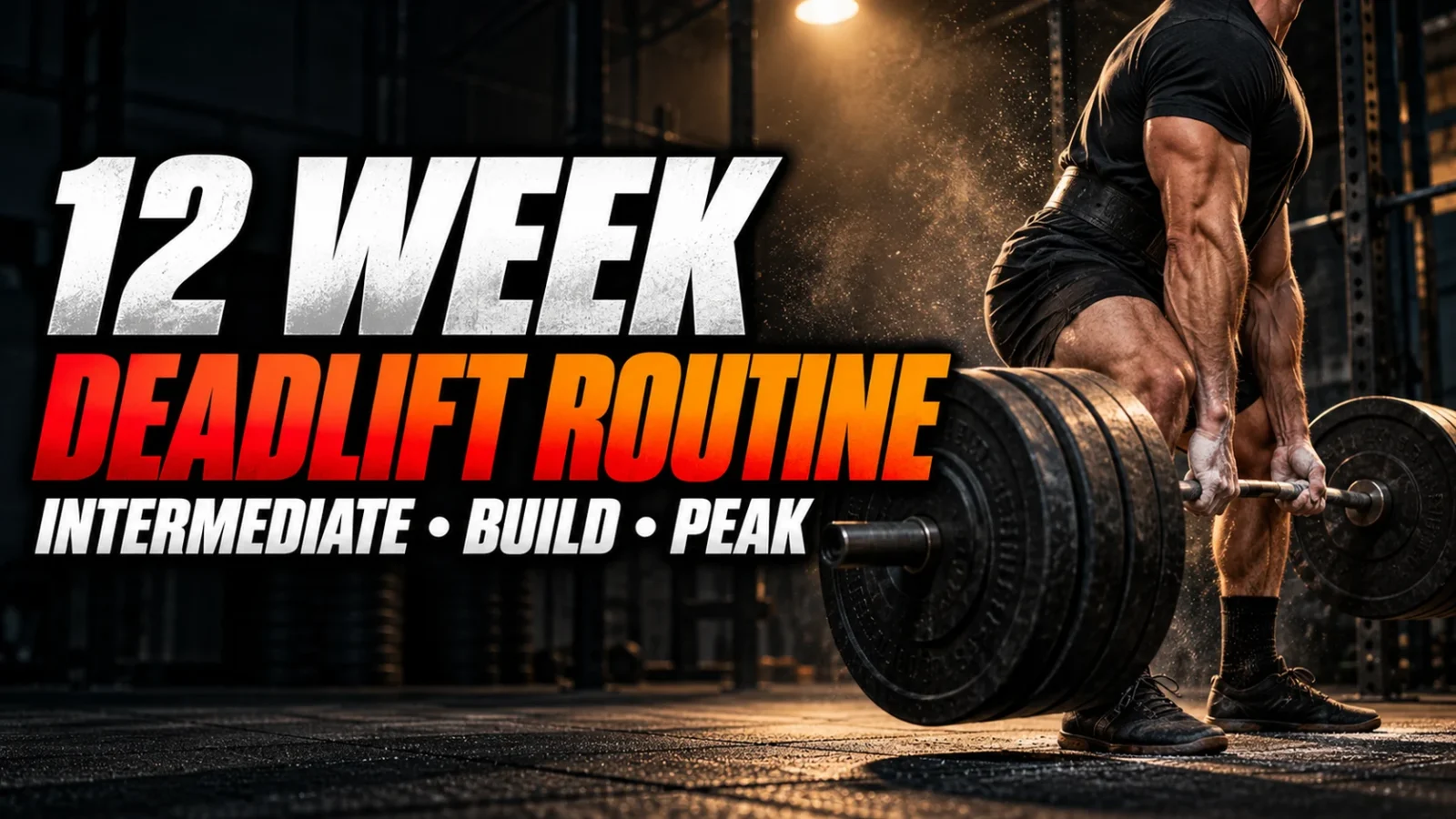
This 12 week deadlift workout is a back strength specialization routine for intermediate lifters who want a bigger pull. It runs in three 4-week blocks: plenty of back work and lighter deadlifts at the start, heavier pulls with less assistance volume in the middle, and a peak to heavy singles that ends with a max attempt in week 12.
Below you will find how the blocks fit together, how to set your training numbers, the full week-by-week deadlift chart with a worked example, the four day split, what kind of gain to expect, and the form points that keep heavy pulls safe.
Key Takeaways
- The program runs in three 4-week blocks: high-volume back work with lighter deadlifts, then moderate work, then a peak to heavy singles and a max attempt in week 12.
- Every percentage comes from a cycle max: your current one-rep max plus 5%, which is also the target for the cycle.
- Deadlifts are trained heavy once a week, on Monday, with squats and rows on Thursday and bench and overhead press days in between.
- Back assistance work drops from 4 to 3 to 2 sets per exercise as the deadlift loads climb, so recovery keeps pace with the heavier pulls.
- A realistic goal is the planned 5%, about 15-20 pounds for a 300-400 pound puller. A strong max day can add more, but gains shrink as you get stronger.
The Program at a Glance
| Detail | 12 Week Intermediate Deadlift Routine |
|---|---|
| Training level | Intermediate |
| Goal | A bigger deadlift and a stronger back |
| Length | 12 training weeks, then 1 week off |
| Split | 4 days a week |
| Heavy deadlift sessions | 1 per week (Monday) |
| Structure | Three 4-week blocks: volume, intensity, peak |
| Target | Your current one-rep max plus 5% |
The plan assumes you already deadlift with solid technique and that adding weight from one session to the next has stopped working. If you are not sure that describes you, see whether you are a beginner, intermediate or advanced lifter.
The Three 4-Week Blocks
| Block | Weeks | Deadlifts | Back work |
|---|---|---|---|
| 1: Volume | 1-4 | Lighter loads (55-70%), more sets and reps | High: 4 sets per exercise |
| 2: Intensity | 5-8 | Moderate and rising loads (75-82.5%) | Moderate: 3 sets per exercise |
| 3: Peak | 9-12 | Heavy singles (85-95%), max attempt in week 12 | Reduced: 2 sets per exercise |
The logic is simple: as the deadlift gets heavier, total volume comes down. The early weeks build work capacity and back muscle with lots of submaximal pulling. The later weeks cut the assistance work so fatigue drops and you can show your strength on heavy singles.
After week 12, take a full week off training. Rest, eat well and sleep. With that 13th week included, one run of the program fills a quarter of the year, so you could repeat it up to four times a year. Base each new cycle on your new max, and if a repeat run stops moving the number, switch to a different block for a while before coming back to it.
Setting Your Cycle Max
Every percentage in the program is based on a cycle max, not on your current max. To find it, take your current one-rep deadlift max and add 5%. A lifter with a 380 pound max gets 399 pounds, rounded to a cycle max of 400.
Because the base sits 5% above your real max, the percentages are heavier than they look. The 95% single in week 11 is almost exactly your current max, and the 100% single on max day is a new personal best by 5%.
The chart below shows the cycle max for current deadlifts from 250 to 500 pounds, rounded to the nearest 5 pounds.
| Current max (lb) | Cycle max (lb) | Current max (lb) | Cycle max (lb) |
|---|---|---|---|
| 250 | 265 | 380 | 400 |
| 260 | 275 | 390 | 410 |
| 270 | 285 | 400 | 420 |
| 280 | 295 | 410 | 430 |
| 290 | 305 | 420 | 440 |
| 300 | 315 | 430 | 450 |
| 310 | 325 | 440 | 460 |
| 320 | 335 | 450 | 475 |
| 330 | 345 | 460 | 485 |
| 340 | 355 | 470 | 495 |
| 350 | 370 | 480 | 505 |
| 360 | 380 | 490 | 515 |
| 370 | 390 | 500 | 525 |
Training in kilograms works the same way: multiply your current max by 1.05 and round to the nearest 2.5 kg.
12 Week Heavy Day Deadlift Cycle
Monday’s deadlifts follow the progression below. The example column shows the working weights for a 400 pound cycle max (a current max of about 380 pounds).
| Week | % of cycle max | Sets x reps | Example (400 lb cycle max) |
|---|---|---|---|
| Week 1 | 55% | 8 x 6 | 220 lb |
| Week 2 | 60% | 7 x 5 | 240 lb |
| Week 3 | 65% | 6 x 4 | 260 lb |
| Week 4 | 70% | 5 x 3 | 280 lb |
| Week 5 | 75% | 4 x 3 | 300 lb |
| Week 6 | 77.5% | 3 x 3 | 310 lb |
| Week 7 | 80% | 3 x 2 | 320 lb |
| Week 8 | 82.5% | 2 x 2 | 330 lb |
| Week 9 | 85% | 3 singles | 340 lb |
| Week 10 | 90% | 2 singles | 360 lb |
| Week 11 | 95% | 1 single | 380 lb |
| Week 12 | 90%, 100%, 102.5%, 105% | 1 single each (max attempt) | 360, 400, 410, 420 lb |
Warm up with a few gradually heavier sets before the working sets each week, and keep every rep clean. Rest as long as you need between the heavy sets and singles; there is no prize for rushing them.
Week 12: The Max Attempt
After a thorough warm-up, take singles at 90%, 100%, 102.5% and 105% of your cycle max. The 100% single is the goal of the program: your old max plus 5%. Only go beyond it if that single moved well and your form held. For a lifter with a 400 pound cycle max, each 2.5% step is about 10 pounds.
If the 100% single fails, don’t keep grinding at it the same day. Use your best single from week 12 as your current max for the next cycle.
The 4-Day Training Split
| Day | Session |
|---|---|
| Monday | Heavy deadlift day |
| Tuesday | Bench press day |
| Wednesday | Rest |
| Thursday | Squats and heavy back day |
| Friday | Overhead press day |
| Saturday | Rest |
| Sunday | Rest |
Deadlifts get Monday, after two rest days, so you pull when you are freshest. Thursday adds squats and heavy rows, which train the legs and back again without another heavy deadlift session. Where a table lists sets as 4 / 3 / 2, the sets change by block (see the back work section below).
Monday: Heavy Deadlift Day
| Exercise | Sets | Reps |
|---|---|---|
| Deadlift | See the weekly chart | See the weekly chart |
| High rack pull and shrug | Work up (see below) | 5 |
| One-arm dumbbell row | 4 / 3 / 2 | 10 |
| Hyperextension | 4 / 3 / 2 | 10 |
| Face pull or bent-over lateral raise | 4 | 12 |
Tuesday: Bench Press Day
| Exercise | Sets | Reps |
|---|---|---|
| Bench press | 4 | 5 |
| Incline dumbbell bench press | 4 | 8 |
| Seated Arnold press | 4 | 10 |
| Cable triceps extension | 4 | 12 |
| Dumbbell curl | 4 | 10 |
The bench work here is steady rather than peaked. If you want a structured bench progression for a later cycle, the 5×3 bench press program is built for that.
Thursday: Squats and Heavy Back Day
| Exercise | Sets | Reps |
|---|---|---|
| Squat | 4 | 5 |
| Barbell row | 4 / 3 / 2 | 5 |
| Pull-up or lat pulldown | 4 / 3 / 2 | 10 |
| Seated cable row | 4 / 3 / 2 | 12 |
| Leg curl | 4 | 12 |
Squats stay at a steady 4 x 5 because this plan peaks the deadlift only. For a squat-focused block, see Matt Kroc’s 12 week squat program.
Friday: Overhead Press Day
| Exercise | Sets | Reps |
|---|---|---|
| Military press | 4 | 8 |
| Close-grip bench press | 4 | 8 |
| Dips | 4 | 10-15 |
| Upright row | 4 | 10 |
| Hammer curl | 4 | 10 |
If upright rows bother your shoulders, use a wider grip and stop the bar around chest height, or swap them for lateral raises.
How to Run the Rack Pulls and Back Work
High Rack Pull and Shrug
Set the pins so the bar starts around knee height or a little above. Pull to lockout, shrug at the top, then lower the bar back to the pins. Start with 135 pounds for 5 reps, then add 90 pounds (one 45 pound plate per side) and do another 5. Keep working up this way until you can no longer complete a clean set of 5. Once the sets get hard, smaller jumps are fine. Straps are also fine here, since the goal is the back and traps rather than grip.
Back Work Sets by Block
For barbell rows, pull-ups or pulldowns, seated cable rows, one-arm dumbbell rows and hyperextensions, the number of sets falls as the deadlift gets heavier. The reps stay the same.
| Block | Weeks | Sets per exercise |
|---|---|---|
| 1 | 1-4 | 4 |
| 2 | 5-8 | 3 |
| 3 | 9-12 | 2 |
What Results to Expect
The program is built to add the 5% in its cycle max. For a lifter pulling 300 to 400 pounds, that works out to roughly 15 to 20 pounds. If the 102.5% and 105% singles go well on max day, the gain can approach 10% (about 30 to 40 pounds for the same lifter), but treat that as a good result, not the expected one.
Don’t expect the same jump every cycle. The stronger you get, the smaller each gain tends to be, and sleep, food and body weight all play a part: a lifter in a calorie deficit should expect less. Benchmark each cycle against your previous best rather than against a yearly target.
For a look at how one of the strongest deadlifters has trained, see Benedikt Magnusson’s deadlift routine.
Deadlift Form Tips for Heavy Pulls
Heavy singles only pay off if your technique holds up under load. These are the points to check, grouped by phase of the lift.
Setup
- Bar position. Stand with the bar over the middle of your feet and your shins close to it.
- Hip height. Start with your hips between your knees and shoulders, not down in a squat position. The right height depends on your build, so film a few sets from the side to find yours.
- Shoulders. At the start, your shoulders should sit directly over or slightly in front of the bar. They only end up behind it at lockout.
- Back and brace. Set a neutral spine, take a big breath into your belly and brace before each rep. Don’t let your back round as the bar leaves the floor.
- Lats. Keep your lats tight so the bar stays close to your body. You don’t need to pinch your shoulder blades together.
The Pull
- No jerking. Straighten your arms and pull the slack out of the bar before it leaves the floor, then push the floor away. Yanking a heavy bar breaks your position.
- Hips and shoulders together. If your hips shoot up first, the lift turns into a stiff-legged back pull. Your hips and shoulders should rise at the same rate off the floor.
- Feet. Drive through your whole foot, with your weight over the midfoot and heels, not on your toes.
- Bar path. Keep the bar close and think about pulling it back into your legs as you stand up.
- Knees. Don’t let your knees cave inward. Keep them tracking in line with your toes.
- Head. Keep your neck neutral, in line with your back. Don’t crank your head up toward the ceiling or turn it to the side, and don’t check a mirror mid-rep. Film from the side if you want to review your form.
Lockout and Lowering
- Lockout. Finish by squeezing your glutes and standing tall. Don’t lean back past upright.
- Lowering. Lower the bar under control with a neutral back: hips back first, then bend the knees once the bar passes them.
Equipment
- Shoes. Wear flat, thin-soled shoes or deadlift slippers. Cushioned running shoes are less stable and add distance to the pull.
- Gloves. Skip them. Gloves make the bar effectively thicker and harder to hold. Chalk is the better option for grip.
- Collars. Always use collars so the plates can’t slide.
Training Smart
- Higher-rep sets. Sets like week 1’s 8 x 6 get harder as you tire, so focus on every rep and reset between reps if you need to. Proper form matters more than finishing the set quickly.
- No forced reps or heavy negatives. Leave these techniques out of your deadlift training.
- Don’t max out often. Heavy deadlifts are hard to recover from. Stick to the percentages and save true max efforts for week 12.
- Pain. Sharp or unusual pain is a reason to stop, not to push through. If you strain something, see how to speed up muscle strain recovery.
The Bottom Line
This 12 week deadlift routine is a straightforward peaking plan: one heavy pull a week, plenty of back work early on, and less volume as the weights climb toward a max attempt in week 12.
- Base every percentage on your current max plus 5%, and only go past the 100% single on max day if it moved well.
- Expect about 5% on your deadlift from a good run. Anything more on max day is a bonus, not the plan.
- Technique comes first: bar over midfoot, shoulders over the bar, neutral back, and hips and shoulders rising together.
Frequently Asked Questions
Disclaimer
Please read carefully
The information on this site is for educational and informational purposes only, and is not medical advice. Always consult a qualified healthcare professional before using any supplement or medication, or making changes to your health, fitness, or nutrition routine.
Not medical advice
Content here is not a substitute for professional medical advice.
Consult your doctor
Talk to your doctor before starting any supplement or new routine.
Use at your own risk
We are not responsible for adverse effects from acting on this.
Do your research
Make informed decisions about your own health.
No guarantees
Individual results vary. No claims about outcomes.
Important — Never disregard professional medical advice or delay seeking it because of something you read here. If you think you may have a medical emergency, call your doctor or your local emergency number right away.