Contents11 sections
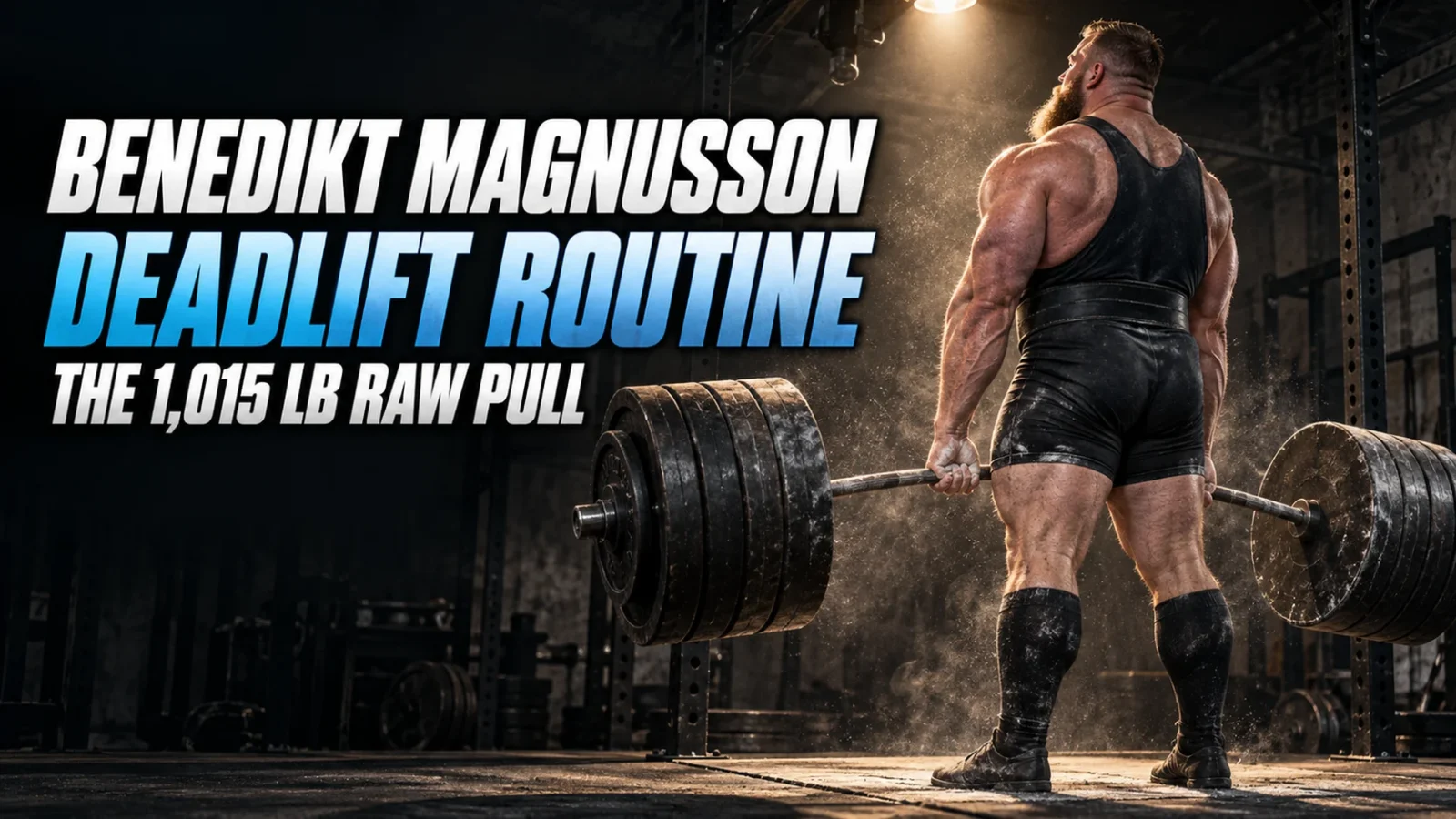
Benedikt Magnusson is an Icelandic powerlifter and one of the strongest deadlifters in history. At the Ronnie Coleman Classic in Texas in 2011 he pulled 460.4 kg (1,015 lb) raw, with no deadlift suit and no straps. That lift set a raw world record that stood for years.
His deadlift training looks simple on paper. He pulled hard once a week and rotated through three different sessions, with deficit pulls and lighter back-off sets in each one.
Below you’ll find that rotation as described by his training partner, the wider training split Magnusson shared himself, and a scaled version for lifters who are not pulling 400 kg.
Key Takeaways
- Magnusson’s best deadlift is 460.4 kg (1,015 lb), pulled raw in a powerlifting meet with no suit and no straps.
- He deadlifted once a week, rotating three sessions: heavy doubles at 80%, a 3-rep max, and the top-down “Jeff Jet” method.
- Every session also included fast deficit deadlifts from a 3-4 inch (8-10 cm) platform, usually followed by lighter sets of 8.
- His wider split builds squats, bench and upper-back work around the deadlift, including a narrow-stance squat that mirrors his pulling position.
- Most lifters should run a scaled version: fewer heavy sets, a smaller deficit, and rack pulls in place of the Jeff Jet method.
Who Is Benedikt Magnusson?
Magnusson made his name in raw powerlifting. Raw lifters compete without supportive suits or wraps, and powerlifting rules do not allow lifting straps on the deadlift, so the grip has to hold the full weight. His 460.4 kg pull at the Ronnie Coleman Classic was a raw world record and is still one of the heaviest deadlifts ever done under powerlifting rules.
He never deadlifted 500 kg. That mark belongs to strongman. Eddie Hall became the first person to deadlift 500 kg (1,102 lb) at the World Deadlift Championships in 2016, and Hafþór Júlíus Björnsson pulled 501 kg (1,104 lb) in 2020. Strongman rules allow straps and a deadlift suit, so those lifts are not directly comparable with a raw powerlifting deadlift.
| Lifter | Deadlift | Year | Rules |
|---|---|---|---|
| Benedikt Magnusson | 460.4 kg (1,015 lb) | 2011 | Raw powerlifting: no suit, no straps |
| Eddie Hall | 500 kg (1,102 lb) | 2016 | Strongman: straps and suit allowed |
| Hafþór Júlíus Björnsson | 501 kg (1,104 lb) | 2020 | Strongman: straps and suit allowed |
Benedikt Magnusson’s Deadlift Routine: Weeks A, B and C
The core of the routine comes from Stefán Sölvi Pétursson, a fellow Icelandic strongman who trained with Magnusson. They deadlifted once a week and rotated through three different sessions. Each one starts with a main deadlift. Then come deficit deadlifts, done standing on a platform about 3-4 inches (8-10 cm) high, and most sessions finish with lighter back-off sets.
All percentages refer to your one-rep max (1RM) in the regular deadlift from the floor.
| Week | Main deadlift | Deficit deadlift (3-4 in platform) | Back-off sets |
|---|---|---|---|
| A | Work up to about 80%, then 8 sets x 2 reps at 80% | 4-6 sets x 4 reps at 40-70%, as fast as possible | 2 sets x 8 reps at 40-50% |
| B | Work up to a 3-rep max | 4-6 sets x 3-5 reps at 50-75%, fast | 2 sets x 8 reps at about 50% |
| C | Jeff Jet method: work up to a 1-3 rep max, as the day allows | 4 sets x 4-6 reps at 50-60% | None listed |
Week A: Heavy Doubles and Speed Work
Eight doubles at 80% is a lot of heavy pulling, but every set stops well short of failure, so bar speed and technique stay sharp. The deficit work that follows uses light to moderate weights for sets of four, pulled as fast as possible.
Standing on the platform lengthens the range of motion. That makes the start of the lift harder, which is why lifters use deficits to build strength off the floor.
Week B: The 3-Rep Max
Week B is the test week: work up to the heaviest clean triple of the day. The deficit sets are slightly heavier than in week A (up to 75%) for 3-5 reps, again with the focus on speed. Two lighter sets of eight finish the session.
Week C: The Jeff Jet Method
Week C uses a top-down deadlift that, according to Sölvi, an American lifter named Jeff Jet showed them. It works like this:
- The bar starts on a rack at about thigh height, as in a rack pull, and the lifter stands up with it.
- Training partners take the rack away.
- The lifter lowers the bar to the floor and pulls it back up to lockout.
- The partners put the rack back under the bar.
Because each rep starts with the lowering phase, there is no dead start from the floor. Sölvi’s explanation was that they could get more out of a given weight this way, so the method let them work with much heavier loads than usual. They worked up to a heavy single, double or triple, depending on the day, and then did four sets of 4-6 deficit pulls at 50-60%.
This is a high-risk lift that depends on your partners. It needs two experienced spotters and a stable setup. Don’t try it alone, and don’t try it with people who have never handled a loaded rack.
Peaking for a Meet
The deadlift stays in the plan every week. For the last three or four sessions before a competition, they switched to regular deadlifts from the floor and worked in singles. They never went heavier than the weight they planned to open with at the meet. In Sölvi’s words, meet day is the day you want to be the strongest.
Benedikt Magnusson’s Workout Split
Magnusson also shared a broader program on his Facebook page. It is a powerlifting routine with squats and bench press, but the deadlift comes first and the rest of the program is built around it. He was clear that it was designed for him and that other lifters should adjust it to their own goals and abilities.
The program runs in two phases: a pre-conditioning block of 2-6 weeks, followed by a four-week muscle-building block.
Phase 1: Pre-Conditioning (2-6 Weeks)
The pre-conditioning phase has four sessions a week. Loads are light to moderate, and the focus is on speed, technique and work capacity.
| Day | Session | Main work |
|---|---|---|
| Monday | Squats | Narrow-stance speed squats up to 50-60% of 1RM, hamstrings, quads |
| Tuesday | Bench press | Bench press, rear delts |
| Wednesday | Rest | – |
| Thursday | Deadlift | Power cleans, technique deadlifts, sprints, pull-ups |
| Friday | Rest | – |
| Saturday | Bodybuilding | Shoulders and lats |
| Sunday | Rest | – |
Monday: Squats
| Exercise | Sets x Reps | Notes |
|---|---|---|
| Empty-bar squat | 5 sets | Warm-up |
| Squat (narrow stance) | Sets of 5-8, working up to 50-60% of 1RM | Explosive reps; start light and add weight each set |
| Hamstring curl | 4 x 12-15 | Hamstrings |
| Leg extension | 4 x 12-15 | Quads |
Magnusson recommends a narrower squat stance that reflects your deadlift position, so the squat carries over to the pull. Every rep should be explosive: this session is about building speed and power, not grinding heavy weights.
Tuesday: Bench Press
| Exercise | Sets x Reps | Notes |
|---|---|---|
| Bench press warm-up | Light weight, high reps | No lockout; focus on stretching the pecs |
| Bench press | 5 x 5-12 | Working sets |
| Rear delt flyes | 6-9 x 8-16 | Upper-back balance |
Thursday: Deadlift
| Exercise | Sets x Reps | Notes |
|---|---|---|
| Power clean | 3-4 x 10 | Warm-up |
| Deadlift | Sets of 4-6, starting at 120 kg (265 lb) | Strict form; add weight each week |
| Sprints | Several | About 70% of maximum effort |
| Pull-ups | Several sets | Lats and grip |
For a lifter who pulled over 460 kg, 120 kg is a very light start. The point is to groove technique and add load step by step. A comparable starting point for most lifters is roughly half of their own max, for easy and perfect reps.
Saturday: Shoulders and Lats
| Exercise | Sets x Reps | Notes |
|---|---|---|
| Standing shoulder press | 6 x 8-16 | Main shoulder lift |
| Military press | 1 light set + 1 heavy set x 8-12 | Light set first, then a heavy set |
| Lat pulldown | 6 x 8-12 | Lats |
| Rear delt work | Not specified | Any rear delt raise or fly |
The deadlift takes up only a small part of the training week, but everything else supports it. Narrow squats train the same leg drive, and the upper-back and lat work helps hold position in a heavy pull.
Phase 2: Muscle Building (4 Weeks)
After pre-conditioning, the focus moves to building strength and muscle. Magnusson runs this phase as three days on, one day off. That rotation does not line up with a calendar week; it works out to six sessions every eight days.
His notes for this phase are looser than the deadlift rotation and give few exact loads, so treat them as a template rather than a fixed prescription.
Day One: Squats
| Exercise | Sets x Reps | Notes |
|---|---|---|
| Empty-bar squat | 5 sets | Warm-up, narrow stance |
| Squat | 3-4 x 3 | Light weight |
| Squat | 4 x 3 | Add weight every set |
| Leg extension | Pump sets | Don’t count reps |
Day Two: Upper-Body Weak Points
Day two is for the muscles you think held you back in your last training block or meet. In his own example, Magnusson lists his chest, triceps and lats.
| Exercise | Sets x Reps | Notes |
|---|---|---|
| Bench press | Not specified | Chest and triceps |
| Military press | Not specified | Shoulders and triceps |
| Lateral, front and rear delt raises | Pump sets | Light weight, high reps |
| Lat pulldown | Not specified | Lats |
Day Three: Deadlift and Back
| Exercise | Sets x Reps | Notes |
|---|---|---|
| Deadlift warm-up | 4 x 6-12 | Light |
| Deadlift | 3 x 5 | Slightly heavier |
| Deadlift | 1 x 5 | Heavier |
| Deadlift | 1 x 5 | Heavier again (top set) |
| Deadlift back-off | 1 x 8-12 | Back down to warm-up weight |
| Dumbbell row | 4-8 sets, low reps | Upper back |
No exact loads are given. Even the top sets of five stay well below a one-rep max, so this day builds pulling volume rather than testing strength.
What Makes the Routine Work
Magnusson’s program is not built on a famous coach’s system. It reads like the notes of a lifter who knows what works for him, and a few principles stand out:
- One hard deadlift session a week: Heavy pulls are hard on the lower back and grip. A week between hard sessions leaves time to recover.
- Variation that stays specific: Deficits and top-down reps change the hardest part of the lift, but both stay close to the competition deadlift.
- Speed work: Light to moderate sets pulled as fast as possible let you practise producing force quickly, with far less fatigue than heavy sets.
- Conservative peaking: Finishing with singles no heavier than the opener means arriving at the meet fresh, without having left your best lift in the gym.
- Supporting work with a purpose: Narrow-stance squats, rows, pulldowns and rear delt work all feed the pull.
A Scaled Version for Non-Elite Lifters
Magnusson’s numbers were written for one of the strongest pullers in history. Eight doubles at 80% plus four to six deficit sets is more heavy deadlifting than most lifters can recover from every week.
The version below is our adaptation, not Magnusson’s own program. It keeps the A/B/C structure and the exercise choices, trims the volume and swaps out the riskiest lift.
It suits intermediate lifters with sound deadlift technique and a recent 1RM, either tested or estimated. If you are not sure where you stand, see Are You a Beginner, Intermediate or Advanced Lifter? Beginners usually progress faster on a simpler plan that adds a little weight each session.
Scaled Deadlift Rotation
| Week | Main deadlift | Deficit deadlift (1-2 in / 2.5-5 cm) | Back-off |
|---|---|---|---|
| A | Work up to 75-80%, then 5 sets x 2 reps | 3 sets x 4 reps at 50-60%, fast | 1 set x 8 reps at 40-50% |
| B | Work up to a 3-rep max, stopping with about one rep left in the tank | 3 sets x 3-5 reps at 55-65%, fast | 1 set x 8 reps at about 50% |
| C | Rack pull from just below the knee: work up to a heavy triple | 3 sets x 5 reps at 50-60% | None |
The rack pull in week C lets you handle heavier-than-usual weights, the same aim as the Jeff Jet method, without needing two partners to move a rack under a loaded bar. A smaller deficit also keeps your back position easier to hold while you learn the movement.
Scaled Weekly Split
| Day | Session | Suggested work |
|---|---|---|
| Monday | Squat | Narrow-stance squat 4 x 5 at 60-70%; hamstring curl and leg extension 3 x 12-15 |
| Tuesday | Bench | Bench press 4 x 5-8; rear delt flyes 3 x 12-15 |
| Thursday | Deadlift | Week A, B or C from the rotation above; pull-ups 3 sets |
| Saturday | Shoulders and back | Standing press 3 x 8-12; lat pulldown 3 x 8-12; dumbbell row 3 x 8-10 |
Guidelines
- Keep the deadlift to one hard session a week, as Magnusson did.
- On speed sets, every rep should move fast. If the bar slows down, the weight is too heavy.
- After each three-week rotation, add 2.5-5 kg to your week A and B targets if every set moved well.
- Before a test day or a meet, copy his peaking rule: a few sessions of singles from the floor, never heavier than your planned opener.
- Take a lighter week if your form starts to break down or your lower back stays sore between sessions.
For a fully laid-out alternative, see our 12 week intermediate deadlift workout routine. If you like strongman-style training, compare this routine with the Bill Kazmaier training routine and Mariusz Pudzianowski’s strongman workout.
The Bottom Line
Benedikt Magnusson’s deadlift routine is simple: one hard pull a week, rotated through three sessions, backed by fast deficit work and a training split built around the deadlift.
- His 460.4 kg (1,015 lb) raw deadlift came from consistent weekly work, not a complicated program.
- The A/B/C rotation of heavy doubles, a 3-rep max and top-down reps varies the stress while keeping the deadlift itself at the centre.
- Most lifters will get more from the scaled version: fewer heavy sets, a smaller deficit, and rack pulls in place of the Jeff Jet method.
Frequently Asked Questions
Disclaimer
Please read carefully
The information on this site is for educational and informational purposes only, and is not medical advice. Always consult a qualified healthcare professional before using any supplement or medication, or making changes to your health, fitness, or nutrition routine.
Not medical advice
Content here is not a substitute for professional medical advice.
Consult your doctor
Talk to your doctor before starting any supplement or new routine.
Use at your own risk
We are not responsible for adverse effects from acting on this.
Do your research
Make informed decisions about your own health.
No guarantees
Individual results vary. No claims about outcomes.
Important — Never disregard professional medical advice or delay seeking it because of something you read here. If you think you may have a medical emergency, call your doctor or your local emergency number right away.