Contents12 sections
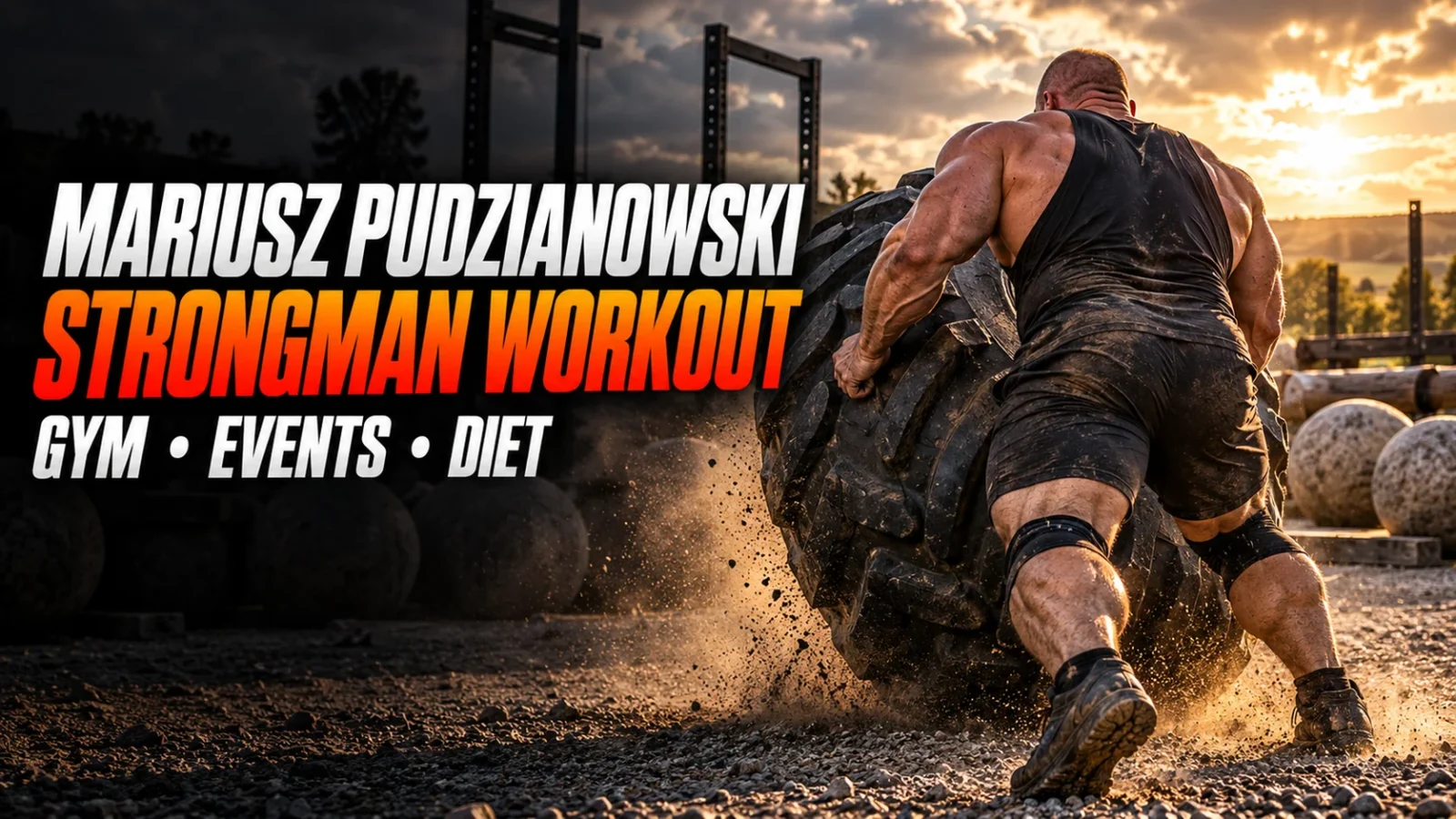
Mariusz Pudzianowski is one of the most successful strongmen in history. The Polish athlete, nicknamed “Pudzian” and “The Dominator”, won World’s Strongest Man a record five times between 2002 and 2008, competing at well over 300 lb, before leaving strongman for mixed martial arts in 2009.
His training was as relentless as his results. He reportedly trained twice a day, with heavy barbell work in the morning and event practice in the evening, at a volume most lifters could not recover from.
This guide lays out the routine attributed to him, what stands out about it, his famously loose diet, and how to use strongman training in your own program without copying a world champion’s workload.
Key Takeaways
- Mariusz Pudzianowski won World’s Strongest Man five times (2002, 2003, 2005, 2007 and 2008), still the record for the contest.
- His reported routine split each day into a morning gym session of heavy barbell lifts and high-rep accessories, and an evening session of strongman events.
- The workload was extreme: pyramids up to a 280 kg squat, a 300 kg deadlift and a 220 kg bench press, plus 6-set blocks of 15-20 reps on accessories.
- He reportedly did plenty of cardio (swimming, running and skipping rope), which supports the work capacity that timed strongman events demand.
- Most lifters should borrow the structure, not the workload: one weekly event session, or a few carries and loads after the main lifts, is plenty.
Mariusz Pudzianowski at a Glance
| Attribute | Detail |
|---|---|
| Full name | Mariusz Pudzianowski |
| Born | 7 February 1977, Biała Rawska, Poland |
| Nicknames | Pudzian, The Dominator |
| Sports | Strongman (until 2009), then mixed martial arts |
| World’s Strongest Man | Winner in 2002, 2003, 2005, 2007 and 2008; runner-up in 2006 and 2009 |
| Strongman bodyweight | Over 300 lb (136+ kg) |
| MMA | Debuted in December 2009; has fought mainly for the Polish promotion KSW |
| Training style | Twice-daily sessions: gym lifts in the morning, strongman events in the evening |
Reported Best Lifts
Pudzianowski’s gym numbers are widely quoted, usually as:
| Lift | Reported best |
|---|---|
| Bench press | 290 kg (about 640 lb) |
| Squat | 380 kg (about 840 lb) |
| Deadlift | 415 kg (about 915 lb) |
Treat these as approximate. The figures vary from source to source, and we could not match them to official competition records, so they are best read as reported gym lifts rather than verified bests. His strongman record is not in doubt, and strongman rewards a mix of absolute strength, speed and conditioning rather than one heavy lift.
From Strongman to MMA
Pudzianowski’s last World’s Strongest Man was in 2009, where he finished second to Žydrūnas Savickas. Within months he had moved to mixed martial arts, making his debut for KSW, Poland’s biggest MMA promotion, in December 2009 and winning in the first round.
His early MMA career included a loss to former UFC heavyweight champion Tim Sylvia in 2010, but he became one of KSW’s biggest draws, headlining major events in Poland and fighting on into his mid-forties. He has now had more than 20 professional MMA fights, and he fought noticeably lighter and leaner than in his strongman prime.
His record changes each time he fights, so check KSW or an MMA record database for his current tally.
Mariusz Pudzianowski’s Strongman Training Routine
Pudzianowski changed his training regularly, so no single program covers his whole career. The routine below is attributed to Steve Kirit, an American strongman who trained with him. We have not been able to trace the original account, so treat it as one reported snapshot of how he trained for strongman, not an official program.
It follows the pattern most accounts describe: two sessions a day, heavy barbell work in the morning and event training in the evening. Reports say he trained five days a week, for three to six hours a day, during the competition season, and took no rest days at all in the off-season.
Weekly Overview
| Day | Morning (9 am) | Evening (7 pm) |
|---|---|---|
| Day 1 | Back squat, leg curl, leg extension, back work, abs | Sandbag carry, Conan’s wheel, tire flip |
| Day 2 | Front squat, calves, standing military press, deadlift, good morning | Heavy carry, competition-style machine press, crucifix hold |
| Day 3 | Bench press, triceps | Day 1 events plus power stairs |
Day 1 Morning: Squats, Legs and Back
| Exercise | Sets x Reps | Notes |
|---|---|---|
| Back squat (warm-up) | 8 sets | Pyramid from 60 kg up to 160 kg |
| Back squat (working sets) | Pyramid, 6 reps down to 2 | 160 kg up to 280 kg; Olympic-style (high-bar) squats with a belt and knee wraps |
| Leg curl | 6 x 20 | Hamstrings |
| Leg extension | 6 x 20 | Quads |
| Pull-up | 6 x 15 | |
| Chin-up | 6 x 10 | |
| Behind-the-neck pulldown | 4 x 15 | Most lifters find front pulldowns easier on the shoulders |
| Barbell row | 4 x 15 | |
| Abs | 6 x 30 | Hanging leg raises, bends and similar |
Day 1 Evening: Event Training
| Event | Load | Volume |
|---|---|---|
| Sandbag carry | 130 kg | 3 x 170 m (as listed) |
| Conan’s wheel | 290 kg | 3 x 2.5 revolutions |
| Tire flip | Not listed | 3 x 10 flips |
Conan’s wheel is a classic World’s Strongest Man event: the athlete holds a weighted lever arm, fixed to a central post, in the crook of the elbows and walks it around in a circle for as many revolutions as possible.
Day 2 Morning: Front Squats, Pressing and Deadlifts
| Exercise | Sets x Reps | Notes |
|---|---|---|
| Front squat | Work up to 250 kg | Sets and reps not listed |
| Calf raise | 6 x 15 | |
| Standing military press (warm-up) | 7 sets | 60 kg up to 100 kg |
| Standing military press (working sets) | 6 sets of 4-5 | Pyramid through 110, 120, 130 and 140 kg |
| Deadlift (warm-up) | 6 with 200 kg (as listed) | |
| Deadlift (working sets) | Work up to 300 kg | |
| Good morning | 8 sets | 100 kg; reps not listed |
Day 2 Evening: Carries and Pressing
| Event | Load | Volume |
|---|---|---|
| “Bushman’s walk” (a heavy carry, as listed) | 300 kg | 3 x 15 m |
| Press machine (the type used in competition) | 120 kg | 3 x 10 |
| Crucifix hold | 40 kg weights | 30-second hold |
The source lists the machine presses as “10 reps x 3 reps”, which is most likely 3 sets of 10. The crucifix hold is a strongman event in which the athlete holds weights out to the sides with straight arms for as long as possible.
Day 3 Morning: Bench Press and Triceps
| Exercise | Sets x Reps | Notes |
|---|---|---|
| Bench press (warm-up) | 8 sets | Up to 180 kg |
| Bench press (working sets) | Pyramid, 8 reps down to 2 | 150 kg up to 220 kg |
| Barbell triceps extension | Work up to 80 kg | |
| Standing French press | Not listed | Overhead triceps extension |
The bench press is reported this way, with the warm-up topping out above the first working set, so one of the figures may be a typo.
Day 3 Evening: Events Plus Power Stairs
The evening session repeated the Day 1 events (sandbag carry, Conan’s wheel and tire flip) and added the power stairs, in which heavy implements are lifted up a flight of steps one step at a time, plus what the source calls “parallel stairs”.
What Stands Out
- Each heavy lift gets its own day. Squats on Day 1, front squats, presses and deadlifts on Day 2, bench press on Day 3, with event practice every evening.
- High reps on accessories. Six sets of 15-20 reps on leg curls, leg extensions and pull-ups is closer to bodybuilding than powerlifting.
- A lot of pulling. Pull-ups, chin-ups, pulldowns and rows add up to 20 sets on Day 1 alone, which builds the upper back that carries and loads depend on.
- Events trained like lifts. Each event has a set load, distance and number of sets rather than being thrown in as a random circuit.
Conditioning and Injury Prevention
Pudzianowski was known for his conditioning as much as his strength. Alongside his lifting he reportedly did plenty of cardio, including swimming, running and skipping rope. That matters in strongman, where many events are timed or run as medleys, and better conditioning lets an athlete get through more work in each session with shorter rests.
He also built a reputation for durability over a long strongman career. Strict technique and not lifting more than he could control are the usual explanations, and swimming is a form of conditioning that is easy on the joints.
For regular lifters the lesson is simple. Most can add two or three moderate conditioning sessions a week without hurting their strength, and better conditioning makes long, heavy sessions easier to get through.
Mariusz Pudzianowski’s Diet
Pudzianowski’s diet is almost as famous as his training, mostly because it was so loose. He is widely quoted as saying he ate whatever he wanted, when he wanted.
The stories repeated most often are a breakfast of 10 eggs and 2-3 lb of bacon, sweets between meals to keep his energy up, and chocolate and ice cream after training to keep his calories high enough that he did not lose weight.
Treat these as anecdotes rather than a meal plan. What they reflect is real enough: a 300 lb athlete training for several hours a day needs a huge amount of energy, and calorie-dense foods make it easier to eat enough. For most lifters, a better route to a calorie surplus is plenty of protein plus energy-dense whole foods; our list of the best high-calorie foods for bulking covers practical options.
What Is Strongman Training?
Strongman is the sport of lifting, carrying, pushing and pulling heavy, awkward objects, often against the clock or for distance. Where powerlifting tests three barbell lifts, a strongman contest might include a log press, a farmer’s walk, a truck pull and a set of Atlas stones in a single weekend. Many of the sport’s greats, including Bill Kazmaier, came to it from powerlifting, which is why heavy barbell work is still the backbone of most strongman training.
The Main Event Types
| Event type | Examples | What it trains |
|---|---|---|
| Overhead pressing | Log press, axle press, circus dumbbell | Shoulders, triceps, leg drive and bracing |
| Carries | Yoke, farmer’s walk, frame carry, Conan’s wheel | Grip, upper back, trunk and hips under load for a long time |
| Loading | Atlas stones, sandbags, kegs | Hips, upper back and arms; picking up and moving awkward objects |
| Pulls and pushes | Truck pull, sled drag, sled push | Legs and conditioning |
| Deadlift variations | Axle deadlift, car deadlift, tire flip | Posterior chain and grip |
Why Strongman Training Builds Strength and Size
Strongman events load the body in ways barbells and machines usually don’t. Carries keep the grip, upper back and trunk working for the whole distance, odd objects force the body to brace and stabilise as the load shifts, and medleys and timed events build work capacity. The heavy loads also provide plenty of mechanical tension, the main driver of muscle growth, which helps explain why strongmen carry so much muscle in the traps, upper back, forearms and legs.
None of this replaces the basics. Squats, deadlifts, presses and rows still do most of the work, and progressive overload drives long-term gains (see our guide to hypertrophy and strength training). Strongman work is best seen as an addition that fills the gaps a barbell-only program can leave, especially grip, upper back and conditioning.
Gym Substitutes for Strongman Equipment
Most gyms have no yoke or Atlas stones, but you can train similar patterns with standard equipment:
| Strongman event | Gym substitute |
|---|---|
| Farmer’s walk | Heavy dumbbells, kettlebells or a trap bar, walked for distance |
| Yoke | Heavy sled push, or a Zercher carry with a barbell |
| Log or axle press | Barbell or fat-grip clean and press, dumbbell push press |
| Atlas stones | Sandbag to shoulder, or sandbag over a bar |
| Conan’s wheel | Zercher carry with a barbell |
| Truck pull | Sled drag or sled push |
| Tire flip | Trap bar deadlift plus sandbag ground-to-shoulder |
How to Add Strongman Training to Your Program
- Start with one event day a week, or two or three events at the end of two of your normal sessions.
- Pick one movement from each group: a press, a carry, a load and a pull or push.
- Measure the work in distance or time (for example 4 x 30 m carries) and add load or distance gradually, as you would add weight to the bar.
- Keep the heavy barbell lifts at the core of the program, and count event work as part of your weekly training load.
- Rest 2-3 minutes between heavy carries and loads; they are more demanding than they look.
Sample Strongman-Style Session
| Exercise | Sets | Reps or distance | Notes |
|---|---|---|---|
| Barbell or axle clean and press | 5 | 3-5 | Clean each rep from the floor or the hang |
| Farmer’s walk (dumbbells or trap bar) | 4 | 30-40 m | Heavy, but stay tall |
| Sandbag ground-to-shoulder | 4 | 5, alternating shoulders | |
| Sled push or drag | 4 | 20-30 m | Hard but steady effort |
| Suitcase carry | 3 | 20 m per side | One-arm carry for the trunk |
Choose loads you can move with good form on every set. In a normal week this session can replace one accessory day.
Safety First
Odd objects are harder to control than a barbell, so learn each event with light weights, warm up properly and end a set when your form breaks down. Use chalk for grip, wear a belt for heavy carries and loads if you normally use one, and never attempt maximal events alone. If you are still building basic strength, get there first; our guide to whether you are a beginner, intermediate or advanced lifter helps you judge where you stand.
How to Adapt Pudzianowski’s Routine
Copying Pudzianowski’s numbers is not the point. His routine was built for a world champion with years of training behind him, rare genetics for strength and the time to train for several hours a day. Elite results are also a poor benchmark for natural lifters, since strength sports at the top level have a long history of performance-enhancing drug use.
What you can borrow is the structure:
- Separate the heavy lifts from the events. Do event work in its own session, or after your main lifts, never before them.
- Use his pyramids with your own weights. Build up over several sets to one or two heavy sets of 2-3 reps, at a weight you could lift for one or two more reps.
- Cut the accessory volume roughly in half. Three sets of 12-20 reps instead of six sets of 20 is plenty for most lifters.
- Train four or five days a week, not every day, and keep one or two short conditioning sessions.
- Eat and sleep for the workload. More training needs more food and more recovery.
If you like combining heavy lifting with bodybuilding-style volume, our guide to the best powerbuilding workouts has more manageable programs built on the same idea.

Pros
- Catalog is specifically organized around muscle building, fat loss, testosterone support, and workout performance.
- Range includes creatine, protein, EAAs, beta-alanine, and L-citrulline alongside more specialized formulas.
- Orders of $99+ qualify for free US shipping.
Cons
- Features several strong claims around muscle growth, testosterone, fat loss, and metabolic effects that should be distinguished from independently demonstrated clinical outcomes
- Heavily oriented toward bodybuilding and performance rather than broader nutritional supplementation.
The Bottom Line
Mariusz Pudzianowski’s reported routine combined heavy barbell pyramids, high-rep accessories and daily event training, backed by plenty of conditioning and a very high calorie intake.
- The routine is a snapshot of a five-time World’s Strongest Man at his peak, not a program most lifters can recover from as written.
- Borrow the structure: heavy lifts first, events and carries separately, and conditioning on the side.
- One weekly strongman session with a press, a carry, a load and a sled is a practical way to train grip, upper back and work capacity.
Frequently Asked Questions
Disclaimer
Please read carefully
The information on this site is for educational and informational purposes only, and is not medical advice. Always consult a qualified healthcare professional before using any supplement or medication, or making changes to your health, fitness, or nutrition routine.
Not medical advice
Content here is not a substitute for professional medical advice.
Consult your doctor
Talk to your doctor before starting any supplement or new routine.
Use at your own risk
We are not responsible for adverse effects from acting on this.
Do your research
Make informed decisions about your own health.
No guarantees
Individual results vary. No claims about outcomes.
Important — Never disregard professional medical advice or delay seeking it because of something you read here. If you think you may have a medical emergency, call your doctor or your local emergency number right away.