Contents12 sections
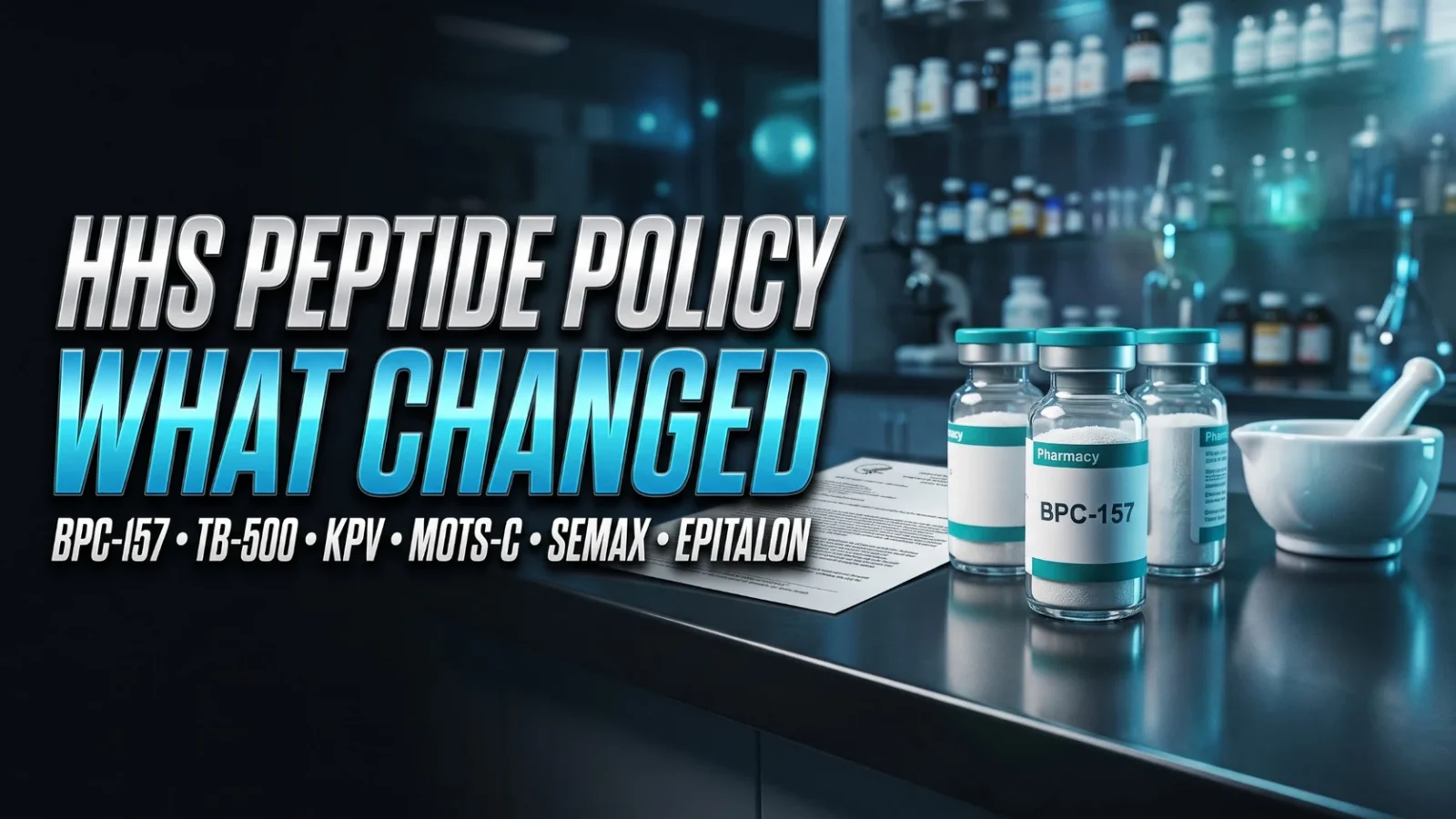
The US Department of Health and Human Services has said it won’t take action against compounding pharmacies that make six peptides, including BPC-157 and TB-500, as long as they follow a list of 10 conditions. The policy was announced on October 28, 2026, and published in the Federal Register on October 30. The public comment period closed on November 13.
For anyone who’s been buying BPC-157 as a “research chemical,” this sounds like the moment peptides went legit. It isn’t quite that. None of the six peptides has been approved by the FDA, the policy only covers prescriptions filled by traditional compounding pharmacies, and it can be pulled back at any time.
This article explains exactly what the HHS peptide compounding policy does, which peptides and forms it covers, the conditions pharmacies have to meet, what it doesn’t change, and why the FDA’s own scientists and the American Medical Association oppose it.
Key Takeaways
- HHS published an enforcement discretion policy on October 30, 2026, covering BPC-157, TB-500, KPV, MOTS-c, Semax and Epitalon.
- It applies only to 503A compounding pharmacies filling a patient-specific prescription. Larger 503B outsourcing facilities aren’t covered.
- Pharmacies must meet 10 conditions, including using ingredients from FDA-registered manufacturers with a certificate of analysis and reporting serious side effects.
- It isn’t an FDA approval. It creates no legal rights, doesn’t cover “research use only” sales, and HHS can revisit it if safety problems appear.
- FDA scientists opposed the move, and on November 9 the American Medical Association called for it to be rescinded.
What HHS Announced
The notice is called “Enforcement Discretion Policy Regarding 503A Compounding Using Certain Peptide Bulk Drug Substances.” It was published in the Federal Register on October 30, 2026 (91 FR 68526, docket HHS-OASH-2026-0496) and signed by HHS Secretary Robert F. Kennedy Jr.
The source matters. The notice came from the HHS Secretary’s office, not from the FDA, which normally handles compounding rules. According to an AP report, most FDA scientists opposed easing access, and HHS turned to enforcement discretion after FDA staff wouldn’t support a formal rule.
“Enforcement discretion” means the government is choosing not to enforce certain rules in certain situations. It doesn’t change the law itself. Here, HHS is saying it won’t act against pharmacies that compound these six peptides, provided they meet every condition in the policy.
Is it a draft or in effect?
That’s not entirely clear. The notice itself “announces” the policy and invited comments for two weeks after publication, until November 13. Several law firms and trade publications, including AJMC, have described it as a draft or interim policy. The notice doesn’t give a separate effective date, and HHS hasn’t said whether it will change the policy after reviewing comments.
Which Peptides Are Covered?
The policy covers six peptides, each only in specific forms. According to a summary by the law firm Venable, all six are covered as the acetate salt except Semax, which is covered as the free base.
| Peptide | Routes the policy covers | Our coverage |
|---|---|---|
| BPC-157 | Injection under the skin or into muscle, oral, topical | BPC-157 research guide |
| TB-500 | Injection under the skin or into muscle | TB-500 |
| MOTS-c | Injection under the skin or into muscle | MOTS-c before and after |
| Epitalon | Injection under the skin or into muscle, in intermittent courses | Epitalon Guide |
| KPV | Oral, topical | KPV peptide guide |
| Semax | Nasal spray only | Semax vs Selank |
A pharmacy that compounds one of these peptides in a form not on the list, such as injectable Semax or a BPC-157 nasal spray, falls outside the policy.
The 10 Conditions Pharmacies Must Meet
The full conditions are in appendices to the HHS policy document. According to summaries from Holland & Knight and Venable, a pharmacy must meet all 10:
- The peptide is one of the six listed in the policy.
- It matches the identity HHS specifies (sequence, structure, molecular weight and formula) and is used only by the listed routes.
- The raw ingredient comes from an FDA-registered facility and has a valid certificate of analysis (COA) covering identity, purity, potency and contaminants such as endotoxin, heavy metals and microbes.
- The original manufacturer is registered, follows good manufacturing practices and is named on the COA. Any reseller in between must have checked the manufacturer and its COA.
- Serious side effects and quality problems are reported to the FDA’s MedWatch system and to state regulators, and the label tells patients how to report them.
- The label says “This is a compounded drug product. Not for resale.”
- The product contains only one of the listed peptides, so no blends.
- Oral products have documented evidence that the peptide is adequately absorbed by mouth in humans.
- The only device packaged with the product is an FDA-cleared syringe.
- Every other legal requirement is met, including a valid prescription for a specific patient and sanitary conditions.
Two of these stand out. The single-peptide rule rules out the popular BPC-157 and TB-500 blends. And the oral absorption rule may be hard to meet: as our BPC-157 guide explains, there’s no published human data showing how much oral BPC-157 reaches the bloodstream.
If you want to know what a proper certificate of analysis should show, see our guide to reading a peptide COA.
What the Policy Doesn’t Do
This is where most of the confusion lies.
- It isn’t an FDA approval. None of the six peptides has gone through clinical trials for safety and effectiveness. The policy says nothing about whether they work.
- It isn’t binding. The notice says it creates no rights for anyone and doesn’t bind HHS or the public. It also doesn’t add the peptides to the official list of ingredients pharmacies may compound.
- It doesn’t cover “research use only” sales. The policy is limited to licensed pharmacies filling prescriptions with ingredients from registered manufacturers. Websites selling vials labeled “not for human consumption” are a different matter entirely. Our article on whether peptides are legal covers that gray market.
- It doesn’t override states. State pharmacy boards and state laws still apply, and the policy doesn’t protect pharmacies from private lawsuits.
- It doesn’t cover outsourcing facilities. Larger 503B facilities that make drugs in bulk without individual prescriptions aren’t included.
- It doesn’t change sport rules. BPC-157 is named on the World Anti-Doping Agency’s list under S0, the category for substances with no current approval for human use, and is banned at all times. A prescription doesn’t change that.
How long does it last?
There’s no end date. According to the Federal Register notice, the policy applies to each peptide until a final rule either adds it to or excludes it from the official list of ingredients pharmacies can use. HHS also says it may revisit the policy, in whole or in part, if a safety or quality problem comes to light.
How We Got Here
The policy is the latest step in a fast-moving year for peptides.
- September 2023: The FDA placed BPC-157 and several other peptides in “Category 2,” a list of bulk ingredients it said may pose significant safety risks. That effectively stopped pharmacies from compounding them.
- February 2026: Kennedy said the Category 2 peptides would be reconsidered, according to the law firm McDermott Will & Schulte.
- April 2026: Twelve peptides, including all six in the new policy, were removed from Category 2 after the requests to add them to the compounding list were withdrawn. The FDA’s Category 2 page now lists BPC-157 as “nominated but withdrawn.” Removal alone didn’t make them legal to compound.
- July 23 and 24, 2026: The FDA’s Pharmacy Compounding Advisory Committee voted on seven peptides. FDA staff recommended against all seven.
- October 14 and 15, 2026: The White House budget office logged an FDA submission, and CNBC reported that a peptide access policy was under review.
- October 28 to 30, 2026: HHS announced and published the enforcement discretion policy.
How the advisory committee voted
| Peptide | Yes | No | Abstain | Result |
|---|---|---|---|---|
| BPC-157 | 8 | 6 | 1 | Recommended |
| KPV | 8 | 6 | 1 | Recommended |
| TB-500 | 8 | 6 | 1 | Recommended |
| MOTS-c | 7 | 5 | 2 | Recommended |
| Epitalon | 7 | 4 | 1 | Recommended |
| Semax | 8 | 5 | 1 | Recommended |
| Emideltide | 6 | 7 | 1 | Not recommended |
Votes as reported by McDermott Will & Schulte and Pharmaceutical Executive. The six peptides the committee backed are exactly the six in the HHS policy.
Why Kennedy backs it
Kennedy has described himself as a big fan of peptides and has said he used BPC-157 for a muscle injury, according to AP and CNBC. His argument is that people are already buying peptides from gray-market sellers, often made in China, and that regulated pharmacies with tested ingredients are the safer option.
Who Supports It and Who Opposes It
Supporters. The Alliance for Pharmacy Compounding welcomed the policy. Its CEO, Scott Brunner, argued that the real question is where patients get peptides, not whether they use them, The Hill reported.
Opponents. The list is longer:
- The American Medical Association adopted policy at its interim meeting on November 9 urging HHS and the FDA to rescind it, Medical Daily reported.
- FDA scientists mostly opposed easing access, according to AP. The FDA itself hasn’t made a public statement.
- The Partnership for Safe Medicines said the policy leaves Americans in a gray area on safety. It has filed a citizen petition and raised conflict-of-interest concerns about the advisory committee, according to The Hill and AJMC.
- Patient safety groups ECRI and ISMP warned against it, and Public Citizen criticized the advisory committee vote.
- The American Action Forum, a center-right policy group, filed a comment opposing the policy.
We found no lawsuits challenging the policy so far.
What the Evidence Says About These Peptides
The policy is about access, not evidence, and the evidence is thin. For BPC-157, the most researched of the six, the published human data consist of a 12-woman pilot study on bladder pain, a two-person IV safety study and a small chart review on knee pain, none with a control group. A 2025 systematic review found 35 animal studies and one clinical study, with no clinical safety data to speak of.
The other five have even less human research in Western journals. Semax and Epitalon were developed in Russia, where most of their research was done. That doesn’t mean they don’t work. It means nobody can say with confidence how well they work or how safe they are over the long term. For what’s known about side effects across the class, see our guide to peptide side effects.
What This Means for You
If you’ve been buying “research” peptides online, the policy gives you a legal route that didn’t exist before: a prescription filled by a licensed pharmacy using tested ingredients. It doesn’t make research chemical vendors any more legal, and it doesn’t make the products they sell any more reliable.
If you’re thinking of getting a prescription, availability is just starting. Some telehealth companies have announced programs. Superpower opened preorders on November 2 for BPC-157, TB-500 and MOTS-c, while Hims & Hers said it would offer BPC-157 and TB-500 when the regulatory environment allows. Expect prices, quality and medical screening to vary widely while the rules settle.
If you compete in a tested sport, nothing has changed. These peptides remain banned, prescription or not.
Whatever you decide, the policy’s own conditions are a useful checklist. A legitimate source should be able to show a certificate of analysis from a registered manufacturer, sell single peptides rather than blends, and tell you how to report side effects. If it can’t, it isn’t operating under this policy.
The Bottom Line
HHS has opened a narrow, temporary route for licensed pharmacies to compound six peptides by prescription, but it hasn’t approved them, and the policy could change or be withdrawn.
- The policy covers BPC-157, TB-500, KPV, MOTS-c, Semax and Epitalon, each only in specific forms, and only at 503A pharmacies.
- Pharmacies must meet 10 conditions, including tested ingredients from registered manufacturers, single-peptide products and side-effect reporting.
- It doesn’t legalize research chemical sales, doesn’t bind the states and doesn’t change WADA’s ban.
- FDA scientists and the AMA oppose it, and the human evidence for all six peptides remains very limited.
Frequently Asked Questions
Disclaimer
Please read carefully
Not medical advice
Content here is not a substitute for professional medical advice.
Consult your doctor
Talk to your doctor before starting any supplement or new routine.
Use at your own risk
We are not responsible for adverse effects from acting on this.
Do your research
Make informed decisions about your own health.
No guarantees
Individual results vary. No claims about outcomes.
Important — Never disregard professional medical advice or delay seeking it because of something you read here. If you think you may have a medical emergency, call your doctor or your local emergency number right away.