Contents12 sections
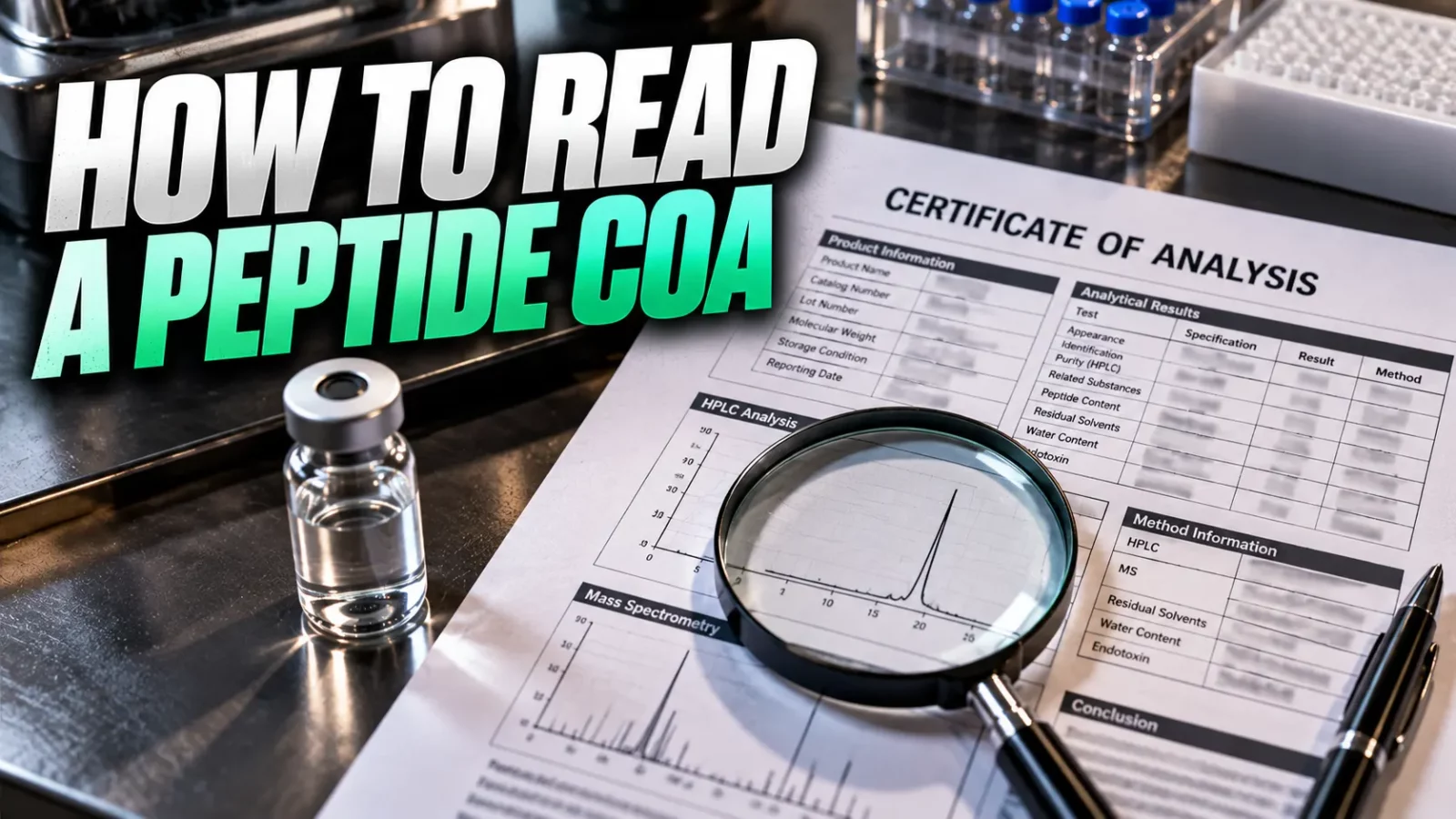
A peptide COA (certificate of analysis) is a lab report describing what testing found in one specific batch of a peptide. Reading one comes down to five checks: the identity is confirmed by mass spectrometry, HPLC purity is reported with its method and chromatogram, the lot number matches the vial, the test date is recent, and the report names a real laboratory that can confirm it issued the document. Everything else on the page, from net peptide content to endotoxin, adds depth to those five checks.
A COA is evidence, not a guarantee. It records what one sample from one batch showed on one date. It says nothing about how the material was stored afterward, and a document is only as trustworthy as the lab behind it. Independent test purchases of peptide products sold online have repeatedly found gaps between what the paperwork claims and what is in the vial, which is why knowing how to read a peptide COA matters more than knowing that one exists.
Key Takeaways
- A peptide COA needs two separate answers: what the compound is (mass spectrometry) and how pure it is (HPLC). Purity without identity is incomplete, because a very pure sample of the wrong peptide still scores well on HPLC.
- HPLC purity of ≥98% is the common research-grade benchmark, but the number only means something when the method and chromatogram are shown.
- Purity and net peptide content are different measurements. A 99% pure peptide can still be roughly 60–90% peptide by weight, with the rest made up of counter-ions such as TFA or acetate and residual water.
- Endotoxin, sterility and heavy metal results are separate tests. Most research peptide COAs do not include them, and a purity figure says nothing about them.
- A 2024 test-purchase study of semaglutide sold online without a prescription found endotoxin in every delivered vial and peptide content up to 39% above the label.
- The fastest way to check whether a COA is genuine is to contact the named lab directly with the batch or report number.
What a Peptide COA Is (and What It Isn’t)
A certificate of analysis is a technical document generated from analytical testing of a specific batch of material. Every peptide synthesis run is slightly different. Raw materials, coupling efficiency and purification all vary, so no two batches are identical. That is why a peptide COA is tied to a single lot number rather than to a product name in general.
It helps to be clear about what a COA is not:
- Not a specification sheet. A spec sheet describes what a product is supposed to be. A COA reports what testing actually measured.
- Not a guarantee. It reflects one sample on one date. Peptides can degrade with heat, light and moisture after testing.
- Not proof of safety. A purity and identity result does not cover sterility, endotoxin or heavy metals unless those tests appear on the report.
- Not proof of authenticity by itself. A PDF can be edited, reused or copied from another batch. The document has to be traceable to a lab that will confirm it.
An approved peptide medicine goes through a full release panel of identity, assay, impurity, sterility and endotoxin tests. A typical research peptide COA covers identity and purity, and sometimes quantity.
Anatomy of a Peptide Certificate of Analysis: An Annotated Walkthrough
The table below walks through the fields found on a well-built peptide certificate of analysis, top to bottom, with what a good entry looks like and what should raise questions.
| COA field | What it tells you | What good looks like | What should raise questions |
|---|---|---|---|
| Compound name | The peptide that was tested | Full name, sequence or CAS number where available | Brand name only, or a name that differs from the vial |
| Molecular formula and theoretical mass | The reference point for identity | Formula and expected molecular weight (monoisotopic or average) stated | No theoretical mass, so the MS result can’t be checked against anything |
| Lot or batch number | Traceability to a specific production run | Matches the number printed on the vial exactly | Missing, generic (“Batch 1”), or identical across many products |
| Sample or report ID | The lab’s own reference for this test | Unique report number the lab can look up | No lab reference, only the seller’s internal code |
| Date of analysis | How current the result is | Date of testing, ideally recent relative to when the batch was produced | No date, or a date years old |
| Test method | How purity and identity were measured | Named methods (RP-HPLC, LC-MS, ESI-MS) with column, mobile phase, gradient and detection wavelength | “Purity: 99%” with no method listed |
| HPLC purity | Proportion of the UV signal belonging to the target peptide | ≥98% Area% for research grade, with the chromatogram attached | A round number with no chromatogram |
| Chromatogram | The raw evidence behind the purity figure | One dominant, sharp main peak with small, labeled minor peaks | Cropped, blurry, or identical to chromatograms for other compounds |
| Mass spectrometry result | Whether the molecule is the correct one | Observed mass within a small tolerance of the theoretical mass, spectrum attached | No MS at all, or an observed mass that doesn’t match |
| Quantity or net peptide content | How much peptide is actually in the vial | Measured mg per vial, or NPC as a percentage | Claimed quantity with no measured value |
| Endotoxin, sterility, heavy metals | Contamination and safety screens | Reported with units (EU/mg, pass/fail, ppm) and the method used | Claimed as “tested” without results |
| Laboratory name and accreditation | Who stands behind the result | Named lab, address, ISO/IEC 17025 accreditation, signature of an analyst or QA reviewer | No lab named, or a lab you can’t find independently |
The first eight fields are the core. If identity, purity, lot traceability and a named lab are missing, the document isn’t doing its job.
HPLC Purity, LC-MS and Mass Spectrometry Explained
HPLC purity: how clean is the sample?
High-performance liquid chromatography (HPLC) pushes a dissolved sample through a packed column. Different molecules travel through the column at different speeds, so they exit at different times and show up as separate peaks on the chromatogram. For peptides, reversed-phase HPLC with UV detection around 210–220 nm is the standard method, and purity is calculated as the main peak’s area divided by the total area of all peaks.
A result of 98.5% Area% means about 98.5% of the UV-absorbing material detected is the target peptide. The remaining 1.5% is impurities. In synthetic peptides these are typically deletion sequences (a missing amino acid), insertion sequences, incompletely deprotected side chains, oxidation products and degradation products.
HPLC purity has two limits. It only measures what absorbs UV light at the chosen wavelength, so water and salts are invisible to it. And it can’t confirm identity: a different peptide eluting at a similar time can look like the right one.
Mass spectrometry: is it the right molecule?
Mass spectrometry (MS) ionizes the sample and measures the mass-to-charge ratio of the ions. For a peptide, the result is compared with the theoretical molecular weight of the intended sequence. Peptides often show several charge states (for example [M+2H]²⁺ and [M+3H]³⁺), which is normal and should be deconvoluted back to a single molecular mass.
When the observed mass matches the expected mass, that is strong evidence the peptide has the correct composition. A mass spectrometry peptide result that is off by the mass of one amino acid, or by 16 daltons (a common sign of oxidation), points to the wrong product or a degraded one.
LC-MS: both at once
LC-MS couples liquid chromatography directly to a mass spectrometer, so each peak in the chromatogram gets its own mass reading. This is the stronger approach because it confirms that the main peak, specifically, is the target peptide and can help identify what the minor peaks are. When a COA lists LC-MS, look for the mass assigned to the main peak, not just a general “MS conforms” statement.
| Method | Answers | Doesn’t answer |
|---|---|---|
| HPLC (UV) | How much of the UV-detectable material is the main compound | What the main compound is; water, salt or counter-ion content |
| MS | Whether a compound of the expected mass is present | How pure the sample is, or how much is there |
| LC-MS | Purity profile plus the mass of each peak | Net peptide content, sterility, endotoxin |
Net Peptide Content vs Purity, and TFA vs Acetate Salts
Why a 99% pure peptide isn’t 99% peptide
Freeze-dried peptide powder contains more than peptide. Basic amino acids and the free N-terminus bind counter-ions left over from synthesis and purification, and the powder holds residual water. Net peptide content (NPC) is the percentage of the powder’s weight that is actually peptide, as opposed to counter-ions and moisture. Bachem, one of the largest peptide manufacturers, notes that NPC and purity “are not equivalent” and that NPC is expected to be low for peptides rich in basic amino acids even when they are very pure.
Manufacturer technical notes commonly put NPC in the range of roughly 60–90% of total weight, depending on sequence and salt form. So a vial labeled 10 mg with 99% HPLC purity and 80% NPC contains about 8 mg of peptide. NPC is usually measured by amino acid analysis or nitrogen elemental analysis, and water by Karl Fischer titration.
Some sellers label vials by gross powder weight and others by net peptide weight. A COA that reports measured quantity per vial, or NPC, removes that ambiguity. It matters for any concentration calculation, which our peptide reconstitution guide and peptide calculator explain in more detail.
TFA vs acetate salts
Most synthetic peptides leave purification as a trifluoroacetate (TFA) salt, because trifluoroacetic acid is used in reversed-phase HPLC. TFA is difficult to remove completely, and converting a peptide to an acetate or hydrochloride salt requires an extra ion-exchange step.
The salt form matters for two reasons. It changes the molecular weight of the powder, and so the net peptide content. And TFA has its own biological activity in research settings: a 1999 study found that TFA at very low concentrations reduced proliferation of osteoblasts and chondrocytes in culture, enough to mask or invert a peptide’s measured effect, and recommended converting peptides to another salt before biological testing. Pharmaceutical peptides are commonly supplied as acetate salts for this reason.
A good COA states the salt form. If it says acetate, a residual TFA figure (measured by ion chromatography) is a sign of thorough testing.
Endotoxin, Sterility and Heavy Metals: The Tests Most COAs Skip
Endotoxin (EU/mg). Endotoxins are fragments of bacterial cell walls that can trigger fever and inflammatory reactions in very small amounts. They survive freeze-drying and are not removed by filtration that removes live bacteria. Results are reported in endotoxin units per milligram (EU/mg) or per vial, usually measured by the LAL (Limulus amebocyte lysate) method. The FDA’s guidance on pyrogen and endotoxins testing refers to the USP <85> bacterial endotoxins test as the basis for methods and acceptance criteria. A COA that reports endotoxin should give a number with units and a limit, not just “pass.”
Sterility. A sterility test (USP <71> or equivalent) checks for viable microorganisms. Lyophilized powder that tests sterile can still carry endotoxin, as the semaglutide study below showed. Sterility results are rare on research peptide COAs, and sterility of a powder says nothing about what happens once a vial is opened and reconstituted.
Heavy metals and elemental impurities. Metals such as lead, arsenic, cadmium and mercury are screened by ICP-MS under USP <232>/<233> in pharmaceutical settings. Very few research peptide COAs include this. If a seller claims heavy metal testing, the results should be reported in ppm against a stated limit.
Missing tests don’t mean a batch is contaminated. They mean the COA can’t speak to it either way.
Third-Party vs In-House Testing, and How to Verify the Lab
Who did the testing?
An in-house COA comes from the manufacturer or seller’s own lab. It is common, and not automatically unreliable, but it is a party grading its own work. A third-party COA comes from an independent laboratory with no stake in the result. Third-party testing is stronger evidence, provided the lab is real and the sample tested was genuinely from the batch in question.
A related issue: a manufacturer’s COA re-badged with a reseller’s logo. The test may be real, but it describes the raw material, not the finished, relabeled vial.
How to verify a peptide COA
- Contact the lab directly. Find the lab’s contact details independently (not from the COA itself) and ask whether it issued that report number for that batch. Some labs offer an online verification portal or QR code. A lab that won’t confirm, or has no record of the report, is the clearest sign a COA has been forged or borrowed from another batch.
- Check accreditation. ISO/IEC 17025 is the international standard for testing and calibration laboratories. Accreditation is granted by bodies such as A2LA or ANAB in the US, and their public directories list the accredited lab and the specific test methods covered. Accreditation for “chemical testing” does not automatically cover peptide LC-MS, so check the scope.
- Compare across batches. Different batches should produce slightly different numbers, dates and chromatograms. Identical figures across products or months suggest a template.
- Look for internal consistency. The molecular weight on the COA should match published values for that peptide. The retention time and mass should be plausible for its size.
What Independent Peptide Testing Has Found
Semaglutide test purchases (2024). Researchers at the University of Pécs and UC San Diego bought semaglutide from six illegal online pharmacies. Only three vials arrived; the three prefilled pens ordered were never delivered. All three vials were judged probable substandard or falsified products. Semaglutide content exceeded the labeled amount by 28.6% to 38.7%. Endotoxin was detected in every sample, at 2.16 to 8.95 EU/mg, even though no viable microorganisms were found. The measured purity ranged from 7.7% to 14.4%, against the 99% claimed on the labels. A shorter research letter from the same group appeared in JAMA Network Open.
Large crowd-sourced testing datasets (2026). A preprint posted in April 2026, which has not been peer reviewed, analyzed 6,441 grey-market samples across 14 peptides, including BPC-157, semaglutide and tirzepatide, from a public independent testing dataset. Depending on whether a compounding-style or an approved-drug-style acceptance standard was applied, 41.6% to 71.1% of samples failed basic quality criteria, and measurable endotoxin was found in about 15%. Those figures depend on what people chose to submit for testing, so they are not a random sample of the market.
Regulatory action. The FDA has issued warning letters to online peptide sellers since late 2024, stating that “research use only” labeling does not change how a product is regulated when the wider marketing points to human use. Our coverage of the Amino Asylum raid and our guide to whether peptides are legal cover the enforcement picture in more detail.
The pattern is consistent: documentation claiming 99% purity does not reliably predict what an independent lab finds. A verifiable, batch-specific COA from an accredited third-party lab narrows that gap. It does not close it.
Peptide COA Red Flags and a 60-Second Checklist
Red flags
- The same COA, chromatogram or purity figure appears across different products or batches
- No lot number, or a lot number that doesn’t match the vial
- A purity figure with no method and no chromatogram
- No mass spectrometry result, or an observed mass that doesn’t match the theoretical mass
- No named laboratory, or a lab that can’t be found independently
- The named lab won’t confirm it issued the report
- Cropped, blurred or low-resolution images with edits visible around numbers or logos
- “Endotoxin tested” or “sterile” claims with no numbers or units
Any one of these doesn’t prove fraud. Several together mean the document carries little weight.
The 60-second peptide COA checklist
- Name and mass: compound name and theoretical molecular weight are stated.
- Lot match: the lot number on the COA matches the vial exactly.
- Identity: MS or LC-MS shows an observed mass matching the theoretical mass.
- Purity: HPLC purity is ≥98%, with the method and chromatogram shown.
- Date: the analysis date is present and recent. A common rule of thumb is within about six months.
- Lab: a named, independent lab, ideally ISO/IEC 17025 accredited, that confirms the report when asked.
- Extras: quantity or NPC, salt form, and endotoxin with units, where provided.
If items 1 to 6 all check out, the COA is meaningful analytical evidence about that batch. If any are missing, the document has gaps that no amount of branding fills.
The Bottom Line
A peptide COA is a record of what one lab found in one batch on one date. Read carefully, it confirms identity and purity; read carelessly, it can make a weak product look trustworthy.
- Identity (mass spectrometry) and purity (HPLC with a visible method and chromatogram) are two separate questions, and a COA needs to answer both.
- Purity is not net peptide content, and most research COAs skip endotoxin, sterility and heavy metal testing entirely.
- Matching the lot number to the vial and contacting the named lab with the report number are the fastest ways to confirm a COA is genuine.
Peptide COA FAQ
Disclaimer
Please read carefully
The information on this site is for educational and informational purposes only, and is not medical advice. Always consult a qualified healthcare professional before using any supplement or medication, or making changes to your health, fitness, or nutrition routine.
Not medical advice
Content here is not a substitute for professional medical advice.
Consult your doctor
Talk to your doctor before starting any supplement or new routine.
Use at your own risk
We are not responsible for adverse effects from acting on this.
Do your research
Make informed decisions about your own health.
No guarantees
Individual results vary. No claims about outcomes.
Important — Never disregard professional medical advice or delay seeking it because of something you read here. If you think you may have a medical emergency, call your doctor or your local emergency number right away.