Contents12 sections
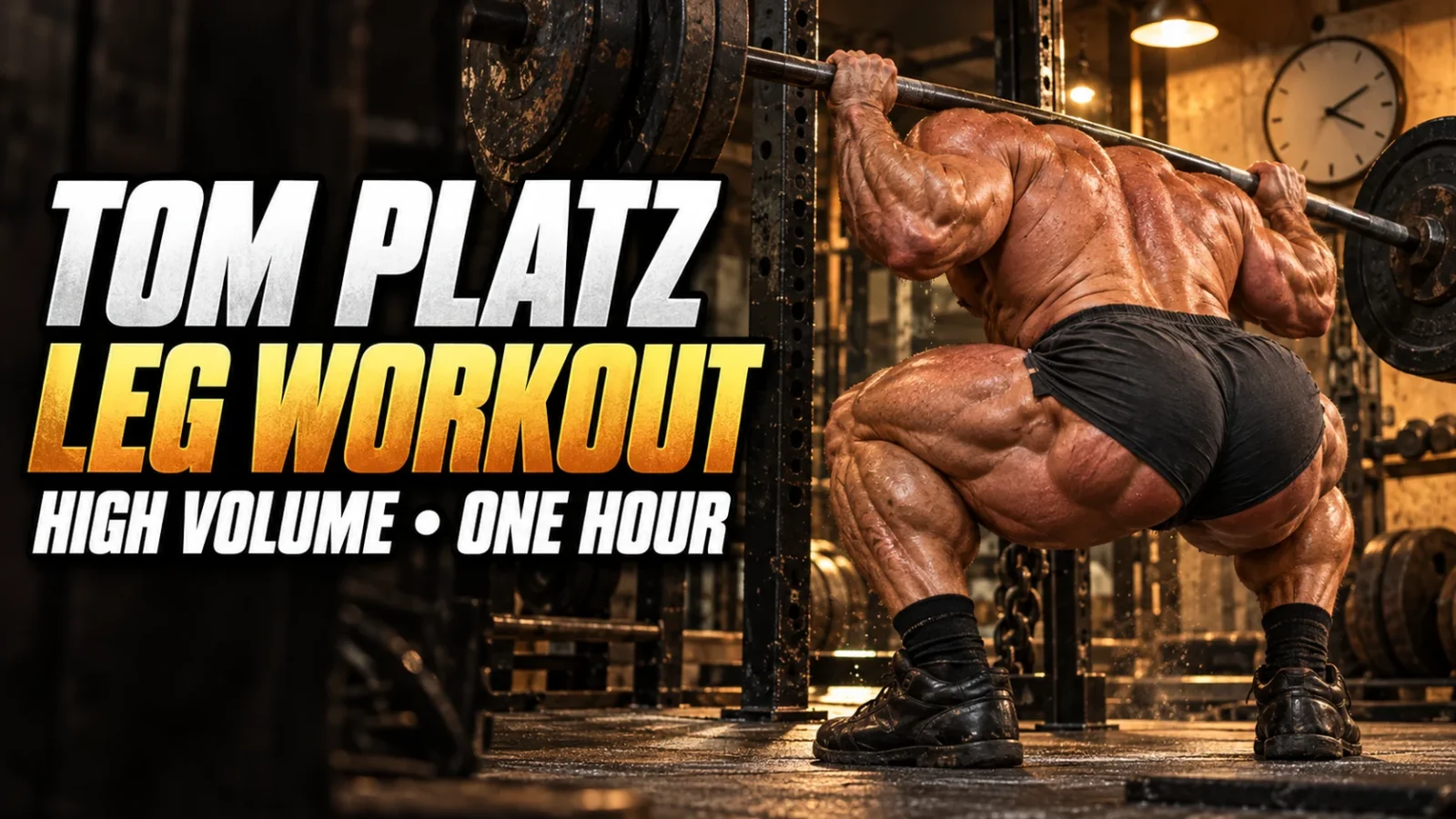
Tom Platz, nicknamed “The Golden Eagle”, built what many fans still call the best legs in bodybuilding history. He became famous for deep, high-rep squats and long, punishing leg sessions, the kind of high-volume training he shared with Arnold Schwarzenegger and many other Golden Era bodybuilders.
Most people don’t have hours to spend on legs. So how do you train like Tom Platz when your schedule is busy and you only have one hour? Where there’s a will, there’s a way.
Call this leg workout Tom Platz version 2.0: 21 working sets for quads, hamstrings and calves, with timed rests and clear progression rules, finished in about 60 minutes. It is hard, so read the warm-up and form notes before your first session.
Key Takeaways
- The workout packs 21 working sets into about an hour: 8 sets of squats, 4 quad sets, 6 hamstring sets and 3 high-rep calf sets.
- Short, timed rests drive the workout: squat rests shrink from 2 minutes to 60 seconds, and the second exercise uses rest-pause style breaks of 10-15 deep breaths.
- On the last set of the quad and hamstring exercises, cut the weight by about 30% and lower each rep over 4-6 seconds.
- Progression is built in: add weight once you reach 30 total reps on the quad exercise or 40 total reps on the hamstring exercise.
- Warm up properly, keep strict form when you’re tired, and start with one session a week so your legs can recover.
Who Is Tom Platz?
Tom Platz is an American bodybuilder who competed in the IFBB in the late 1970s and 1980s. His best Mr. Olympia result was third place in 1981, but he is remembered far more for his legs than for his placings. His quads and hamstrings were so large and detailed that they are still the benchmark people use when they talk about great legs.
Platz is just as well known for how he trained them: deep squats, very high reps, and sets pushed far past the point where most lifters stop. There are few body parts in the sport as iconic as the legs of Tom Platz, alongside the biceps of Arnold Schwarzenegger. Both men were known for long, high-volume sessions. This workout keeps that spirit and fits it into an hour.
How the One-Hour Tom Platz Leg Workout Works
The main principle is short, strictly timed rest. You will be watching the clock after every set. On squats, the rest periods shrink from 2 minutes to 60 seconds as the weight goes up. On the second exercise, you rest only 10-15 deep breaths between sets, which works like rest-pause training: short breaks, rising fatigue, and fewer reps each set.
The second tool is slow negatives. On the last set of each non-squat exercise, drop the weight by about 30%. Lift at a normal tempo, lower each rep over 4-6 seconds, and keep going until you can’t complete another rep with good form.
The first few sessions will feel brutal. Stick with it: over several weeks your work capacity improves, and the same weights and rest periods become manageable.
| Exercise | Sets x Reps | Rest | Time |
|---|---|---|---|
| Squats | 8 sets, 12 down to 4 reps | 2 min down to 60 s | About 25 min |
| Leg extensions, leg press or lunges (pick one) | 4 x 6-20 | 10-15 deep breaths | About 10 min |
| Romanian deadlifts or hamstring curls | 6 x 6-20 | 60 s | About 15 min |
| Calf raises (your choice) | 3 x 50 | 60-90 s | About 10 min |
| Total | 21 working sets | About 60 min |
Warm Up Before You Start the Clock
Your first working set is 12 squats with a real load, so don’t walk in cold. Spend about five minutes on a bike or rower, then do a few sets of bodyweight squats, leg swings and walking lunges to loosen up your hips, knees and ankles.
Then ramp up on the squat with two or three lighter sets, for example the empty bar for 10 reps, about 135 lb (60 kg) for 6-8 and about 185 lb (85 kg) for 3-5, scaled to your own first working weight. Keep these sets easy. They prepare you for the work and don’t count toward the 21 sets.
Squats
The weights below are an example for a lifter whose first working set is 225 lb. Pick a starting weight you could lift for about 15 reps when fresh, then add roughly 20 lb (10 kg) at each step, as shown.
| Set | Weight (example) | Reps | Rest after |
|---|---|---|---|
| 1 | 225 lb (102 kg) | 12 | 2 min |
| 2 | 245 lb (111 kg) | 10 | 2 min |
| 3 | 265 lb (120 kg) | 8 | 90 s |
| 4 | 265 lb (120 kg) | 8 | 90 s |
| 5 | 285 lb (129 kg) | 6 | 90 s |
| 6 | 285 lb (129 kg) | 6 | 90 s |
| 7 | 305 lb (138 kg) | 4 | 60 s |
| 8 | 305 lb (138 kg) | 4 | Move on |
Including the ramp-up sets, these 8 sets of squats take about 25 minutes. Your legs will feel finished already, but you’re not done yet.
Squat Form Cues
- Set the safety pins just below your lowest squat position, or squat with a spotter. Heavy sets on short rest are exactly when form slips.
- Brace before every rep. Take a big breath into your belly, tighten your trunk, then descend.
- Go as deep as you can with good form: lower back neutral, knees tracking over your toes, whole foot on the floor.
- Leave a rep in the tank. Stop the set if your back rounds or the bar slows to a grind. On squats, the volume and short rests do the work, not missed reps.
Leg Extensions, Leg Press or Lunges
Perform only one of these exercises per workout, and rotate them over three workouts: leg extensions in the first, leg press in the second, lunges in the third.
Rest only 10-15 deep breaths between sets. Pick a weight, and when you can perform 30 total reps across all 4 sets, move up in weight. On the last set of leg extensions or leg press, drop the weight by about 30% and use slow negatives.
- 4 sets of 6-20 reps
These 4 sets take about 10 minutes, including set-up time. You have now been training legs for about 35 minutes, and it’s time for your hamstrings.
Form Cues for the Rest-Pause Sets
- Stay at the machine and count your breaths. Take slow, deep breaths and start the next set on breath 10-15, not when you feel ready.
- Expect your reps to drop from set to set. That’s the point. Track the total, not each set.
- End each set when your form breaks or the reps slow sharply, not when the burn starts.
- Leg extensions: sit back against the pad, line your knees up with the machine’s pivot point, and squeeze your quads for a moment at the top. Don’t kick or swing the weight up.
- Leg press: keep your lower back and hips on the pad at the bottom of each rep, and don’t lock your knees out hard at the top.
- Lunges: stay tall, take a long enough step that your front knee tracks over your toes, and count reps per leg. Keep the last set at normal tempo and stop a rep or two short of failure, because failing a lunge means losing your balance.
Form Cues for the Slow-Negative Sets
- Drop the weight by about 30% from your working weight.
- Lift at a normal speed (about one second), then lower over a slow, steady count of 4-6 seconds.
- Keep the tempo the same on every rep. No bouncing out of the bottom and no dropping the weight on the last reps.
- Train to failure on the lift, not the form. The set ends when you can’t complete a full rep cleanly. On the leg press, set the safety stops before you start.
- Expect extra soreness for the first few weeks. Slow lowering work causes more delayed-onset muscle soreness than normal reps, and it eases as you adapt. For more on finishing sets like these, see how to use burn sets to build muscle.
Romanian Deadlifts or Hamstring Curls
Rest 60 seconds between sets, and don’t forget the slow negatives on your last set. When you can perform 40 total reps across all 6 sets, move up in weight.
You can also rotate in wide-stance deadlifts for variety. They work the hamstrings too, but a Romanian deadlift or a curl keeps the hamstrings as the main target.
- 6 sets of 6-20 reps
With set-up time, the hamstring work takes about 15 minutes, which brings you to roughly 50 minutes. Calves are last.
Hamstring Form Cues
- Romanian deadlifts: keep a soft bend in your knees, push your hips back, keep the bar close to your legs, and lower until you feel a strong stretch in your hamstrings with your back still flat.
- On RDLs, failure means technical failure. End the slow-negative set as soon as your lower back starts to round or the bar drifts away from your legs. Never grind out a rounded-back rep.
- Hamstring curls: keep your hips pressed into the pad and don’t let the weight stack slam between reps.
Calf Work
For calves, pick your favorite exercise, such as standing calf raises, seated calf raises or calf presses on the leg press, and perform 50-rep sets. It may take a session or two to find the right weight. Rest 60-90 seconds between sets. If you have to drop the weight from set to set to reach 50 reps, do so. Skip the slow negatives here; with this many reps, they aren’t needed.
- 3 sets of 50 reps
Use a full range of motion on every rep: a deep stretch at the bottom, a brief pause, then a full rise onto the balls of your feet. Bouncing at the bottom lets your Achilles tendon do part of the work your calves should be doing.
Recovery and How Often to Train It
In about 60 minutes you have done 21 hard sets. That is far less than the marathon sessions Platz was known for, but it’s a big step up for most lifters.
Take at least a day or two off from heavy leg work afterward. For most lifters, once a week is the right frequency for a session this demanding. Eat enough protein and carbohydrates, sleep well, and expect the first two or three weeks to leave you sore.
If you’re newer to training, start with about half the sets (4 squat sets, 2 sets on the second exercise, 3 hamstring sets and 2 calf sets) and build up as your recovery allows. Not sure where you stand? Find out whether you’re a beginner, intermediate or advanced lifter.
For more leg and volume training, see our big legs workout and our complete guide to German Volume Training.
The Bottom Line
This one-hour Tom Platz leg workout gets its volume from short, timed rests, slow negatives and simple progression rules rather than hours in the gym.
- Warm up and ramp up first, then let the shrinking squat rests, the rest-pause style quad sets and the slow-negative finishers do the work.
- Keep your form strict when fatigue hits: safety pins on squats, a flat back on RDLs, and no failed reps on lunges.
- Add weight only when you hit the rep targets (30 total on the quad exercise, 40 on hamstrings), and give your legs a full recovery between sessions.
Frequently Asked Questions
Disclaimer
Please read carefully
The information on this site is for educational and informational purposes only, and is not medical advice. Always consult a qualified healthcare professional before using any supplement or medication, or making changes to your health, fitness, or nutrition routine.
Not medical advice
Content here is not a substitute for professional medical advice.
Consult your doctor
Talk to your doctor before starting any supplement or new routine.
Use at your own risk
We are not responsible for adverse effects from acting on this.
Do your research
Make informed decisions about your own health.
No guarantees
Individual results vary. No claims about outcomes.
Important — Never disregard professional medical advice or delay seeking it because of something you read here. If you think you may have a medical emergency, call your doctor or your local emergency number right away.