Contents12 sections
How you store peptides decides how long they stay usable. A peptide that has been kept warm, wet or in the light can lose potency long before the date on the label, and you cannot see most of that damage with the naked eye.
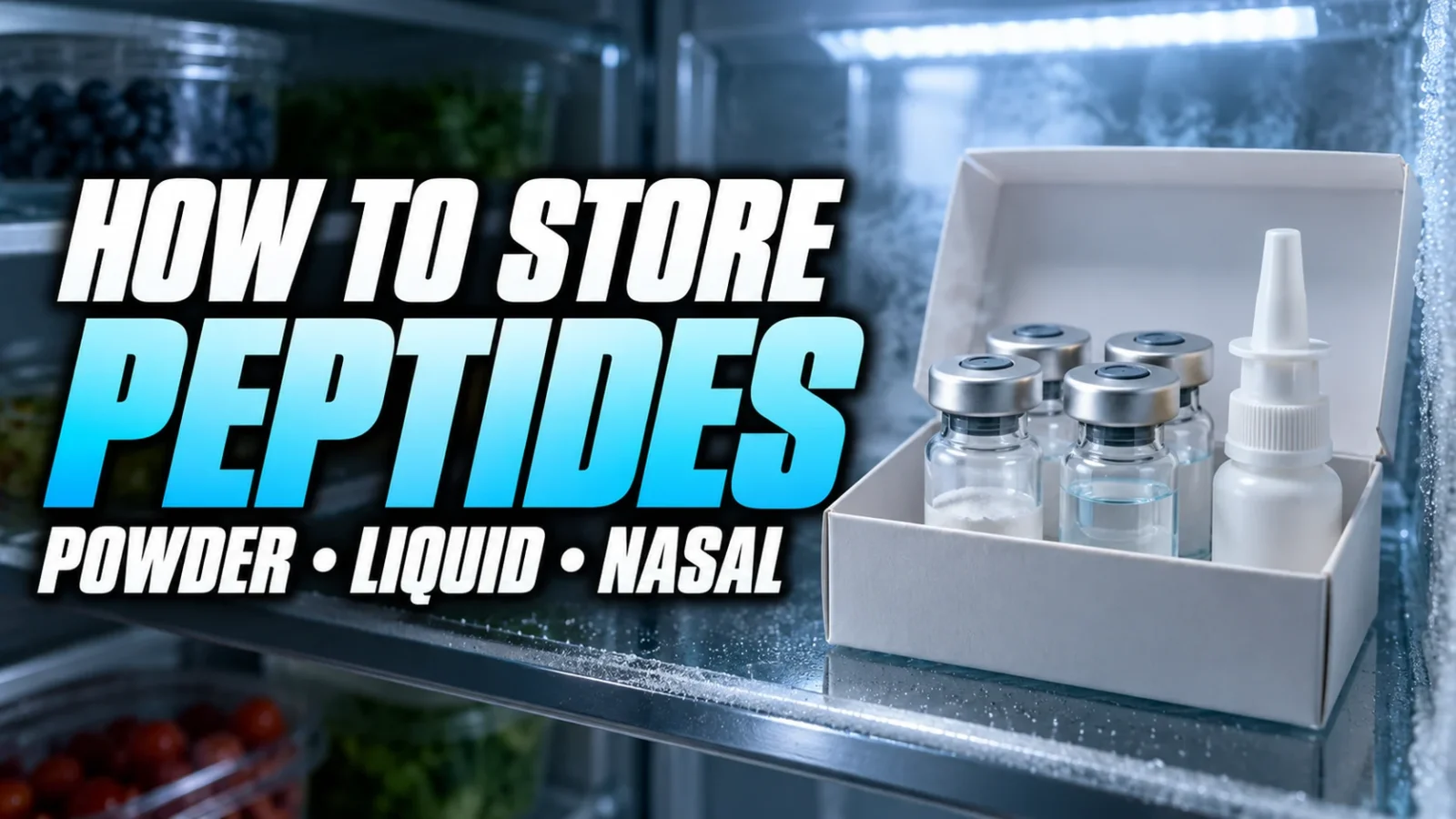
The rules depend on the form. Freeze-dried powder is the most stable form and handles the freezer well. A reconstituted (mixed) vial belongs in the fridge, and how long it lasts depends largely on the water it was mixed with. Nasal sprays follow their own rules. This guide covers all three, plus the signs that a vial should go in the bin.
Key Takeaways
- Powder (lyophilized) peptides keep best sealed, dry and dark in a freezer at about -20°C. A fridge is fine for vials you plan to mix within the next few weeks.
- Once mixed, a vial goes in the fridge at 2-8°C, upright and in its box, away from the door and the cold back wall. Do not freeze a vial you are drawing doses from.
- Bacteriostatic water is sterile water with 0.9% benzyl alcohol, so a vial mixed with it can be used for several doses, commonly over up to about four weeks. Sterile water has no preservative: treat a vial mixed with it as single use.
- Nasal sprays: follow the label first. Keep research nasal solutions capped, upright and refrigerated, mark the date you opened them, and never share the bottle.
- Throw out any solution that turns cloudy, shows particles or changes color. A certificate of analysis tells you what was in the vial when it was tested, not how it has been stored since.
Why Peptides Break Down
Peptides are short chains of amino acids (1), and those chains are fragile. Four things damage them in storage:
- Heat speeds up every kind of chemical breakdown. This is why cold storage matters more than anything else.
- Water lets the chain break apart (hydrolysis) and lets some amino acids change shape. Asparagine and glutamine are prone to this (deamidation). It is the main reason powder outlasts solution.
- Air and light cause oxidation. Peptides containing cysteine, methionine or tryptophan are the most sensitive.
- Microbes can grow in a solution once a needle has been through the stopper. That makes it a safety issue, not just a potency issue.
Every rule below is a way of controlling one of these four.
Peptide Storage at a Glance
| Form | Where to keep it | How long (general guide) |
|---|---|---|
| Powder, sealed, long term | Freezer, about -20°C, dark and dry | Months to years; follow the supplier’s date |
| Powder, to be mixed soon | Fridge, 2-8°C, in its box | Weeks |
| Powder at room temperature | Only in transit or for short periods | Days, away from heat |
| Mixed with bacteriostatic water | Fridge, 2-8°C, never frozen | Commonly up to about 4 weeks; 28 days at most for an opened multi-dose vial |
| Mixed with sterile water | Fridge, 2-8°C | Single use: use it straight away, discard leftovers |
| Single-use frozen portions (lab practice) | Freezer, -20°C or colder | Thaw once; never refreeze |
| Nasal spray, opened | As labeled; research sprays usually in the fridge, capped and upright | The label’s or supplier’s discard date |
Individual peptides differ, so the supplier’s or manufacturer’s instructions win whenever they are stricter than this table.

How to Store Lyophilized (Powder) Peptides
Most peptides are supplied lyophilized: freeze-dried into a powder or a small “puck” at the bottom of a sealed glass vial. With almost no water present, this is the most stable form a peptide can be kept in.
Temperature

For long-term storage, keep sealed powder in a freezer at around -20°C. A household freezer runs at about -18°C, which is close enough. Labs use -80°C for very long storage, but that is not needed for vials you will use within months.
If you plan to mix a vial within the next few weeks, the fridge (2-8°C) is fine. Short spells at room temperature, such as shipping, are generally tolerated by powder. Real heat is not: a hot car, a sunny windowsill or a mailbox in summer.
Frost-free freezers warm up briefly during their defrost cycles. If yours is frost-free, keep vials at the back, away from the door, in a closed box that buffers the swings.
Moisture and Air
Freeze-dried powder readily absorbs moisture, and moisture is what starts it breaking down. Keep vials sealed until you mix them. If you store several vials together, a zip bag or airtight box with a desiccant pack adds protection.
If you have powder in a container that is actually opened (rather than a sealed vial you pierce through the rubber stopper), let it warm to room temperature before opening. Opening it cold makes moisture from the air condense straight onto the powder. Close it again quickly to limit contact with air.
Light

Keep vials out of light, especially sunlight and other UV sources. The simplest way is to leave them in their original box. An opaque container or a wrap of aluminum foil works too.
Limit Temperature Swings
Every trip out of the freezer warms the vial and invites condensation. Take out only the vial you plan to use next, rather than moving the whole batch back and forth.
Labeling
Label each vial or its box with the peptide name, strength, date received and, once mixed, the mixing date and the water used. That one line on the label is what tells you later whether a vial is still inside its window.
How to Store Reconstituted (Liquid) Peptides
The clock starts when water goes into the vial. In solution, a peptide is exposed to hydrolysis and oxidation, and to any microbes a needle brings in. Reconstituted peptides are always less stable than the same peptide as powder, so mix a vial only when you are ready to start using it.
Mixing itself is covered step by step in our guide on how to reconstitute peptides. The peptide reconstitution calculator works out the concentration and syringe units. For storage, the decision that matters most is which water you use.
Bacteriostatic Water vs Sterile Water: How Long a Vial Lasts
These two are often confused, but they are not the same thing. Bacteriostatic water is sterile water for injection with 0.9% benzyl alcohol added as a preservative. The benzyl alcohol holds back the growth of bacteria introduced each time a needle goes through the stopper. That is what makes a multi-dose vial possible. Sterile water for injection is sterile, but it has no preservative, so nothing stops contamination from growing once the vial has been pierced.
| Bacteriostatic water | Sterile water for injection | |
|---|---|---|
| What it is | Sterile water + 0.9% benzyl alcohol | Sterile water, nothing added |
| Preservative | Yes | No |
| Meant for | Multi-dose vials | Single use |
| Mixed vial in the fridge | Commonly used within about 4 weeks; 28 days at most once opened | Use straight away; discard what is left |
The 28-day figure comes from pharmacy practice: an opened multi-dose vial is given at most 28 days unless its maker states otherwise. This limit is about contamination, not potency. Some peptides lose strength in solution sooner than that, so a shorter window from the supplier takes priority. And bacteriostatic does not mean sterile: the preservative slows bacteria down, it does not make careless handling safe.
Where in the Fridge
- Keep mixed vials at 2-8°C on a middle shelf. The door warms up every time it opens, and items touching the back wall can freeze.
- Store vials upright in their box, so the solution stays off the stopper and out of the light.
- A cheap fridge thermometer is worth having: many household fridges run warmer or colder than their dial suggests.
- Put the vial back in the fridge right after each dose instead of leaving it on the counter.
Handling Each Dose
Wipe the rubber stopper with an alcohol swab and let it dry before every puncture. Use a new sterile needle and syringe each time. Never shake a mixed vial: if it needs mixing, swirl or roll it gently. Our guide on how to inject peptides covers the rest of the technique.
Can You Freeze Reconstituted Peptides?
Labs do freeze peptide solutions, but in a specific way. They split the solution into single-use portions (aliquots) and freeze them at -20°C or colder. Each portion is thawed once and never refrozen, because repeated freeze-thaw cycles can break down or clump some peptides.
That is different from putting a multi-dose vial in the freezer between injections, which exposes the peptide to a freeze-thaw cycle every time you use it. For a vial in use, the fridge is the right place.
Signs a Vial Has Gone Bad
You cannot measure potency at home, but you can spot obvious problems. Discard a mixed vial if:
- the solution is cloudy, has particles or flakes, or has changed color (most mixed peptides should be clear)
- the stopper is damaged or the vial is cracked
- it has passed its use-by window, or you do not know when it was mixed
- it was left in heat for hours or froze solid in the fridge
When in doubt, throw it out. A clear vial can still have lost strength, and a contaminated injection costs far more than a new vial.
How to Store Nasal Peptide Sprays
Some peptides are used as nasal sprays. These include approved medicines such as desmopressin and calcitonin nasal sprays, and research peptides such as Semax and Selank (compared in our Semax vs Selank guide) and nasal ipamorelin. A spray is still a peptide in solution, so the same enemies apply. A spray bottle is also opened every day, which a sealed vial is not.
Approved Nasal Sprays: Follow the Label
Prescription peptide sprays come with exact storage instructions, and they differ between products. Some are kept in the fridge until first use, then at room temperature for a set number of days once the pump is primed. Follow the label and the discard date, and ask your pharmacist if anything is unclear.
Research Nasal Sprays
- Keep it cold: store the bottle in the fridge at 2-8°C unless the supplier says otherwise. Do not freeze it.
- Keep it closed and upright: put the cap back on after every use and store the bottle upright, in its box or another dark place.
- Keep it clean: wipe the nozzle after use and never share the bottle. Most simple spray pumps let air back into the bottle as you use them, so each spray is a small chance for contamination.
- Date it: write the opening date on the bottle and stick to the supplier’s discard date. A solution without a preservative has the shortest life once opened.
- Check it: the cloudiness, particle and color rules for vials apply here too.
If you make a nasal solution from powder yourself, mix small batches that you will finish quickly. An open spray bottle does not protect its contents the way a sealed, stoppered vial does.
What Container Should Be Used to Store Peptides?
In almost every case, the vial the peptide came in. A glass vial with a rubber stopper and a crimped aluminum seal is inert, airtight and sterile inside, which is exactly what peptide storage needs. Moving the peptide to another container adds contamination risk and gains nothing.
If a solution has to be split, as with lab aliquots, use sterile glass vials or low-binding polypropylene tubes with tight caps. Size them so there is little empty air space above the liquid. Clear containers let you check for cloudiness without opening them. Keep them in a box between checks so they stay out of the light.
Traveling With Peptides
Powder travels far better than solution. If you can, travel with sealed vials and mix at your destination. For mixed vials, use an insulated bag with cold packs, wrapped so the vial does not touch the pack directly (that can freeze it). Never leave peptides in a parked car. Back in the fridge on arrival, check the solution as described above before using it.
Good Storage Starts With a Good Vial
Storage can only protect what was in the vial to begin with. Buy from a supplier that ships lyophilized peptides promptly and publishes a batch certificate of analysis (see how to read a peptide COA). When a package arrives, check that the seals are intact and the vials undamaged, then move them straight into the freezer or fridge.

Pros
- Exceptional purity & testing (≥98%)
- Pharmaceutical-style packaging for stability
- Broad catalog across peptides & nootropics
- Strong reputation & consistency across years
Cons
- Some items frequently out of stock due to high demand
- Limited long-term data for some compounds
The Bottom Line
Peptide storage comes down to cold, dry, dark and clean, and the clock starts the moment water goes into the vial.
- Keep powder sealed in the freezer for the long term, in its box, and take out only the vial you plan to use next.
- Mix with bacteriostatic water if a vial has to last for several doses. Keep it in the fridge and use it within the supplier’s window, 28 days at most. A vial mixed with sterile water is single use.
- Treat a nasal spray like any opened solution: label rules first, then the fridge, the cap and a discard date. Throw out anything cloudy, discolored or past its window.
Frequently Asked Questions
Disclaimer
Please read carefully
The information on this site is for educational and informational purposes only, and is not medical advice. Always consult a qualified healthcare professional before using any supplement or medication, or making changes to your health, fitness, or nutrition routine.
Not medical advice
Content here is not a substitute for professional medical advice.
Consult your doctor
Talk to your doctor before starting any supplement or new routine.
Use at your own risk
We are not responsible for adverse effects from acting on this.
Do your research
Make informed decisions about your own health.
No guarantees
Individual results vary. No claims about outcomes.
Important — Never disregard professional medical advice or delay seeking it because of something you read here. If you think you may have a medical emergency, call your doctor or your local emergency number right away.