Contents13 sections
AICAR is usually sold online as “AICAR peptide,” but it is not a peptide. It is a small nucleoside, also known as acadesine or AICA riboside, that cells convert into a molecule that mimics AMP, the chemical signal of low energy. That signal switches on AMPK, the same fuel sensor that hard endurance training activates. Because of this, AICAR is grouped with Cardarine (GW501516) and the newer SLU-PP-332 as an “exercise mimetic”: a compound that triggers some of the muscle changes normally earned on the road or the treadmill.
All three became famous through mouse treadmill studies, and all three are now sold as research chemicals to athletes and biohackers. What none of them has is a human study showing better endurance, faster fat loss or better recovery.
This guide compares how each compound works, what the animal and human research actually found, the known risks, and where each one stands in sport. The short version: AICAR has the best-understood mechanism, Cardarine has the most human data and the worst safety record, and SLU-PP-332 has the least evidence of all.
Key Takeaways
- AICAR, Cardarine and SLU-PP-332 are all called exercise mimetics, but none of them is a peptide and none has been shown to improve endurance in humans.
- AICAR activates AMPK, the cell’s fuel sensor. Sedentary mice given high daily injections for four weeks ran 44% longer, at a dose equal to grams a day for a person.
- Cardarine switches on PPARδ fat-burning genes. It improved blood lipids in small human trials, but its development was stopped after it caused cancers in rodents.
- SLU-PP-332 activates the ERR receptors and improved running capacity and fat burning in mice, but it has never been tested in people.
- All three are unapproved for human use, banned by WADA at all times, and none of them replaces actual training.
What Is an Exercise Mimetic?
Endurance training changes muscle in predictable ways. It builds more mitochondria, grows new capillaries, shifts fibers toward the slow, fatigue-resistant end of the spectrum, and makes muscle better at burning fat and taking up glucose. Those changes are driven by a handful of internal signals: energy stress sensed by AMPK, and gene switches such as PGC-1α, PPARδ and the estrogen-related receptors (ERRs).
An exercise mimetic is a compound that flips one of those signals directly. The term took off after a 2008 study from the Salk Institute, published in Cell under the title “AMPK and PPARδ agonists are exercise mimetics,” which tested AICAR and GW501516 in mice. SLU-PP-332 was designed later to target the ERR switch.
The name oversells what these compounds do. Training also enlarges the heart, increases blood volume, strengthens tendons and bones, and teaches the nervous system to move efficiently. The compounds below act mainly on muscle metabolism, so at best they copy part of the training response.
AICAR vs Cardarine vs SLU-PP-332 at a Glance
| Feature | AICAR | Cardarine (GW501516) | SLU-PP-332 |
|---|---|---|---|
| What it is | Nucleoside (acadesine), not a peptide | Synthetic small molecule | Synthetic small molecule |
| Main target | AMPK, via its active form ZMP | PPARδ receptor | ERRα, ERRβ and ERRγ receptors |
| Best-known animal result | Sedentary mice ran 44% longer after 4 weeks | No gain alone in sedentary mice; larger gains when combined with training | Mice ran about 70% longer and 45% further |
| Human data | Heart-surgery trials and short IV infusion studies; no performance studies | Small trials of 2-12 weeks on blood lipids and fat burning | None published |
| Main safety concern | Low blood sugar; not selective for AMPK | Cancers in multiple organs in long-term rodent studies | Unknown: never tested in people |
| Approved for human use | No | No | No |
| WADA status | Prohibited (S4, named) | Prohibited (S4, named) | Prohibited as a non-approved substance (S0) |
AICAR: The AMPK Activator
How AICAR Works
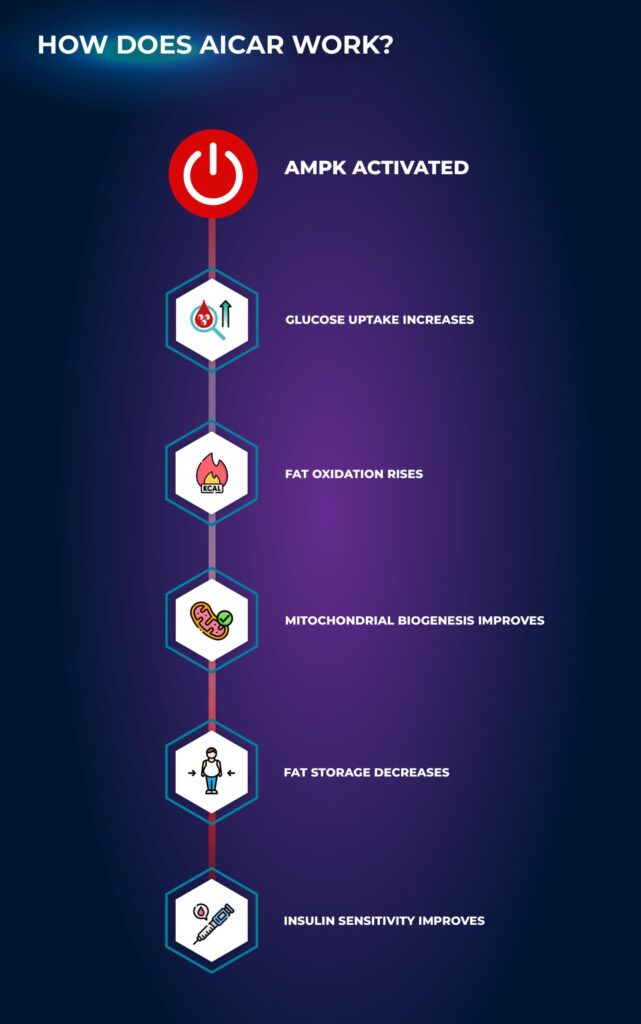
AMPK (AMP-activated protein kinase) is the cell’s fuel gauge. When a muscle works hard, it uses ATP faster than it can replace it, AMP builds up, and AMPK switches on. Its job is to restore energy balance: speed up fuel supply and slow down energy-expensive building work.
AICAR hits this switch chemically. It enters cells through the same transporters as adenosine and is converted into ZMP, which looks enough like AMP to activate AMPK even when the cell has plenty of energy. ZMP is also a natural intermediate in the way cells make purines, the building blocks of DNA and ATP.
Once AMPK is on, several things follow in muscle:
- Glucose uptake rises: GLUT4 glucose transporters move to the cell surface, independently of insulin.
- Fat burning increases: AMPK switches off the enzyme ACC, which lowers malonyl-CoA and lets more fatty acids into the mitochondria to be burned.
- Mitochondrial building is encouraged: repeated activation pushes PGC-1α, the master regulator of new mitochondria.
- Growth signals are turned down: AMPK inhibits mTOR, the main switch for muscle protein synthesis.
AICAR is a blunt tool. ZMP also affects other enzymes that respond to AMP, and lab studies show that many of AICAR’s effects still happen in cells without working AMPK. For the basics on the compound itself, see the AICAR compound page.
What the AICAR Research Shows
The study that made AICAR famous is the 2008 Salk paper. Sedentary mice given daily AICAR injections for four weeks switched on endurance-related genes in their muscles and ran 44% longer on a treadmill than untreated mice, without any training.
The dose matters. The mice received around 500 mg per kg of body weight per day by injection. Scaled to humans with the standard body-surface-area conversion, that is roughly 40 mg per kg, or about 3 grams a day for an 80 kg (176 lb) person. AICAR is also poorly absorbed when swallowed, which is why studies inject or infuse it.
In rodent models of insulin resistance, repeated AICAR dosing improved insulin sensitivity and other markers of metabolic health.
Human data is thin and has nothing to do with performance:
- As the drug acadesine, it was developed to protect the heart during coronary bypass surgery. A large randomized trial in bypass patients was stopped early because it showed no benefit, and the drug was never approved.
- A few small studies gave AICAR as an intravenous drip to healthy volunteers and to people with type 2 diabetes to study blood sugar control. In type 2 diabetes it lowered blood glucose.
- No published human trial has tested AICAR for endurance, fat loss, body composition or recovery.
AICAR Side Effects and Unknowns
AICAR has only been given to people in supervised clinical settings, so its effects in healthy users on repeated doses are largely unknown. The known risks:
- Low blood sugar: AICAR lowers blood glucose, so fasting, long training sessions, insulin or other glucose-lowering drugs add to the risk.
- Uric acid: AICAR is broken down along the purine pathway, which ends in uric acid, so raised uric acid (a gout and kidney concern) is a plausible risk at high doses.
- Weaker muscle-building signals: in rat muscle, AICAR-driven AMPK activation reduced protein synthesis, which is not what a lifter wants during a growth phase.
- Unknown long-term effects: no study has followed healthy people on repeated doses, and products sold online are not made or tested to pharmaceutical standards.
Cardarine (GW501516): The PPARδ Agonist
How Cardarine Works
Cardarine is not a SARM, even though it is usually sold alongside them. It is a PPARδ agonist, developed in the 1990s by GlaxoSmithKline and Ligand as a potential treatment for abnormal blood lipids and metabolic disease.
PPARδ is a nuclear receptor: a switch inside the cell nucleus that controls genes for fat uptake and fat burning. Activating PPARδ pathways pushes muscle toward fat as its main fuel and, in humans, raises HDL cholesterol. In a well-known 2004 experiment, mice genetically engineered with permanently active PPARδ in muscle had more slow-twitch fibers and could run about twice as far as normal mice. They were nicknamed “marathon mice.”
What the Cardarine Research Shows
The drug did not reproduce the marathon mouse in sedentary animals. In the same 2008 Salk study that tested AICAR, GW501516 switched on fat-burning genes but did not make sedentary mice run longer. Combined with four weeks of treadmill training, it increased both oxidative muscle fibers and running endurance beyond what training alone achieved.
Cardarine is the only one of the three with human trials. Small studies lasting two to twelve weeks, at 2.5 to 10 mg a day, found higher HDL cholesterol, lower triglycerides and increased fat burning in muscle. None of them measured athletic performance.
Doses commonly reported in performance circles are 10 to 20 mg a day, which is at or above the top of the range studied in humans.
The Cancer Problem
GlaxoSmithKline stopped developing Cardarine after long-term rodent studies found cancers developing in multiple organs. In 2013, the World Anti-Doping Agency took the rare step of issuing a public health warning to athletes about it.
Whether the same risk applies to people at lower doses or over shorter courses is unknown, because no one can ethically run that study. The full picture is in our guide to Cardarine side effects and cancer risk.


Overview
- Form: Oral Capsules
- Researched Dosage: 10 mg to 20 mg daily (1-2 capsules)
- Typical Cycle: 6-8 weeks
- Cost: $69.95
- Stacking Options: LGD-4033, MK-677, Ostarine (MK-2866)
Pros
- Human studies from its time as a drug candidate found higher HDL (“good”) cholesterol and lower triglycerides. This is why it was first studied for heart disease risk.
- Long half-life of about 16-24 hours means one capsule a day is usually enough to keep steady levels.
- Pre-dosed capsules remove the measuring step, so they’re easy to take consistently and to travel with.
Cons
- Animal studies found it caused cancer at multiple sites, and no one knows whether a safe human dose exists over the long term.
- Can be detected in drug tests long after the last dose, and WADA has warned athletes about it specifically.
SLU-PP-332: The ERR Agonist
How SLU-PP-332 Works
SLU-PP-332 is a synthetic small molecule named after Saint Louis University, where it was developed. Like AICAR, it is often marketed as a peptide, and like AICAR, it is not one.
It activates the estrogen-related receptors ERRα, ERRβ and ERRγ, with the strongest effect on ERRα. Despite the name, these receptors do not respond to estrogen. Working with PGC-1α, they control the genes for mitochondrial energy production and fat burning, so they sit downstream of much of what endurance training switches on. In theory, that makes ERR a more direct lever on the aerobic program than AMPK, which also affects many unrelated processes.
What the SLU-PP-332 Research Shows
The first published mouse study, in 2023, found that SLU-PP-332 increased the share of oxidative type IIa fibers in muscle, raised mitochondrial activity and improved treadmill performance. The researchers reported that treated mice ran about 70% longer and 45% further than untreated mice.
Follow-up work in obese mice found higher energy expenditure and fat burning, less fat gain and better insulin sensitivity.
There are no published human studies of any kind: no dose-finding, no pharmacokinetics and no safety data. The mouse studies gave it by injection, and how well it is absorbed when swallowed in people is unknown. More detail is on the SLU-PP-332 compound page.
What We Don’t Know
ERRs are active in the heart, liver, kidneys and brain, not just muscle, and switching them on across the whole body for weeks has never been studied in people. The absence of reported problems in a few short mouse studies is not evidence of safety; it mostly reflects how little testing has been done.
Other Compounds Called Exercise Mimetics
MOTS-c
MOTS-c is a real peptide, encoded in mitochondrial DNA. In mouse studies it works partly by raising the cell’s own AICAR levels, which in turn activates AMPK, and it improved metabolic health and physical capacity in mice. Human research on it is at an early stage. See the MOTS-c compound page for the details.
Overview
- Form: Lyophilized powder
- Researched Dosage: 5 mg to 10 mg per week, split into 2-3 injections
- Typical Cycle: 4-8 weeks
- Cost: $69.95
- Stacking Options: 5-Amino-1MQ, SS-31, AOD-9604, BPC-157
Pros
- Activates AMPK, the body’s main energy sensor, which may improve how cells use glucose and fat.
- Mouse studies show better insulin sensitivity and protection against diet-induced weight gain.
- Older mice given MOTS-c showed better physical capacity and endurance, which has drawn interest in its role in healthy aging.
Cons
- No human trials show that injected MOTS-c works.
- At 10 mg per vial and several milligrams per dose, one vial usually lasts only 1-2 weeks, so a full cycle gets expensive.
- MOTS-c is not an approved human medication. The FDA lists it as a bulk substance with potential safety risks (Category 2), and WADA bans it as a metabolic modulator.
SR9009 (Stenabolic)
SR9009 targets Rev-Erb, a receptor involved in the body clock and metabolism. It increased exercise capacity in mice, but it is very poorly absorbed when swallowed, and later research found that some of its effects occur even without its target receptor. Read more in our SR9009 guide.
Metformin
Metformin, an approved diabetes drug, activates AMPK indirectly. It makes one point clearly: in trials in older adults, metformin blunted muscle growth from resistance training and some of the mitochondrial gains from aerobic training. Turning on AMPK with a drug while training does not simply add up.
Can an Exercise Mimetic Replace Training?
No. Even in the mouse studies, the compounds copied only part of the training response, and in Cardarine’s case the endurance effect needed training on top. Mouse treadmill tests also measure how long an animal can keep going at a modest pace, which depends heavily on fuel use. Human performance depends on much more: heart size and output, blood volume, VO2max, lactate threshold, pacing and skill.
These compounds were developed with patients in mind: people with metabolic disease, heart disease or muscle wasting who cannot exercise enough. For healthy athletes, there is no evidence that any of them adds to a well-designed training program.
Legal Status and Anti-Doping Rules
None of the three is approved for human use by the FDA or any other regulator. They are sold online as research chemicals labelled “not for human consumption,” and the rules on buying and possessing them vary by country.
In sport, all three are prohibited at all times, in and out of competition. WADA’s Prohibited List names AICAR and GW1516 (Cardarine) under hormone and metabolic modulators (section S4). SLU-PP-332 falls under section S0, which bans any substance without approval for human therapeutic use, even where it is not named. Cardarine in particular has produced positive tests in several sports.
Which One Has the Strongest Evidence?
- AICAR: the best-understood mechanism and the most famous mouse result, but impractical at the doses used in mice, not selective, and untested for performance in humans.
- Cardarine: the only one with human trials, which showed effects on blood lipids and fat burning, but the rodent cancer findings ended its development.
- SLU-PP-332: the newest and, on paper, the most targeted, with promising mouse data and no human data at all.
There is no head-to-head study of the three, in animals or humans, so any claim that one is “stronger” than another is guesswork.
The Bottom Line
AICAR, Cardarine and SLU-PP-332 can switch on parts of the endurance-training program in mice, but none has been shown to improve performance in humans.
- AICAR is not a peptide. It activates AMPK through its active form ZMP and made sedentary mice run 44% longer, but at doses equal to grams a day in a person, and it failed as a heart-surgery drug.
- Cardarine has the only human data, showing better blood lipids and more fat burning, but it was abandoned after causing cancers in rodents.
- SLU-PP-332 has promising mouse results and no human studies at all, so its effects and safety in people are unknown.
- All three are unapproved and banned by WADA, and none of them replaces consistent training.
Frequently Asked Questions
Disclaimer
Please read carefully
The information on this site is for educational and informational purposes only, and is not medical advice. Always consult a qualified healthcare professional before using any supplement or medication, or making changes to your health, fitness, or nutrition routine.
Not medical advice
Content here is not a substitute for professional medical advice.
Consult your doctor
Talk to your doctor before starting any supplement or new routine.
Use at your own risk
We are not responsible for adverse effects from acting on this.
Do your research
Make informed decisions about your own health.
No guarantees
Individual results vary. No claims about outcomes.
Important — Never disregard professional medical advice or delay seeking it because of something you read here. If you think you may have a medical emergency, call your doctor or your local emergency number right away.