Contents11 sections
Chris Evans became one of the most talked-about physiques in film with his 2011 portrayal of Captain America. Audiences who knew him from comedies and the Fantastic Four films were struck by how much bigger and more athletic he looked as Steve Rogers.
He kept that shape through two more Captain America films and four Avengers movies, ending with Avengers: Endgame in 2019. Those roles made him one of the highest-paid actors in the world and a fitness reference for millions of fans who want to train like him.
This guide covers what it took to turn Chris Evans into Captain America: his training approach, the full weekly workout routine, his diet and his supplements, with the popular claims checked against what is actually known.
Key Takeaways
- Chris Evans trained two body parts a day, Monday to Friday, in sessions of about two hours, with Saturday off and Sunday reserved for weak points.
- Heavy compound lifts done in pyramid sets were finished with bodyweight moves such as weighted push-ups, pull-ups and dips.
- Gymnastics, plyometrics and short sprints replaced most traditional cardio to keep him agile for the fight scenes.
- His diet was a calorie surplus built on lean protein, oats, fruit, nuts and vegetables. Research supports about 0.7-1 g of protein per pound of bodyweight, not the 2 g per pound often quoted.
- There is no public evidence that Evans used steroids, and his physique is within natural limits, but only testing could confirm it.
Chris Evans Stats
| Attribute | Detail |
|---|---|
| Full name | Christopher Robert Evans |
| Date of birth | June 13, 1981 |
| Birthplace | Boston, Massachusetts |
| Height | 6’0″ (183 cm), reported |
| Weight | About 176 lb (80 kg), reported |
| Chest | 47″ (reported) |
| Waist | 33″ (reported) |
| Biceps | 16″ (reported) |
| Best known for | Steve Rogers / Captain America in the Marvel films (2011-2019) |
Actors rarely publish official body measurements. The figures above are the ones most often reported and should be read as estimates; his weight and arm size changed from role to role.
Who Is Chris Evans?
Christopher Robert Evans was born on June 13, 1981 in Boston, Massachusetts. He is one of four children, with an older sister and a younger brother and sister.
As a teenager he took musical theater classes and attended acting camp. After high school he moved to New York, where he studied at the Lee Strasberg Theatre and Film Institute.
His first feature film role came in The Newcomers (2000), and he appeared in a string of films over the next few years. His first comic book role was Johnny Storm, the Human Torch, in Fantastic Four (2005), a part he played again in the 2007 sequel.
In 2010 he signed a multi-film deal with Marvel Studios to play Steve Rogers, whose alter ego is Captain America. He turned the part down at first and only accepted after Marvel kept insisting he was right for the role.
In Captain America: The First Avenger (2011), Rogers is transformed from a frail army recruit into a super-soldier. The film earned about $370 million at the worldwide box office and made Evans an international star. A year later he returned in The Avengers (2012), which became one of the highest-grossing films of all time.
The Captain America Years
| Year | Film |
|---|---|
| 2011 | Captain America: The First Avenger |
| 2012 | The Avengers |
| 2014 | Captain America: The Winter Soldier |
| 2015 | Avengers: Age of Ultron |
| 2016 | Captain America: Civil War |
| 2018 | Avengers: Infinity War |
| 2019 | Avengers: Endgame |
Every one of these films was a major commercial success, and by the end of 2019 the role had made Evans one of the highest-paid actors in Hollywood.
Life After Endgame
Endgame closed Steve Rogers’ story in 2019, and Evans moved on to a wide mix of roles. He played Ransom Drysdale in Knives Out (2019) and earned praise for the Apple TV+ series Defending Jacob (2020), playing an assistant district attorney whose son is accused of murder.
Since then he has played the villain Lloyd Hansen in The Gray Man (2022), voiced Buzz Lightyear in Pixar’s Lightyear (2022), starred in Ghosted (2023) and Red One (2024), and returned as Johnny Storm in a cameo in Deadpool & Wolverine (2024). In 2025 he co-starred in Celine Song’s Materialists. People magazine named him its Sexiest Man Alive in 2022.
How Chris Evans Trained for Captain America
Evans got into excellent shape for his first Captain America role and looked even leaner and more athletic in later films. Many fans consider Captain America: The Winter Soldier (2014), the second Captain America film, to show him at his best, which is a big reason so many people search for the Captain America workout.
Preparing for The First Avenger meant months of hard, heavy training and an overhaul of his diet: more calories, more protein and fewer simple carbohydrates.
Popular articles often claim he packed on around 30 pounds of lean muscle in about three months. That figure has never been verified, and gaining that much muscle that quickly would be far beyond what natural lifters typically achieve. A more realistic reading is that Evans, who was already in good shape from earlier roles, added a meaningful amount of muscle to an existing base and arrived on set lean, well fed and pumped. Either way, he needed to look believable next to heavily built co-stars such as Chris Hemsworth’s Thor.
Evans has a naturally slim build, so the plan focused on exercises that add visible size, particularly in the chest, shoulders and arms. He also had to stay agile and fit enough for the acrobatic stunts and fight scenes the role demands.
Two Body Parts a Day
Evans trained two body parts per day in sessions of around two hours. The core mass-building exercises were done from several angles and with different grips to work each muscle group fully.
He trained Monday to Friday, rested on Saturday and used Sunday for weak points: the muscle groups that needed extra attention or would feature most in upcoming scenes.
Heavy free-weight work was finished with bodyweight exercises such as weighted push-ups, pull-ups and weighted dips. On chest day, for example, he would finish with weighted push-ups taken to failure.
Gymnastics Instead of Cardio
To build the coordination the role needed, Evans added gymnastics-style training: plyometrics, jumps, spins and bar work. This kind of training is also hard on the heart and lungs, which helped his endurance for long action sequences.
Beyond that, he did very little traditional cardio. The aim was to save energy and calories for building muscle. The main exception was a small amount of sprint work for speed and agility.
He preferred to get his conditioning from circuits of weights and bodyweight exercises. Circuits keep the heart rate high while still training the muscles, which makes them a time-efficient option when the main goal is adding size.
Did Chris Evans Use Steroids for Captain America?
Captain America’s on-screen transformation comes from a fictional super-serum. In real life, there is no public evidence that Evans used steroids or other performance-enhancing drugs for the role. His physique, lean and athletic rather than massive, sits within what a well-trained natural lifter of his height can reach with good genetics, hard training and careful nutrition.
That said, appearance alone cannot prove or rule out drug use, and shirtless film scenes can benefit from lighting, a pump right before filming and careful preparation. For a closer look at the evidence, see our analysis of whether Chris Evans took steroids for Captain America and our guide to telling natural and enhanced lifters apart.
The Chris Evans Workout Routine

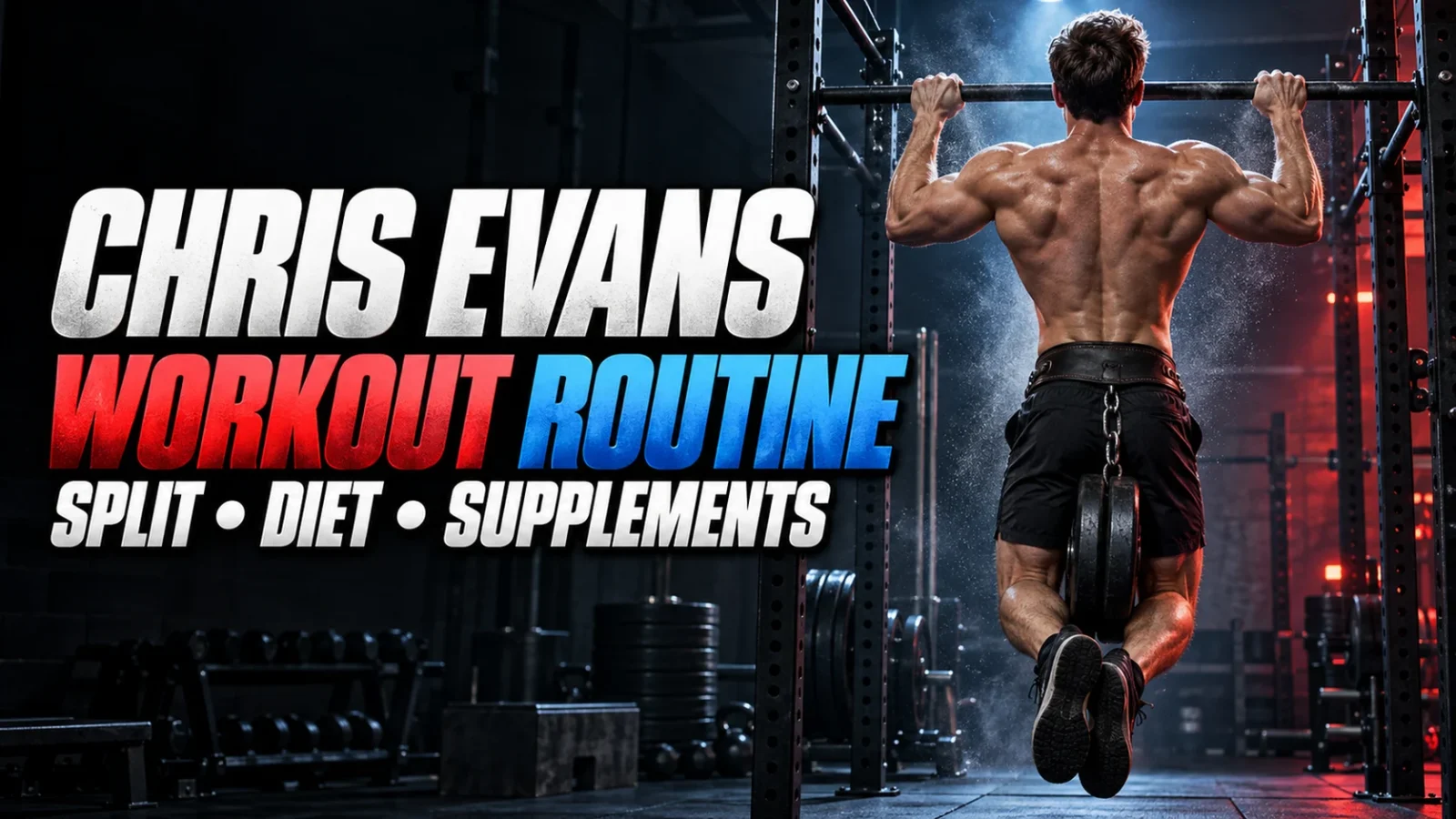
Here is the full Chris Evans workout routine, broken down by day and body part. It is compiled from interviews and published accounts of his Captain America preparation, so treat it as a close template rather than an exact training log.
Most lifts were done as pyramid sets: he added weight and reduced the reps from one set to the next. On squats, for example, he would start with a set at the higher end of the rep range and finish with a heavy set near the bottom of it.
| Day | Focus |
|---|---|
| Monday | Chest and back |
| Tuesday | Legs |
| Wednesday | Arms and shoulders |
| Thursday | Chest and abs |
| Friday | Back and core |
| Saturday | Rest |
| Sunday | Weak points (quads, shoulders, arms) |
Monday: Chest and Back
| Exercise | Sets x Reps | Focus |
|---|---|---|
| Barbell bench press | 4 x 6-8 | Chest |
| Incline bench press | 2 x 6-8 | Upper chest |
| Dumbbell fly | 4 x 8-10 | Chest |
| Cable fly | 2 x 10-12 | Chest |
| Weighted push-ups | 2 x to failure | Chest finisher |
| Weighted pull-ups | 4 x 6-8 | Lats |
| Bent-over rows | 2 x 6-8 | Mid back |
| Wide-grip cable rows | 3 x 6-8 | Mid back |
| Lat pulldowns | 3 x 8-12 | Lats |
| Cable crunches | 4 x 10-12 | Abs |
Tuesday: Legs
| Exercise | Sets x Reps | Focus |
|---|---|---|
| Squats | 4 x 6-12 | Quads, glutes |
| Deadlifts | 4 x 6-12 | Hamstrings, glutes, back |
| Leg press | 3 x 8-12 | Quads |
| Leg extensions | 3 x 6-12 | Quads |
| Seated leg curls | 3 x 6-12 | Hamstrings |
| Hyperextensions | 3 x 10-12 | Lower back, glutes |
| Wood choppers | 3 x 10-15 | Obliques, core |
Wednesday: Arms and Shoulders
| Exercise | Sets x Reps | Focus |
|---|---|---|
| Barbell curls | 4 x 6-15 | Biceps |
| Alternating cable curls | 3 x 10-15 | Biceps |
| Close-grip chin-ups | 2 x to failure | Biceps, lats |
| Triceps pushdowns | 3-4 x 6-15 | Triceps |
| Lying dumbbell skull crushers | 3-4 x 6-15 | Triceps |
| Reverse (bench) dips | 2 x to failure | Triceps |
| Overhead dumbbell shoulder press | 4 x 6-15 | Shoulders |
| Cable side lateral raises | 3 x 6-15 | Side delts |
Thursday: Chest and Abs
| Exercise | Sets x Reps | Focus |
|---|---|---|
| Incline dumbbell press | 4 x 6-8 | Upper chest |
| Hammer machine press | 4 x 8-15 | Chest |
| Decline barbell press | 3 x 6-8 | Lower chest |
| Decline push-ups | 3 x 15 | Chest finisher |
| Hanging leg raises | 3-4 x 15 | Lower abs |
| Weighted crunches | 3-4 x 12-15 | Abs |
| Wood choppers | 2 x 12-15 | Obliques |
| Plank | 3-5 minute hold | Core |
Friday: Back and Core
| Exercise | Sets x Reps | Focus |
|---|---|---|
| Deadlifts | 5 x 6-15 | Hamstrings, glutes, back |
| T-bar rows | 2 x 6-8 | Mid back |
| One-arm cable pulldowns | 2 x 6-8 | Lats |
| Pull-ups | 2 x to failure | Lats |
| Weighted hyperextensions | 5 x 10 | Lower back |
| Glute raise machine | 2 x 10-15 | Glutes |
| Medicine ball wall throws | 4 x 15 | Core, power |
| Medicine ball wood choppers | 2 x 15 | Obliques |
Saturday: Rest
Saturday was a full rest day. With six hard sessions a week, this was the main chance for his muscles and joints to recover.
Sunday: Weak Points
Sundays targeted weak points and the areas that would show most on screen. That usually meant squat and leg press supersets for quad size and power, plus detail work to sharpen the separation in his shoulders, biceps and triceps. A typical Sunday session looked like this:
| Exercise | Sets x Reps | Focus |
|---|---|---|
| Squat / leg press superset | 4 x 12 | Quads |
| Side lateral raises | 5 x 8-15 | Side delts |
| Cable rear delt raises | 2 x 15 | Rear delts |
| One-arm cable curls | 5 x 12 | Biceps |
| Preacher cable curls | 5 x 6-12 | Biceps |
| One-arm cable pushdowns | 5 x 6-12 | Triceps |
| Triceps kickbacks | 2 x 15 | Triceps |
How to Use This Routine
This is a high-volume, six-day plan built for an actor with a film deadline, a professional trainer and a diet planned around his training. Most people will get better results by adapting it than by copying it set for set.
- Start with fewer sets: if you are not used to this much volume, cut one set from each exercise for the first few weeks and add sets back as your recovery allows.
- Watch the overlap: deadlifts appear on both Tuesday and Friday, and hyperextensions load the lower back again. If your lower back feels beaten up, keep heavy deadlifts to one day a week.
- Progress the weights: pyramid sets only work if the top sets get heavier over time. Log your lifts and aim to add weight or reps each week.
- Recover properly: six sessions of up to two hours demand enough sleep and food. If your lifts stall for more than a couple of weeks, take an extra rest day.
If you like this style of superhero training, compare it with the Henry Cavill workout routine.
Chris Evans Captain America Diet
Training was only half of the job. The workouts provide the stimulus, but muscle is built during recovery, and that only happens with enough food, protein and sleep. By most accounts, eating enough was one of the hardest parts of the whole transformation.
The first step was raising his daily calories so he could gain weight, especially in his upper body. His main protein sources were chicken, lean beef, fish and protein shakes.
How Much Protein Did Chris Evans Eat?
Many articles say Evans aimed for two grams of protein per pound of bodyweight. That figure is not confirmed, and it is far more than research supports: at around 176 pounds, it would mean roughly 350 grams of protein a day.
A 2018 meta-analysis in the British Journal of Sports Medicine found that the benefit of extra protein for muscle gain leveled off at around 1.6 g per kilogram of bodyweight a day (about 0.7 g per pound), with intakes up to about 2.2 g/kg (1 g per pound) likely covering almost everyone. For a lifter of Evans’s size, that works out to roughly 130-175 grams a day.
What Chris Evans Ate
A typical reported breakfast, eaten an hour or two before training, was porridge with walnuts, raisins, low-fat Greek yogurt, a scoop of protein powder and sliced banana. Through the rest of the day his meals were built around a good protein source, with plenty of fish and meat.
He ate a lot of salads and green leafy vegetables for fiber and micronutrients, nuts for healthy fats and extra protein, and fruit for energy and vitamins. Bananas were a regular choice before and after training to help top up glycogen.
| Food group | Foods in his diet | Role |
|---|---|---|
| Protein | Chicken, lean beef, fish, whey shakes, casein before bed | Muscle repair and growth |
| Carbohydrates | Porridge (oats), bananas and other fruit | Training fuel, glycogen |
| Fats | Walnuts and other nuts | Healthy fats, extra calories |
| Vegetables | Salads, green leafy vegetables | Fiber, vitamins, minerals |
| Dairy | Low-fat Greek yogurt | Protein, calcium |
If you struggle to eat enough to gain weight, calorie-dense whole foods make a surplus much easier. See our list of the best high-calorie foods for bulking.
What Supplements Did Chris Evans Use?
Supplements played a supporting role in Evans’s Captain America preparation. Hard training at this volume puts a premium on recovery, and the products most often reported are:
- Whey protein (isolate)
- Casein protein
- Glutamine
- Branched-chain amino acids (BCAAs)
- Omega fatty acids (some accounts mention an omega-3/6/9 blend)
Whey isolate, at about 30 grams of protein per serving, was used through the day and around his workouts. Before bed he reportedly had a casein shake. Casein digests slowly, and research shows that protein taken before sleep is digested and used overnight, supporting muscle protein synthesis while you sleep.
The others are less essential. BCAAs and glutamine add little when total protein intake is already high, because protein-rich food and shakes already supply these amino acids. Omega-3 fats from fish or fish oil support general health; most Western diets already contain plenty of omega-6, so a combined omega-3/6/9 product offers little over plain omega-3.
For most lifters, a quality protein powder is the most useful supplement here, followed by well-studied basics such as creatine monohydrate. If you are a naturally slim lifter like Evans, see our guide to the best protein powder for skinny guys.

Pros
- Catalog is specifically organized around muscle building, fat loss, testosterone support, and workout performance.
- Range includes creatine, protein, EAAs, beta-alanine, and L-citrulline alongside more specialized formulas.
- Orders of $99+ qualify for free US shipping.
Cons
- Features several strong claims around muscle growth, testosterone, fat loss, and metabolic effects that should be distinguished from independently demonstrated clinical outcomes
- Heavily oriented toward bodybuilding and performance rather than broader nutritional supplementation.
The Bottom Line
The Chris Evans workout is a demanding, high-volume bodybuilding split combined with athletic conditioning and a carefully planned calorie surplus.
- Two body parts a day, heavy pyramid sets and bodyweight finishers built the size, while gymnastics, plyometrics and sprints kept him agile.
- Nutrition is where most people fall short: a modest surplus of roughly 250-500 calories a day, about 0.7-1 g of protein per pound and plenty of whole foods will do more than any supplement.
- There is no public evidence of steroid use, but his look also reflects years of training, good genetics and on-set preparation, so set realistic expectations for your own progress.
Frequently Asked Questions
Disclaimer
Please read carefully
The information on this site is for educational and informational purposes only, and is not medical advice. Always consult a qualified healthcare professional before using any supplement or medication, or making changes to your health, fitness, or nutrition routine.
Not medical advice
Content here is not a substitute for professional medical advice.
Consult your doctor
Talk to your doctor before starting any supplement or new routine.
Use at your own risk
We are not responsible for adverse effects from acting on this.
Do your research
Make informed decisions about your own health.
No guarantees
Individual results vary. No claims about outcomes.
Important — Never disregard professional medical advice or delay seeking it because of something you read here. If you think you may have a medical emergency, call your doctor or your local emergency number right away.