Contents14 sections
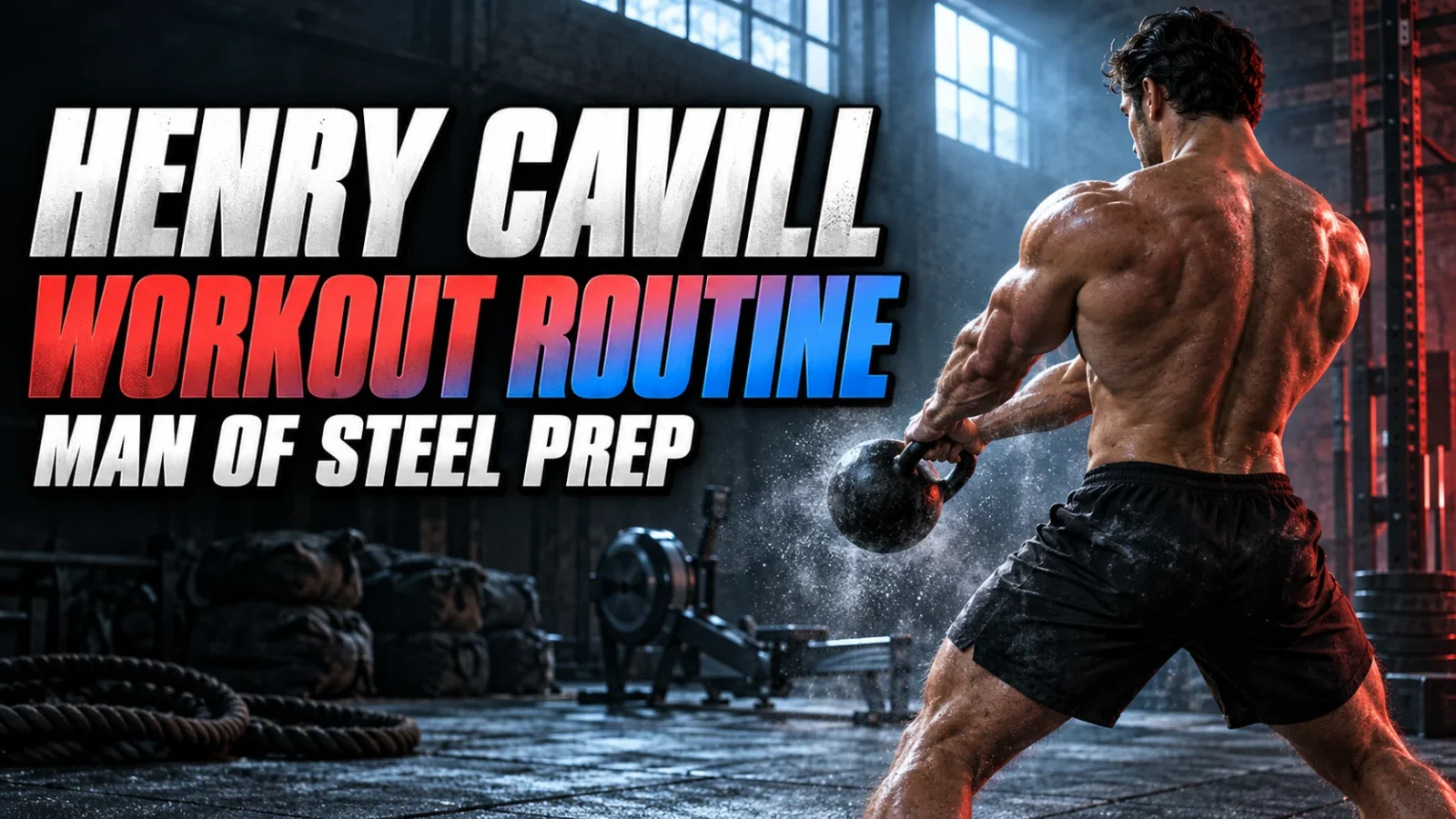
Henry Cavill’s first turn as Superman in Man of Steel (2013) set a new standard for superhero physiques: broad shoulders, a full chest, a wide back and a tight waist, on an actor who also had to run, jump and fight convincingly on camera.
That look came from months of work with Mark Twight and the coaches at Gym Jones, the Salt Lake City gym that had prepared the cast of 300. The plan combined athletic lifting, high-rep conditioning circuits, interval cardio, a reported 5,000-6,000 calories a day in the building phase and a strict rule about sleep.
This guide covers the Man of Steel workout and diet as they have been reported, with the training split laid out day by day, the popular numbers checked, and a look at how his training changed for later roles such as The Witcher and Argylle.
Key Takeaways
- Henry Cavill trained with Mark Twight and the Gym Jones team for several months before Man of Steel started filming in 2011, and kept training through the shoot.
- The reported weekly plan pairs three lifting days built on giant sets, supersets and tri-sets with three fasted cardio sessions of 30-50 minutes.
- Fat loss came from high-rep conditioning circuits, such as a 100-rep-per-exercise circuit, and 9-10 hours of sleep a night was a condition of the program.
- In the building phase he reportedly ate 5,000-6,000 calories a day over six meals and shakes, then cut carbohydrates to get lean for filming.
- Several popular figures, such as 3-4% body fat or 10 sets of 10 front squats at 225 lb, are estimates or don’t add up. The structure of the plan matters more than the exact numbers.
Henry Cavill Stats
| Attribute | Detail |
|---|---|
| Full name | Henry William Dalgliesh Cavill |
| Date of birth | May 5, 1983 |
| Birthplace | Saint Helier, Jersey (Channel Islands) |
| Height | 6’1″ (185 cm), reported |
| Man of Steel weight | About 186-190 lb (84-86 kg), reported |
| Man of Steel coaches | Mark Twight and the Gym Jones team |
| Best known for | Superman in the DC films (2013-2022), Geralt of Rivia in The Witcher, Sherlock Holmes in Enola Holmes |
Actors rarely publish official measurements, so treat these as estimates.
Who Is Henry Cavill?
Henry Cavill was born on May 5, 1983 in Saint Helier on Jersey, one of the Channel Islands, and went to boarding school in England. He has said he was a chubby teenager who was called “Fat Cavill” at school. As a teenager he met Russell Crowe, who was filming at his school, and has credited the encounter with encouraging him to act.
His early screen work included The Count of Monte Cristo (2002), I Capture the Castle (2003) and Tristan & Isolde (2006), and he played Charles Brandon in the TV series The Tudors (2007-2010). He came close to two of the biggest roles of the mid-2000s: he lost out to Daniel Craig for James Bond in Casino Royale, and he was in the running for Superman before the part went to Brandon Routh in Superman Returns (2006).
He was finally cast as Clark Kent in early 2011 for Zack Snyder’s Man of Steel, released in 2013. He had already been lean and muscular as Theseus in Immortals (2011), so the Superman prep started from a training base rather than from scratch.
How Henry Cavill Trained for Man of Steel

Cavill’s coach for the role was Mark Twight, a well-known American alpinist who went on to found Gym Jones in Salt Lake City. Twight had already worked with Zack Snyder on 300 (2007), getting Gerard Butler and the actors who played the Spartans into shape. Gym Jones coach Michael Blevins also worked with Cavill.
Training began in early 2011, several months before filming started later that year, and continued through the shoot. The approach was athletic rather than pure bodybuilding: Superman had to look powerful, but Cavill also had to get through long days of stunt and fight work.
The first two weeks raised the intensity gradually. His diet changed step by step as well, starting with a basic supplement routine of a multivitamin, essential fatty acids, probiotics and magnesium. About two months in, he was reportedly training twice a day and eating 5,000-6,000 calories daily.
Once filming began, two sessions a day were no longer possible and training dropped to about three days a week. The muscle he had built in the first months carried him through the shoot.
Sleep Came First
Before handing over any training plan, Twight asked Cavill to commit to 9-10 hours of sleep a night. Twight has described sleep as possibly the most important part of the program: without it Cavill could not recover, and the training could not continue.
The science backs him up. Growth hormone is released mainly during deep (slow-wave) sleep, and in a small JAMA study, cutting healthy young men’s sleep to about five hours a night for one week lowered their daytime testosterone by 10-15%. Few people can manage 9-10 hours, but a consistent 7-9 hours is the cheapest recovery tool there is.
Reported Strength Numbers
These are the lifts most often quoted from his prep. They come from coverage of the film, not from test results published by Cavill or Gym Jones, so treat them as approximate.
| Lift | At the start (reported) | By the end of prep (reported) |
|---|---|---|
| Deadlift | 300 lb (136 kg) | 435 lb (197 kg) |
| Push press | Not reported | 245 lb (111 kg) |
| Back squat | Not reported | 365 lb (166 kg) |
| Front squat | Not reported | 305 lb (138 kg), from Cavill’s own quoted account |
One widely repeated claim, that he front squatted 225 lb for 10 sets of 10, does not fit with a heavy front squat of around 305 lb. 225 lb is about 74% of that, close to a 10-rep max, and nobody can repeat a 10-rep max for ten straight sets. It has been left out of the table.
Both men framed the strength work as mental as much as physical. Cavill has been quoted saying the program showed him his limits were well beyond what his head told him, and Twight has said that by changing his body through hard work, Cavill changed his attitude and the way he carried himself.
The Result: Weight and Body Fat
By the time filming started, Cavill reportedly weighed about 186-190 lb. Popular accounts claim he lost about 20 lb of fat and added about 20 lb of muscle along the way. Doing both in a few months is not realistic for a natural lifter; a more plausible reading is that he added a meaningful amount of muscle on top of an existing base, then dieted down for filming.
Body-fat figures of 5-7% for filming, and 3-4% for shirtless scenes, are also often repeated. They are estimates at best: 3-4% is close to the level of essential fat in men and is rarely seen outside the final days of a bodybuilding contest prep. What the film does show is that he was very lean while carrying a lot of muscle.
The Henry Cavill Fat-Loss Circuit
Fat loss was driven by high-rep conditioning work rather than long, easy cardio. The best-known example is a circuit reported under the name “Tailpipe”: 100 reps of each exercise, followed by eight slow breaths in and out through the nose before moving straight to the next exercise.
Twight has described the circuit as having two halves: the work, which is designed to leave you gassed, and the recovery, which matters just as much. The controlled nasal breathing is that recovery half, a way to bring the heart rate down under control before the next 100 reps.
| Exercise | Load | Reps |
|---|---|---|
| Kettlebell swing | 40 lb (18 kg) kettlebell | 100 |
| Push-up | Bodyweight | 100 |
| Squat | 25% of your one-rep max | 100 |
| Lunge | Bodyweight | 100 |
Break the reps into smaller sets as needed. If 100 reps per exercise is too much, start with 50 and build up.
The Henry Cavill Workout Split
The muscle-building part of the plan, as it is usually published, runs over six days: three lifting sessions built around giant sets, supersets and tri-sets, alternating with three fasted cardio sessions. It is compiled from published accounts of his Man of Steel prep, so treat it as a close template rather than an exact training log.
The goal was the classic Superman shape: wide shoulders, a full chest, a wide back and a tight waist. That is why shoulders, upper back and obliques come up so often, and why the lifting days mix in jumps and core work. Every set was meant to be done with maximum effort.
| Day | Focus |
|---|---|
| Day 1 | Shoulders, plyometrics, glutes and quads |
| Day 2 | Cardio: 50 minutes on a stair climber |
| Day 3 | Back, rear delts, chest and obliques |
| Day 4 | Cardio: 30 minutes of rowing |
| Day 5 | Glutes, quads, chest, biceps, triceps and core |
| Day 6 | Cardio: 30 minutes of treadmill intervals |
| Day 7 | Not listed in published versions; use it to rest |
Day 1: Shoulders, Plyometrics, Glutes and Quads
| Group | Exercise | Sets x Reps |
|---|---|---|
| Giant set | Standing barbell military press | 4 x 10 |
| Giant set | Squat jump | 4 x 10 |
| Giant set | Dumbbell lateral raise | 4 x 10 |
| Giant set | Squat jump | 4 x 10 |
| Superset | Machine shoulder press | 3 x 12 |
| Superset | Rope sissy squat | 3 x 15 |
| Tri-set | Half Arnold press | 3 x 12 |
| Tri-set | Leg extension (toes out) | 3 x 15 |
| Tri-set | Broomstick twist | 300 reps nonstop |
Do the four giant-set exercises back to back with no rest, rest 2.5 minutes, and repeat for four rounds. Rest 2 minutes after each round of the superset and the tri-set. The squat jumps after each shoulder exercise keep the heart rate high and train lower-body power.
Day 2: Stair Climber
50 minutes on a stair climber first thing in the morning, before breakfast, keeping the heart rate above 150 beats per minute.
Fasted cardio is a matter of preference rather than a fat-loss advantage. A 2014 study by Schoenfeld and colleagues found similar fat loss whether cardio was done fasted or after a meal, as long as total calories were the same.
Day 3: Back, Rear Delts, Chest and Obliques
| Group | Exercise | Sets x Reps |
|---|---|---|
| Tri-set 1 | Chin-to-hand wide-grip pull-up | 3 x 5 per side |
| Tri-set 1 | Dumbbell incline breaststroke | 3 x 12 |
| Tri-set 1 | Side plank hip dip | 3 x 15 |
| Tri-set 2 | Straight-arm pulldown | 3 x 12 |
| Tri-set 2 | Rear delt rope pull | 3 x 12 |
| Tri-set 2 | Side plank twisting crunch | 3 x 15 |
| Tri-set 3 | Dumbbell swimmer’s fly | 3 x 10 |
| Tri-set 3 | Decline medicine ball Russian twist | 3 x 30 per side |
| Tri-set 3 | Broomstick twist | 300 reps nonstop |
Rest 2 minutes after each round of the first tri-set, 2.5 minutes after the second and 1 minute after the third.
Day 4: Rowing
30 minutes on a Concept2 rowing machine, again fasted in the morning with the heart rate above 150 bpm. Rowing works the legs, back and arms together, which suits the athletic look the role needed.
Day 5: Glutes, Quads, Chest, Arms and Core
| Group | Exercise | Sets x Reps |
|---|---|---|
| Tri-set 1 | Dumbbell snatch drop lunge | 3 x 6 per side |
| Tri-set 1 | Wide-grip dip | 3 x 15-20 |
| Tri-set 1 | Barbell curl | 3 x 10 |
| Tri-set 2 | Deadlift | 3 x 10 |
| Tri-set 2 | Plyo push-up | 3 sets (reps not given in published versions) |
| Tri-set 2 | Incline dumbbell curl | 3 x 10 |
| Superset | Dumbbell hold | 2 x as long as possible |
| Superset | Cable wood chopper (high to low) | 2 x 10 per side |
| Tri-set 3 | Cable overhead triceps extension | 3 x 12 |
| Tri-set 3 | Cable wood chopper (low to high) | 3 x 10 per side |
| Tri-set 3 | Broomstick twist | 300 reps nonstop |
Rest 2 minutes after each round of the first two tri-sets, and 1 minute after each round of the superset and the final tri-set.
Day 6: Treadmill Intervals
30 minutes on the treadmill, fasted, with the heart rate above 150 bpm. Each interval is one minute of running followed by 30 seconds of recovery, with the speed rising each interval until the top of the ladder, then starting again:
| Interval | Speed |
|---|---|
| 1 | 5.5 mph (8.9 km/h) |
| 2 | 6 mph (9.7 km/h) |
| 3 | 6.5 mph (10.5 km/h) |
| 4 | 7 mph (11.3 km/h) |
| 5 | 7.5 mph (12.1 km/h) |
| 6 | 8 mph (12.9 km/h) |
This session is often called a modified Tabata workout, but it is not Tabata. The Tabata protocol uses eight rounds of 20 seconds at an all-out effort with 10 seconds of rest. This is a longer interval ladder at running speeds that most trained people can sustain.
Man of Steel Workout Exercise Guide
Dumbbell Incline Breaststroke
- Lie face down on an incline bench set to 45 degrees, holding a pair of light dumbbells.
- Start with your elbows tucked in at your sides and your palms facing each other.
- Extend your arms straight out in front of you at chin height, turning your palms to face down.
- Sweep your arms out to the sides in an arc and back to the start, like the arm stroke in breaststroke swimming.
Side Plank Twisting Crunch
- Start in a side plank with your weight on one elbow and the side of the same foot.
- With your top hand behind your head, rotate your upper body down toward the floor in a twisting crunch.
- Reverse the motion to return to the side plank.
- Do all reps on one side, then switch sides.
Squat Jump
- Lower into a full squat.
- Drive up explosively and jump vertically at the top of each rep.
- Land softly and go straight into the next rep.
When he added load, Cavill reportedly kept it to no more than about 30% of his back squat one-rep max, using a barbell, dumbbells or a sandbag across his shoulders for variety.
Rear Delt Rope Pull
- Stand facing a high cable pulley and hold a rope attachment with both hands.
- Lean back slightly to brace, then pull the rope toward your chin.
- Lead with your elbows and finish with them above shoulder height.
The movement is close to a face pull. Focus on the rear delts throughout.
Chin-to-Hand Wide-Grip Pull-Up
- Take a grip slightly wider than shoulder width on the pull-up bar.
- Pull yourself up and to one side, so that your chin reaches that hand at the top.
- Lower back down to the middle, then pull up to the opposite side.
Keep the movement strict, with no swinging or kipping.
Dumbbell Swimmer’s Fly
- Lie face up on a flat bench, holding a pair of dumbbells just outside your chest with your elbows bent and your palms facing in.
- Press the dumbbells up with a close grip, then lower them out to the sides in a fly motion with your arms extended.
- When your arms are parallel to the floor, bring the dumbbells back in to the start position.
Dumbbell Snatch Drop Lunge
- Perform a single-arm dumbbell snatch and drop into a split stance, landing at the bottom of a lunge.
- Drive straight back up to standing while lowering the dumbbell.
- Go into the next rep with the opposite foot forward, switching legs every rep.
Cavill did this as an explosive move, pulling hard on the snatch and almost jumping out of the bottom of the lunge. It is a technical lift, so learn it with a light dumbbell first.
Half Arnold Press
- Sit on the edge of a flat bench with the dumbbells at chest level and your palms facing you.
- Press the dumbbells only partway up, until your upper arms are about parallel to the floor, while rotating your palms to face forward.
- Lower back to the start and repeat.
Keep a neutral spine throughout and focus on the front delts.
Dumbbell Hold
- Stand holding a pair of dumbbells at your sides.
- Raise your arms in front of you until they are parallel to the floor, without bending your elbows.
- Hold the position as long as you can without letting your arms drop.
This isometric hold puts direct stress on the front delts. Build up the hold time from week to week.
Cable Wood Chopper
- Stand side-on to a cable machine with the pulley set high.
- Grab the handle with both hands and pull it down and across your body.
- Rotate your torso as you pull, then return under control.
The plan uses both versions: high to low, as above, and low to high with the pulley set at the bottom. Focus on the obliques.
Henry Cavill’s Man of Steel Diet
The diet mattered as much as the training. To add size, Cavill’s intake reportedly went from around 2,500 calories a day to 5,000-6,000 in the building phase. He did not restrict any macronutrient in that phase. Once he had gained the weight, carbohydrates were cut back to get lean for filming.
Here is a typical day from the building phase, as it has been reported. Quantities are approximate.
| Meal | Foods |
|---|---|
| Meal 1 (about 7:30 am, after morning cardio) | 5 egg whites, 2 egg yolks and 8 oz (225 g) of steak with pink Himalayan salt, followed by a shake of 1 cup of oats, 1 scoop of whey isolate and 3/4 cup of water |
| Meal 2 (about 9 am) | 1.5 scoops of protein powder, 1/2 cup of cottage cheese, 2 cups of grapes and a handful of sunflower seeds |
| Pre-workout | An espresso for caffeine |
| Post-workout | Whey isolate shake with almond or cashew milk, peanut butter and a scoop of maltodextrin |
| Meal 3 (lunch) | 1 lb (450 g) of curry-style chicken, 2 large sliced potatoes cooked in avocado oil and an apple |
| Meal 4 (about 4 pm) | About 1.5 cups of Greek yogurt mixed with 1 scoop of whey isolate and chilled for 30 minutes, 2 oranges and a handful of almonds |
| Meal 5 (dinner) | Bison steak with brown rice pasta |
| Meal 6 (before bed) | Casein protein shake with a greens powder |
A few things stand out:
- Protein was very high. Based on the reported quantities, he was eating well over 300 g of protein a day. A 2018 meta-analysis in the British Journal of Sports Medicine found that gains in muscle level off at around 1.6 g of protein per kg of bodyweight a day, with 2.2 g/kg a sensible upper target. For a 190 lb (86 kg) lifter that is roughly 140-190 g a day.
- The yogurt bowl is not 80 g of protein. It is often quoted that way, but 1.5 cups of plain nonfat Greek yogurt (about 35 g) plus one scoop of whey (about 25 g) comes to roughly 60 g.
- Maltodextrin is a fast-digesting carbohydrate made from starch. After training it helps refill muscle glycogen, which matters most when you train twice a day.
- Vegetables were missing. Apart from the greens powder, the reported meals contain almost no vegetables. A greens powder does not fully replace whole vegetables, which also supply fiber.
If you struggle to eat enough to gain weight, calorie-dense whole foods make a surplus much easier. See our list of the best high-calorie foods for bulking.
Henry Cavill’s Supplements
Cavill’s supplement routine was simple: whey isolate and casein protein, a multivitamin, essential fatty acids, probiotics, magnesium, a greens powder and caffeine before training. These are basics rather than performance boosters. Protein powder simply makes a very high protein intake easier to reach.
For what a multivitamin can and cannot do for a lifter, see our guide to the best multivitamins for bodybuilders.

Pros
- Catalog is specifically organized around muscle building, fat loss, testosterone support, and workout performance.
- Range includes creatine, protein, EAAs, beta-alanine, and L-citrulline alongside more specialized formulas.
- Orders of $99+ qualify for free US shipping.
Cons
- Features several strong claims around muscle growth, testosterone, fat loss, and metabolic effects that should be distinguished from independently demonstrated clinical outcomes
- Heavily oriented toward bodybuilding and performance rather than broader nutritional supplementation.
How His Training Changed After Man of Steel
Cavill returned as Superman in Batman v Superman: Dawn of Justice (2016), Justice League (2017) and Zack Snyder’s Justice League (2021), with a brief cameo in Black Adam (2022). In December 2022 he confirmed that he would not be returning to the role under DC Studios’ new leadership.
He has not published full programs for his later roles, and many of the “Witcher workouts” online are guesses. Here is what is known:
- The Witcher (2019-2023). Cavill played Geralt of Rivia in the first three seasons of the Netflix series, combining strength training with extensive sword and fight training. He has spoken in interviews about cutting back on water before shirtless scenes to look more defined. That is a short-term filming trick, not a training method, and dehydration carries real risks. He left after the third season, and Liam Hemsworth took over the role.
- Mission: Impossible – Fallout (2018), the Enola Holmes films (2020, 2022) and Argylle (2024). In these roles, including the title spy in Argylle, his job was to look fit and capable on screen rather than to hit a shirtless, filming-day level of leanness.
The lesson for anyone copying him: the Man of Steel plan was a peak built for a fixed filming date. Nobody, Cavill included, holds a filming-day physique all year.
Was Henry Cavill Natural for Superman?
There is no public evidence that Cavill used steroids or other performance-enhancing drugs for Man of Steel. His build is within what a well-coached, well-fed natural lifter with good genetics can reach, especially one who already had a training base from earlier roles.
The part that raises questions is the reported speed: roughly 20 lb gained in a few months. Some of that would have been water, glycogen and fat from a 5,000-6,000 calorie diet rather than muscle alone. Appearance cannot prove or rule out drug use, and only testing could confirm it. For the markers people look for, see our guide to telling natural and enhanced lifters apart, or compare another superhero build in our breakdown of Robert Pattinson’s Batman physique.
How to Use the Henry Cavill Workout
- Scale the volume. Six sessions a week built on giant sets is a lot. Most people with a full-time job should start with the three lifting days and one or two cardio sessions, then add more if they recover well.
- Use loads you can control. Keep squat jumps at or below about 30% of your squat max, and learn the snatch drop lunge with a light dumbbell before you push the pace.
- Eat for your size, not his. 5,000-6,000 calories was for a 6’1″ actor training twice a day. A surplus of roughly 250-500 calories a day is a better starting point for most lifters.
- Protect your sleep. If his coach made 9-10 hours a condition of training, 7-9 hours is a reasonable floor for anyone trying to build muscle.
- Don’t chase his body-fat numbers. Filming leanness is held for days or weeks, not year-round.
If you like this style of superhero training, compare it with the Chris Evans workout routine for Captain America.
The Bottom Line
Henry Cavill’s Man of Steel workout combined athletic lifting, high-rep conditioning, interval cardio, a very large calorie intake and plenty of sleep, run for months against a fixed filming date.
- The structure is the useful part: three dense lifting days built on giant sets and tri-sets, three cardio sessions, and a focus on shoulders, back and core for the V-taper.
- Many of the popular numbers, such as 3-4% body fat, 10 x 10 front squats at 225 lb or an 80 g protein yogurt bowl, are estimates or don’t add up.
- Scale the volume, calories and cardio to your own schedule and size, and treat sleep as part of the program.
Frequently Asked Questions
Disclaimer
Please read carefully
The information on this site is for educational and informational purposes only, and is not medical advice. Always consult a qualified healthcare professional before using any supplement or medication, or making changes to your health, fitness, or nutrition routine.
Not medical advice
Content here is not a substitute for professional medical advice.
Consult your doctor
Talk to your doctor before starting any supplement or new routine.
Use at your own risk
We are not responsible for adverse effects from acting on this.
Do your research
Make informed decisions about your own health.
No guarantees
Individual results vary. No claims about outcomes.
Important — Never disregard professional medical advice or delay seeking it because of something you read here. If you think you may have a medical emergency, call your doctor or your local emergency number right away.