Contents6 sections
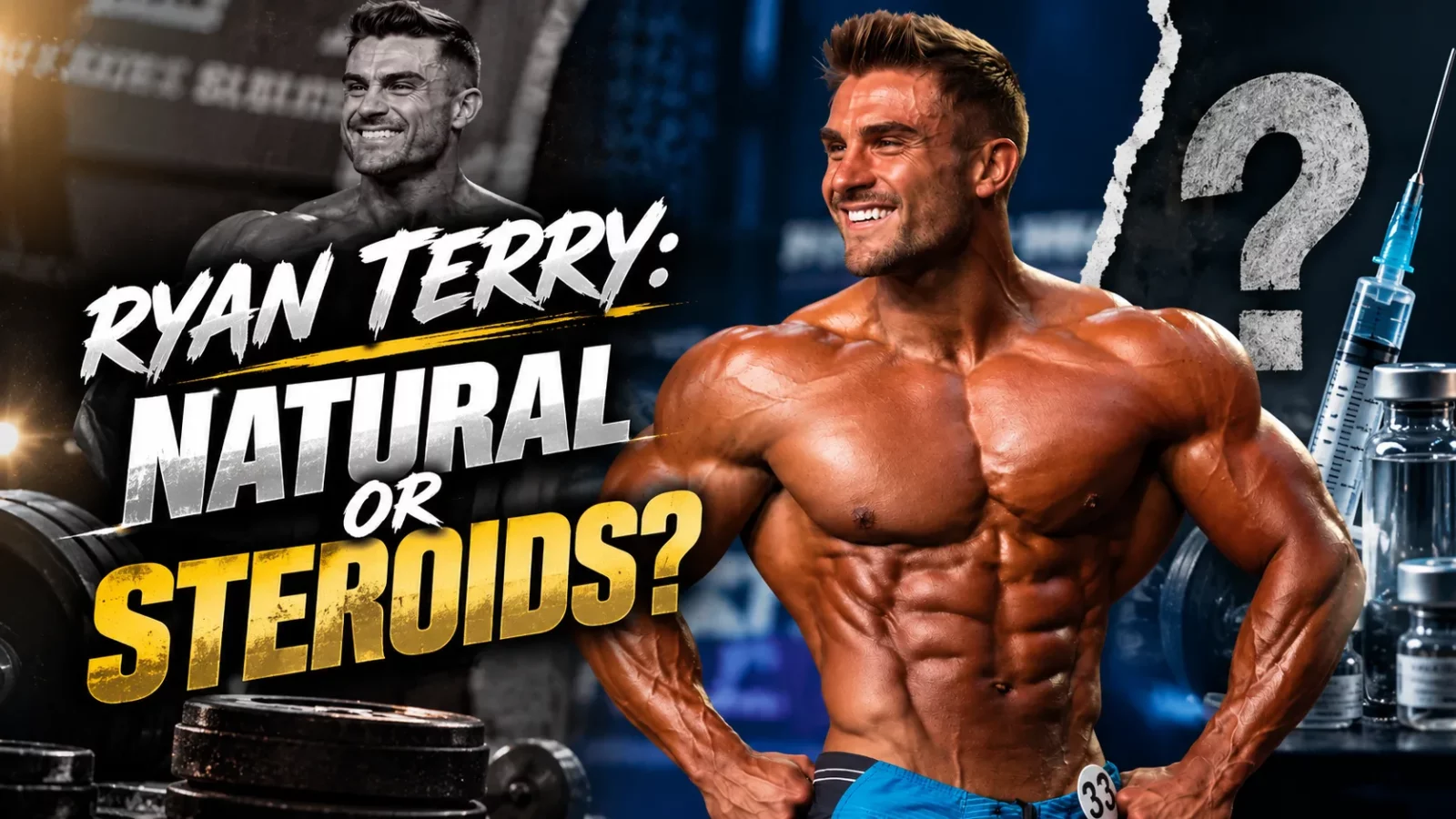
Ryan Terry is an English IFBB Pro Men’s Physique competitor and fitness model who has been a fixture in the division’s top ranks for over a decade. A former Mr. Britain and Mr. International winner, Terry transitioned from fitness modeling to competitive bodybuilding and quickly established himself as one of the most consistent performers on the Olympia and Arnold Classic stages.
Terry has competed against top Men’s Physique athletes including Jeremy Buendia, Brandon Hendrickson, and Andre Ferguson. His physique is characterized by wide shoulders, a narrow waist, and an aesthetic proportion that has earned him multiple Arnold Classic titles and consistent top-five Olympia finishes. The Ryan Terry natural vs steroids question comes up frequently because his physique appears attainable compared to the mass monsters in the Open division.
Ryan Terry Quick Stats
- Height: 5’10” (178 cm)
- Competition weight: ~185-190 lbs (84-86 kg)
- Off-season weight: ~210 lbs (95 kg)
- Division: Men’s Physique
- Notable wins: Arnold Classic (2017, 2019, 2021), Mr. Britain, Mr. International
- Best Olympia finish: 2nd place (2016, 2017)
Who Is Ryan Terry?
Ryan Terry grew up in Nottingham, England, and was involved in athletics from a young age, competing in gymnastics and swimming. He began lifting weights at 14, initially motivated by confidence issues rather than competitive bodybuilding ambitions. His natural aesthetics led to success in fitness modeling, winning Mr. Britain and Mr. International titles before pivoting to the IFBB stage.
Competition History
| Year | Show | Placement |
|---|---|---|
| 2013 | UKBFF British Finals | 1st (Overall) |
| 2015 | Olympia Men’s Physique | 4th |
| 2016 | Olympia Men’s Physique | 2nd |
| 2017 | Arnold Classic Men’s Physique | 1st |
| 2017 | Olympia Men’s Physique | 2nd |
| 2019 | Arnold Classic Men’s Physique | 1st |
| 2019 | Olympia Men’s Physique | 3rd |
| 2020 | Olympia Men’s Physique | 3rd |
| 2021 | Arnold Classic Men’s Physique | 1st |
Ryan Terry Men’s Physique longevity is notable. While many Men’s Physique competitors peak for a year or two, Terry has maintained a top-tier physique for over a decade, consistently placing in the top five at the sport’s biggest shows.
Ryan Terry Physique Analysis
Body Composition Assessment
At 5’10” and approximately 185-190 lbs in competition condition (~5% body fat), Ryan Terry’s estimated FFMI falls in the 24-25 range. This is at the upper end of what is considered naturally achievable for a male with good genetics and years of consistent training.
For context, the natural FFMI ceiling is generally accepted at 25-26, with most natural lifters maxing out at 23-24. Terry’s numbers are within the natural range but sit at its upper boundary, which makes definitive assessment based on size alone difficult.
Muscle Group Development
Ryan Terry’s physique is proportional across all visible muscle groups. His shoulders are well-developed but not disproportionately capped, his traps are relatively flat (not overdeveloped), and his overall muscle density is consistent with what a genetically gifted natural lifter could achieve over a decade of training.
The Men’s Physique division does not reward excessive mass. Competitors are judged on proportion, symmetry, and conditioning in board shorts (legs are not visible). This creates an environment where the physical differences between an elite natural and an enhanced athlete can be much smaller than in the Open bodybuilding division.
Visible Side Effect Assessment
Visible indicators commonly associated with steroid use include:
| Indicator | Ryan Terry |
|---|---|
| Shoulder/trap overdevelopment | Not observed — proportional to frame |
| Gynecomastia | No visible signs |
| Acne scarring (back/shoulders) | Some acne visible in certain photos and time periods |
| Hair thinning/loss | Full head of hair throughout career |
| Facial bloating | Not observed |
| Extreme vascularity | Moderate, consistent with low body fat |
| Skin texture changes | Not observed |
Most steroid side effects are absent in Terry’s case. The occasional back acne noted by followers could be diet-related or hormonal in nature and is not definitive evidence of steroid use on its own.
Evidence For Natural Status
Consistent Size Over Time
One of the strongest pieces of evidence supporting Ryan Terry natural claims is that his muscle mass has remained relatively stable throughout his career. He has not experienced the dramatic size increases commonly seen when athletes begin using anabolic compounds. His physique at Mr. International (pre-IFBB career) is similar in overall mass to his competition physique years later — the primary difference is conditioning and body fat levels.
Natural athletes who get leaner can appear significantly more muscular without having gained additional mass. Going from 9-10% body fat to 5% makes a dramatic visual difference in muscle definition and perceived size.
Proportional Development
Terry’s muscle groups are developed proportionally to each other. His traps are not overdeveloped relative to his shoulders, and his deltoids do not have the 3D, capped appearance associated with androgen receptor density responses to supraphysiological hormone levels. His overall look is consistent with elite natural genetics combined with over a decade of dedicated training.
Off-Season Fluctuation
Terry visibly carries more body fat during the off-season, bulking up to approximately 210 lbs before cutting for shows. This pattern is common among natural athletes who need caloric surplus periods to build muscle. Enhanced athletes can often build muscle in a caloric deficit or maintain lower body fat year-round, making extended bulking phases less necessary.
Evidence Against Natural Status
IFBB Competition Environment
The IFBB does not test for performance-enhancing drugs in its professional divisions. While the UKBFF (where Terry competed nationally) does conduct post-show drug testing, these tests are not random and do not occur during the off-season. This testing structure allows athletes to use compounds during training phases and clear them before competitions.
Competing at the top of any untested professional division for over a decade raises questions about what level of pharmacological support may be involved, regardless of the individual competitor’s physique.
Division Baseline
While Men’s Physique is the least mass-focused IFBB division, the athletes who consistently place in the top five at the Olympia are still competing against a field where PED use is widespread. Maintaining a podium-level physique year after year against enhanced competitors without any pharmacological assistance would require extraordinary genetics.
The Acne Question
While not definitive, the occasional back acne that observers have noted on Terry’s physique can be a sign of hormonal fluctuation consistent with steroid cycling. However, acne can also result from diet, stress, sweat, and genetics — it is not conclusive evidence.
The Bottom Line
Ryan Terry is possibly natural, but competing in an environment where PED use is standard.
- His physique is within the theoretical natural limit based on FFMI calculation, and he lacks most of the visible side effects associated with long-term steroid use.
- His muscle mass has remained relatively stable throughout his career, and his proportional development is consistent with natural genetics.
- However, he competes at the highest level of an untested professional division where steroid use is the norm rather than the exception. Maintaining a top-five Olympia physique for over a decade in this environment, while theoretically possible naturally, would be extraordinary.