Contents12 sections
Chris Evans played Steve Rogers in seven Marvel films, from Captain America: The First Avenger (2011) to Avengers: Endgame (2019). The character’s jump from a frail army reject to a super-soldier is one of the most talked-about body transformations in superhero films, and because Rogers gets his muscle from a serum, many fans have asked whether the actor had chemical help too.
The word “steroids” has followed his Captain America physique on bodybuilding forums ever since. Yet Evans has never been bodybuilder-big. He is not the size of fellow Avenger Chris Hemsworth, and he was never stage-lean either.
This article looks at his physique across his whole career, from his early films and Fantastic Four through the Marvel years and beyond, checks the popular claims about how much muscle he gained, and weighs the evidence on each side. It is an honest analysis of public information, not an accusation.
Key Takeaways
- There is no admission, failed drug test or documented evidence that Chris Evans has ever used anabolic steroids.
- Skinny pre-serum Steve Rogers was a visual effect, so the film’s before-and-after is not a real transformation.
- Evans was already muscular in Fantastic Four (2005) and has kept a broadly similar build for about two decades, with no late jump in size.
- Claims that he added 20-30 lbs of muscle for the role are unverified, and his estimated FFMI of roughly 21-24.5 sits below the level of about 25 linked to natural limits.
- Shaving, oil, lighting and a pump before filming make his shirtless scenes look bigger than he does in the rest of the films.
Chris Evans Stats
| Detail | Information |
|---|---|
| Full name | Christopher Robert Evans |
| Born | June 13, 1981, Boston, Massachusetts |
| Height | 6’0″ (183 cm), reported |
| Weight | Reported figures vary, from about 176 lbs (80 kg) to around 200 lbs (91 kg) for Captain America |
| Body fat on screen | Roughly 8-10% in his shirtless Captain America scenes (estimate) |
| First Marvel role | Johnny Storm, the Human Torch, in Fantastic Four (2005) and its 2007 sequel |
| Captain America | Seven films from 2011 to 2019 |
| Estimated FFMI | About 21-24.5, depending on which weight is correct |
Actors rarely publish official measurements, so treat the weight and body fat figures as estimates. Either way, around 6 feet tall and somewhere between 176 and 200 lbs at single-digit body fat is not unusually heavy for a well-trained man of his height.
The “Skinny Steve” Transformation Was a Visual Effect
In the comics, Steve Rogers is a scrawny volunteer who is injected with the Super Soldier Serum and turned into a peak human. The First Avenger shows the same story on screen: a small, thin Rogers steps into a machine and comes out as Captain America.
That “before” body was not real. The visual effects team digitally shrank Evans’ head and body for the pre-serum scenes, using a slimmer body double for some shots. The Daily Mail reported on the effect when the first trailer came out, and it was widely covered when the film was released.
So the useful comparison is not skinny Steve versus Captain America. It is Chris Evans before the role versus Chris Evans during it, and that gap is much smaller.
Chris Evans’ Physique Timeline
The most reliable physique evidence is a timeline. Natural muscle gain follows a predictable curve: fast in the first years of training, then slower. A sudden jump in size years into someone’s career raises questions; a stable build over many years points the other way.
| Years | Roles | What His Physique Showed |
|---|---|---|
| 2000-2004 | Not Another Teen Movie, Cellular | Lean and athletic, with modest early gains from training |
| 2005-2007 | Fantastic Four and Rise of the Silver Surfer (Johnny Storm) | Several shirtless scenes; already muscular, with a similar amount of mass to his later Captain America look |
| 2011 | Puncture, then Captain America: The First Avenger | In good shape before Captain America; leaner and fuller for the shirtless reveal scene |
| 2012-2016 | The Avengers, The Winter Soldier, Age of Ultron, Civil War | His peak Captain America years; many fans consider The Winter Soldier (2014) his best shape |
| 2018-2019 | Avengers: Infinity War and Endgame | A similar size to his earlier Marvel films |
| 2019-2025 | Knives Out, The Gray Man, Ghosted, Red One, Deadpool & Wolverine (cameo as Johnny Storm), Materialists | Fit, but no larger than in his Captain America years |
Fantastic Four: Already in Shape
Evans’ first Marvel role was Johnny Storm, the Human Torch, in Fantastic Four (2005) and Fantastic Four: Rise of the Silver Surfer (2007). He appeared shirtless several times, and he was already in good shape, with a similar amount of muscle to what he carried as Captain America six years later.
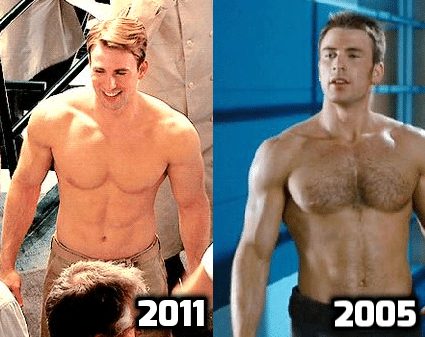
The main differences are presentation. As Captain America his chest is shaved and the lighting is more flattering, both of which make the same muscle look more defined. For much of the Captain America films he also wore fitted T-shirts or the suit, which add to the impression of size.
Puncture and the Run-Up to Captain America
In 2011, the same year as The First Avenger, Evans starred in the drama Puncture as Mike Weiss, a drug-addicted Houston lawyer. As the photo below shows, he was already in very good shape in that film too.

For Captain America he followed a demanding program of heavy lifting, bodyweight work and gymnastics-style training with a personal trainer, combined with a calorie surplus and plenty of protein. We break down the reported routine and diet in our Chris Evans workout routine guide.
The Marvel Years and After
Across eight years and seven films as Steve Rogers, his size stayed remarkably consistent. He looked leaner and more athletic in The Winter Soldier than in The First Avenger, which is what you would expect from three more years of hard training, but there was never a point where he suddenly got much bigger.
Since Endgame closed Rogers’ story in 2019, Evans has moved on to roles such as Ransom Drysdale in Knives Out, the villain Lloyd Hansen in The Gray Man, Ghosted and Red One, and a surprise return as Johnny Storm in Deadpool & Wolverine (2024). None of these roles called for a bigger body, and he has not appeared larger than in his Captain America years. Now in his 40s, he has a fit, athletic build rather than a bodybuilder’s.
How Much Muscle Did Chris Evans Really Gain?
Many articles claim that Evans gained 20-30 lbs of muscle to play Captain America. That figure has never been verified, and the Fantastic Four comparison argues against it. Twenty pounds of pure muscle on top of the body he already had in 2005 would have made him dramatically bigger, and he is not.
A more likely explanation is that he had trained for years, lost some size between roles, then rebuilt it for Captain America while eating in a surplus. Scale weight gained during a bulk is not all muscle: extra food, water and stored glycogen add pounds quickly, especially in the first weeks of eating more.
Regaining lost muscle is also faster than building it the first time, an effect often called muscle memory. Animal studies suggest that muscle fibers keep the extra nuclei they gained during training even after the muscle shrinks, and a small 2018 human study (Seaborne and colleagues, Scientific Reports) found changes in muscle gene regulation that persisted after a break from training and went with faster regrowth when training resumed.
What muscle memory does not do is make 20-30 lbs of new muscle in a few months realistic. Controlled training studies in beginners usually report lean mass gains of a few pounds over two to three months. A trained actor regaining size can move faster than that, but much of a fast scale jump is still water, glycogen and some fat.
FFMI Check
The Fat-Free Mass Index (FFMI) relates lean body mass to height, which makes it a rough tool for judging natural limits. A 1995 study by Kouri and colleagues compared steroid users with drug-free athletes and found that the drug-free lifters topped out at an FFMI of about 25.
- At 176 lbs and 10% body fat: an FFMI of about 21.3, well inside the natural range.
- At 190 lbs and 9% body fat: about 23.2, typical of a well-trained natural lifter.
- At 200 lbs and 9% body fat: about 24.5, near the top of the natural range but still below 25.
These are estimates built on reported figures, and FFMI is only one data point. Some natural lifters exceed 25, and many steroid users never reach it. But even the highest weight reported for Evans gives an FFMI that a drug-free lifter with good genetics can reach.
Evidence Suggesting Chris Evans Is Natural
No Late Growth Spurt
From Fantastic Four in 2005 to his recent films, Evans has stayed within a narrow range of size. He made modest gains early on, got leaner for his shirtless Marvel scenes, and has never ballooned. That steady pattern is what natural training looks like after the first few years.
A Realistic, Not Extreme, Physique
His Captain America body is a good example of how you can look very muscular without carrying an extreme amount of muscle. Below roughly 10% body fat, muscle definition and separation increase, which makes a lifter look bigger than the scale suggests. For the markers that do separate natural and enhanced lifters, see our guide to spotting a fake natty.
No Visible Steroid Side Effects
In his films and public appearances, Evans does not show the classic visible side effects of steroid use:
- No gynecomastia: steroids that convert to estrogen can cause breast tissue to grow. There is no sign of it in his shirtless scenes.
- No bloating: estrogenic bulking compounds often cause water retention and a puffy face. Evans has kept a slim face and a small waist.
- A full head of hair: androgens, especially DHT, speed up male-pattern hair loss in men who are genetically prone to it. Evans still has a full head of hair and a normal hairline in his 40s.
- No visible acne: steroids increase oil production in the skin, and acne on the back and shoulders is a common side effect.
- No flushed complexion: a red, flushed look can come with the higher blood pressure and red blood cell counts that steroids often cause.
These markers are weak evidence on their own. Film makeup hides skin problems, hair loss depends mostly on genetics (see our guide to steroids that don’t cause hair loss), and low doses of mild compounds can produce few visible signs. Their absence fits a natural lifter, but it does not prove one.
Evidence That Leaves Questions Open
No Drug Testing
Actors are not drug tested the way athletes in tested sports are. There are no test results for Evans in either direction, so every conclusion about him rests on public information and appearance.
Hollywood Deadlines
Big-budget films set fixed shooting dates, and lead actors have trainers, chefs and months of preparation built around looking a certain way on a certain day. Use of testosterone or growth hormone for roles is often rumoured in Hollywood but rarely confirmed. Nothing ties Evans to it, but the pressure to transform on a deadline is the main reason people ask the question at all.
Why Captain America Looked Bigger on Screen
Ask someone to picture Chris Evans’ body in Captain America and most will think of the scene where Rogers steps out of the machine after the serum:
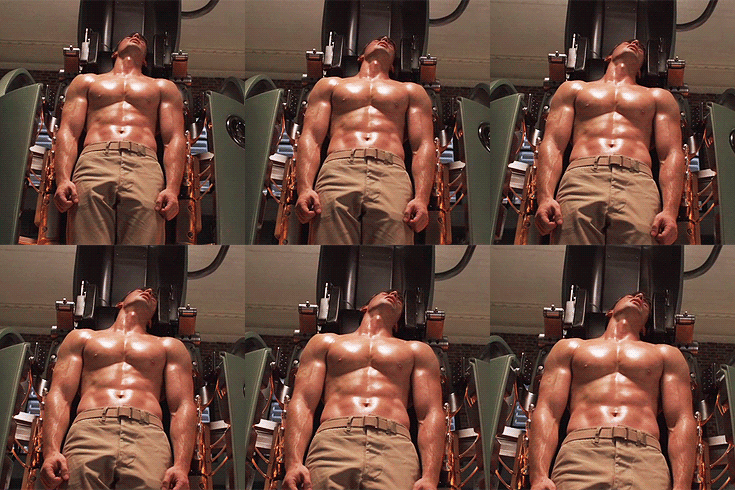
He looks bigger and more impressive here than in most of the film because he is shaved, oiled and carefully lit, and actors usually pump up just before a shirtless take. Bodybuilders remove body hair and apply oil and tan before stepping on stage for the same reason: it makes the same muscle look fuller and more defined. In other scenes of the Captain America films, he does not look as muscular as he does in this one.
Can You Build Chris Evans’ Physique Naturally?
For most men, yes, with time. A body like his in Captain America is a realistic goal for a natural lifter with decent genetics who trains hard and consistently for several years. It takes progressive overload on the big lifts, enough protein (about 0.7-1 g per pound of bodyweight is well supported by research), a calorie surplus to build and a careful cut to reveal the muscle.
What you should not expect is his film-ready look in three months from scratch. Evans arrived at Captain America with years of training behind him and a professional team around him. If you want to compare superhero preparations, the Henry Cavill workout routine for Superman shows a similar approach on a bigger frame.

Pros
- Catalog is specifically organized around muscle building, fat loss, testosterone support, and workout performance.
- Range includes creatine, protein, EAAs, beta-alanine, and L-citrulline alongside more specialized formulas.
- Orders of $99+ qualify for free US shipping.
Cons
- Features several strong claims around muscle growth, testosterone, fat loss, and metabolic effects that should be distinguished from independently demonstrated clinical outcomes
- Heavily oriented toward bodybuilding and performance rather than broader nutritional supplementation.
The Bottom Line
Based on the public evidence, Chris Evans is most likely natural, although only testing could confirm it.
- He has kept a broadly similar build since Fantastic Four in 2005, with none of the late growth spurts that usually point to steroid use.
- His estimated FFMI of about 21-24.5 is within the range drug-free lifters reach, and he shows no visible steroid side effects.
- The dramatic on-screen change came from visual effects, while shaving, oil, lighting and a pump did the rest in his shirtless scenes.
Frequently Asked Questions
Disclaimer
Please read carefully
The information on this site is for educational and informational purposes only, and is not medical advice. Always consult a qualified healthcare professional before using any supplement or medication, or making changes to your health, fitness, or nutrition routine.
Not medical advice
Content here is not a substitute for professional medical advice.
Consult your doctor
Talk to your doctor before starting any supplement or new routine.
Use at your own risk
We are not responsible for adverse effects from acting on this.
Do your research
Make informed decisions about your own health.
No guarantees
Individual results vary. No claims about outcomes.
Important — Never disregard professional medical advice or delay seeking it because of something you read here. If you think you may have a medical emergency, call your doctor or your local emergency number right away.