
Contents9 sections
Knowing how to inject peptides properly is the most practical skill any peptide user can develop. Injectable peptides deliver significantly higher bioavailability than oral forms — a critical advantage in peptide therapy, meaning more of the active compound reaches the bloodstream and produces its intended effects. Most research peptides — from growth hormone secretagogues to recovery compounds like BPC-157 and TB-500, and fat-loss peptides like HGH Fragment 176-191 — are designed for injection.
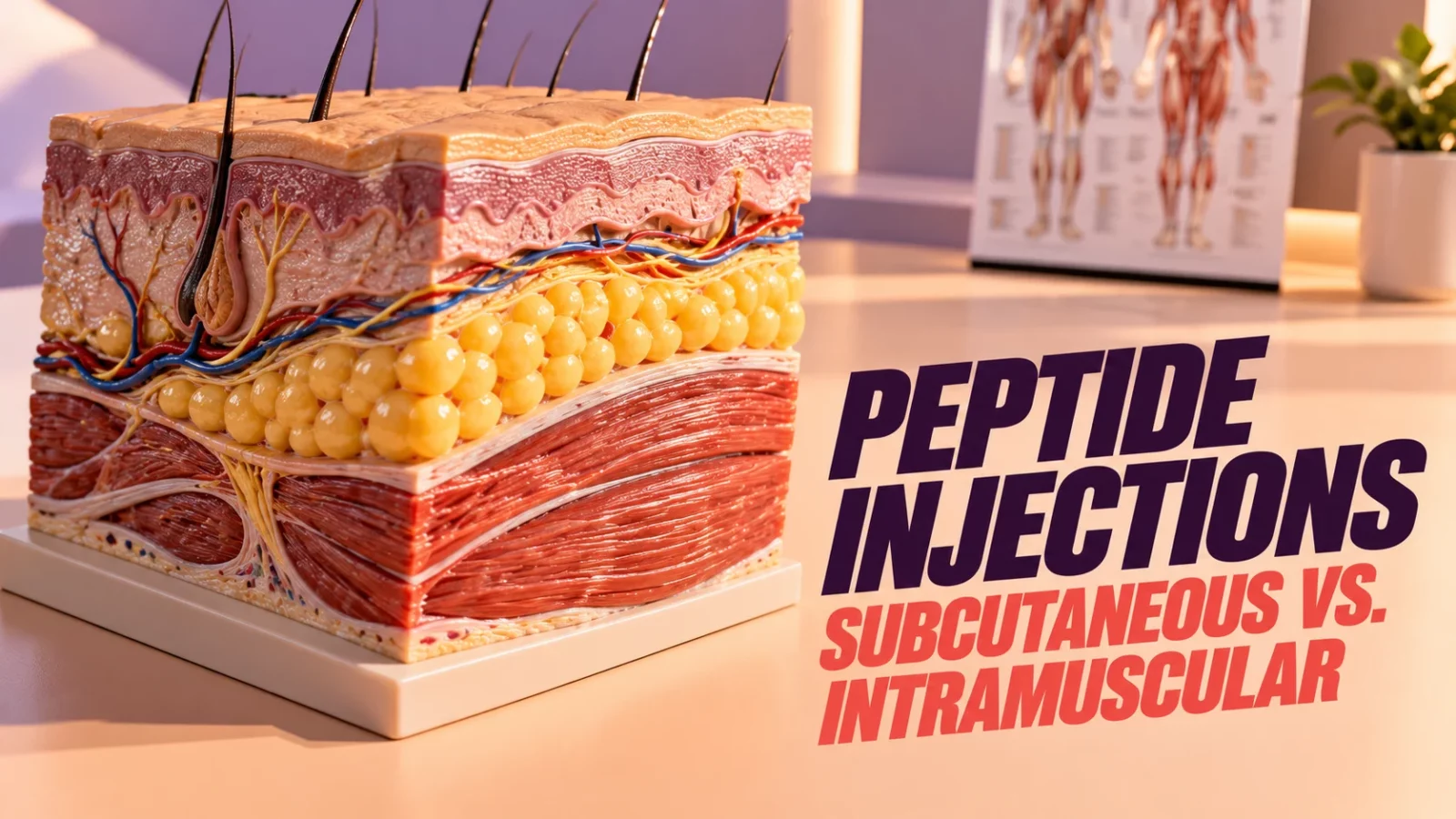
The two primary methods for peptide injection are subcutaneous (under the skin) and intramuscular (into the muscle). Most users inject peptides subcutaneously because it is the standard route and the easier technique to learn. This guide walks through both methods with step-by-step instructions, proper needle selection, injection site rotation, and safety practices.
The information on this site is for educational and informational purposes only, and is not medical advice. Always consult a qualified healthcare professional before using any supplement or medication, or making changes to your health, fitness, or nutrition routine.
Key Takeaways
- Subcutaneous peptide injection is the standard method for most research peptides. It is simpler, less painful, and appropriate for nearly all compounds.
- Intramuscular injection is used for select peptides that require deeper tissue delivery or larger injection volumes.
- Use a 27-30 gauge insulin syringe for subcutaneous injections and a 22-25 gauge needle for intramuscular injections.
- Always reconstitute lyophilized (powdered) peptides with bacteriostatic water before injection. Never inject dry powder.
- Rotate injection sites between doses to prevent tissue irritation, scarring, or lipodystrophy.
Before You Inject: Preparation
Supplies Needed
| Item | Purpose | Notes |
|---|---|---|
| Reconstituted peptide vial | Active compound | Must be stored refrigerated after reconstitution |
| Insulin syringe (27-30 gauge) | Subcutaneous injection | 1 mL or 0.5 mL capacity |
| IM syringe (22-25 gauge) | Intramuscular injection | 1-3 mL capacity |
| Alcohol swabs | Sterilization | For vial tops and injection sites |
| Sharps container | Safe needle disposal | Never discard needles in regular trash |
| Bacteriostatic water | Reconstitution | Required for powdered peptides |
Reconstitution
Most peptides arrive as lyophilized (freeze-dried) powder that must be reconstituted before injection. The standard process:
- Clean the top of both the peptide vial and bacteriostatic water vial with alcohol swabs
- Draw the desired amount of bacteriostatic water into the syringe
- Insert the needle into the peptide vial and direct the water stream against the glass wall — not directly onto the powder
- Allow the powder to dissolve naturally. Do not shake the vial. Gentle swirling is acceptable.
- Once fully dissolved, the solution should be clear. Discard any vial with cloudy or discolored solution.
The amount of bacteriostatic water added determines the concentration. For example, adding 2 mL of water to a 5 mg peptide vial creates a concentration of 2.5 mg/mL (250 mcg per 0.1 mL).
How to Inject Peptides Subcutaneously
Subcutaneous injection delivers the peptide into the fat layer between the skin and muscle. This is the recommended administration route for most research peptides including growth hormone releasing peptides, BPC-157, and thymosin compounds.
Steps for Subcutaneous Injection
Step 1: Wash your hands thoroughly. Use soap and water for at least 20 seconds. Dry with a clean towel.
Step 2: Prepare the syringe. Draw air equal to your intended dose volume into the syringe. Insert the needle into the reconstituted peptide vial, inject the air (this equalizes pressure), then invert the vial and withdraw the correct dose. Remove air bubbles by tapping the syringe and pushing them out.
Step 3: Select an injection site. The primary subcutaneous peptide injection sites are:
- Abdomen: 2 inches from the navel, at or below belly button level. This is the most common site.
- Upper thigh: Front or outer area of the thigh
- Upper arm: Back or side of the upper arm
- Love handles: Lateral abdominal fat
Step 4: Clean the injection site with an alcohol swab. Allow the alcohol to dry completely before injecting.
Step 5: Pinch the skin. Gently pinch a fold of skin and fat at the injection site to separate it from the underlying muscle.
Step 6: Insert the needle. Push the needle into the pinched skin at a 45-90 degree angle. Use 90 degrees if you have adequate subcutaneous fat at the site. Use 45 degrees if you are lean at that site.
Step 7: Inject slowly. Depress the plunger steadily. Rushing the injection can cause localized pain.
Step 8: Withdraw and dispose. Remove the needle, apply gentle pressure with a clean alcohol swab, and dispose of the syringe in a sharps container. Never recap and reuse needles.
Subcutaneous Injection Tips
- Rotate between at least 3-4 injection sites to prevent lipodystrophy (localized fat tissue changes from repeated injections)
- Inject at a consistent time each day for peptides that require daily dosing
- If a small amount of the peptide leaks back out after withdrawing the needle, wait 5-10 seconds with the needle inserted before removing it
- Minor redness, swelling, or bruising at the injection site is normal and typically resolves within 24 hours
How to Inject Peptides Intramuscularly
Intramuscular injection delivers the peptide directly into muscle tissue. This method of peptide administration is less common than subcutaneous injection but may be appropriate for certain compounds or larger injection volumes.
When to Use Intramuscular Injection
- When the peptide instructions specifically call for IM administration
- When injecting larger volumes (over 1 mL) that would be uncomfortable subcutaneously
- For peptides targeting localized muscle tissue effects
Steps for Intramuscular Injection
Step 1: Wash your hands and gather supplies. Use a 22-25 gauge needle, 1-1.5 inches in length.
Step 2: Prepare the syringe with the correct dose following the same procedure as subcutaneous preparation (air injection, inversion, withdrawal, air bubble removal).
Step 3: Select an injection site. The safest intramuscular injection sites are:
- Vastus lateralis (outer thigh): The middle third of the outer thigh. Easiest for self-injection.
- Deltoid (upper arm): The thickest part of the deltoid muscle, 2-3 finger widths below the acromion.
- Gluteal (upper outer buttock): The upper outer quadrant of the buttock. Difficult for self-injection but appropriate for larger volumes.
Step 4: Clean the site with an alcohol swab and allow it to dry.
Step 5: Insert the needle at a 90-degree angle to the skin surface. Push the needle in with a steady, controlled motion.
Step 6: Aspirate (optional). Pull back slightly on the plunger. If blood enters the syringe, you have hit a blood vessel — withdraw the needle, apply pressure, and select a new site. If no blood appears, proceed with injection. Note: aspiration is no longer universally recommended for all IM injections but remains a reasonable safety step.
Step 7: Inject slowly and withdraw the needle. Apply gentle pressure with an alcohol swab.
Step 8: Dispose of the syringe in a sharps container.
Needle Selection Guide
| Injection Type | Gauge | Length | Syringe Volume |
|---|---|---|---|
| Subcutaneous | 27-30 gauge (insulin syringe) | 5/16 inch (8 mm) to 1/2 inch (12.7 mm) | 0.5-1 mL |
| Intramuscular | 22-25 gauge | 1-1.5 inches (25-38 mm) | 1-3 mL |
Higher needle gauge numbers mean thinner needles. Thinner needles cause less pain but draw fluid more slowly. For the small volumes typical of peptide injections, insulin syringes (27-30 gauge) are ideal for subcutaneous use.
Injection Safety and Best Practices
Site Rotation
Injecting into the same spot repeatedly causes tissue damage, scarring, and lipodystrophy. Use at least 3-4 different peptide injection sites and rotate between them systematically. Keep the injection sites at least 1 inch apart even within the same general area (such as alternating sides of the abdomen).
Storage
- Store reconstituted peptides in the refrigerator (2-8 degrees C / 36-46 degrees F)
- Most reconstituted peptides remain stable for 3-4 weeks when refrigerated
- Never freeze reconstituted peptides
- Unreconstituted (lyophilized) peptides can be stored at room temperature or frozen for long-term storage
When to Seek Medical Attention
Contact a healthcare provider if you experience:
- Persistent redness, swelling, or warmth at the injection site lasting more than 48 hours
- Signs of infection: increasing pain, pus, red streaks extending from the site
- Fever following injection
- Allergic reaction: hives, difficulty breathing, swelling of face or throat
The Bottom Line
Subcutaneous injection with an insulin syringe is the standard method for most research peptides and requires minimal equipment: a clean syringe, an alcohol swab, and a reconstituted vial.
- Intramuscular injection is reserved for specific situations where deeper tissue delivery is needed.
- The most common mistakes are skipping hand washing, reusing needles, and injecting into the same site repeatedly.
- If you are new to peptide injection, inject peptides subcutaneously to start — it is the simplest, least painful method and works for nearly every peptide.
Frequently Asked Questions
Disclaimer
Please read carefully
The information on this site is for educational and informational purposes only, and is not medical advice. Always consult a qualified healthcare professional before using any supplement or medication, or making changes to your health, fitness, or nutrition routine.
Not medical advice
Content here is not a substitute for professional medical advice.
Consult your doctor
Talk to your doctor before starting any supplement or new routine.
Use at your own risk
We are not responsible for adverse effects from acting on this.
Do your research
Make informed decisions about your own health.
No guarantees
Individual results vary. No claims about outcomes.
Important — Never disregard professional medical advice or delay seeking it because of something you read here. If you think you may have a medical emergency, call your doctor or your local emergency number right away.




I am 75 old years male, living in Portugal.
I suffer from aging related problems, like
– Decreased muscles mass – metabolism – digestive capacity – eye sight
– Also insomnia – brain fog – erectile dysfunction
– increased weight
Please suggest me the appropriate injectable peptide
Thank you
I’m 71 have MS, colitis, & asthma. My MS makes my feet burn horribly at night therefore I can’t sleep. I would like to do this however not sure what to use and would love some anti-aging benefits.
If you have MS you need a parasite cleanse look at the work of dr Bryan Ardis and MS
I want to buy the injectable anti-aging peptide. Which one would you suggest?
June Graham
Anti-Aging would rely on an increase in IGF-1, so, look for peptides that increase IGF-1
Somatropin-HGH will increase your IGF 1 for anit aging
I want to inject peptides IV in my arm, is this ok?