Contents10 sections
Selective androgen receptor modulators (SARMs) are often sold as the safer alternative to steroids: muscle-building effects with fewer side effects. The question most people never get a straight answer to is what they do to the body over years, not weeks.
The honest answer is that nobody knows for certain. No SARM has been approved for medical use, and the clinical trials that exist lasted weeks to a few months, in small groups, at doses well below those commonly reported by bodybuilders. There is no long-term human safety data for any of them.
What we do have are warning signs: trials showing hormone suppression and falling HDL cholesterol, published liver-injury case reports, animal cancer data for Cardarine (often sold alongside SARMs) and FDA warnings. This guide sets out what each shows, which evidence is human and which is animal, and what is still unknown.
Key Takeaways
- No SARM is approved for medical use, and there is no long-term human safety data: the trials that exist lasted weeks to months, at lower doses than users commonly report.
- Testosterone suppression is dose-dependent and shows up even at low doses: in a 3-week trial, LGD-4033 at up to 1 mg a day lowered total testosterone and HDL cholesterol.
- Published case reports link SARM products, most often LGD-4033 and RAD-140, to drug-induced liver injury with jaundice, usually appearing a few weeks into use.
- Cardarine (GW501516) is not a SARM but is sold alongside them; its development was stopped after long-term rodent studies found cancers in multiple organs.
- Many products sold as SARMs are mislabelled, so users can end up taking compounds and doses they never chose, a risk on top of the compounds themselves.
Understanding SARMs (Selective Androgen Receptor Modulators)
SARMs are synthetic compounds that bind to the androgen receptor, the same receptor testosterone acts on. Researchers and drug companies began developing nonsteroidal SARMs in the late 1990s as possible treatments for muscle wasting, frailty and osteoporosis. The aim was a drug that builds muscle and bone with less effect on the prostate, skin and other tissues than anabolic steroids.
That selectivity is real but partial. SARMs still signal to the brain’s hormone centres, which is why they lower your own testosterone production. As oral drugs, they also pass through the liver and change blood lipids. “Fewer androgenic side effects than steroids” was a design goal, not proof of safety.
No SARM has been approved by the FDA or any other major regulator. In the US they cannot legally be sold as dietary supplements, which is why most are sold as “research chemicals” labelled “not for human consumption”. WADA prohibits them in sport at all times, and legal status elsewhere varies: see our guide to whether SARMs are legal in your country.
Long Term Side Effects of SARMs: What the Evidence Shows
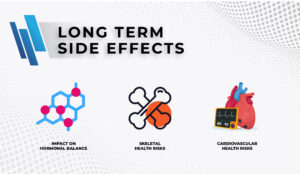
Long-term safety can only be measured by following people for years, and that has never been done for any SARM. The trials that exist were short, carefully dosed and run in specific groups such as healthy volunteers, older adults or patients with muscle loss. Recreational use is different: higher doses, repeated cycles, stacks and products of unknown content.
So the long-term picture has to be pieced together from short-term signals. If a compound changes hormones, cholesterol or liver function within weeks, it is fair to ask what years of on-and-off use might do, even though nobody has measured it.
| Risk | What has been seen | Type of evidence |
|---|---|---|
| Testosterone suppression | Dose-dependent drops in testosterone, even at low trial doses | Human, controlled trials |
| Lower HDL cholesterol | Dose-dependent HDL falls within weeks | Human, controlled trials |
| Liver injury | Liver injury with jaundice, mostly with LGD-4033 and RAD-140 products | Human case reports |
| Heart attack and stroke | FDA warning of possible increased risk; no long-term outcome studies | Regulatory warning |
| Cancer | Cancers in multiple organs in rodents given Cardarine (not a SARM); no long-term data for SARMs | Animal studies |
Testosterone Suppression
Suppression of the body’s own testosterone is the most consistent finding across SARM studies, and reviews of the clinical data list it as a core safety concern [1].
The clearest human example is a placebo-controlled trial of LGD-4033 (Ligandrol) published in 2013 in The Journals of Gerontology. Seventy-six healthy men aged 21 to 50 took placebo or 0.1, 0.3 or 1 mg a day for 21 days. Lean mass rose by about 1.2 kg at the top dose, but total testosterone, SHBG, HDL cholesterol and triglycerides fell in a dose-dependent way, and free testosterone and FSH dropped significantly at 1 mg. Levels returned towards baseline after the men stopped.
Two points matter for long-term risk. 1 mg a day is a fraction of the 5 to 10 mg or more commonly reported by bodybuilders, and three weeks is far shorter than a typical cycle, let alone years of repeated cycles. Recovery after short, low-dose exposure says little about recovery after long, high-dose use.
Weeks or months of low testosterone can cause low libido, erectile problems, fatigue, low mood and loss of strength. Because LH and FSH drive sperm production, suppression can also reduce fertility while it lasts. Some users report that their levels are slow to recover after stopping, and the only way to know is a blood test compared against normal testosterone levels for your age. Our guide to PCT for SARMs covers how suppression and recovery work.
Cholesterol and Cardiovascular Risk
The same LGD-4033 trial showed HDL (“good”) cholesterol falling within three weeks, at doses well below those people commonly take. Lower HDL has also been reported in trials of other SARMs. Oral androgens are known to lower HDL partly through their effects on the liver, and SARMs appear to share this effect.
A few weeks of lower HDL is unlikely to cause harm on its own. The concern is repeated cycles over years, since an unfavourable lipid profile is a known contributor to atherosclerosis. No study has tracked heart attacks or strokes in long-term SARM users, but the FDA has warned that SARMs may increase the risk of both.
Liver Injury
The idea that SARMs are easy on the liver does not hold up. A growing number of published case reports describe drug-induced liver injury in people using SARM products, most often LGD-4033 and RAD-140, sometimes in products containing several compounds. The FDA has also warned that SARMs have been linked to life-threatening liver damage.
The reports follow a similar pattern. Symptoms usually appear a few weeks after starting: yellow skin and eyes, intense itching, dark urine, nausea and tiredness. Blood tests typically show cholestatic injury, meaning bile flow from the liver is blocked. Some patients needed hospital care; most recovered after stopping, sometimes over months. Case reports can’t show how common this is or rule out contaminated products, but they do show that serious liver injury is not limited to oral steroids.
Cancer: What Is Known and What Isn’t
There is no human evidence that SARMs cause cancer, and no evidence that they don’t. Long-term cancer studies have simply never been done.
The prostate is the obvious worry with any androgen. SARMs were designed to spare it, and the 21-day LGD-4033 trial showed no change in PSA, but three weeks says nothing about years. The picture is also more complex than “androgens feed tumours”: enobosarm (Ostarine) and RAD-140 have both been tested as possible treatments for certain hormone-receptor-positive breast cancers. Androgen receptor effects on cancer depend on the tissue and the compound, so long-term effects can’t be guessed.
The clearest cancer signal comes from a compound that isn’t a SARM. Cardarine (GW501516) is a PPAR-delta agonist that is sold and stacked alongside SARMs. GlaxoSmithKline stopped developing it in 2007 after long-term studies in mice and rats found cancers in multiple organs, and in 2013 WADA took the unusual step of publicly warning athletes about it. This is animal data and its relevance to humans at commonly reported doses is unknown, but no human research has shown it to be safe.
Hair Loss, Acne and Other Androgenic Effects
Tissue selectivity reduces androgenic effects but does not remove them. Users commonly report hair loss and acne, especially with more potent compounds and higher doses. For men with a genetic tendency to baldness, hair loss is one of the effects that may not fully reverse.
Women face an added risk of virilization: a deeper voice, facial and body hair, menstrual changes and clitoral enlargement. With androgens in general, some of these changes, particularly voice changes, can be permanent.
Short-Term Side Effects of SARMs
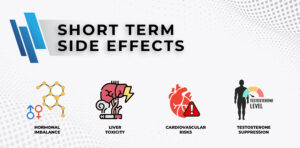
Short-term effects are where the long-term risks start, because each repeated cycle adds to the total exposure. Most of them are covered above: symptoms of low testosterone, lower HDL cholesterol, raised liver enzymes, acne and hair shedding. Users also commonly report:
- Headaches, poor sleep and irritability: mostly in the first weeks of a cycle.
- Vision changes: a yellow tint and poor night vision with Andarine (S4), usually at higher doses.
SARMs vs Anabolic Steroids: How the Risks Compare
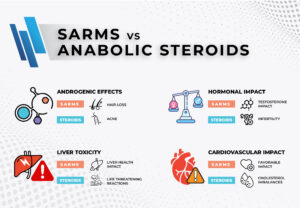
SARMs are often described as having a lower impact on natural testosterone than steroids. That is only partly true. Suppression with SARMs is dose-dependent: it is measurable even at the low doses used in trials and can be marked at the doses many users take. The comparison below sets out where the two differ and where they overlap.
| SARMs | Anabolic steroids | |
|---|---|---|
| Receptor action | Designed to act mainly on muscle and bone; selectivity is partial | Act on androgen receptors throughout the body |
| Testosterone suppression | Dose-dependent; seen even at low trial doses | Marked at most doses used for performance |
| HDL cholesterol | Lowered in clinical trials | Lowered, especially by oral steroids |
| Liver | Case reports of cholestatic liver injury | Oral 17-alpha-alkylated steroids are known to be toxic to the liver; injectables less so |
| Androgenic effects | Reduced but present (acne, hair loss, virilization in women) | Common (acne, hair loss, prostate growth, virilization in women) |
| Long-term human data | None | Decades of observational data in users |
| Approval and legality | Not approved anywhere; legal status varies by country; banned by WADA | Some approved for medical use; controlled substances in many countries; banned by WADA |
The fair summary: SARMs may be milder than steroids on some measures, but the risks of steroids are far better mapped. With SARMs you trade some known side effects for a larger set of unknowns. Our full SARMs vs steroids comparison covers results as well as risks.
Product Quality: A Risk on Top of the Compound
Because SARMs are unapproved, nobody checks what goes into the bottle before it is sold. Sellers label them “for research purposes” or “not for human consumption” to sit in a legal grey area, which also means no manufacturing standards apply.
An analysis of 44 products sold online as SARMs, published in JAMA in 2017, found that only about half contained a SARM at all. Many contained other unapproved drugs or substances not listed on the label, several contained no active ingredient, and the amounts often did not match what the label claimed. For long-term risk this matters: a user can take a different compound, a different dose or a combination they never chose.
For that reason, people who research these compounds look for vendors that publish independent third-party test results for each batch. A test result shows what is in the bottle; it does not make the compound safe to use.

Pros
- Exceptional purity & testing (≥98%)
- Pharmaceutical-style packaging for stability
- Broad catalog across peptides & nootropics
- Strong reputation & consistency across years
Cons
- Some items frequently out of stock due to high demand
- Limited long-term data for some compounds
Monitoring Your Health if You Have Used SARMs
If you have used SARMs, the risks above are ones a doctor can check for, and being open about it gets you better care than guessing.
- Hormones: total and free testosterone, LH and FSH, ideally with a baseline before use and a check after stopping to confirm recovery.
- Lipids: a cholesterol panel including HDL and LDL.
- Liver: liver function tests (ALT, AST, ALP and bilirubin).
- Warning signs: stop and seek medical care for yellow skin or eyes, dark urine, pale stools, persistent itching, upper-right abdominal pain, chest pain or shortness of breath.
If testosterone stays low months after stopping, an endocrinologist can investigate. Self-prescribing PCT drugs without testing can hide whether your own production has actually recovered.
The Bottom Line
The long-term side effects of SARMs are unknown because no one has studied them, but the short-term evidence already points to real risks for hormones, cholesterol and the liver.
- Controlled trials show dose-dependent drops in testosterone and HDL cholesterol within weeks, at doses below those users commonly report.
- Published case reports link LGD-4033, RAD-140 and other SARM products to serious liver injury, and the FDA warns of possible heart attack and stroke risk.
- There is no human cancer data for SARMs; the clearest cancer signal comes from rodent studies of Cardarine, which is not a SARM.
- Mislabelled products add risk, and bloodwork for hormones, lipids and liver function is the only way to know how your body is responding.
Frequently Asked Questions
Disclaimer
Please read carefully
The information on this site is for educational and informational purposes only, and is not medical advice. Always consult a qualified healthcare professional before using any supplement or medication, or making changes to your health, fitness, or nutrition routine.
Not medical advice
Content here is not a substitute for professional medical advice.
Consult your doctor
Talk to your doctor before starting any supplement or new routine.
Use at your own risk
We are not responsible for adverse effects from acting on this.
Do your research
Make informed decisions about your own health.
No guarantees
Individual results vary. No claims about outcomes.
Important — Never disregard professional medical advice or delay seeking it because of something you read here. If you think you may have a medical emergency, call your doctor or your local emergency number right away.