Contents11 sections
Dwayne “The Rock” Johnson has one of the most famous physiques in the world, and one of the most debated. He was already huge in his WWE days in the late 1990s, and in his 50s he was still adding muscle for film roles. That has made “is The Rock on steroids?” one of the most common natty-or-not questions online.
Johnson is also one of the few stars in this debate who has spoken about steroids on the record. He has said he tried them as a teenager, and he has not admitted to any use since.
This article sets out what he has said, how his physique has changed from WWE to his most recent films, the case on each side, and which popular “tells” don’t hold up. It is an honest analysis of public evidence, not an accusation.
Key Takeaways
- Dwayne Johnson said in a 2009 MTV News interview that he tried steroids at 18 or 19. He has not admitted to any use since, and there is no failed drug test on record.
- His Samoan heritage comes from his mother’s side: her father was the wrestler Peter Maivia. His father, Rocky Johnson, was a Black Nova Scotian wrestler.
- Elite genetics, a 6’5″ frame, more than 30 years of training and a full-time coach explain much of his physique.
- The doubts come from scale: a reported 30 lbs of muscle gained for The Smashing Machine in his early 50s, and an estimated FFMI above the often-cited natural ceiling of about 25.
- Skin tone, head shape and big traps in photos are not evidence of steroid use. Only clinical testing could confirm whether he is natural.
Dwayne Johnson Stats and Background
| Detail | Information |
|---|---|
| Full Name | Dwayne Douglas Johnson |
| Born | May 2, 1972, Hayward, California |
| Age | 54 (as of 2026) |
| Height | 6’5″ (196 cm) |
| Weight | Billed at 260 lbs (118 kg) in WWE; varies with film roles |
| Father | Rocky Johnson, Black Nova Scotian wrestler (WWE Hall of Fame) |
| Maternal Grandfather | Peter Maivia, Samoan wrestler (WWE Hall of Fame) |
| Sports Background | University of Miami football, CFL, WWE |
| Known For | WWE, Fast & Furious, Jumanji, Moana, The Smashing Machine |
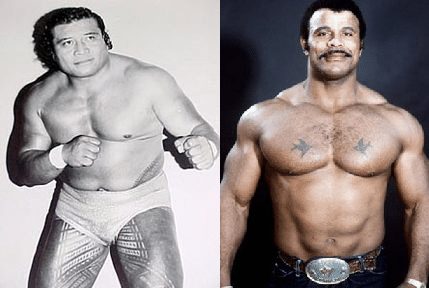
Johnson was born into wrestling. His father, Rocky Johnson, was a Black Nova Scotian wrestler who, with Tony Atlas, became the first Black tag team champions in WWF history in 1983. His mother, Ata, is Samoan, and her father was High Chief Peter Maivia, a Samoan wrestler. Both men were inducted into the WWE Hall of Fame in 2008.
So his Samoan heritage comes from his mother’s side, not his father’s, as is sometimes claimed.
Before wrestling, Johnson played defensive tackle at the University of Miami and was part of its 1991 national championship team. After a brief spell with the CFL’s Calgary Stampeders in 1995, he debuted in WWE (then the WWF) at Survivor Series 1996 as Rocky Maivia.
What The Rock Has Said About Steroids
In a 2009 interview with MTV News, Johnson said he and his friends tried steroids when he was 18 or 19 and “didn’t know what we were doing,” as NBC Washington reported in March 2009.
He has framed it as a teenage experiment, and he has not admitted to any use since. There is no public record of him failing a drug test.
There are two ways to read this. Taken at face value, his adult physique is the product of elite genetics, decades of training and a professional team. Skeptics argue that his size, especially in his 50s, is hard to square with that. Photos and public numbers can inform the debate, but they can’t settle it.
Dwayne Johnson’s Physique Timeline
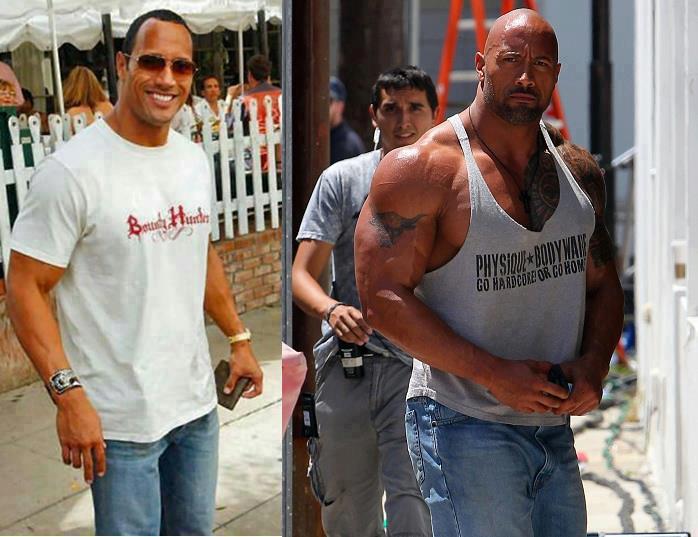
The best way to judge any natty-or-not question is the timeline: when someone got big, how big, and whether they kept growing after the years when natural gains slow down.
| Years | Era | What the Public Record Shows |
|---|---|---|
| 1990-1994 | University of Miami football | Defensive tackle; part of the 1991 national championship team |
| 1995 | Calgary Stampeders (CFL) | Brief spell on the practice roster before being cut |
| 1996-2004 | WWE, full-time | Debuted as Rocky Maivia in 1996, became The Rock; billed at 6’5″ and 260 lbs; left full-time wrestling after WrestleMania XX in 2004 |
| 2001-2010 | Early film career | The Mummy Returns (2001) and The Scorpion King (2002), then action films and family comedies; his size changed with the roles |
| 2011-2013 | Fast Five, WWE return, Pain & Gain | Visibly bigger and more muscular than in his wrestling prime; won the WWE Championship at the 2013 Royal Rumble |
| 2013-2014 | Hercules | About 260 lbs on set after a long prep with coach Dave Rienzi, Muscle & Fitness reported in 2014 |
| 2021-2022 | Black Adam | Rienzi described a roughly 12-month prep in four phases |
| 2024 | WrestleMania XL | Wrestled a tag team match on night one, aged 51 |
| 2024-2025 | The Smashing Machine (released 2025) | Told Variety he gained 30 lbs of muscle to play MMA fighter Mark Kerr, in his early 50s |
Two things stand out. First, he has been big since his late teens, which fits his genetics and sports background. Second, his size kept going up well into middle age, long after the years when natural gains usually level off. He has looked bigger and leaner in his 40s and 50s than he did as a wrestler.
The Case That He Is Natural
Elite Genetics and a Huge Frame
Johnson is 6’5″, the son and grandson of professional wrestlers, and was big enough to play defensive tackle for one of the best college football programs of his era. A tall, broad frame carries far more muscle in absolute pounds than an average one, which makes his size look more extreme than it would on a smaller man.
More Than Three Decades of Structured Training
Few people train and eat with his consistency for as long. His coach for more than a decade, Dave Rienzi, has planned his film preps. In a 2015 interview he said he lifts six days a week, mostly 4 sets of 12 reps, plus 30-50 minutes of cardio first thing in the morning. For Hercules, Muscle & Fitness reported a diet of seven meals and about 4,940 calories a day. Elite coaching, measured meals and time to train are real advantages that most lifters never have.
No Failed Tests and No Classic Side-Effect Signs
There is no public record of Johnson failing a drug test. His physique also lacks some markers linked to heavy drug use in pro bodybuilding, such as the distended midsection known as palumboism; his waist has stayed tight through every era.
Both points carry less weight than they seem. His full-time wrestling career ended before WWE introduced its current Wellness Policy, which includes drug testing, in 2006, and acting has no anti-doping testing. And moderate doses can leave few visible side effects, so a clean-looking physique does not prove natural status.
Why Many Lifters Doubt He Is Natural
Adding Muscle While Getting Leaner
Since his WWE days, Johnson has added visible muscle while getting leaner. Beginners can build muscle and lose fat at the same time, but for someone who has trained seriously for decades, natural progress is slow, and adding a lot of size while staying lean is very hard.
Testosterone changes that picture. In a classic 1996 trial in the New England Journal of Medicine, men who trained while taking 600 mg of testosterone a week for 10 weeks gained more muscle than men who did the same training on a placebo, and even the men on testosterone who did not train at all gained muscle.
Gaining 30 lbs of Muscle in His 50s
For The Smashing Machine, Johnson told Variety he gained 30 lbs of muscle to play Mark Kerr, over a prep his coach put at about six months. Commonly cited estimates for advanced natural lifters are a few pounds of new muscle a year at most (see our guide to realistic muscle gain per month).
There are fair caveats. Part of a figure like that is usually water, glycogen and some fat, and muscle that has been built before tends to come back faster than new muscle. Even so, a gain of that size in a man’s 50s, when natural testosterone tends to drift lower (see average testosterone levels by age), is the main reason many lifters doubt a fully natural career.
FFMI Estimate
The fat-free mass index (FFMI) compares lean mass with height. A 1995 study comparing steroid users with drug-free athletes found the drug-free group topped out at a normalized FFMI of about 25, and that figure is still widely used as a rough natural ceiling.
- At 260 lbs and 10-12% body fat: a normalized FFMI of roughly 26-27 at 6’5″.
- At 250 lbs and 12% body fat: about 25, right at the ceiling.
FFMI is a screen, not proof. Billed weights are often generous, his real body fat is unknown, and small changes in either move the result a lot. It suggests his size is at or beyond the usual natural range; it cannot tell you what he has taken.
Popular “Tells” That Don’t Hold Up
A lot of online “proof” about The Rock comes from photo comparisons that don’t actually show anything about drug use.
Big Traps
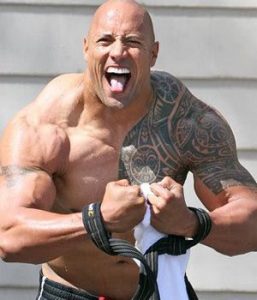
Large traps are often called a steroid giveaway, but they are not proof. Trap size depends heavily on genetics and training, and Johnson has trained them hard for years: his Hercules program included heavy dumbbell shrugs, and for The Smashing Machine he told Variety he did more trap and neck work than ever before.
Skin Tone
Claims that his skin looks “darker” or “flushed” in recent photos say nothing reliable about drug use. Skin tone in photos changes with lighting, sun exposure, tanning, makeup and color grading, all of which differ between a 1990s TV broadcast and a modern film set.
Head and Jaw Size
Some posts claim his head or jaw has grown, a supposed sign of growth hormone. Camera lenses, angles, hair versus a shaved head, body weight and normal aging all change how a face looks, so stills taken decades apart can’t show bone growth. Real growth hormone excess is diagnosed with blood tests and imaging, not screenshots.
The “Juicy” Look
Full, shiny, vascular muscles on screen are often the product of a pump, oil, careful lighting and short-term water and carb manipulation before shooting. They look dramatic in a still, but they don’t tell you what someone has taken.
Is Dwayne Johnson on Steroids? Our Assessment
Nobody outside his medical team knows, and photos can’t settle it. Here is where the public evidence points:
- Confirmed: he has said he tried steroids at 18 or 19.
- Not confirmed: any use after that. He has not admitted to it, and there is no failed test on record.
- Open to debate: whether the physique he has built and kept into his 50s is achievable without help. Many experienced lifters doubt it; his genetics, training history and professional team explain a lot of it.
Our honest read: it is reasonable to question whether a man who added a reported 30 lbs of muscle in his 50s, with an estimated FFMI at or above the usual natural ceiling, has been drug-free his whole adult life. But that is an inference from public numbers, not evidence, and it is not an accusation. Only testing could confirm it either way.
If you want to judge physiques like this yourself, our guide to steroids vs natural bodybuilders covers the signs that matter and the ones that don’t. For realistic drug-free benchmarks, look at the best natural bodybuilders.
The Bottom Line
There is no proof that Dwayne Johnson uses steroids: he has admitted only to trying them as a teenager, but the size he has built and kept into his 50s keeps the question alive.
- His one on-record admission is trying steroids at 18 or 19, from a 2009 MTV News interview.
- Elite genetics, a huge frame, decades of structured training and a full-time coach explain much of his physique, but not easily all of it.
- Photo “tells” such as skin tone, head size and traps prove nothing; only testing could settle whether he is natural.
Frequently Asked Questions
Disclaimer
Please read carefully
The information on this site is for educational and informational purposes only, and is not medical advice. Always consult a qualified healthcare professional before using any supplement or medication, or making changes to your health, fitness, or nutrition routine.
Not medical advice
Content here is not a substitute for professional medical advice.
Consult your doctor
Talk to your doctor before starting any supplement or new routine.
Use at your own risk
We are not responsible for adverse effects from acting on this.
Do your research
Make informed decisions about your own health.
No guarantees
Individual results vary. No claims about outcomes.
Important — Never disregard professional medical advice or delay seeking it because of something you read here. If you think you may have a medical emergency, call your doctor or your local emergency number right away.