
Contents11 sections
If you eat plenty of protein and train consistently but find muscle harder to build or keep than it used to be, part of the reason may be anabolic resistance: a blunted response of muscle to the two main signals that make it grow, dietary protein and resistance exercise.
Anabolic resistance is best documented in older adults, and it also follows periods of inactivity, illness or bed rest. It is one of the drivers of age-related muscle loss (sarcopenia), slower recovery and declining strength over time.
It is not a fixed sentence. Older muscle still responds to protein and training; it simply needs more of both. This guide covers what anabolic resistance is, what the research in older adults shows, what causes it and the steps that best counter it.
Key Takeaways
- Anabolic resistance means muscle responds less to protein and exercise. It is well documented in older adults and also develops quickly with inactivity.
- Older muscle needs more protein per meal: about 0.4 g per kg of body weight, versus about 0.24 g/kg in young adults. For a 75 kg person that is roughly 30 g per meal.
- Progressive resistance training is the strongest countermeasure, and it works at any age: even people in their 90s have made large strength gains with it.
- Daily movement matters: two weeks of very low step counts was enough to cut leg lean mass and blunt the response to protein in healthy older adults.
- Creatine and whey have the best supplement evidence. Extra leucine on its own did not add muscle or strength in a 12-week trial in older men.
What Is Anabolic Resistance?
Anabolic resistance is a reduced ability of skeletal muscle to raise muscle protein synthesis (MPS) in response to anabolic stimuli, mainly dietary protein, amino acids and resistance exercise. The muscle still responds, but a meal or a workout that would produce a full response in a young, active person produces a smaller one.
Muscle is constantly being built and broken down. When the building response to each meal and each session is smaller, the daily balance tips slightly toward loss. Over years, that small gap adds up, which is why anabolic resistance is considered a major contributor to sarcopenia (age-related loss of muscle mass and strength) and to slower recovery from injury or illness.
It is most common in older adults, but it is not only about age. Inactivity, bed rest and immobilization of a limb produce it in younger people too, and insulin resistance and chronic inflammation are linked to it. At the cellular level it involves weaker signalling through mTOR, the main growth pathway in muscle, and reduced delivery and use of amino acids.
What the Research Shows in Older Adults
Researchers measure anabolic resistance with stable isotope tracers that track how quickly new protein is built into muscle after a meal or a workout. A handful of studies set out the main findings:
| Study | Who Was Studied | What It Found |
|---|---|---|
| Cuthbertson et al., 2005 (FASEB Journal) | Young and older men given essential amino acids | Older men had a smaller rise in muscle protein synthesis, with weaker mTOR signalling |
| Katsanos et al., 2006 (American Journal of Physiology) | Young and older adults given 6.7 g of essential amino acids | The dose raised MPS in young but not older adults; raising its leucine share from 26% to 41% restored the response |
| Kumar et al., 2009 (Journal of Physiology) | Young and older men doing leg exercise at light to heavy loads | The rise in MPS after exercise was smaller in the older men |
| Yang et al., 2012 (British Journal of Nutrition) | Older men after leg resistance exercise | 40 g of whey raised muscle protein synthesis more than 20 g |
| Breen et al., 2013 (Journal of Clinical Endocrinology and Metabolism) | Healthy older adults cut to about 1,500 steps a day for two weeks | Leg lean mass fell and the muscle-building response to a meal was blunted |
| Moore et al., 2015 (Journals of Gerontology) | Pooled data from young and older men | Older men needed about 0.40 g/kg of protein per meal to maximize MPS, versus about 0.24 g/kg for young men |
Two points stand out. First, older muscle is not unresponsive: a larger protein dose, or more leucine in the dose, restores much of the response. Second, inactivity on its own creates anabolic resistance quickly, which helps explain why a short illness, injury or hospital stay can cost older adults so much muscle.
Causes of Anabolic Resistance
Several factors contribute, and they usually act together over time:
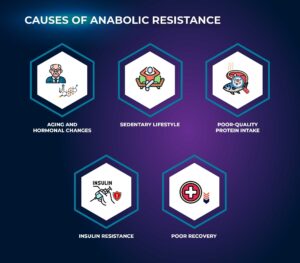
Aging and Hormonal Changes
Testosterone, growth hormone and IGF-1 tend to fall with age, and all three support muscle maintenance. Lower levels are one contributor, but the core defect seen in tracer studies is in the muscle’s own response to amino acids and exercise. For typical changes over a lifetime, see average testosterone levels by age.
Inactivity
Inactivity is one of the fastest ways to induce anabolic resistance. Fewer daily steps, bed rest or a limb in a cast reduce the muscle’s response to protein within days to weeks. The effect is larger in older adults, who also tend to regain lost muscle more slowly.
Too Little Protein, or Too Little per Meal
Total daily protein matters, and so does the dose in each meal. A light breakfast and lunch with most of the day’s protein at dinner means two meals fall below the amount older muscle needs for a full response. Meals low in leucine, the amino acid that most strongly switches on mTOR, make this worse.
Insulin Resistance and Inflammation
Insulin resistance, excess body fat and chronic low-grade inflammation are linked to a weaker anabolic response. In the Health ABC study of older adults, higher blood levels of the inflammatory markers IL-6 and TNF-α were associated with lower muscle mass and strength. That link is observational, so it shows an association rather than proof of cause.
Poor Sleep and Recovery
In a study of healthy young adults, one night of total sleep deprivation reduced muscle protein synthesis after a meal by 18%, alongside higher cortisol and lower testosterone (Lamon et al., 2021). Chronic short sleep and ongoing stress have been studied less directly, but they push in the same direction.
Signs of Anabolic Resistance
There is no blood test or home test for anabolic resistance; it is measured in research labs. In everyday life it shows up as a pattern rather than a single symptom:
- Difficulty gaining or keeping muscle despite consistent training and adequate protein.
- Slower recovery after workouts, injuries or illness.
- Strength and endurance declining over time.
- Rising body fat with a loss of muscle tone.
- Training plateaus even with progressive overload.
None of these signs is specific. Under-eating, poor sleep, overtraining, low testosterone, thyroid problems and some medications can produce the same picture. If you are losing strength or weight without an obvious reason, see a doctor before changing your plan.
How to Overcome Anabolic Resistance
The research points to the same few levers: more protein per meal, progressive resistance training, more movement during the day and good recovery. Each helps on its own, and they work best together.
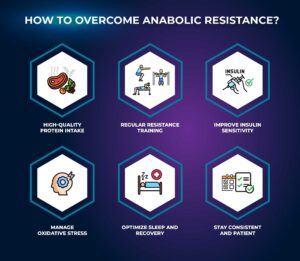
Eat Enough Protein, and Enough at Each Meal
Muscle needs a supply of amino acids, especially leucine, to switch on protein synthesis. Two numbers matter: your total for the day and the dose in each meal.
Per day: the PROT-AGE expert group recommends at least 1.0-1.2 g of protein per kg of body weight per day for healthy adults over 65, and at least 1.2 g/kg for those who exercise. For people lifting to build muscle, a large meta-analysis by Morton and colleagues (2018) found that extra protein stopped adding lean mass at around 1.6 g/kg per day, with an upper estimate of about 2.2 g/kg.
Per meal: this is where older adults differ most. Moore and colleagues (2015) pooled data from several studies and found that older men needed about 0.40 g/kg of protein in a meal to maximize muscle protein synthesis, compared with about 0.24 g/kg in young men. For a 75 kg adult, that is roughly 30 g per meal for an older person versus about 18 g for a younger one. A 20 g serving that is plenty for a young lifter falls short for many older adults.
| Body Weight | Protein per Meal (0.4 g/kg) | Three Meals a Day | Four Meals a Day |
|---|---|---|---|
| 60 kg (132 lb) | 24 g | 72 g | 96 g |
| 70 kg (154 lb) | 28 g | 84 g | 112 g |
| 80 kg (176 lb) | 32 g | 96 g | 128 g |
| 90 kg (198 lb) | 36 g | 108 g | 144 g |
| 100 kg (220 lb) | 40 g | 120 g | 160 g |
Three meals at 0.4 g/kg give 1.2 g/kg per day; four meals, or three meals plus a protein-rich snack, reach 1.6 g/kg. If you have kidney disease, agree a protein target with your doctor.
Spreading protein evenly also helps. In a seven-day study of healthy adults, eating about 30 g of protein at each of three meals produced roughly 25% higher 24-hour muscle protein synthesis than the same total skewed toward dinner (Mamerow et al., 2014). Leucine-rich sources include whey, dairy, eggs, fish, poultry and lean meat. Plant proteins are generally lower in leucine and less digestible, so vegetarians and vegans need somewhat larger servings or a blend of sources. For practical options, see our guide to protein supplements for the elderly.
Lift Weights, and Progress Over Time
Resistance training is the most effective tool against anabolic resistance. It raises muscle protein synthesis directly and, in studies of young men, keeps muscle more sensitive to protein for up to 24 hours afterwards. Older muscle responds less to a single session (Kumar et al., 2009), but it still adapts well to regular training.
The gains possible later in life are large. In a 1990 study published in JAMA, ten frail nursing-home residents with an average age of 90 increased leg strength by an average of 174% after eight weeks of high-intensity resistance training.
- Train each major muscle group at least twice a week.
- Use progressive overload: add load, reps or sets gradually as you get stronger.
- Build the program around multi-joint lifts such as squats or leg presses, presses, rows and hip hinges, adapted to your joints.
- Take most working sets close to failure, with only a few reps left in reserve.
- If heavy loads are not an option, low-load blood flow restriction (BFR) training or slow eccentric work can still build muscle; learn BFR from a qualified coach or physiotherapist.
- Eat a protein-rich meal within a few hours of training.
Our guide to hypertrophy and strength training covers how to set up sets, reps and progression.
Move More Between Workouts
Daily activity matters as well as gym sessions. In the Breen study, healthy older adults who cut their steps to about 1,500 a day for two weeks lost leg lean mass and developed a blunted response to protein. Inactivity also worsens insulin sensitivity, and in older adults insulin’s normal effect of increasing blood flow, and with it amino acid delivery, to muscle is already weaker.
Walk most days, break up long periods of sitting, take a short walk after meals and get back on your feet as soon as it is safe after an illness or injury. A diet built on vegetables, legumes, whole grains and minimally processed foods, with fewer refined carbohydrates and added sugars, also supports insulin sensitivity.
Keep Inflammation in Check
Omega-3 fatty acids are the best-studied nutritional option here. In an eight-week randomized trial in older adults, 4 g a day of omega-3 fatty acids increased the muscle protein synthesis response to insulin and amino acids (Smith et al., 2011). Otherwise the practical steps are familiar: eat fish regularly, plenty of vegetables, fruit and olive oil, limit alcohol and keep body fat in a healthy range.
Sleep and Recover
Aim for 7-9 hours of sleep. Growth hormone is released mainly in deep sleep, and testosterone peaks in the morning after a full night. As noted above, a single night without sleep reduced post-meal muscle protein synthesis by 18%. Keep a regular sleep schedule, limit screens before bed and leave rest days between hard sessions for the same muscles. Chronic stress keeps cortisol high, which favors muscle breakdown, so managing it is part of recovery too.
Supplements That May Help
Supplements cannot replace enough protein and regular training, but a few have useful evidence in older adults or in lifters generally.
Creatine Monohydrate
Creatine is the best-supported supplement here. Meta-analyses of trials in older adults, such as Devries and Phillips (2014), found that creatine taken during resistance training added more lean mass and strength than training alone. The usual dose is 3-5 g a day; taking it daily matters more than timing. See types of creatine for how the different forms compare.
Whey Protein
Whey is fast-digesting and leucine-rich, which makes it an easy way to reach the 0.4 g/kg per-meal target. In older men after leg exercise, 40 g of whey raised muscle protein synthesis more than 20 g (Yang et al., 2012).
Essential Amino Acids and Leucine
Essential amino acid (EAA) blends with a high leucine share can raise muscle protein synthesis in older adults, as the Katsanos study showed. Adding leucine on its own to a diet that already contains enough protein has not built muscle: in a 12-week trial, 2.5 g of leucine with each main meal did not increase muscle mass or strength in healthy older men (Verhoeven et al., 2009). EAAs are most useful for people who struggle to eat enough whole protein.
Ashwagandha
Ashwagandha is an herbal extract mainly studied for stress. In an eight-week trial in young men, 300 mg of root extract twice a day produced larger gains in strength and muscle size than placebo during resistance training (Wankhede et al., 2015). It has not been studied for anabolic resistance in older adults. Avoid it in pregnancy, and stop it if you notice signs of liver problems, as rare cases of liver injury have been reported. More in our article on ashwagandha benefits.
Doses Used in Studies
| Supplement | Dose | Timing | Strength of Evidence |
|---|---|---|---|
| Creatine monohydrate | 3-5 g a day | Any time, every day | Strong; meta-analyses in older adults |
| Whey protein | About 0.4 g/kg per serving (roughly 25-40 g) | With a low-protein meal, between meals or after training | Strong for raising muscle protein synthesis |
| Essential amino acids | Per label; a serving with about 2.5-3 g of leucine is commonly used | Between meals or around training | Moderate; most useful when protein intake is low |
| Omega-3 fatty acids | 4 g a day in the key trial in older adults | With meals | Moderate; one small randomized trial |
| Ashwagandha root extract | 300-600 mg a day | Once or split into two doses | Limited; studied in young men |

Pros
- Catalog is specifically organized around muscle building, fat loss, testosterone support, and workout performance.
- Range includes creatine, protein, EAAs, beta-alanine, and L-citrulline alongside more specialized formulas.
- Orders of $99+ qualify for free US shipping.
Cons
- Features several strong claims around muscle growth, testosterone, fat loss, and metabolic effects that should be distinguished from independently demonstrated clinical outcomes
- Heavily oriented toward bodybuilding and performance rather than broader nutritional supplementation.
Check with your doctor before starting any supplement if you have a medical condition, take medication (fish oil, for example, can add to the effect of blood thinners) or are under a physician’s care.
Everyday Habits That Add Up
Beyond training and balanced nutrition, a few daily habits make the plan above easier to stick to:
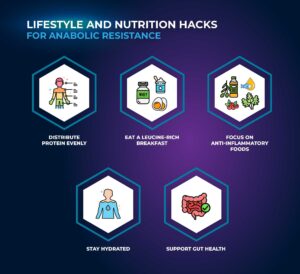
- Make breakfast a protein meal. Eggs, Greek yogurt, cottage cheese or a whey shake instead of a mostly carbohydrate breakfast, which is often the lowest-protein meal of the day.
- Build every meal around protein. Choose the protein source first, then add carbohydrates and vegetables.
- Eat fish regularly, along with plenty of vegetables, fruit, legumes and olive oil.
- Drink enough fluid, especially around training; thirst becomes a less reliable signal with age.
- Get enough fiber from vegetables, legumes and whole grains, plus fermented foods such as yogurt or kefir if you tolerate them.
- Be patient. Strength usually improves within weeks; visible muscle changes take months of consistent training and eating.
The Bottom Line
Anabolic resistance makes muscle harder to build and keep, especially with age and inactivity, but older muscle still responds when it gets more protein per meal and a regular reason to grow.
- Older adults should aim for about 0.4 g of protein per kg of body weight at each meal and at least 1.0-1.2 g/kg per day, or around 1.6 g/kg when training to build muscle.
- Progressive resistance training at least twice a week is the strongest countermeasure, and it produces real strength gains even in people in their 90s.
- Stay active between sessions and sleep well. Creatine and whey have the best supplement evidence; leucine on its own has not added muscle in trials.
Frequently Asked Questions
Disclaimer
Please read carefully
The information on this site is for educational and informational purposes only, and is not medical advice. Always consult a qualified healthcare professional before using any supplement or medication, or making changes to your health, fitness, or nutrition routine.
Not medical advice
Content here is not a substitute for professional medical advice.
Consult your doctor
Talk to your doctor before starting any supplement or new routine.
Use at your own risk
We are not responsible for adverse effects from acting on this.
Do your research
Make informed decisions about your own health.
No guarantees
Individual results vary. No claims about outcomes.
Important — Never disregard professional medical advice or delay seeking it because of something you read here. If you think you may have a medical emergency, call your doctor or your local emergency number right away.