Contents15 sections
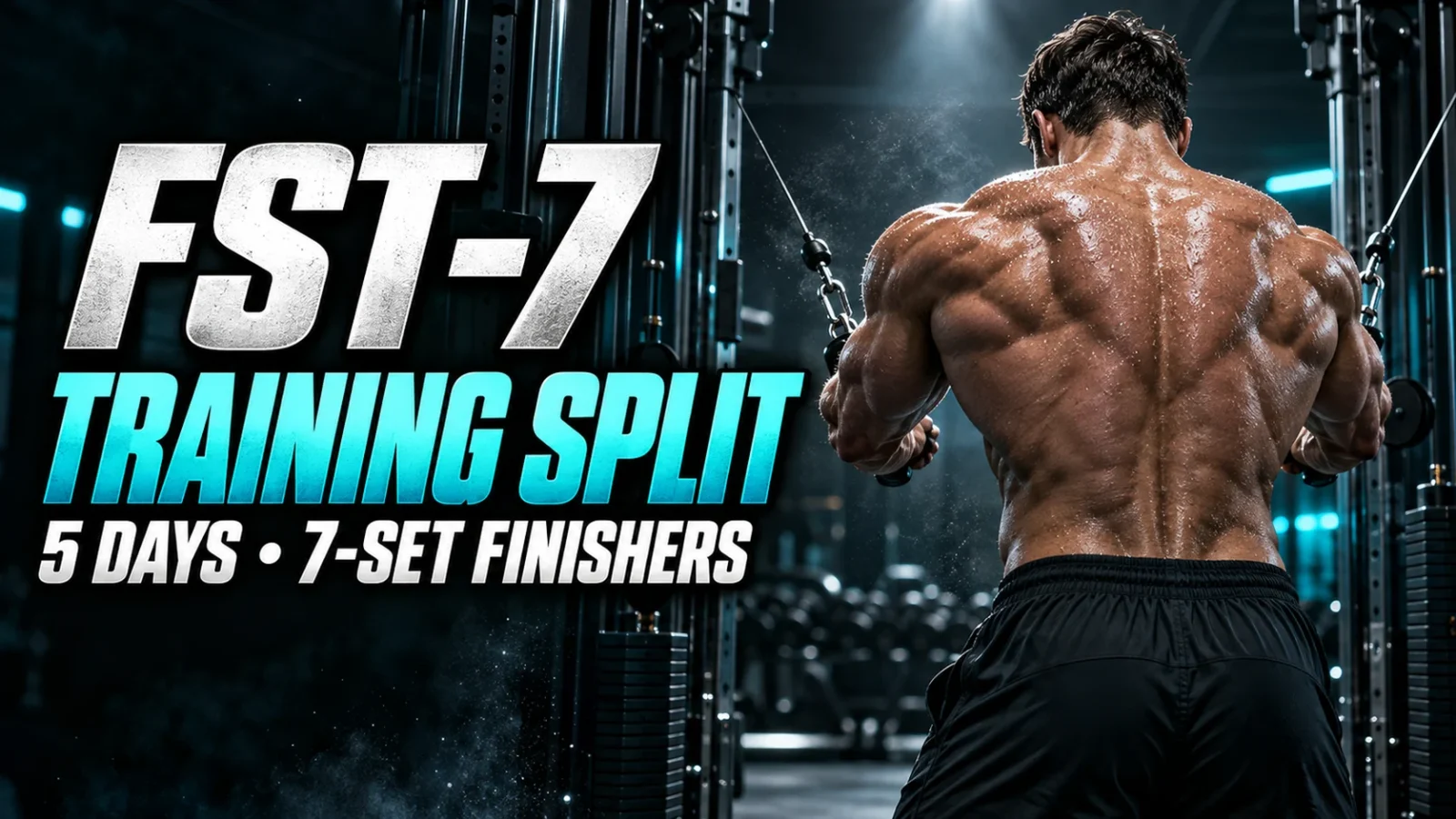
FST-7 is a bodybuilding training system created by coach Hany Rambod. The name stands for Fascia Stretch Training, and the 7 refers to the seven sets you perform on the final exercise for each muscle group, with short rest between them. The goal is the biggest pump possible at the end of the session.
This guide lays out the full FST-7 five day split, workout by workout, with an honest look at the research. One point up front: Rambod’s idea that pump sets stretch the fascia and make room for growth is his rationale, not a proven mechanism. The program can still work, mostly for other reasons.
Key Takeaways
- FST-7 is Hany Rambod’s system: heavier work first, then 7 sets of 8–10 reps on one exercise with 30–60 seconds of rest.
- This five day split trains chest, legs, back, shoulders and arms on separate days, with abs three times and calves twice a week.
- The claim that pump sets stretch fascia to allow more growth has not been shown in research. It is a coaching theory.
- Research does support what FST-7 delivers: more weekly sets tend to produce more growth, and high-effort techniques like drop sets build muscle about as well as standard sets.
- Very short rest can slightly reduce growth compared with resting longer than 60 seconds, so keep the short rest for the finisher only.
What Is FST-7 Training?
FST-7 is a way of finishing a body part workout. You do your normal heavier exercises first, then end with one exercise performed for 7 sets of 8–10 reps, resting only 30–60 seconds between sets.
A 2009 Iron Man magazine column credited Rambod with FST-7 and described the same core idea: seven extra sets of 8 to 10 reps of a continuous-tension isolation exercise, with about 30 seconds of rest, at the end of a body part workout.
What “Fascia Stretch Training” Means
Fascia is the connective tissue that wraps each muscle. Rambod’s rationale is that tight fascia may limit how much a muscle can expand, and that stretching it from the inside, by filling the muscle with blood, gives the muscle more room to grow. Seven short-rest sets on one exercise create a large, sustained pump that is meant to provide that stretch.
That theory has not been tested in controlled research, so treat it as Rambod’s explanation for the method, not established physiology.
Who Is Hany Rambod?
Hany Rambod is a bodybuilding coach whose clients have included Mr. Olympia winners Jay Cutler and Phil Heath, along with many other professional bodybuilders. That profile is a big part of why FST-7 became so well known.
A champion’s coach using a method does not prove the method caused the results. Elite bodybuilders have exceptional genetics, years of training and, in open-class competition, often use performance-enhancing drugs. For more on that gap, see our guide to steroids vs natural bodybuilders.
How the FST-7 Finisher Works
- Seven sets, one exercise. The FST-7 exercise usually comes last for each muscle group.
- 8–10 reps per set. Calves use 20–30 reps in this split.
- Short rest. About 30–45 seconds between sets for smaller muscles, and 45–60 seconds for larger muscles.
- Hit your reps on every set. If your reps drop, reduce the load slightly on later sets rather than cutting reps short.
- Use machines and cables. They are stable and quick to adjust, so you can focus on the target muscle as fatigue builds.
- Heavy work comes first. The exercises before the finisher are where you push heavier weights.
Good FST-7 Exercise Choices
| Muscle Group | FST-7 Exercise Options |
|---|---|
| Chest | Cable crossovers, pec deck |
| Back (lats) | Lat pulldowns, straight-arm pulldowns |
| Shoulders | Cable or machine lateral raises, reverse pec deck (rear delts) |
| Quads | Leg extensions, leg press |
| Hamstrings | Seated or lying leg curls |
| Biceps | Cable curls |
| Triceps | Rope or bar pressdowns |
| Calves | Seated calf raises, calf raises on the leg press |
Avoid heavy barbell lifts such as squats and deadlifts as finishers. Seven short-rest sets under heavy fatigue make technique more likely to break down.
The FST-7 Five Day Training Split
The split runs five workouts over seven days, with rest on Days 4 and 7. Here is the full week, with the workouts numbered in order.
| Day | Workout | Muscle Groups |
|---|---|---|
| Day 1 | Workout 1 | Abs and chest |
| Day 2 | Workout 2 | Calves, quads and hamstrings |
| Day 3 | Workout 3 | Abs and back |
| Day 4 | Rest | Off |
| Day 5 | Workout 4 | Abs, shoulders and traps |
| Day 6 | Workout 5 | Calves, triceps and biceps |
| Day 7 | Rest | Off |
Beginners and intermediates: Use no more than two FST-7 finishers per week to start, and run the other finishers as 3 regular sets. Add more only as your recovery allows.
Workout 1 (Day 1): Abs and Chest
| Exercise | Sets | Reps |
|---|---|---|
| Hanging leg raises | 4 | 30 |
| Exercise ball crunches | 4 | 30 |
| Crunches | 4 | 30 |
| Incline dumbbell press | 4 | 8–10 |
| Flat dumbbell press | 4 | 8–10 |
| Hammer Strength incline press | 3 | 8–10 |
| Hammer Strength flat press | 3 | 8–10 |
| Cable crossovers (FST-7) | 7 | 8–10 |
Notes: Abs come first because they are easy to skip after chest. The incline press leads because the upper chest is a common weak point.
Workout 2 (Day 2): Calves, Quads and Hamstrings
| Exercise | Sets | Reps |
|---|---|---|
| Standing calf raises | 4 | 20–30 |
| Leg press calf raises | 4 | 20–30 |
| Seated calf raises (FST-7) | 7 | 20–30 |
| Leg extensions | 3 | 8–10 |
| Squats (alternate front and back squats each session) | 3 | 8–10 |
| Hack squats | 3 | 8–10 |
| Leg press (FST-7) | 7 | 8–10 |
| Lying leg curls | 3 | 8–10 |
| Stiff-leg deadlifts | 3 | 8–10 |
| Seated leg curls (FST-7) | 7 | 8–10 |
Notes: Leg extensions pre-fatigue the quads before squats. With three finishers, this is the hardest day. If you are new to the system, keep only the leg press finisher.
Workout 3 (Day 3): Abs and Back
| Exercise | Sets | Reps |
|---|---|---|
| Reverse crunches | 4 | 30 |
| Roman chair crunches | 4 | 30 |
| Cable rope crunches | 4 | 30 |
| Wide-grip pull-ups | 3 | 8–10 |
| Reverse-grip pulldowns | 3 | 8–10 |
| T-bar rows | 3 | 8–10 |
| Reverse-grip barbell rows | 3 | 8–10 |
| Deadlifts | 3 | 8–10 |
| Straight-arm pulldowns (FST-7) | 7 | 8–10 |
Notes: The reverse-grip movements emphasize the lower lats. Deadlifts come last among the heavy lifts so they don’t drain you before the rows. Your lower back will already be tired, so use a load you can control with good form.
Day 4: Rest
No lifting. Light walking or mobility work is fine.
Workout 4 (Day 5): Abs, Shoulders and Traps
| Exercise | Sets | Reps |
|---|---|---|
| Hanging leg raises | 4 | 30 |
| Cable rope crunches | 4 | 30 |
| Reverse crunches | 4 | 30 |
| Dumbbell shoulder press | 4 | 8–10 |
| Prone incline dumbbell front raises | 4 | 8–10 |
| Upright rows | 4 | 8–10 |
| Dumbbell or machine lateral raises (FST-7) | 7 | 8–10 |
| Bent-over dumbbell lateral raises | 4 | 8–10 |
| Barbell shrugs | 4 | 8–10 |
| Dumbbell shrugs | 4 | 8–10 |
| Reverse pec deck (FST-7) | 7 | 8–10 |
Notes: The reverse pec deck doubles up on the rear delts, a common weak area. You can rotate the press between dumbbells, a Smith machine and a barbell. If upright rows bother your shoulders, swap in cable lateral raises.
Workout 5 (Day 6): Calves, Triceps and Biceps
| Exercise | Sets | Reps |
|---|---|---|
| Seated calf raises | 4 | 20–30 |
| Leg press calf raises | 4 | 20–30 |
| Standing calf raises (FST-7) | 7 | 20–30 |
| Rope pressdowns (FST-7) | 7 | 8–10 |
| Close-grip bench press | 3 | 8–10 |
| Dips | 3 | 8–10 |
| Lying triceps extensions | 3 | 8–10 |
| Straight-bar cable curls (FST-7) | 7 | 8–10 |
| Hammer curls | 3 | 8–10 |
| Preacher curls | 3 | 8–10 |
| High cable curls | 3 | 8–10 |
Notes: Here the arm finishers come first. Pressdowns and cable curls build a mind-muscle connection and warm up the elbows before heavier work.
Day 7: Rest
No lifting. The next week starts again with Workout 1.
Weekly Volume on the FST-7 Split
Counting only sets that directly target each muscle, here is the weekly workload.
| Muscle Group | Direct Sets per Week | Sessions per Week |
|---|---|---|
| Abs | 36 | 3 |
| Shoulders | 30 | 1 |
| Calves | 30 | 2 |
| Back | 22 | 1 |
| Chest | 21 | 1 |
| Quads | 16 | 1 |
| Triceps | 16 | 1 (plus pressing) |
| Biceps | 16 | 1 (plus rows and pulldowns) |
| Hamstrings | 13 | 1 |
| Traps | 8 | 1 (plus upright rows and deadlifts) |
That is a lot of volume, most of it in a single session per muscle.
What the Research Says About FST-7
No published study has tested the FST-7 program itself. There is, however, solid research on the variables it manipulates.
The Fascia Theory Is Unproven
We could not find any controlled human study showing that pump-focused sets stretch fascia or that fascia stretching increases muscle growth. The idea rests on reasoning, not measurement. The results lifters get from FST-7 are better explained by the factors below.
The Pump and Metabolic Stress
A pump comes from blood and fluid pooling in a working muscle, along with a buildup of byproducts such as lactate. In a 2013 Sports Medicine review, Brad Schoenfeld noted that mechanical tension is the main driver of muscle growth, while metabolic stress may add to it through mechanisms such as greater fiber recruitment and cell swelling. Those mechanisms are still debated, so treat the pump as a sign of hard work rather than a growth signal on its own.
Short Rest Between Sets
FST-7’s 30–60 second rest periods are shorter than what most hypertrophy research now favors.
- In an 8-week trial in 21 resistance-trained men, resting 3 minutes between sets produced more strength and more thigh muscle growth than resting 1 minute.
- A 2024 Bayesian meta-analysis found a small benefit to resting longer than 60 seconds, likely because short rest reduces the total weight you can lift. Beyond about 90 seconds, it found no clear extra benefit.
Short rest is fine for a finisher, but it is not why FST-7 builds muscle. Rest longer on the heavy exercises and keep the 30–60 second rest for the 7-set block.
Volume: Where FST-7 Likely Earns Its Results
FST-7 adds a lot of hard sets, which is probably its biggest strength.
- A 2017 meta-analysis of 15 studies found a graded dose-response relationship: each additional weekly set was linked to about 0.37% more muscle growth.
- A 2022 systematic review of trained lifters suggested 12–20 weekly sets per muscle as a sound standard. It found no clear extra benefit above 20 sets for the quads or biceps, although the triceps responded better to higher volume.
- A 2025 meta-regression of 67 studies found that growth keeps rising with more weekly sets, but with diminishing returns.
Chest, back, shoulders and calves sit at or above 20 direct sets a week on this split. Advanced lifters may benefit. Many people will progress just as well on somewhat less, with less fatigue.
Hormones
FST-7 is often said to maximize testosterone and growth hormone output. A short post-workout hormone rise is not a good reason to train this way. In a 15-week study by West and colleagues, young men trained one arm under conditions that produced a large post-workout rise in growth hormone, IGF-1 and testosterone, and the other arm without that rise. Muscle cross-sectional area increased 12% in the low-hormone arm and 10% in the high-hormone arm, with no significant difference, and strength gains were similar.
FST-7 vs Drop Sets and Other Techniques
FST-7 belongs to the same family as drop sets and rest-pause, techniques that pack more hard work into less time.
- A 2023 meta-analysis of drop-set studies found no significant difference in muscle growth between drop sets and traditional sets, though some drop-set protocols took half to a third of the time.
- A 2026 review of 23 studies on advanced training systems found no significant overall muscle growth advantage over standard multiple-set training. Drop sets and cluster-type sets matched traditional sets when volume and effort were equal.
A 7-set finisher is a valid way to add hard work. It is not a shortcut that beats normal training set for set.
Training Frequency
This split trains most muscles once a week. A 2016 meta-analysis found that training a muscle twice a week produced more growth than once a week. A larger 2019 meta-analysis of 25 studies found that frequency made no meaningful difference when weekly volume was equal. A once-a-week split can work, but splitting the same sets across two sessions may make each workout easier to recover from.
Who Should Try the FST-7 Workout?
FST-7 suits lifters with at least a couple of years of consistent training who have solid technique, recover well, can commit to five long sessions a week and have stalled on a lower-volume routine. Not sure where you stand? Our guide to beginner, intermediate and advanced lifters can help.
It is a poorer fit for beginners, for lifters chasing maximal strength and for anyone short on time or sleep. Beginners grow well on far less volume. For a strength-focused option, try our Ohio State Buckeye workout chart. For other bodybuilder-style programs, compare the Nick Walker workout routine and the Wesley Vissers workout plan.
How to Run and Progress FST-7
Run the program for at least six weeks before judging it. Log weights and reps for every set, including all 7 finisher sets, plus body weight, a few tape measurements, sleep and any joint aches.
Use double progression on every exercise:
- Pick a weight you can lift for the bottom of the rep range on every set.
- Add reps over the following weeks until you reach the top of the range on all sets.
- Increase the weight slightly and start again at the bottom of the range.
On the FST-7 finisher, add load once you complete all 7 sets at the top of the range with the planned rest. Don’t shorten the rest or add sets to progress.
If performance drops for more than a week, your joints ache or your sleep suffers, scale back. Remove one finisher per workout, or take a lighter week with about half the usual sets.
Nutrition for FST-7 Training
Calories
To build muscle, eat slightly more than you burn. A 2019 review of off-season bodybuilding nutrition recommended a calorie surplus of about 10–20%, aiming to gain about 0.25–0.5% of body weight per week for novice and intermediate bodybuilders, with advanced lifters more conservative. The same review suggested at least 3–5 g of carbohydrate per kilogram per day to fuel resistance training.
Protein
Classic bodybuilding diets, including the one first published with this program, often call for 1.2–1.6 grams of protein per pound of body weight, up to 320 grams a day for a 200-pound lifter. That is far more than the research supports.
- The International Society of Sports Nutrition position stand recommends 1.4–2.0 g per kilogram per day for most exercising people, about 0.64–0.91 g per pound.
- A 2018 meta-analysis of 49 trials found that gains in fat-free mass leveled off at around 1.6 g per kilogram per day.
- The 2019 off-season review suggested 1.6–2.2 g per kilogram per day.
For a 200-pound (about 91 kg) lifter, that is roughly 145–200 grams a day. The ISSN suggests spreading it across meals of about 0.25 g per kilogram, or 20–40 grams, every 3–4 hours. Meat, fish, eggs, dairy and soy all work.
Supplements: Evidence-Based Basics
Get training, food and sleep in place before spending money on supplements. Three have good evidence.
- Creatine monohydrate. The ISSN creatine position stand calls it the most effective nutritional supplement available for increasing high-intensity exercise capacity and lean body mass during training. A typical dose is 3–5 g per day, with an optional loading phase of about 0.3 g per kilogram per day for 5–7 days.
- Caffeine. The ISSN caffeine position stand reports that 3–6 mg per kilogram, usually about 60 minutes before training, consistently improves performance, including muscular endurance and strength. Very high doses add side effects without clear extra benefit, and late-day caffeine can hurt sleep.
- Protein powder. A convenience, not a requirement. In the 2018 meta-analysis, the benefit of protein supplementation leveled off once total intake reached about 1.6 g per kilogram per day.

Pros
- Catalog is specifically organized around muscle building, fat loss, testosterone support, and workout performance.
- Range includes creatine, protein, EAAs, beta-alanine, and L-citrulline alongside more specialized formulas.
- Orders of $99+ qualify for free US shipping.
Cons
- Features several strong claims around muscle growth, testosterone, fat loss, and metabolic effects that should be distinguished from independently demonstrated clinical outcomes
- Heavily oriented toward bodybuilding and performance rather than broader nutritional supplementation.
Recovery on a High-Volume Program
- Sleep. The CDC recommends that adults aged 18 to 60 get 7 or more hours a night.
- Use the rest days. Light walking or mobility work is fine on Days 4 and 7, but don’t add extra hard sessions.
- Protect your joints. Seven sets of one movement are hard on elbows, shoulders and knees. Use smooth machines and cables, control the lowering phase and warm up before heavy work.
- Adjust on busy weeks. Cut a finisher or two rather than skipping sessions.
Watch FST-7 in Action
The Bottom Line
FST-7 is a practical way to add hard, high-volume work to a bodybuilding split, but the fascia-stretching explanation behind it remains unproven.
- The five day split trains each major muscle hard once a week, finishing with 7 sets of 8–10 reps on short rest.
- Its results are best explained by extra volume and effort, which research consistently links to growth.
- Rest longer on heavy exercises, and don’t expect hormone spikes or the pump alone to drive growth.
- Start with two FST-7 finishers a week, use double progression, and support the work with enough calories, 1.4–2.2 g/kg of protein and 7+ hours of sleep.
Frequently Asked Questions
Disclaimer
Please read carefully
The information on this site is for educational and informational purposes only, and is not medical advice. Always consult a qualified healthcare professional before using any supplement or medication, or making changes to your health, fitness, or nutrition routine.
Not medical advice
Content here is not a substitute for professional medical advice.
Consult your doctor
Talk to your doctor before starting any supplement or new routine.
Use at your own risk
We are not responsible for adverse effects from acting on this.
Do your research
Make informed decisions about your own health.
No guarantees
Individual results vary. No claims about outcomes.
Important — Never disregard professional medical advice or delay seeking it because of something you read here. If you think you may have a medical emergency, call your doctor or your local emergency number right away.