Contents10 sections
Most nutrition advice is about losing weight. If your goal is the opposite, good guidance is much harder to find.
Maybe you have been naturally thin your whole life, you are rebuilding after an illness or a stressful stretch, or you simply want more muscle, strength and shape. Either way, healthy weight gain comes down to eating more than you burn and giving your body a reason to turn those calories into muscle. The right supplements make both easier.
This guide covers the five weight gain supplements for women that are worth considering, how to use them, a high-calorie shake recipe with checked macros, and the food and training habits that matter even more.
Key Takeaways
- Healthy weight gain starts with a steady calorie surplus from nutrient-dense food; supplements only make that surplus easier to reach.
- Strength training is what turns extra calories into muscle rather than mostly fat, so supplements work best alongside regular lifting.
- The five supplements worth considering are protein powder, a mass gainer or high-calorie shake, creatine monohydrate, essential amino acids (EAAs), and vitamin D or a multivitamin.
- Tracking your calories, weight, measurements and photos lets you adjust your intake and keep most of the gain as lean mass.
- If you are underweight without a clear reason, see a doctor first, and talk to a healthcare provider or dietitian before adding supplements or making big dietary changes.
Why Gaining Weight Is More Than Just Eating More
Gaining weight sounds simple: eat more. In practice, filling up on junk food mostly brings bloating, energy crashes and fat gain. What most women want is lean mass: muscle, with a healthy amount of body fat, not just a higher number on the scale.
Being underweight (a BMI below 18.5) carries its own health risks. This research on the risks associated with being underweight looks at Japanese women, a group with high rates of low body weight. Low body weight is an established risk factor for weaker bones, and long-term under-eating can also affect immune function and menstrual cycles. A healthy weight is about strength and resilience, not just appearance.
Weight gain supplements help by filling nutritional gaps and adding easy calories and protein. Combined with a good training plan and proper meals, they make lasting results easier to reach.
One caution before you start: if you lose weight without trying, or you can’t gain weight no matter how much you eat, see a doctor. An overactive thyroid, gut conditions such as celiac disease, and eating disorders can all make weight hard to gain or keep.
The 5 Best Weight Gain Supplements for Women
Adjusting your diet is step one, but a bigger appetite is not something you can switch on. These five supplements each have a clear job in a weight gain plan, listed from most to least useful for most women.
1. Protein Powder
Protein is the raw material for new muscle, and many women eat far less of it than they need once they start training. A large 2018 meta-analysis by Morton and colleagues found that the benefit of extra protein for muscle gain levels off at around 1.6 g per kg of body weight per day (about 0.7 g per pound). For a 130 lb (59 kg) woman, that is roughly 95 g a day.
Whey protein is the usual pick: it digests quickly, mixes easily and provides about 20-25 g of protein per scoop, which makes it a convenient post-workout shake. If dairy upsets your stomach, a whey isolate (lower in lactose) or a dairy-free powder made from beef, egg or plants is a better fit. Our guide to protein powders for sensitive stomachs covers the options.
Best for: women who lift weights or train regularly, and anyone who struggles to reach their protein target from food alone.
2. Mass Gainer or a High-Calorie Shake
If your appetite is the problem, liquid calories help, because drinks tend to fill you up less than the same calories eaten as solid food. Mass gainers are protein powders with added carbohydrates (and sometimes fats), and many provide several hundred to over 1,000 calories per serving.
Read the label: some gainers get most of their calories from sugar, and a full serving can be too much for a smaller frame or a sensitive stomach, so start with half. You can also make your own gainer from whole foods, like the shake recipe further down or this 1,000 calorie shake.
Best for: women with small appetites or busy days who can’t fit in another meal.
3. Creatine Monohydrate
Creatine isn’t just for bodybuilders. It is one of the most studied supplements in sports nutrition, and the International Society of Sports Nutrition considers it safe for healthy adults at recommended doses. It raises the creatine stores in your muscles, which helps you do a little more work in each set; over weeks of training, that adds up to more strength and lean mass.
There is less research in women than in men, but a 2021 review of creatine in women’s health by Smith-Ryan and colleagues concluded that it is safe and can support strength and exercise performance, especially when combined with resistance training.
Creatine also draws water into your muscle cells, so some of the early gain on the scale is water stored inside the muscle, not fat or bloating under the skin. The usual dose is 3-5 g a day, every day; a loading phase is optional. Our guide to the types of creatine explains why plain monohydrate is the form to buy.
Best for: women who lift weights and want more strength and visible muscle.
4. Essential Amino Acids (EAAs)
Your body needs nine essential amino acids from food to build muscle. BCAAs (leucine, isoleucine and valine) are only three of them, so a BCAA product on its own can’t fully support muscle building, a point made in a 2017 review by Robert Wolfe in the Journal of the International Society of Sports Nutrition. An EAA supplement provides all nine essential amino acids, which is why it is the better choice.
Be realistic about the benefit: if you already eat enough protein, extra amino acids add little. EAAs are most useful if you struggle to eat enough protein, or you want something light around training that won’t fill you up the way a shake does.
Best for: active women with small appetites or a low protein intake.
5. Vitamin D and a Basic Multivitamin
These won’t add weight by themselves, but they cover gaps that are common after a long stretch of under-eating. Iron deficiency is especially common in women who menstruate, and it causes tiredness that makes hard training feel harder. Vitamin D, together with calcium, supports bone health, and levels are often low in people who get little sun.
A basic multivitamin is a cheap safety net. For iron and vitamin D, ask your doctor for a blood test before taking high doses, since too much iron can be harmful.
Best for: women who have been under-eating for a while, follow a restrictive diet, or rarely see the sun.
Here is how the five compare:
| Supplement | Main job in weight gain | Typical use |
|---|---|---|
| Protein powder | Helps you reach your daily protein target | 1-2 scoops a day, with or between meals |
| Mass gainer or high-calorie shake | Adds several hundred calories in one drink | 1 serving (or half) a day, between meals |
| Creatine monohydrate | More strength and lean mass from training | 3-5 g a day, at any time |
| EAAs | Supports muscle building when protein intake is low | 1 serving during or after training |
| Vitamin D and multivitamin | Fills nutrient gaps; no direct weight gain | Daily, ideally guided by a blood test |
Enhanced Labs Picks
Disclosure: Enhanced Labs is a commercial partner of Muscle & Brawn, and we may earn a commission if you buy through links on this page. That does not change the advice above: any third-party-tested product with the same ingredient does the same job.
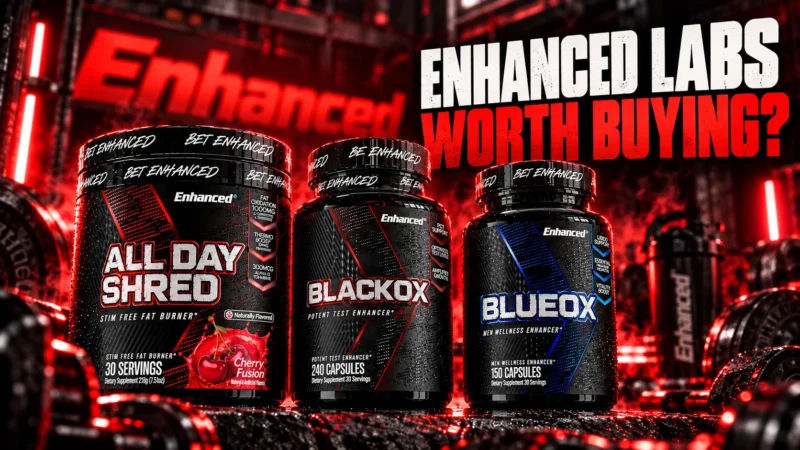
If you would rather buy the basics from one brand, these four Enhanced Labs products cover protein, creatine and EAAs. The protein and serving figures below are the brand’s own.
Enhanced Labs Primal Protein

Primal Protein is a dairy-free protein powder made from hydrolyzed beef protein and egg white isolate. It is a good fit if whey leaves you bloated or you avoid dairy.
- Protein: 27 g per scoop
- Source: hydrolyzed beef protein and egg white isolate, no dairy
- How to use: after training, between meals or before bed
- Pairs well with: creatine monohydrate
Enhanced Labs iO Premium Whey

iO Premium Whey is Enhanced Labs’ whey protein, with about 24 g of protein per scoop and an added digestive enzyme blend. It has sold out at times; if it is unavailable, Primal Protein or any third-party-tested whey does the same job.
- Protein: about 24 g per scoop
- Source: whey (contains dairy)
- How to use: daily, after training or between meals during a gaining phase
Enhanced Labs Creatine Monohydrate

Plain creatine monohydrate, the form used in most creatine research. It comes unflavored or in flavored versions.
- Dose: 3-5 g daily
- How long: it can be taken continuously; there is no need to cycle it
- Possible side effects: some early water weight; stomach upset if you take large single doses
- Pairs well with: a protein powder or EAAs
Enhanced EAA by Enhanced Labs

Enhanced EAA provides all nine essential amino acids, about 14 g per serving with the three BCAAs in a 2:1:1 ratio, according to the brand. Mix it into water during or after training.
- Dose: 1 serving during or after training
- Possible side effects: mild stomach upset in some people
- Pairs well with: creatine and a protein powder
For a closer look at the rest of the range, see our Enhanced Labs review.

Pros
- Catalog is specifically organized around muscle building, fat loss, testosterone support, and workout performance.
- Range includes creatine, protein, EAAs, beta-alanine, and L-citrulline alongside more specialized formulas.
- Orders of $99+ qualify for free US shipping.
Cons
- Features several strong claims around muscle growth, testosterone, fat loss, and metabolic effects that should be distinguished from independently demonstrated clinical outcomes
- Heavily oriented toward bodybuilding and performance rather than broader nutritional supplementation.
Natural Ways to Gain Weight Beyond Supplements

1. Eat More Calories
To gain weight, you need to eat more than you burn. This is called a calorie surplus, and it is the foundation of healthy weight gain; no supplement replaces it.
A practical way to set your surplus:
- Start with about 300-500 extra calories a day above what you eat now while your weight is stable.
- If your weight hasn’t moved after 2-3 weeks, add another 100-200 calories a day.
- Bigger surpluses add weight faster, but more of the extra weight is fat.
These are only estimates: your needs depend on your size, activity level and metabolism. Calorie-dense foods such as nuts, nut butters, whole milk, oats and olive oil make the surplus easier to reach; see our list of high-calorie foods for bulking for more ideas.
2. Get Enough Protein
If you want to gain muscle and not just fat, you need enough protein. Many studies show that a higher protein intake supports muscle growth and repair, especially when paired with strength training. The FDA’s Daily Value for protein is 50 g a day, but that is a general food-label figure: if you train, aim closer to 1.6 g per kg of body weight.
Good sources of high-quality protein include:
- Meat (chicken, beef, turkey)
- Eggs
- Dairy (Greek yogurt, cheese, milk)
- Fish (salmon, tuna)
- Legumes (beans, lentils) and soy foods such as tofu
- Nuts and seeds (more fat than protein, but very calorie-dense)
Protein shakes are a convenient way to add more, especially if you are always on the go or struggle to eat big meals.
Note: protein is very filling. If you overdo it, you may feel too full to eat enough calories overall, so balance it with carbs and fats.
High-Calorie Protein Shake Recipe for Weight Gain

Chocolate Peanut Butter Shake
Ingredients:
- 2 scoops of chocolate whey protein (about 50 g protein)
- 2 tbsp peanut butter
- 1 medium banana
- 1/2 cup rolled oats
- 1 tbsp honey
- 1 cup whole milk
- 1 cup plain whole-milk Greek yogurt
- 1 tbsp ground flaxseed
- Ice cubes, as needed
Blend everything until smooth. Approximate nutrition per ingredient (values vary by brand):
| Ingredient | Calories | Protein | Carbs | Fat |
|---|---|---|---|---|
| 2 scoops whey protein | 250 | 50 g | 6 g | 3 g |
| 2 tbsp peanut butter | 190 | 8 g | 7 g | 16 g |
| 1 medium banana | 105 | 1 g | 27 g | 0 g |
| 1/2 cup rolled oats | 150 | 5 g | 27 g | 3 g |
| 1 tbsp honey | 65 | 0 g | 17 g | 0 g |
| 1 cup whole milk | 150 | 8 g | 12 g | 8 g |
| 1 cup whole-milk Greek yogurt | 220 | 20 g | 9 g | 11 g |
| 1 tbsp ground flaxseed | 35 | 1 g | 2 g | 3 g |
| Total | About 1,165 | 93 g | 107 g | 44 g |
That is roughly 1,150-1,200 calories with about 90 g of protein, 105 g of carbs and 45 g of fat. It is a big drink: if it’s too much, split it into two servings or halve the recipe. Have it between meals rather than instead of one, so it adds to your day instead of replacing food.
3. Don’t Fear Carbs and Fats
Carbs have a bad reputation, but they are not the enemy when you are trying to gain healthy weight. They fuel your training and make it easier to raise your calorie intake without feeling stuffed. Nutrient-dense, whole-food carbs include:
- Oats
- Quinoa
- Starchy vegetables such as sweet potatoes
- Fruits such as bananas, berries, apples and oranges
- Whole grain bread, pasta and rice
The Dietary Guidelines for Americans recommend that 45-65% of your daily calories come from carbohydrates. That might sound like a lot, but it is easy to hit if you are active.
Healthy fats help too. At 9 calories per gram, compared with 4 for carbs and protein, foods like nuts, seeds, avocado and olive oil add a lot of calories in a small volume.
Tips for Gaining Weight the Healthy Way

- Go slow and steady: a gain of about 0.25-0.5% of your body weight per week (roughly a quarter to half a pound for most women) keeps more of it as lean mass. If you are clearly underweight, a faster pace may be fine; let your doctor or dietitian guide it.
- Lift and eat smart: strength training 2-4 times a week, adding weight or reps over time, helps turn extra calories into lean muscle rather than unwanted fat.
- Eat more often: three meals plus two or three snacks is easier on a small appetite than trying to eat huge plates.
- Track your gains: weigh yourself under the same conditions each week, and use a food-tracking app, tape measurements or monthly photos to see real progress over time.
- Recognize the signs: constant fatigue, irregular or missed periods, frequent injuries or slow recovery can all mean you are not getting enough fuel. Raise them with your doctor.
- Sleep enough: adults need at least 7 hours a night, and poor sleep makes it harder to recover from training.
Things to Avoid When Trying to Gain Weight

Here’s what to watch out for:
- Weight gain pills with unlisted or vague ingredients, or appetite syrups sold on social media for “curves”. Apetamin, for example, contains the prescription antihistamine cyproheptadine and is not an approved medicine in the US or UK.
- Products with labels promising “fast gains in 7 days”.
- Skipping training. Gaining weight without strength training means more of the gain is stored as fat.
- Relying on junk food. It makes the calorie target easy but leaves you short on protein, fiber and micronutrients.
- Smoking. Smokers tend to weigh less than non-smokers, and quitting usually leads to some weight gain.
- Drinking a lot of water right before meals, as it fills your stomach and makes it harder to eat enough.
The Bottom Line
Healthy weight gain for women comes down to a steady calorie surplus, enough protein and regular strength training; supplements make those targets easier to hit, but they cannot replace them.
- Protein powder and a high-calorie shake do the most to add protein and calories; creatine helps you build more muscle from your training.
- EAAs and vitamin D or a multivitamin are useful extras for small appetites, low protein intake or known nutrient gaps.
- Aim for slow, steady gains and adjust your calories every few weeks based on the scale, the tape and your photos.
- See a doctor if you can’t gain weight despite eating more, or if your periods become irregular or stop.
Frequently Asked Questions
Disclaimer
Please read carefully
The information on this site is for educational and informational purposes only, and is not medical advice. Always consult a qualified healthcare professional before using any supplement or medication, or making changes to your health, fitness, or nutrition routine.
Not medical advice
Content here is not a substitute for professional medical advice.
Consult your doctor
Talk to your doctor before starting any supplement or new routine.
Use at your own risk
We are not responsible for adverse effects from acting on this.
Do your research
Make informed decisions about your own health.
No guarantees
Individual results vary. No claims about outcomes.
Important — Never disregard professional medical advice or delay seeking it because of something you read here. If you think you may have a medical emergency, call your doctor or your local emergency number right away.