
Contents9 sections
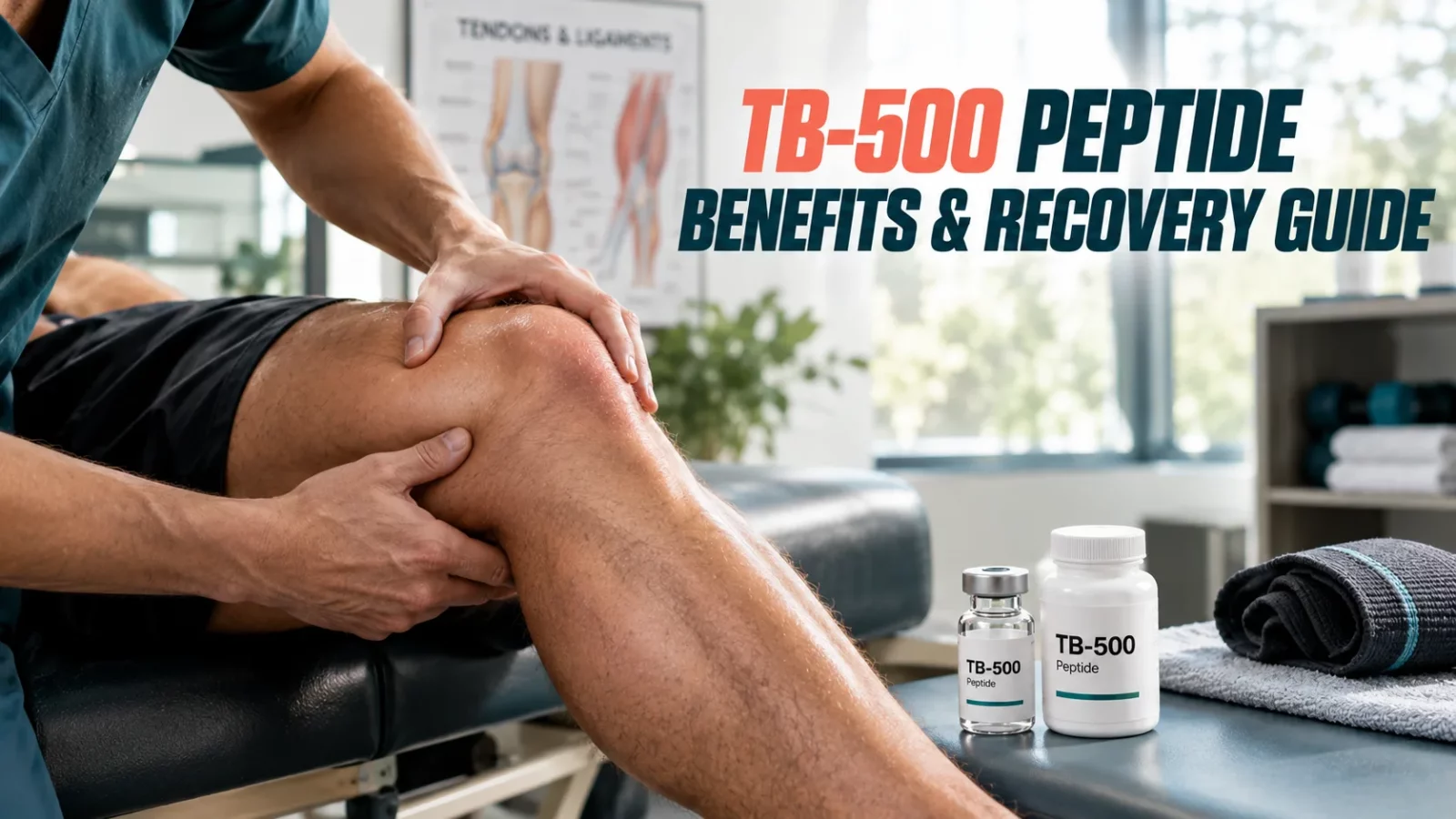
TB-500 is a synthetic peptide derived from thymosin beta-4 (TB4), a naturally occurring 43-amino-acid protein produced primarily by the thymus gland. The active fragment of TB-500 — the sequence (17)LKKTETQ(23) — is responsible for its wound-healing and tissue-repair properties, working through actin upregulation, angiogenesis, and enhanced cell migration.
Research on thymosin beta-4 and wound healing has demonstrated accelerated tissue repair in animal models, making TB-500 one of the most widely used recovery peptides among athletes and bodybuilders dealing with injuries. While human clinical data remains limited, the peptide’s mechanism of action is well-characterized, and its application for musculoskeletal recovery has generated significant interest.
TB-500 is banned by WADA for competitive sport. It is available as a research chemical but is not FDA-approved for human therapeutic use.
Key Takeaways
- TB-500 is a synthetic derivative of thymosin beta-4 that accelerates wound healing through actin upregulation, angiogenesis, and cell migration.
- The active sequence (17)LKKTETQ(23) promotes tissue repair across muscles, tendons, ligaments, and skin.
- Standard TB-500 dosage: 2-5 mg twice weekly during a 4-6 week loading phase, then 2-5 mg every 1-2 weeks for maintenance.
- TB-500 BPC-157 stacking is common, as the peptides work through complementary mechanisms for enhanced recovery.
- TB-500 is WADA-banned and not approved for therapeutic use in humans.
What Is TB-500?

Thymosin beta-4 is produced naturally in the human body, primarily by the thymus gland, and is found in high concentrations in wound fluid, blood platelets, and white blood cells. It plays a central role in tissue repair, inflammation modulation, and cellular protection.
TB-500 is a synthetic version containing the active region of thymosin beta-4. Its relatively low molecular weight allows it to travel rapidly through the body, reaching injury sites quickly after administration. The peptide’s mechanism centers on three primary pathways:
Actin Upregulation
TB-500 upregulates cell-building proteins, particularly actin, which is a critical structural component of muscle fibers. Actin and myosin are the contractile filaments that enable muscle contraction and relaxation. By increasing the body’s responsiveness to actin, TB-500 promotes cell growth, healthy cell proliferation, and migration of keratinocytes and endothelial cells to injury sites.
Angiogenesis
TB-500 stimulates the formation of new blood vessels (angiogenesis), creating additional pathways for blood supply to damaged tissues. Enhanced blood flow to injury sites delivers oxygen, nutrients, and immune cells more efficiently, which is foundational to the accelerated healing response observed with TB-500.
Anti-Inflammatory Action
The peptide modulates inflammation at injury sites, promoting beneficial acute inflammation (which initiates healing) while reducing chronic inflammation that impedes recovery. This dual action supports faster resolution of injuries without the tissue damage associated with prolonged inflammatory responses.
TB-500 Benefits
Accelerated Wound and Tissue Healing
The primary TB-500 benefits center on wound healing. The combination of angiogenesis, actin upregulation, cell proliferation, and enhanced cell migration produces a measurably faster healing response across multiple tissue types — skin, muscle, tendon, and ligament. For athletes and bodybuilders recovering from training injuries, this translates to reduced downtime and faster return to full training capacity.
Ligament and Joint Recovery
TB-500 has shown particular promise for connective tissue injuries. The peptide promotes organized collagen fiber deposition during the healing process, which produces stronger, more functional scar tissue compared to disorganized healing. This is especially relevant for ligament sprains and joint injuries, where tissue quality during repair determines long-term function and reinjury risk.
Cardiac Tissue Protection
Research on thymosin beta-4 in cardiac repair has demonstrated protective effects on heart tissue, including promotion of cardiomyocyte survival and regeneration after myocardial infarction. While these findings are primarily from animal models, they suggest potential applications for individuals with cardiovascular stress, including the left ventricular hypertrophy (athlete’s heart) sometimes seen in endurance athletes.
Endurance and Recovery
By accelerating tissue repair and reducing inflammation between training sessions, TB-500 indirectly supports improved endurance. Faster recovery from micro-damage sustained during intense training allows for higher training frequency and volume. Combined with the cardiovascular benefits observed in research, these advantages extend beyond simple injury repair into performance optimization territory.
Hair Growth Stimulation
TB-500’s upregulation of keratinocyte migration has a secondary effect on hair follicle stimulation. While not its primary application, users have reported accelerated hair growth during TB-500 cycles, consistent with the peptide’s known effects on keratinocyte activity and skin-related tissue regeneration.
TB-500 Dosage and Administration
Dosage Protocol
Human clinical trial data for TB-500 dosing is limited. The following protocols are based on animal research extrapolation and user-reported experiences:
| Phase | Duration | TB-500 Dosage | Frequency |
|---|---|---|---|
| Loading phase | 4-6 weeks | 2-5 mg per dose | Twice weekly |
| Maintenance phase | Ongoing | 2-5 mg per dose | Once every 1-2 weeks |
The loading phase establishes therapeutic levels in the body, while the maintenance phase sustains the healing response. Total weekly TB-500 dosage during loading typically falls in the 4-10 mg range, adjusted based on body weight, injury severity, and individual response.
Reconstitution and Preparation
TB-500 is supplied as lyophilized (freeze-dried) powder. Reconstitute with bacteriostatic water (1-2 mL per vial), swirling gently rather than shaking to preserve peptide integrity. The reconstituted solution should be refrigerated and used within 4-6 weeks.
Administration Routes
TB-500 can be administered via three routes:
| Route | Advantages | Considerations |
|---|---|---|
| Subcutaneous injection | Easiest self-administration; consistent absorption | Most common method; inject near injury site when possible |
| Intramuscular injection | Direct delivery to muscle tissue | Useful for muscle-specific injuries |
| Intravenous injection | Fastest systemic distribution | Requires medical supervision; highest bioavailability |
Subcutaneous injection is the most common self-administration method. The standard injection protocol applies: clean the injection site with an alcohol swab, inject at a 45-degree angle into a pinch of skin (typically abdominal area), and gently massage the area after injection to promote distribution.
TB-500 vs BPC-157
The TB-500 BPC-157 comparison is one of the most common questions in the peptide recovery space. Both peptides promote healing but through different mechanisms, making them complementary rather than competitive.
| Factor | TB-500 | BPC-157 |
|---|---|---|
| Origin | Synthetic derivative of thymosin beta-4 | Synthetic derivative of body protection compound (gastric juice peptide) |
| Primary mechanism | Actin upregulation, angiogenesis | Growth factor modulation, nitric oxide system |
| Effect distribution | Systemic (circulates throughout the body) | Both systemic and localized |
| Healing focus | Muscle, tendon, ligament, cardiac tissue | GI tract, tendons, ligaments, muscle, nerve tissue |
| Anti-inflammatory | Yes | Yes (stronger GI anti-inflammatory action) |
| Dosing frequency | Twice weekly (loading) | Daily |
| WADA status | Banned | Grey area (not explicitly listed) |
| Best for | Musculoskeletal injuries, cardiac protection | Gut healing, tendon/ligament repair, systemic recovery |
TB-500 BPC-157 Stack
Stacking TB-500 with BPC-157 is a popular protocol among athletes seeking maximum recovery. The rationale is that both peptides promote angiogenesis and tissue repair through different pathways, creating a synergistic healing response. TB-500 provides systemic actin-mediated repair while BPC-157 modulates growth factors and supports gut-related recovery.
A common stack protocol runs BPC-157 at 250-500 mcg daily alongside the standard TB-500 loading protocol. The combination targets both localized injury repair and systemic recovery support simultaneously.
TB-500 Side Effects
TB-500 side effects are generally mild and transient, particularly compared to other performance-enhancing compounds. However, the limited human clinical data means that the full side effect profile is not fully characterized.
Reported TB-500 Side Effects
| Side Effect | Frequency | Notes |
|---|---|---|
| Injection site discomfort | Common | Redness, mild soreness at injection site |
| Headache | Occasional | Typically mild and transient; more common during loading phase |
| Nausea | Occasional | Usually resolves after initial doses |
| Lightheadedness | Uncommon | More common with first administration |
| Fatigue | Uncommon | Temporary; may occur during body’s adaptation |
| Abdominal discomfort | Uncommon | Mild; dose-dependent |
Theoretical Concerns
Some theoretical concerns exist based on TB-500’s mechanism of action:
- Cell proliferation: Because TB-500 promotes cell growth and migration, there is a theoretical concern about its use in individuals with existing cancerous or pre-cancerous conditions. While no direct link between TB-500 and cancer development has been established, the peptide’s proliferative properties warrant caution in this population.
- Hepatic and renal stress: High-dose or prolonged use may place additional metabolic burden on the liver and kidneys. Regular blood work monitoring liver and kidney function is advisable during extended TB-500 cycles.
The Bottom Line
TB-500 is a well-characterized recovery peptide with strong mechanistic support for its wound-healing and tissue-repair properties.
- The combination of actin upregulation, angiogenesis promotion, and anti-inflammatory action makes it particularly valuable for athletes dealing with musculoskeletal injuries, connective tissue damage, and chronic recovery challenges.
- While human clinical data remains limited, the animal research and user experience base consistently support TB-500 benefits for accelerated healing and reduced recovery time.
- For non-competitive athletes and bodybuilders, TB-500 remains one of the most widely used and well-tolerated recovery peptides available.
Frequently Asked Questions
Disclaimer
Please read carefully
The information on this site is for educational and informational purposes only, and is not medical advice. Always consult a qualified healthcare professional before using any supplement or medication, or making changes to your health, fitness, or nutrition routine.
Not medical advice
Content here is not a substitute for professional medical advice.
Consult your doctor
Talk to your doctor before starting any supplement or new routine.
Use at your own risk
We are not responsible for adverse effects from acting on this.
Do your research
Make informed decisions about your own health.
No guarantees
Individual results vary. No claims about outcomes.
Important — Never disregard professional medical advice or delay seeking it because of something you read here. If you think you may have a medical emergency, call your doctor or your local emergency number right away.






The article says “BPC-157 tends to work across the body, while TB-500 brings the same healing effect at a particular injury site.” I thought it was the opposite that TB-500 works more systemically?
I have a 5mg bottle of tb-500 powder how much water do I add to make each shot 2mg
Can females take TB500? Dosage? Cycle length?
There are no sexual health side effects found in the current research. For dosing protocols, you would need to schedule a call with me https://muscleandbrawn.com/coaching/
Should you take it before sleep? In the morning? Is there an optimum time?
No
After each injection I get itchy for days all over even after 20mg of Zyrtec
I want to start with tb500, but still confused on reconstituting and dozing. I would like to know if you can help me. I want to go with 3mg twice a week for 4 weeks. How many 10 mg vials of tb500 and how much bac water do I need for each vial.
Schedule a call with me here https://muscleandbrawn.com/coaching/
I want some clarity. I am going to be buying TB-500 as well as BPC-157. I have seen the compounds that have both, but since the dosing schedule is different, should one avoid the blend and just get separate bottles of each?
You can blend them
is it best to keep this in the Refrigerator?
How do you use TB-500 for hair growth? Do you pin it in the scalp? And how much, how often?
Facebook won’t let me join. I’ve subscribed tho…