
Contents11 sections
Prostamax is a short synthetic peptide made of four amino acids: lysine, glutamic acid, aspartic acid and proline (Lys-Glu-Asp-Pro, or KEDP). It is one of the peptide bioregulators developed by Vladimir Khavinson’s group in St Petersburg, Russia, and it is aimed at the prostate gland.
It is often confused with Prostatilen, an older Russian medicine made from cattle prostate extract. Prostamax is not an extract. It is a lab-made peptide that Khavinson’s group designed from the amino acid makeup of Prostatilen, and it contains no animal tissue.
The evidence for Prostamax is preclinical: studies in rats with chronic prostatitis and lab work on human cells. There are no controlled human trials, and it is not an approved medicine. This guide covers what it is, how it is thought to work, what the studies found, the doses people report and what is still unknown about safety.
Key Takeaways
- Prostamax is a synthetic tetrapeptide (Lys-Glu-Asp-Pro, or KEDP) from Khavinson’s bioregulator program. It is not an animal prostate extract; that is Prostatilen.
- In rats with experimentally induced chronic abacterial prostatitis, it was reported to reduce prostate swelling, vascular congestion, inflammatory cell infiltration and fibrosis (rat data).
- In lab studies of human lymphocytes, Prostamax loosened tightly packed chromatin (heterochromatin), which the authors read as reactivating genes silenced with age (cell data).
- There are no controlled human trials. The 5 mg a day, 7-12 day courses described online are vendor and user protocols, not doses tested in studies.
- Urinary symptoms can signal an enlarged prostate, infection or prostate cancer. Get a diagnosis first and keep prescribed treatment; Prostamax is not a substitute.
What Is Prostamax?
Prostamax is a prostate-targeted peptide bioregulator: a short synthetic tetrapeptide with the sequence Lys-Glu-Asp-Pro (KEDP). It belongs to the same family of Khavinson peptides as Vilon, Epitalon, Cardiogen and Ovagen. Our guide to bioregulators and their benefits explains the idea behind the whole group, and the Prostamax compound profile gives a quick summary.
The theory is that each of these peptides acts on one tissue by entering cells and adjusting which genes are switched on. For Prostamax, the target is the prostate. Almost all of the research comes from Khavinson’s group and its collaborators, much of it published in Russian journals, and independent confirmation is limited.
Prostamax vs Prostatilen
Khavinson’s research produced two kinds of bioregulators. The first were peptide extracts purified from animal organs, sometimes called cytomedins. Prostatilen, made from cattle prostate, is one of them. It is a registered medicine in Russia, used mainly for chronic prostatitis.
The second were short synthetic peptides, designed from the amino acid makeup of those extracts. Prostamax is the synthetic peptide that corresponds to Prostatilen. It is made by chemical synthesis, has one fixed sequence and contains no animal tissue. Results reported for Prostatilen do not automatically apply to Prostamax.
| Prostamax | Prostatilen | |
|---|---|---|
| What it is | Synthetic tetrapeptide (Lys-Glu-Asp-Pro) | Peptide complex extracted from cattle prostate |
| How it is made | Chemical synthesis | Extraction and purification from animal tissue |
| Status | Research chemical, not approved for human use | Registered medicine in Russia |
| Main evidence | Rat prostatitis studies and human cell studies | Russian clinical use in chronic prostatitis |
How Prostamax Is Thought to Work

Khavinson’s group proposes that short peptides like Prostamax work inside cells, at the level of DNA and gene activity, rather than through a classic receptor. Three ideas come up in the research:
- Loosening chromatin (human cell data). In a lab study of the effect of Prostamax on human lymphocyte heterochromatin, the peptide was reported to decondense heterochromatin, the tightly packed form of DNA in which genes are mostly switched off. The authors read this as a sign that it can reactivate genes that are silenced with age.
- Gene activity in the prostate (proposed). The group’s wider work on short peptides suggests they influence the expression of genes involved in tissue repair, inflammation, cell differentiation and programmed cell death. For Prostamax, this is a hypothesis about prostate tissue, not something measured in men.
- Calming inflammation (rat data). In rat models of chronic prostatitis, the main effects reported were less inflammation, swelling and scarring in the gland (details below).
How much of an injected peptide reaches prostate cells intact, how long it stays active and whether it behaves the same way in people has not been measured in human studies. The older claim that Prostamax “normalizes protein synthesis” in prostate cells is part of the same hypothesis, not a proven effect.
What the Research Shows
The evidence comes from two places: rat studies of experimental chronic prostatitis and lab studies of human cells. None of the findings below has been confirmed in controlled human trials.

Prostate Inflammation (Rat Data)
The main animal evidence comes from studies by Khavinson’s group and collaborators in rats with experimentally induced chronic abacterial (non-bacterial) prostatitis, a common and hard-to-treat form of prostatitis in men. In treated rats, the researchers reported less swelling (edema) of the prostate, less vascular congestion, fewer immune cells infiltrating the tissue and less fibrosis (scarring) than in untreated animals.
Rat models are useful but imperfect. The disease is induced over a short period, while chronic prostatitis in men has varied and often unclear causes and can last for years. A result in rats is a reason to run human trials, not a reason to expect the same effect in men.
Chromatin and Aging Cells (Human Cell Data)
The “anti-aging” label for Prostamax rests on the lymphocyte work described above. Lymphocytes are white blood cells, so these studies say more about immune cells in a dish than about the prostate. They show that Prostamax can change how DNA is packed in lab conditions. They do not show that it slows prostate aging, rejuvenates the gland or improves immune function in men.
Urinary Symptoms: No Human Trials
Weak flow, urgency, frequent urination and getting up at night are the symptoms most men care about. No controlled trial has tested whether Prostamax improves them. Some users report easier urination, but these accounts cannot be verified, and prostate symptoms often change on their own or respond to placebo.
There is also no published human data showing that Prostamax changes DHT, testosterone or other hormone levels, so the hormonal claims made for it online are unsupported.
What the Evidence Does and Doesn’t Show
| Finding | Where It Was Seen | Human Data |
|---|---|---|
| Less prostate swelling and vascular congestion | Rats with experimental chronic abacterial prostatitis | None |
| Fewer infiltrating immune cells and less fibrosis | Rats with experimental chronic abacterial prostatitis | None |
| Looser (decondensed) heterochromatin | Human lymphocytes in the lab | Cell studies only |
| Better urinary flow, fewer night-time trips | User reports | No controlled trials |
| Effects on DHT or other hormones | Not shown | None |
Prostamax Dosage: What Is Commonly Reported
No human dose has been established in clinical trials. The figures below are the protocol listed by vendors and repeated in user reports, in the short-course pattern typical of injectable bioregulators. They are shown for information, not as a recommendation.
| Detail | Commonly Reported |
|---|---|
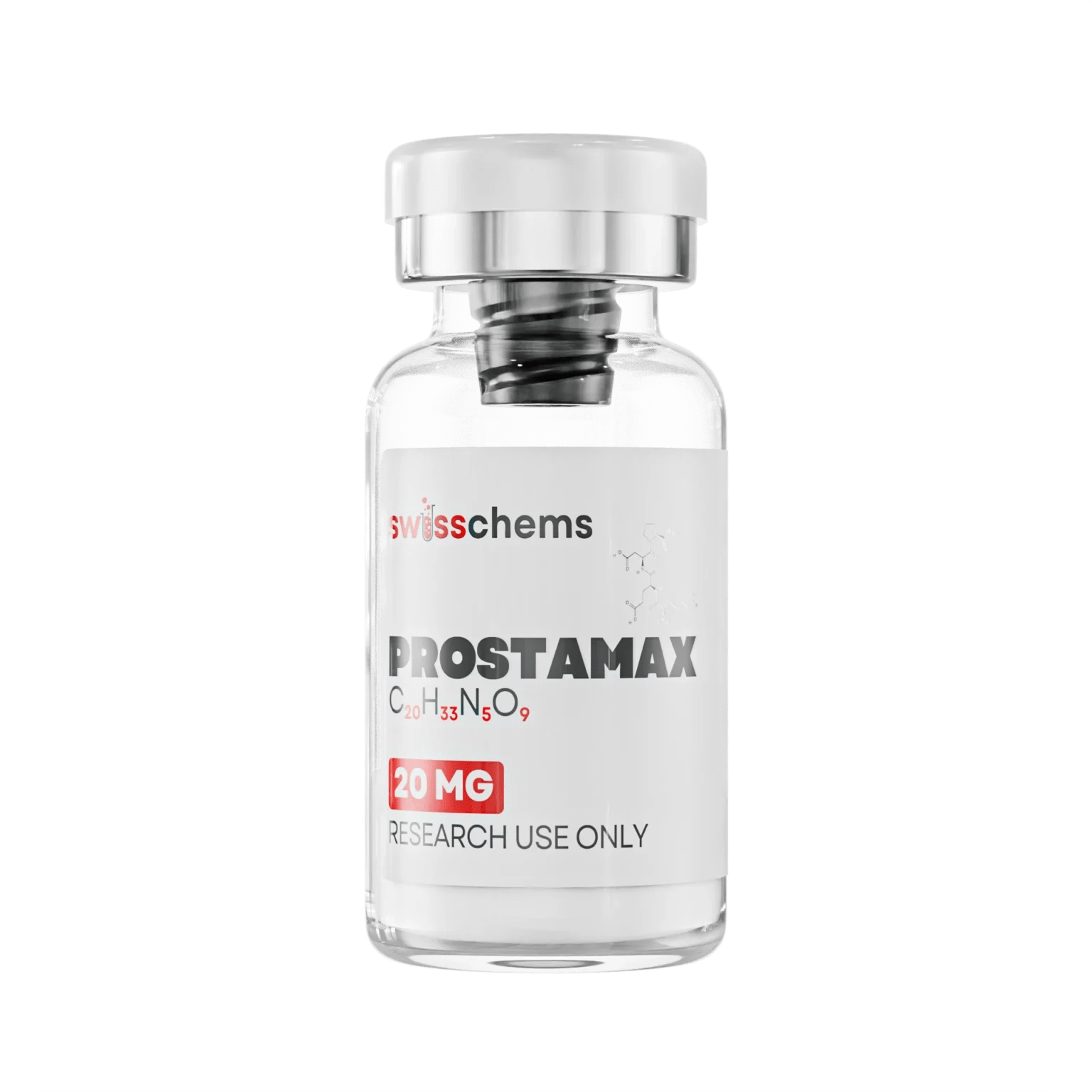
| Form | Freeze-dried powder in vials (often 20 mg), mixed with bacteriostatic water |
| Route | Subcutaneous injection |
| Dose | 5 mg once a day |
| Course length | 7-12 days |
| Repeat | Once every 4-6 months |
| Tested in human trials | No |
Rat doses cannot simply be scaled up to people, and the actual content and purity of research-grade vials vary between suppliers. Anyone considering Prostamax should talk to a doctor first, especially with an existing prostate condition or when taking other medicines.
Stacking With Other Bioregulators
Users often pair Prostamax with Epitalon, a synthetic pineal peptide studied for its effects on aging, and Thymalin, a thymus peptide extract used in Russia as an immune modulator. The idea is to cover several organ systems in one course.
No study has tested these combinations, so their combined effects and risks are unknown. Each peptide adds its own unknowns, and stacking makes it harder to tell what, if anything, is having an effect.
Side Effects & Safety
There are no controlled human trials of Prostamax, so its safety in people is unknown. The animal and cell studies were designed to look at prostate and chromatin effects, not to detect side effects in humans.
Reported Side Effects (Anecdotal)
- Injection site: Redness, slight swelling or discomfort, as with any subcutaneous injection.
- Short-lived symptoms: Some users describe mild fatigue, a headache or a brief upset stomach after dosing. These are unverified reports, not study results.
- Allergic reactions: People with a history of reactions to peptide products should be cautious; how often reactions occur is unknown.
Product Quality
Research-grade peptides are not made to drug standards. Wrong dosing, impurities, contamination or a vial that contains little or no Prostamax are real risks with any unregulated product.
Medical Oversight
- Get symptoms diagnosed: Urinary symptoms overlap between an enlarged prostate (BPH), prostatitis, infection and prostate cancer. A doctor can check with an exam, urine tests and a PSA blood test.
- Keep prescribed treatment: Prostamax has not been shown to work in men. Never stop prescribed prostate medicine to try it.
- Seek care quickly for blood in the urine, being unable to urinate, fever with pelvic pain, or pain that does not settle.
Long-Term & Regulatory Considerations
- No long-term data: Nothing is known about the effects of repeated courses over months or years.
- Not FDA-approved: Prostamax is sold as a research chemical, labeled not for human use. All human use is unregulated.
Where to Buy Prostamax?
Prostamax is sold only as a research chemical. Quality varies widely between suppliers, so the first thing to ask for is a recent third-party certificate of analysis (COA) for the exact batch, with identity and purity testing. Our guide on how to read a peptide COA explains what to check.
SwissChems is the research-peptide supplier featured in our other bioregulator guides and has sold Prostamax in 20 mg vials. Check current availability, the price and the batch COA before buying anything.

Pros
- Exceptional purity & testing (≥98%)
- Pharmaceutical-style packaging for stability
- Broad catalog across peptides & nootropics
- Strong reputation & consistency across years
Cons
- Some items frequently out of stock due to high demand
- Limited long-term data for some compounds
The Bottom Line
Prostamax is a synthetic prostate bioregulator with interesting rat and cell data, but it is not a proven treatment for prostatitis, an enlarged prostate or urinary symptoms in men.
- Prostamax is a lab-made tetrapeptide (Lys-Glu-Asp-Pro), not an animal extract. Prostatilen is the cattle prostate extract it was modeled on, and the two should not be confused.
- In rats with experimental chronic prostatitis, it reduced swelling, congestion, inflammatory infiltration and fibrosis; in human lymphocytes, it loosened tightly packed chromatin. Neither finding has been confirmed in human trials.
- The 5 mg a day, 7-12 day course seen online is a vendor and user protocol, not a tested dose. Anyone with urinary symptoms should get a diagnosis and keep prescribed treatment.
Frequently Asked Questions
Disclaimer
Please read carefully
The information on this site is for educational and informational purposes only, and is not medical advice. Always consult a qualified healthcare professional before using any supplement or medication, or making changes to your health, fitness, or nutrition routine.
Not medical advice
Content here is not a substitute for professional medical advice.
Consult your doctor
Talk to your doctor before starting any supplement or new routine.
Use at your own risk
We are not responsible for adverse effects from acting on this.
Do your research
Make informed decisions about your own health.
No guarantees
Individual results vary. No claims about outcomes.
Important — Never disregard professional medical advice or delay seeking it because of something you read here. If you think you may have a medical emergency, call your doctor or your local emergency number right away.