Contents13 sections
MOTS-c is a small peptide built from instructions in your mitochondrial DNA rather than the DNA in the cell nucleus. It acts on how muscle uses glucose and fat, and exercise raises its levels in the body. That makes it one of the most talked-about peptides for metabolism, endurance and healthy aging.
Unlike most performance peptides, MOTS-c does not work by releasing growth hormone. Most of what is known about it comes from cell and mouse studies, and MOTS-c itself has not been through completed human efficacy trials.
This MOTS-C peptide guide covers how it works, what the research shows, commonly reported doses, side effects, stacks and legal status, and it marks clearly which findings come from animals and which come from people.
Key Takeaways
- MOTS-c is a 16-amino-acid peptide encoded in mitochondrial DNA. It acts on metabolism, not on growth hormone release.
- In mice, MOTS-c improves insulin sensitivity, mainly in skeletal muscle, by activating the cell’s energy sensor AMPK.
- Mouse studies also show less fat gain on a high-fat diet and better running capacity, including in old mice. Bone and heart findings come from cell and animal work only.
- Exercise raises MOTS-c levels in human muscle and blood, but no completed trial has shown that taking MOTS-c improves fat loss, performance or aging in people.
- Doses of 5-10 mg one to three times a week come from user reports, not studies, and long-term safety in humans is unknown.
What Is MOTS-c?
MOTS-c stands for “mitochondrial open reading frame of the 12S rRNA type-c”. It is one of a small group of mitochondrial-derived peptides, alongside humanin, that researchers have studied as signals sent from the mitochondria to the rest of the body.
It is a peptide of 16 amino acids encoded by a short sequence within the mitochondrial 12S rRNA gene (1). The body makes it naturally; the MOTS-c sold online is a synthetic copy.
Research so far links MOTS-c to weight regulation, exercise capacity, aging and glucose metabolism (2). Almost all of that work is preclinical, which means cells and animals. For a quick profile of the compound, see our MOTS-c compound page.
How Does MOTS-c Work?
Many popular peptides, such as CJC-1295 or ipamorelin, work by making the pituitary gland release more growth hormone. MOTS-c does not. It acts on energy metabolism inside the cell, mainly in skeletal muscle.

In the study that first described MOTS-c, mice given the peptide were protected against obesity and insulin resistance caused by a high-fat diet, and against the insulin resistance that comes with age (3).
The researchers found that MOTS-c slows the folate cycle and the linked pathway that builds purines. This causes a build-up of AICAR, a natural molecule that switches on AMPK, the cell’s main energy sensor (4). AMPK is the same switch that exercise turns on. When it is active, muscle takes up more glucose, burns more fat and makes more energy available.
In the mouse studies, the main effect was better insulin sensitivity in skeletal muscle, with more glucose cleared from the blood, rather than lower glucose output from the liver. Treated mice had lower non-fasting glucose and performed better on glucose tolerance tests.
Later cell work showed that under metabolic or oxidative stress, MOTS-c moves into the cell nucleus and helps switch on genes involved in stress resistance, including antioxidant-response genes. That is unusual: a peptide encoded in the mitochondria directly influencing genes in the nucleus.
Benefits of MOTS-c: What the Research Shows
The findings below are promising, but nearly all of them come from mice, rats or cells. Treat them as reasons for more research, not as proven effects in people.
Weight and Fat Gain (Animal Data)
Weight loss is one of the main reasons people are interested in MOTS-c. The peptide pushes muscle to use more of its fuel, glucose and fatty acids, for energy (5).
In mice fed a high-fat diet, MOTS-c treatment reduced weight gain and fat gain and improved insulin sensitivity. No published trial has tested MOTS-c for weight loss in humans.
Exercise Capacity and Endurance (Animal Data)
In mice of different ages, MOTS-c treatment improved treadmill running performance. Treatment started late in life also improved physical capacity in old mice. These results are the main reason MOTS-c is discussed as an endurance peptide.

The human side is different. In the same line of research, a bout of exercise raised MOTS-c levels in the skeletal muscle and blood of healthy men. That shows MOTS-c is part of the body’s response to exercise. It does not show that injecting it improves endurance in people.
Mitochondrial Health and Stress Resistance (Cell Data)
Because MOTS-c helps switch on antioxidant and stress-response genes when cells are under strain, researchers see it as a possible protector of cells against oxidative stress. This has been shown in cell and animal models, not in human tissue.
Heart and Blood Vessels
In people, lower circulating MOTS-c levels have been linked with endothelial dysfunction, where the lining of the blood vessels does not work properly. In rodent studies, MOTS-c treatment improved markers of blood vessel and heart function (6).
The human data are associations: low levels go together with poorer vessel function. That does not prove that taking MOTS-c protects the heart.
Bone Health (Cell and Animal Data)
In cell studies, MOTS-c promoted the development of bone-forming cells. In mice with surgically induced menopause, a standard model for osteoporosis, it reduced bone loss. There are no human studies of MOTS-c for osteoporosis, and the mechanism is not fully understood.
Aging
The improved physical capacity in old mice, the effects on age-related insulin resistance and the bone findings all feed interest in MOTS-c for healthy aging (7). A genetic study also linked a MOTS-c gene variant found in Japanese people with exceptional longevity. None of this shows that taking MOTS-c slows aging in humans.
MOTS-c Evidence at a Glance
| Effect | Where it was shown | Shown in human trials? |
|---|---|---|
| Better insulin sensitivity | Mice (mainly skeletal muscle) | No |
| Less fat gain on a high-fat diet | Mice | No |
| Better running capacity | Young and old mice | No |
| Stress and antioxidant gene response | Cells | No |
| Heart and blood vessel function | Rodents; human association data | No |
| Reduced bone loss | Cells and mice | No |
| Levels rise with exercise | Humans | Yes (natural levels, not injected MOTS-c) |
The closest thing to a human treatment trial is an analog of MOTS-c called CB4211, which reached early (phase 1) testing in people with obesity and fatty liver disease. A small early-stage trial of a modified drug cannot tell us how the research peptide sold online behaves in healthy, training adults.
MOTS-c Dosage and Cycling
No human dose of MOTS-c has been established. Animal doses are given per kilogram of body weight and do not translate directly to people, so the numbers below come from user reports, not from studies.
- Commonly reported dose: about 5-10 mg per injection, given once to three times a week.
- Commonly reported cycle length: 4-8 weeks, sometimes with three injections a week for the first four weeks and one a week after that.
- Route: users report subcutaneous injection after reconstituting the freeze-dried powder with bacteriostatic water.
These doses are high for a peptide: most research peptides are discussed in micrograms, while MOTS-c is discussed in milligrams. Anyone considering a peptide should speak with a healthcare professional first, especially if they have a medical condition or take medication.
For what users say they noticed over a cycle, and how realistic those claims are, see our guide to MOTS-c before and after.
Side Effects of MOTS-c
MOTS-c is often described online as side-effect free. That claim is not supported: there are no long-term safety data in humans, so the honest answer is that its risks are largely unknown.
- Injection-site reactions: redness, itching, swelling or rash where the peptide is injected are the most commonly reported problems.
- Blood sugar: MOTS-c lowers glucose in animal studies, so people on insulin or other glucose-lowering drugs have a particular reason for caution.
- Product quality: research peptides are not made to pharmaceutical standards. Wrong dosing, impurities and contamination are real risks, as is infection from poor injection technique.
- Unknown long-term effects: no study has followed people using MOTS-c for months or years. It has not been studied in pregnancy or breastfeeding.
If you notice any unexpected symptom while using any peptide, stop and report it to a healthcare professional.
User Reports (Anecdotal)
Because human research on MOTS-c is so limited, many people look at user reports. These are anecdotes: they are unverified, they often involve other compounds at the same time, and they cannot show cause and effect.
One user on Reddit wrote:
“The typical protocol for MOTS-c is 10mg 3X weekly for four weeks, then 10mg weekly for four weeks. I also use 5mg instead of the 10mg dosing with good results.
When it comes to mitochondrial dysfunction, this peptide is great. I have used it personally without much result, but I’m a conditioned athlete who exercises 2-3 hours daily. I find that this is a great adjunct to treatment in my patients with any mitochondrial dysfunction.”
Note that this user saw little effect personally, and the “typical protocol” they describe is a community convention, not a studied regimen.
Another wrote:
“I’m using MOTS-C currently. I’m doing 5mg three times a week. It appears beneficial, but it’s hard to attribute my results to MOTS-C specifically because I’m also just training a ton on TRT and CJC1295/ipamorelin.
That said, after my first dose I swim a record distance for myself (2100 yards continuously whereas my max was 400 yards).”
As the user says, testosterone, a growth hormone peptide stack and heavy training make it impossible to credit MOTS-c, and a single-session record after one dose is not something the research would predict.
MOTS-c Stacks
No study has tested MOTS-c together with other peptides. The combinations below are reported by users, and the reasons behind them are theory. Stacking also stacks the unknowns: more compounds mean more possible side effects and interactions.
| Stack | What the added compounds do | Reasoning (theoretical) | Commonly reported doses (anecdotal) |
|---|---|---|---|
| MOTS-c + IGF-1 LR3 + PEG-MGF | IGF-1 LR3 is a long-acting IGF-1 analog; PEG-MGF is a long-acting form of an IGF-1 splice variant. Both are studied for muscle growth and repair. | Combine MOTS-c’s metabolic effects with growth-factor signaling for muscle repair | No human data on the combination, and no established human dose for any of the three |
| MOTS-c + CJC-1295/Ipamorelin | Both increase growth hormone release from the pituitary gland | Growth hormone supports fat breakdown and recovery; MOTS-c might offset its tendency to reduce insulin sensitivity | MOTS-c as above; CJC-1295 and ipamorelin as reported in their own guides |
MOTS-c + IGF-1 LR3 + PEG-MGF
IGF-1 LR3 is a modified form of IGF-1 that binds poorly to the proteins that normally hold IGF-1 in check, so it stays active far longer than natural IGF-1. It acts through the IGF-1 receptor, which drives muscle protein synthesis and the activity of muscle stem (satellite) cells in lab studies.
IGF-1 LR3 does not inhibit myostatin, a claim often repeated in stack guides. Myostatin blockers are a separate class of compounds. IGF-1 LR3 is not a fat-loss compound either; its insulin-like effects can lower blood sugar, which matters when combined with MOTS-c, since both may lower glucose.
PEG-MGF is a pegylated (longer-lasting) version of mechano growth factor, a variant of IGF-1 that muscle produces after mechanical loading. Its role overlaps with IGF-1 LR3, and the evidence comes from cell and animal studies. Neither has an established human dose, and the combination has never been tested in people.
MOTS-c + CJC-1295/Ipamorelin
CJC-1295 and ipamorelin work together to increase growth hormone release from the pituitary gland. CJC-1295 mimics growth hormone-releasing hormone, and ipamorelin acts on the ghrelin receptor.
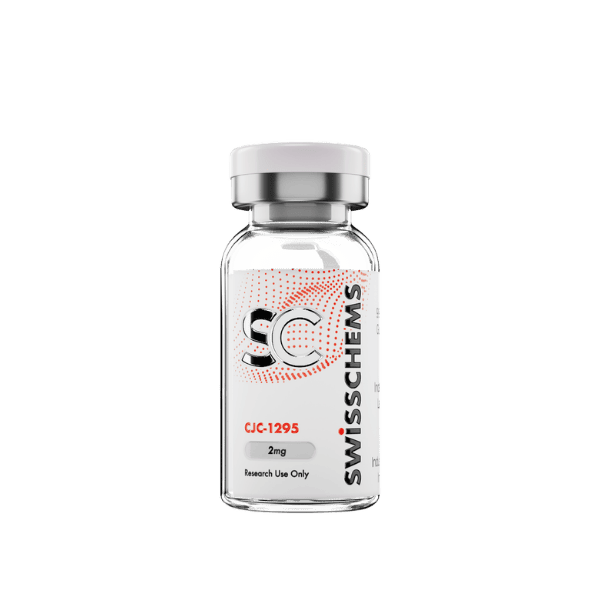

Overview
- Form: Peptide vial for subcutaneous injection (2 mg)
- Researched Dosage: 100 mcg, 1-3 times daily
- Typical Cycle: 8-12 weeks
- Cost: $42.95 (1 vial), $429.50 (10 vials)
- Stacking Options: Ipamorelin, GHRP-6, Hexarelin
Pros
- Also called Mod GRF (1-29), it is a GHRH analog with four amino acid swaps that stop enzymes from breaking it down so quickly.
- It boosts the size of natural growth hormone pulses instead of creating a constant elevation, which keeps normal feedback intact.
- Paired with a GHRP like Ipamorelin, it may release several times more growth hormone than either peptide alone.
Cons
- A 2 mg vial covers only about 7-20 days at typical doses, so a full cycle takes several vials.
- Doses should be taken on an empty stomach, since food and insulin blunt the growth hormone release.
- It is not an approved human medication, SwissChems sells it for research use only, and WADA bans it.
Higher growth hormone supports fat breakdown and, through IGF-1, protein synthesis. Unlike MOTS-c, however, growth hormone tends to reduce insulin sensitivity and can raise blood sugar. The idea behind this stack is that MOTS-c might balance that effect, but no study has tested it.
Sourcing and Quality
MOTS-c is sold only as a research chemical, usually as a freeze-dried powder labeled “not for human consumption”. Because it is unregulated, purity and the actual amount in each vial vary between suppliers.
A supplier should provide a recent third-party certificate of analysis for the batch, showing purity by HPLC and identity by mass spectrometry. Our guide on how to read a peptide COA explains what to check. A good COA confirms what is in the vial; it does not make the compound safe to use.
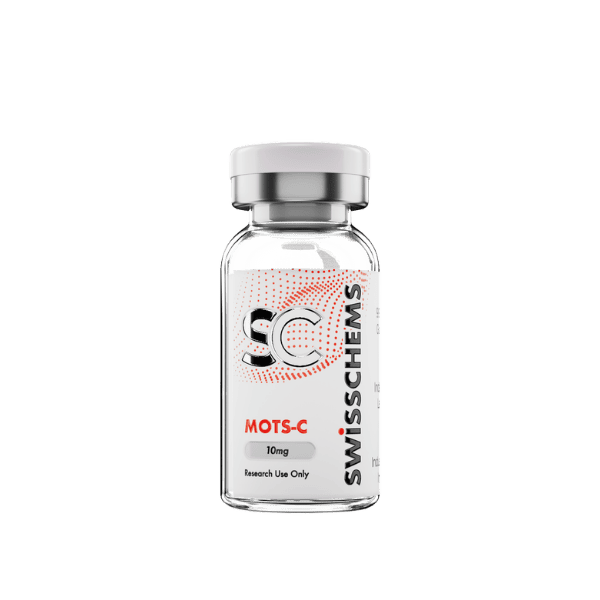
Overview
- Form: Lyophilized powder
- Researched Dosage: 5 mg to 10 mg per week, split into 2-3 injections
- Typical Cycle: 4-8 weeks
- Cost: $69.95
- Stacking Options: 5-Amino-1MQ, SS-31, AOD-9604, BPC-157
Pros
- Activates AMPK, the body’s main energy sensor, which may improve how cells use glucose and fat.
- Mouse studies show better insulin sensitivity and protection against diet-induced weight gain.
- Older mice given MOTS-c showed better physical capacity and endurance, which has drawn interest in its role in healthy aging.
Cons
- No human trials show that injected MOTS-c works.
- At 10 mg per vial and several milligrams per dose, one vial usually lasts only 1-2 weeks, so a full cycle gets expensive.
- MOTS-c is not an approved human medication. The FDA lists it as a bulk substance with potential safety risks (Category 2), and WADA bans it as a metabolic modulator.
Is MOTS-c Legal?
MOTS-c is not approved by the FDA, or by any other regulator, for human use. In the United States it is not a controlled substance, but it cannot legally be sold as a drug or supplement for human consumption, which is why vendors label it for research use only.
Rules differ between countries, and some treat peptides as prescription-only medicines. Our guide to peptide legality by country covers the details.
For athletes, the position is clear. MOTS-c is named on the WADA Prohibited List under S4.4 (metabolic modulators) as an activator of AMPK, and it is banned at all times, in and out of competition. Because it has no approved medical use, athletes can’t get a therapeutic use exemption for it (USADA).
The Bottom Line
MOTS-c is a genuinely interesting mitochondrial peptide with strong animal data for metabolism and exercise capacity, but the human evidence is still thin.
- The best evidence comes from mice: better insulin sensitivity, less diet-induced fat gain and improved running capacity, driven largely by AMPK activation in muscle.
- In people, exercise raises MOTS-c levels and an analog has reached early testing, but MOTS-c itself has not been shown to improve fat loss, performance, diabetes or aging in trials.
- The doses shared online are anecdotal, product quality varies and long-term safety is unknown. MOTS-c is not approved for human use and is banned in tested sport.
Frequently Asked Questions
Disclaimer
Please read carefully
The information on this site is for educational and informational purposes only, and is not medical advice. Always consult a qualified healthcare professional before using any supplement or medication, or making changes to your health, fitness, or nutrition routine.
Not medical advice
Content here is not a substitute for professional medical advice.
Consult your doctor
Talk to your doctor before starting any supplement or new routine.
Use at your own risk
We are not responsible for adverse effects from acting on this.
Do your research
Make informed decisions about your own health.
No guarantees
Individual results vary. No claims about outcomes.
Important — Never disregard professional medical advice or delay seeking it because of something you read here. If you think you may have a medical emergency, call your doctor or your local emergency number right away.