
Contents14 sections
MK-677 vs HGH comes down to one question: do you want to make your body release more of its own growth hormone, or do you want to inject the hormone directly? MK-677 (ibutamoren) is an oral pill that tells the pituitary gland to release more growth hormone. HGH (human growth hormone) is the hormone itself, injected under the skin.
Both raise growth hormone and IGF-1, and both have been studied in clinical trials. But they differ in how they work, how strong the evidence is, what they cost, what side effects they cause and whether you can get them legally. This guide compares the two side by side, using what the published studies actually found.
Key Takeaways
- MK-677 is an oral pill that mimics the hunger hormone ghrelin to make the pituitary release more growth hormone. HGH is the hormone itself, given by injection.
- In a 2-year trial in older adults, 25 mg of MK-677 a day raised growth hormone and IGF-1 to young-adult levels and added 1.1 kg of fat-free mass, but did not improve strength or function.
- Common MK-677 side effects in trials were increased appetite, mild swelling, muscle pain, higher fasting blood sugar and lower insulin sensitivity. A hip fracture trial was stopped early over a heart failure signal.
- HGH is FDA-approved for conditions such as growth hormone deficiency and Turner syndrome. Reviews in healthy older adults and athletes found more lean mass but no clear gains in strength, plus higher rates of side effects.
- HGH requires a prescription in the US, and distributing it for anti-aging or bodybuilding is illegal. MK-677 is not FDA-approved and is banned in sport under the WADA Prohibited List.
MK-677 vs HGH at a Glance
| MK-677 (Ibutamoren) | HGH (Somatropin) | |
|---|---|---|
| What it is | Small-molecule growth hormone secretagogue (not a peptide) | Peptide hormone with 191 amino acids |
| Molecular weight | 624.8 g/mol (mesylate salt) | About 22 kDa |
| How it’s taken | Oral, once a day | Subcutaneous injection |
| How it works | Activates the ghrelin receptor, so the pituitary releases more GH | Replaces or adds GH directly |
| Effect on your own GH | Keeps the natural pulse pattern | Suppresses your own GH release while in use |
| Main side effects in studies | Appetite, swelling, muscle pain, higher blood sugar | Swelling, joint pain, carpal tunnel, higher blood sugar |
| Approved uses | None (not FDA-approved) | GH deficiency, Turner syndrome, Prader-Willi syndrome and more |
| Legal status (US) | Not approved; sold as a “research chemical” | Prescription only |
| Banned in sport | Yes (WADA S2) | Yes (WADA S2) |
What Is MK-677 (Ibutamoren)?
MK-677, also called ibutamoren or MK-0677, was developed by Merck in the 1990s as an oral alternative to growth hormone injections. It’s often grouped with SARMs and peptides, but it’s neither. It’s a small, non-peptide molecule that survives digestion, which is why it works as a pill.
MK-677 is a growth hormone secretagogue, meaning it makes the body secrete more growth hormone. It binds to the same receptor as ghrelin, the hormone that signals hunger. That receptor sits on the pituitary gland and in the hypothalamus. When MK-677 activates it, the pituitary releases larger pulses of growth hormone, and the liver responds by making more IGF-1.
Because MK-677 works through your own pituitary, the growth hormone it releases still follows the body’s natural pulse pattern. A review of the early research by its developers notes that a single daily dose raised GH secretion for about 24 hours, increasing the size of each pulse rather than the number of pulses.
Merck tested MK-677 for growth hormone deficiency, frailty in older adults, osteoporosis and hip fracture recovery, but it was never approved for any of them. For real-world reports from people who have used it, see our MK-677 before and after guide.
What Is HGH?
Human growth hormone, or somatropin, is a 191-amino-acid peptide hormone made by the pituitary gland. It’s released in pulses, mostly during deep sleep and after exercise. GH acts on tissues directly and also tells the liver to make insulin-like growth factor 1 (IGF-1), which drives much of its effect on muscle, bone and cartilage.
Pharmaceutical HGH is made with recombinant DNA technology and sold under brand names such as Genotropin, Norditropin, Humatrope and Omnitrope. It comes as a powder to be mixed or as a ready-to-use pen, and it’s injected under the skin.
When you inject HGH, the pituitary senses the higher levels and cuts back its own production. That’s the main practical difference from MK-677: HGH adds hormone from outside, while MK-677 pushes your own gland to release more. Our HGH cycle for men guide covers how bodybuilders use it.
How They Work: Secretagogue vs Replacement

The two approaches reach the same place by different roads:
- MK-677 binds to the ghrelin receptor (GHS-R1a) on the pituitary and hypothalamus.
- The pituitary releases bigger pulses of its own growth hormone.
- GH travels to the liver, which makes more IGF-1.
- IGF-1 and GH act on muscle, bone, fat and other tissues.
HGH skips steps 1 and 2. The injected hormone goes straight into circulation and on to the liver and tissues.
That difference has real consequences. MK-677 depends on a working pituitary, so it does far less for people whose pituitary can’t make GH. In a study of nine men with severe childhood-onset GH deficiency, MK-677 still raised IGF-1, and the men with the least severe deficiency responded best. Injected HGH works whether the pituitary works or not, which is why it’s the standard treatment for true GH deficiency.
Because MK-677 also acts on the ghrelin system, it raises appetite. In trials, that hunger was the most common side effect, though it usually eased within a few months.
What the Research Shows on MK-677
Most MK-677 research comes from Merck-funded trials in the 1990s and 2000s. The trials are real and placebo-controlled, but most were small and short, and none tested MK-677 in young, healthy lifters.
| Study | Who | Dose | What Happened |
|---|---|---|---|
| Nass et al., 2008 | 65 healthy adults aged 60 to 81, for up to 2 years | 25 mg a day | GH and IGF-1 rose to young-adult levels. Fat-free mass rose 1.1 kg vs a 0.5 kg loss on placebo. No change in strength or function. Fasting glucose rose 5 mg/dL |
| Svensson et al., 1998 | 24 obese men aged 18 to 50, for 8 weeks | 25 mg a day | IGF-1 rose about 40% and fat-free mass increased. Total and visceral fat didn’t change. Glucose tolerance got worse |
| Murphy et al., 1998 | 8 healthy adults on a calorie-restricted diet | 25 mg a day for 7 days | Reversed diet-induced protein loss: nitrogen balance was +0.31 g a day vs −1.48 g on placebo |
| Copinschi et al., 1997 | 8 young and 6 older adults | 25 mg at bedtime | In young adults, deep (stage IV) sleep rose about 50% and REM sleep more than 20%. Older adults had about 50% more REM sleep |
| Chapman et al., 1997 | 9 men with severe childhood-onset GH deficiency | 10 or 50 mg a day for 4 days | IGF-1 rose 52% on 10 mg and 79% on 50 mg. Insulin and post-meal glucose rose |
| Murphy et al., 2001 | 292 women aged 64 to 85 with osteoporosis | 25 mg a day, with or without alendronate | Bone turnover markers rose. With alendronate, femoral neck bone density rose 4.2% vs 2.5% for alendronate alone, with no extra gain at the spine, total hip or whole body |
| Adunsky et al., 2011 | 123 older adults recovering from hip fracture | 25 mg a day | IGF-1 rose, but most function measures didn’t improve. The trial was stopped early over a congestive heart failure safety signal |
Muscle and Body Composition
MK-677 reliably adds fat-free mass. In the Nass trial, the gain was about 1.1 kg over a year, and the Svensson study saw a similar rise in obese men in just 8 weeks. Fat-free mass includes water, though, and MK-677 causes water retention, so not all of that gain is muscle tissue. The Nass trial found no improvement in strength or physical function. If muscle growth is your goal, compare it with the options in our guide to the best peptides for muscle growth.
Fat Loss
The evidence here is weak. Neither the Nass nor the Svensson trial found a drop in total or visceral fat, and in the Nass trial, limb fat actually rose more in the MK-677 group than on placebo. Body weight went up 2.7 kg on MK-677, partly from appetite and water. For fat loss, our guide to peptides for weight loss covers compounds with better data.
Sleep
Sleep is one of MK-677’s better-supported benefits. In the Copinschi study, bedtime doses increased deep sleep and REM sleep in young adults and REM sleep in older adults. It was a small study, but it matches what users commonly report.
Bone
MK-677 raises markers of bone formation and bone breakdown, which shows bone is being remodeled. That hasn’t translated into broad gains in bone density. In the largest trial, 292 women with osteoporosis, MK-677 added only a modest benefit at the femoral neck when combined with alendronate.
Preventing Muscle Loss While Dieting
The Murphy study found that MK-677 reversed the protein loss caused by a low-calorie diet over one week. That’s one reason some lifters use it during a cut, though the study was short and included only eight people.
What the Research Shows on HGH
HGH has decades of clinical use behind it. In the US, it’s FDA-approved for:
- Children: growth hormone deficiency, Turner syndrome, Prader-Willi syndrome, chronic kidney disease, Noonan syndrome, SHOX deficiency, children born small for gestational age and idiopathic short stature.
- Adults: growth hormone deficiency, HIV-associated wasting and short bowel syndrome (specific brands only).
In these conditions, HGH is well studied. Started early, it helps girls with Turner syndrome reach a taller adult height, and a study of the Genentech cohort found that the timing of estrogen treatment affects how much height they gain. In Prader-Willi syndrome, a 2018 Canadian review notes that HGH improves body composition, which is why guidelines support treating children with the condition. For adults with diagnosed GH deficiency, the Endocrine Society guideline supports treatment, starting at low doses and adjusting to IGF-1 levels.
The evidence is much weaker for healthy people:
- Anti-aging: A 2007 systematic review of 18 study groups in healthy older adults found HGH cut fat mass by 2.1 kg and added 2.1 kg of lean mass. It also raised rates of swelling, joint pain, carpal tunnel syndrome and gynecomastia, with a trend toward diabetes. The authors concluded HGH “cannot be recommended as an antiaging therapy.”
- Athletic performance: A 2008 systematic review of young, fit adults found the same 2.1 kg rise in lean mass, but strength and exercise capacity didn’t improve, and swelling and fatigue were more common.
Bodybuilders often stack HGH with other compounds to push results further. Our HGH and IGF-1 LR3 stack guide covers one common combination.
Side Effects and Safety
| Side Effect | MK-677 | HGH |
|---|---|---|
| Increased appetite | Very common, often fades after a few months | Not typical |
| Water retention and swelling | Common, usually mild | Common, dose-related |
| Joint or muscle pain | Muscle pain reported | Joint pain and carpal tunnel common |
| Blood sugar | Fasting glucose up, insulin sensitivity down | Higher risk of impaired glucose and diabetes |
| Cortisol | Raised in some studies | Not typical |
| Gynecomastia | Not among the common effects in trials | Reported more often than placebo |
| Heart | Heart failure signal in frail, older hip fracture patients | Fluid retention can strain the heart at high doses |
| Injection risks | None (oral) | Injection site reactions; needles and mixing required |
MK-677 Safety
The most common effects in trials were increased appetite, mild swelling in the lower legs and muscle pain. The more important effect is on blood sugar. MK-677 raised fasting glucose and lowered insulin sensitivity in the Nass trial and worsened glucose tolerance in the Svensson trial. Anyone with prediabetes or diabetes should take that seriously, and anyone using MK-677 long term should track fasting glucose and HbA1c.
The hip fracture trial is the biggest red flag. It was stopped early because some patients developed congestive heart failure. Those patients were older and frail, so the result doesn’t translate directly to healthy lifters. Still, the FDA cites it when it lists ibutamoren as a substance that poses “significant safety risks” for compounding. For tips on handling the bloating, see our guide to MK-677 water retention.
Quality is the other risk. Because MK-677 isn’t an approved drug, it’s sold online as a “research chemical” with no pharmacy oversight, so what’s in the bottle may not match the label.
HGH Safety
Under medical supervision, HGH is considered safe for its approved uses, with doses adjusted to keep IGF-1 in the normal range. Problems come mostly from high doses used for bodybuilding or anti-aging: swelling, joint pain, carpal tunnel syndrome, high blood sugar and, over the long term, concerns about enlarged organs and cancer risk that remain under study. Counterfeit HGH is also common outside pharmacies.
Doses: What Studies Used and What Users Report
These numbers are reported from clinical studies and community practice. They are not recommendations.
| MK-677 | HGH | |
|---|---|---|
| Doses in clinical studies | 10 to 50 mg a day orally; 25 mg was the most studied | Adult GH deficiency: the Endocrine Society suggests starting at 0.2 to 0.4 mg a day under 60, and 0.1 to 0.2 mg a day over 60 |
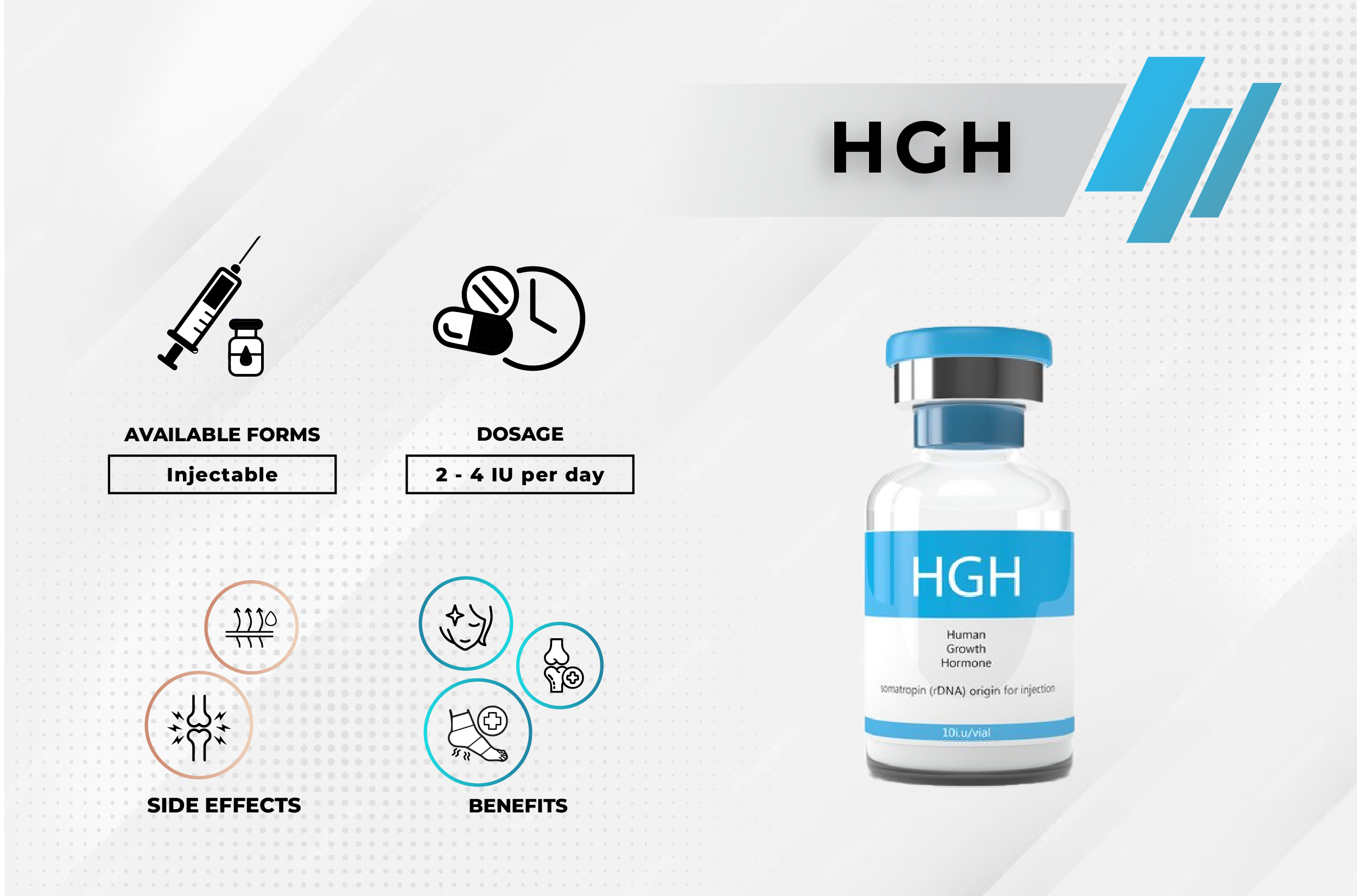
| Commonly reported in bodybuilding | 10 to 25 mg a day, often at bedtime to make use of the sleep effect and limit daytime hunger | 2 to 4 IU a day (about 0.7 to 1.3 mg), with higher doses reported by competitive bodybuilders |
| Commonly reported cycle length | 8 to 16 weeks | 3 to 6 months or longer |
One milligram of HGH is about 3 IU. HGH is injected subcutaneously. Our guide on how to inject peptides covers the technique. MK-677 is often combined with SARMs. Our RAD-140 and MK-677 stack guide explains the most popular pairing.
Legal Status
HGH is a prescription-only medicine in the US and most other countries. US federal law goes further than for most drugs: distributing HGH for any use other than an FDA-approved one, including anti-aging and bodybuilding, is a crime. The legal route is a doctor who diagnoses a qualifying condition. Some telehealth clinics offer testing for adult GH deficiency.
MK-677 has never been approved by the FDA for any use. It’s sold online labeled “for research use only” or “not for human consumption.” The FDA lists ibutamoren mesylate among bulk drug substances that pharmacies may not use for compounding because of significant safety risks. Laws on buying and possessing it vary by country, so check where you live.
In sport, both are banned at all times. The WADA Prohibited List names growth hormone and growth hormone secretagogues, including ibutamoren, under section S2.
MK-677 vs HGH: Which One Makes Sense?
There’s no single winner. The right choice depends on why you’re considering either one.
- If you have symptoms of growth hormone deficiency, see an endocrinologist. Prescription HGH is the proven treatment, and MK-677 can’t replace it when the pituitary can’t make GH.
- If you want an anti-aging boost, the evidence for both is thin. Lean mass goes up, but strength and function don’t clearly improve, and side effects rise.
- If you’re a healthy lifter, MK-677 is cheaper, oral and easier to get. It raises GH and IGF-1 and can improve sleep, but it brings hunger, water retention and blood sugar effects, and it isn’t an approved drug. HGH is more expensive, needs injections and is illegal to use without a valid prescription.
Other growth hormone secretagogues work through the pituitary too. Tesamorelin is an FDA-approved GHRH analog (for HIV-associated belly fat), and the ipamorelin and CJC-1295 stack is a popular injectable option.
The Bottom Line
MK-677 and HGH both raise growth hormone and IGF-1, but they do it in opposite ways.
- MK-677 is an oral pill that makes your own pituitary release more GH while HGH is the hormone itself, injected.
- HGH has decades of evidence for real medical conditions and is prescription-only.
- MK-677 has a handful of small trials showing more lean mass and better sleep, alongside higher blood sugar, water retention and one stopped trial.
- Neither has shown clear gains in strength in healthy people.
Frequently Asked Questions
Disclaimer
Please read carefully
Not medical advice
Content here is not a substitute for professional medical advice.
Consult your doctor
Talk to your doctor before starting any supplement or new routine.
Use at your own risk
We are not responsible for adverse effects from acting on this.
Do your research
Make informed decisions about your own health.
No guarantees
Individual results vary. No claims about outcomes.
Important — Never disregard professional medical advice or delay seeking it because of something you read here. If you think you may have a medical emergency, call your doctor or your local emergency number right away.





What are the key differences and benefits of MK677 versus HGH for muscle growth and overall health enhancement?