Contents11 sections
Erectile dysfunction affects an estimated 30 million men in the United States alone, and the search for alternatives to PDE5 inhibitors like Viagra and Cialis has driven growing interest in peptide-based approaches. Unlike conventional ED medications that act exclusively on blood vessel dilation, certain peptides target the central nervous system, hormonal signaling pathways, or both—addressing erectile dysfunction through mechanisms that standard treatments do not reach.
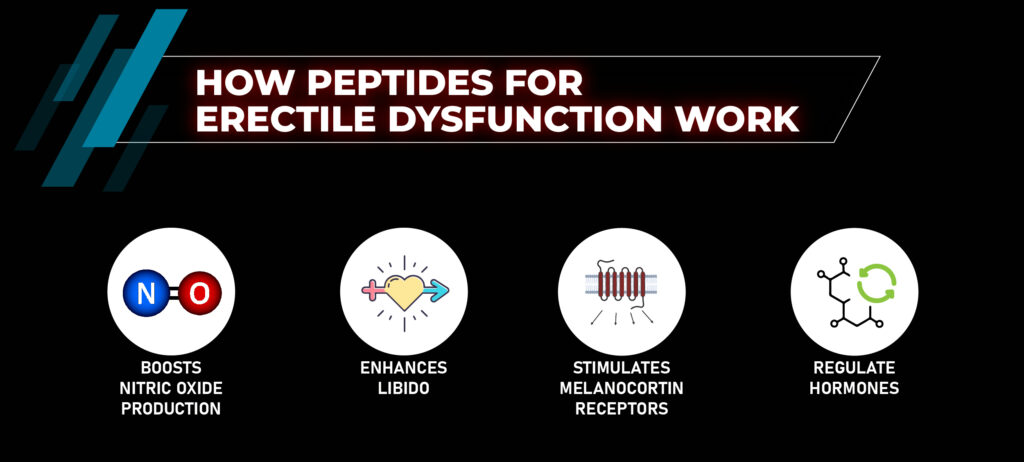
Four peptides have the strongest evidence base for erectile function: PT-141 (bremelanotide), Melanotan II, Kisspeptin-10, and Oxytocin. Each works through a distinct pathway, from melanocortin receptor activation in the brain to upstream hormonal regulation via the HPG axis.
This guide covers the mechanism, dosing, evidence, and practical considerations for each peptide, along with how they compare to each other and to standard ED medications.
Key Takeaways
- PT-141 (bremelanotide) is the most clinically validated peptide for sexual dysfunction—it is FDA-approved as Vyleesi for hypoactive sexual desire disorder in premenopausal women, with strong off-label interest for male ED.
- Melanotan II stimulates melanocortin receptors similarly to PT-141 but carries additional effects including skin tanning and appetite suppression.
- Kisspeptin-10 works upstream of the entire HPG axis, stimulating natural testosterone production rather than directly targeting arousal pathways.
- Oxytocin plays a supporting role in arousal, bonding, and erectile function through central nervous system pathways.
- Peptides for ED work through the brain and hormonal system rather than just blood vessel dilation, which is why they can help men who do not respond to Viagra or Cialis.
How Erectile Dysfunction Works
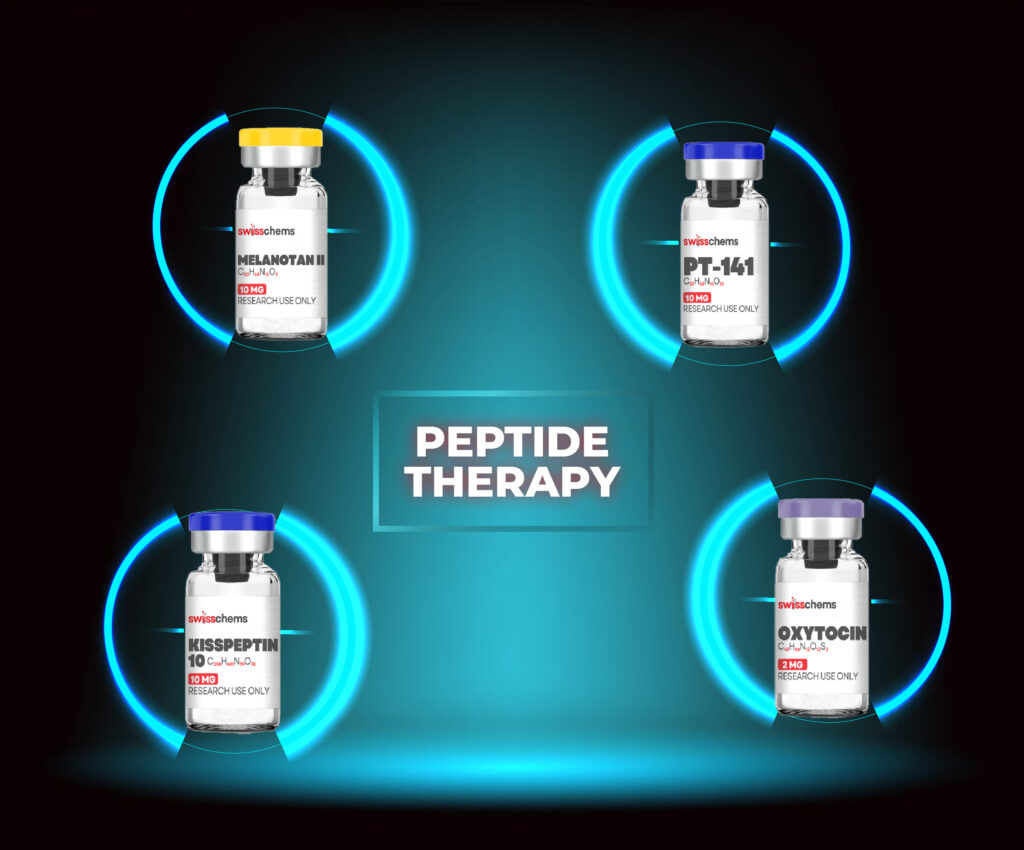
Erectile dysfunction is the consistent inability to achieve or maintain an erection sufficient for satisfactory sexual performance. The physiology behind an erection involves a coordinated sequence: sexual stimulation triggers the brain to send signals through the spinal cord, releasing nitric oxide in the penile tissue, which relaxes smooth muscle and allows blood to fill the corpora cavernosa.
ED occurs when any part of this chain breaks down:
| Cause Category | Examples | How Peptides May Help |
|---|---|---|
| Vascular | Atherosclerosis, hypertension, diabetes | Limited direct effect—peptides primarily target central pathways |
| Neurological | Spinal injury, neuropathy, MS | PT-141 and Melanotan II bypass peripheral nerves via central activation |
| Hormonal | Low testosterone, hypogonadism | Kisspeptin-10 stimulates endogenous testosterone production |
| Psychological | Performance anxiety, depression, stress | Oxytocin and PT-141 act on brain circuits involved in desire and arousal |
| Medication-induced | Antidepressants (SSRIs), antihypertensives | Central-acting peptides may partially overcome medication-related ED |
This is why peptides represent a genuinely different approach. PDE5 inhibitors like sildenafil only work on the vascular step—they enhance nitric oxide signaling in the penis. Peptides like PT-141 activate desire and arousal pathways in the brain, which means they can help men whose ED stems from low desire, psychological factors, or neurological issues rather than poor blood flow alone.
The 4 Best Peptides for Erectile Dysfunction
PT-141 (Bremelanotide)
PT-141 is the most clinically studied peptide for sexual dysfunction. It works by activating melanocortin-4 receptors (MC4R) in the hypothalamus—the brain region that controls sexual arousal and desire. Unlike Viagra, which acts peripherally on blood vessels, PT-141 generates arousal centrally, producing both the desire for sex and the physiological response that follows.
The FDA approved PT-141 as Vyleesi in 2019 for hypoactive sexual desire disorder (HSDD) in premenopausal women. While it is not FDA-approved for male ED, clinical trials in men with ED demonstrated statistically significant improvements in erectile function scores compared to placebo, particularly in men who had not responded adequately to sildenafil.
How It Works
- PT-141 binds to MC4R receptors in the hypothalamus
- This triggers downstream signaling cascades that increase dopamine activity
- The dopamine increase drives both psychological arousal (desire) and physiological response (erection)
- The effect is independent of the nitric oxide/PDE5 pathway
This central mechanism is why PT-141 can work for men who have failed PDE5 inhibitors—it addresses a completely different part of the arousal chain.
| Detail | Information |
|---|---|
| Mechanism | Melanocortin-4 receptor agonist (central nervous system) |
| Administration | Subcutaneous injection |
| Typical dose | 1–2 mg, 30–45 minutes before sexual activity |
| Onset | 30–60 minutes |
| Duration of effect | 6–12 hours |
| Frequency | No more than 8–10 times per month |
| Cycle length | 6–12 weeks |
| Key side effects | Nausea (most common), flushing, headache, injection site reactions |
| FDA status | Approved for HSDD in women (Vyleesi); not approved for male ED |
What to Know: Nausea is the most frequently reported side effect and tends to be dose-dependent. Starting at 1 mg and assessing tolerance before increasing to 2 mg reduces this risk. PT-141 can also cause a transient increase in blood pressure, so men with uncontrolled hypertension should exercise caution.
Melanotan II
Melanotan II is a synthetic analog of alpha-melanocyte-stimulating hormone (α-MSH) that activates multiple melanocortin receptors, including MC4R (sexual function) and MC1R (skin pigmentation). Its erectile effects were actually discovered accidentally during tanning research—early trial participants reported spontaneous erections as an unexpected side effect.
Melanotan II works through the same central melanocortin pathway as PT-141, but it is a less selective agonist. Where PT-141 was designed to preferentially target MC4R, Melanotan II activates MC1R, MC3R, MC4R, and MC5R. This broader receptor profile explains both its additional effects (tanning, appetite suppression) and its additional side effects.
How It Works
- Melanotan II activates MC4R in the hypothalamus (same as PT-141) to stimulate arousal
- Simultaneously activates MC1R in melanocytes, increasing melanin production (skin darkening)
- Acts on MC3R to suppress appetite
- The combined effect produces sexual arousal, skin tanning, and reduced hunger
Research in men with ED showed that Melanotan II administered via subcutaneous injection produced erections in a dose-dependent manner, including in men with psychogenic ED and those with organic ED who had not responded to other treatments.
| Detail | Information |
|---|---|
| Mechanism | Non-selective melanocortin receptor agonist |
| Administration | Subcutaneous injection |
| Typical dose | 0.5–1 mg initially, up to 1–2 mg maintenance |
| Onset | 1–2 hours for sexual effects |
| Duration of effect | 6–12 hours (tanning effect builds over days) |
| Frequency | 2–4 times per month |
| Cycle length | 4–12 weeks |
| Key side effects | Nausea, facial flushing, fatigue, skin darkening, new mole development |
| FDA status | Not approved for any indication |
What to Know: The tanning effect is essentially unavoidable at doses that produce sexual effects. Men should monitor moles during use, as melanocortin activation can stimulate melanocyte activity in existing nevi. Melanotan II has not gone through the rigorous clinical trial process that PT-141 has, so the safety data is less robust.
Kisspeptin-10
Kisspeptin-10 takes a fundamentally different approach to erectile dysfunction. Rather than directly stimulating arousal pathways, it works at the top of the hypothalamic-pituitary-gonadal (HPG) axis to increase endogenous testosterone production. Low testosterone is a significant contributor to ED in many men, particularly those over 40 or men recovering from steroid use.
Kisspeptin-10 binds to GPR54 receptors on GnRH neurons in the hypothalamus, triggering the release of GnRH, which stimulates LH and FSH secretion from the pituitary. LH then acts on Leydig cells in the testes to produce testosterone. Research confirms that kisspeptin administration elevates LH levels in healthy men at doses as low as 0.3 nmol/kg.
Beyond hormonal effects, research published in The Journal of Clinical Investigation found that kisspeptin administration enhanced brain activity in regions associated with sexual arousal when men viewed erotic images—suggesting it plays a direct role in sexual processing, not just hormone production.
| Detail | Information |
|---|---|
| Mechanism | GPR54 agonist—stimulates GnRH release, upstream of entire HPG axis |
| Administration | Subcutaneous injection |
| Typical dose | 100–250 mcg SubQ |
| Onset | LH elevation within 30–60 minutes; testosterone effects over days to weeks |
| Duration of effect | Short half-life (~4 min IV; longer effective window SubQ) |
| Frequency | 1–2 times daily |
| Cycle length | 4–8 weeks |
| Key side effects | Mild injection site reactions, potential hormonal fluctuations |
| FDA status | Not approved; investigational |
What to Know: Kisspeptin-10 is best suited for men whose ED is driven by low testosterone or hormonal imbalance rather than psychological or vascular causes. Its extremely short half-life means each injection produces a pulsatile hormonal response rather than sustained elevation. Extended use risks receptor desensitization (tachyphylaxis), which is why cycles should be kept to 4–8 weeks. For men coming off testosterone replacement or steroid cycles, Kisspeptin-10 supports natural HPG axis recovery.
Oxytocin
Oxytocin is a naturally occurring peptide hormone produced in the hypothalamus and released by the posterior pituitary gland. While commonly known as the “bonding hormone” for its role in social attachment and pair bonding, oxytocin also plays a direct role in male sexual function. It is involved in penile erection through central mechanisms and facilitates ejaculation by promoting smooth muscle contraction.
Oxytocin acts on oxytocin receptors in the paraventricular nucleus of the hypothalamus, which sends excitatory signals to the spinal erection centers. Research has shown that intranasal or injectable oxytocin can enhance arousal, orgasm intensity, and sexual satisfaction in both men and women.
The role of oxytocin in ED is more supportive than primary. It enhances the subjective experience of sexual activity—desire, pleasure, and emotional connection—rather than directly producing erections in the way PT-141 does. This makes it most valuable as part of a stack or for men whose ED has a significant psychological or relational component.
| Detail | Information |
|---|---|
| Mechanism | Oxytocin receptor agonist—central nervous system and peripheral smooth muscle |
| Administration | Subcutaneous injection or intranasal |
| Typical dose | 20–30 mcg SubQ before sexual activity |
| Onset | 15–30 minutes |
| Duration of effect | 2–4 hours |
| Frequency | Before sexual activity |
| Cycle length | 4–12 weeks |
| Key side effects | Mild headache, dizziness, nausea (rare) |
| FDA status | FDA-approved (Pitocin) for labor induction; not approved for sexual dysfunction |
What to Know: Oxytocin has the mildest side effect profile of the four peptides discussed here. Its primary limitation for ED is that the evidence for standalone erectile improvement is weaker than for PT-141 or Melanotan II. It works best as part of a peptide stack or for men seeking enhanced sexual experience rather than a solution to mechanical erectile failure.
Head-to-Head Comparison
| Feature | PT-141 | Melanotan II | Kisspeptin-10 | Oxytocin |
|---|---|---|---|---|
| Primary mechanism | MC4R activation (brain) | Multi-MCR activation (brain) | GnRH/LH stimulation (HPG axis) | OT receptor activation (brain + peripheral) |
| Onset | 30–60 min | 1–2 hours | Days to weeks (hormonal) | 15–30 min |
| Best for | Direct arousal + erection | Arousal + erection + tanning | Low-T driven ED, HPG recovery | Psychological ED, intimacy enhancement |
| Works for PDE5 non-responders | Yes | Yes | Only if low-T is the cause | Partially |
| FDA-approved for any indication | Yes (Vyleesi, HSDD in women) | No | No | Yes (Pitocin, labor) |
| Clinical trial data for male ED | Strong | Moderate | Limited (indirect) | Moderate |
| Tanning side effect | No | Yes (significant) | No | No |
| Testosterone increase | No | No | Yes (primary effect) | No |
| Nausea risk | High (dose-dependent) | Moderate | Low | Low |
| Cost per dose | $$ | $ | $$$ | $ |
Peptide Stacks for Erectile Dysfunction
Combining peptides that work through different mechanisms can produce synergistic effects. The most evidence-supported stacks target both central arousal (desire/brain) and hormonal optimization simultaneously.
PT-141 + Kisspeptin-10
This stack addresses ED from two directions. Kisspeptin-10 optimizes testosterone production through the HPG axis, while PT-141 directly activates desire and arousal through melanocortin receptors. The combination is particularly relevant for men with both low testosterone and diminished desire—common in men over 40 or those recovering from steroid cycles.
- Kisspeptin-10: 100–200 mcg SubQ daily for 4–6 weeks
- PT-141: 1–2 mg SubQ before sexual activity, up to 8 times per month
PT-141 + Oxytocin
This stack combines PT-141’s strong arousal and erectile effects with oxytocin’s enhancement of pleasure, bonding, and orgasm intensity. It targets men who can achieve erections with PT-141 but want a more complete sexual experience.
- PT-141: 1–2 mg SubQ, 30–45 minutes before activity
- Oxytocin: 20–30 mcg SubQ, 15–30 minutes before activity
Melanotan II + PT-141
Both peptides activate melanocortin receptors but with different selectivity profiles. This stack provides stronger and longer-lasting erectile effects through overlapping but distinct receptor activation. However, the combined nausea risk is higher, and the tanning effect from Melanotan II is unavoidable.
- Melanotan II: 0.5–1 mg SubQ
- PT-141: 1 mg SubQ (use lower dose when stacking)
For general peptide combination guidance, see our best peptide stacks guide.
Peptides vs. Viagra, Cialis, and Other ED Medications
| Factor | PDE5 Inhibitors (Viagra/Cialis) | Peptides (PT-141/Melanotan II) |
|---|---|---|
| Mechanism | Enhance nitric oxide → blood vessel dilation in penis | Activate melanocortin receptors → central arousal in brain |
| Requires sexual stimulation | Yes | PT-141 generates desire independently |
| Works for psychological ED | Poorly—no effect on desire | Yes—targets desire pathways directly |
| Works for vascular ED | Yes—primary indication | Partially—central activation still requires vascular capacity |
| Blood pressure effect | Can lower blood pressure; contraindicated with nitrates | Minimal blood pressure impact (PT-141 may cause transient increase) |
| Duration | Sildenafil: 4–6 hrs; Tadalafil: up to 36 hrs | PT-141: 6–12 hrs; MTII: 6–12 hrs |
| Side effects | Headache, flushing, nasal congestion, visual changes | Nausea, flushing, injection site reactions |
| Administration | Oral tablet | Subcutaneous injection |
| Prescription required | Yes | PT-141 (as Vyleesi): prescription; research peptides: varies |
| Cost | Generic sildenafil: ~$1–5/dose | Research peptides: ~$5–15/dose |
The key distinction is that peptides and PDE5 inhibitors are not direct competitors—they address different causes of ED. A man with poor blood flow to the penis needs vascular support (Viagra/Cialis). A man with low desire, psychological barriers, or who does not respond to PDE5 inhibitors may benefit more from central-acting peptides. In some cases, combining both approaches addresses ED from multiple angles, though this should only be done under medical supervision.
Side Effects and Safety
Side Effect Comparison
| Side Effect | PT-141 | Melanotan II | Kisspeptin-10 | Oxytocin |
|---|---|---|---|---|
| Nausea | Common (40%+) | Common | Rare | Rare |
| Headache | Occasional | Occasional | Rare | Occasional |
| Flushing | Common | Common | Rare | Rare |
| Injection site reaction | Mild | Mild | Mild | Mild |
| Skin darkening | No | Yes (significant) | No | No |
| Blood pressure change | Transient increase | Minimal | Minimal | Minimal |
| Mole changes | No | Possible | No | No |
| Hormonal fluctuation | No | No | Possible | No |
Safety Considerations
- Start low: Begin with the lowest recommended dose for any peptide and assess tolerance before increasing.
- Injection technique: Use proper subcutaneous injection technique with sterile equipment. Rotate injection sites.
- Cycle limits: Do not exceed recommended cycle lengths. PT-141 should not be used more than 8–10 times per month. Kisspeptin-10 cycles should be 4–8 weeks maximum due to tachyphylaxis risk.
- Contraindications: Men with uncontrolled hypertension should use PT-141 with caution. Men with a history of melanoma should avoid Melanotan II due to melanocortin stimulation of melanocytes.
- Storage: Reconstitute with bacteriostatic water and store refrigerated at 2–8°C. Use within 4–6 weeks of reconstitution.
- Source quality: Purchase from vendors with verified third-party testing and batch-specific COAs. See our best peptide vendors guide.
- Medical supervision: Consult a healthcare provider before use, particularly if you take medications for blood pressure, heart conditions, or psychiatric disorders.
Who Should Consider Peptides for ED
Peptides are not the right first-line treatment for every man with erectile dysfunction. They are most appropriate in specific situations:
Good candidates:
- Men who have tried PDE5 inhibitors (Viagra, Cialis) without adequate results
- Men whose ED is primarily driven by low desire or psychological factors
- Men with low testosterone contributing to ED (Kisspeptin-10 specifically)
- Men recovering from steroid or SARM cycles who need HPG axis support
- Men who cannot take PDE5 inhibitors due to contraindications (e.g., nitrate use)
Not ideal candidates:
- Men with severe vascular disease as the primary cause—peptides cannot overcome significant blood flow impairment
- Men with uncontrolled hypertension (PT-141 specifically)
- Men under 18
- Men with a history of melanoma (Melanotan II specifically)
For men exploring broader peptide applications beyond sexual health, our guides on best peptides for men and best peptides for muscle growth cover additional options.
The Bottom Line
For men who have not responded to Viagra or Cialis, or whose ED stems from low desire, psychological factors, or hormonal deficiency, peptides like PT-141, Melanotan II, Kisspeptin-10, and Oxytocin offer mechanisms that conventional medications simply do not address.
- PT-141 has the strongest clinical evidence and is the most practical choice for on-demand erectile support. Kisspeptin-10 is the best option for men whose ED is driven by low testosterone.
- Melanotan II provides strong erectile effects but comes with unavoidable tanning. Oxytocin enhances the overall sexual experience but is better as a supporting compound than a standalone ED treatment.
- As with any intervention for sexual health, these peptides should be used responsibly, sourced from reputable vendors with third-party testing, and ideally used under the guidance of a healthcare provider who can assess the underlying cause of ED and monitor for side effects.
Frequently Asked Questions
Disclaimer
Please read carefully
The information on this site is for educational and informational purposes only, and is not medical advice. Always consult a qualified healthcare professional before using any supplement or medication, or making changes to your health, fitness, or nutrition routine.
Not medical advice
Content here is not a substitute for professional medical advice.
Consult your doctor
Talk to your doctor before starting any supplement or new routine.
Use at your own risk
We are not responsible for adverse effects from acting on this.
Do your research
Make informed decisions about your own health.
No guarantees
Individual results vary. No claims about outcomes.
Important — Never disregard professional medical advice or delay seeking it because of something you read here. If you think you may have a medical emergency, call your doctor or your local emergency number right away.