Contents11 sections
Brock Lesnar has never had a publicly reported positive test for an anabolic steroid. He did, however, fail two UFC drug tests around UFC 200 in 2016, both for clomiphene, a banned anti-estrogen that is widely used to restart natural testosterone production after a steroid cycle. Those two results, and the sanctions that followed, are the only hard evidence in the Brock Lesnar steroids debate. Everything else is inference from his size and physique.
Lesnar was born on July 12, 1977, and grew up on a dairy farm near Webster, South Dakota. He became an NCAA Division I heavyweight wrestling champion, the youngest WWE Champion in history at the time at age 25, and UFC heavyweight champion in only his fourth professional MMA fight. At 6’3″ and billed at 286 lbs, he has faced steroid questions for most of his career.
Here is what is documented, what the 2016 results do and do not show, and why the physique “tells” quoted about him prove less than they seem.
Key Takeaways
- Lesnar’s only publicly reported failed tests came around UFC 200 in 2016: an out-of-competition sample from June 28 and a fight-night sample from July 9, both positive for clomiphene and its metabolite.
- Clomiphene is not an anabolic steroid. It is a selective estrogen receptor modulator that raises the body’s own testosterone, which is why it is banned in sport and why it is common in post-cycle therapy.
- The Nevada State Athletic Commission fined him $250,000, suspended him for one year and overturned his win over Mark Hunt to a no contest.
- A 2001 arrest on suspicion of steroid possession ended with the charge dropped after his lawyer said the substance was a growth hormone, not a steroid.
- His size, traps and estimated FFMI raise fair questions, but they fit elite genetics as well as drug use. Photos cannot settle it; only testing can.
Brock Lesnar Stats and Career Overview
| Detail | Information |
|---|---|
| Full Name | Brock Edward Lesnar |
| Date of Birth | July 12, 1977 |
| Hometown | Webster, South Dakota |
| Height | 6’3″ (191 cm) |
| Weight | Billed at 286 lbs (130 kg) in WWE; fought at the 265 lb heavyweight limit in the UFC |
| Amateur Wrestling | Junior college national champion (Bismarck State); NCAA Division I heavyweight champion (University of Minnesota, 2000) |
| Pro Wrestling | Multiple-time WWE Champion; first title at SummerSlam 2002, aged 25; IWGP Heavyweight Champion in New Japan (2005) |
| Football | Minnesota Vikings training camp and preseason, 2004 |
| MMA | UFC Heavyweight Champion (2008-2010); professional record 5-3, 1 no contest |
| Failed Drug Tests | Two in 2016 (clomiphene), linked to UFC 200 |
From Farm Kid to Champion in Three Sports
Lesnar’s athletic record is part of why the steroid question keeps coming up. Very few people have reached the top in amateur wrestling, pro wrestling and MMA, let alone at close to 290 lbs.
Amateur Wrestling
After high school in Webster, Lesnar wrestled at Bismarck State College, where he won a junior college national title, and then moved to the University of Minnesota. He reached the NCAA Division I heavyweight final in 1999, losing to Stephen Neal, and won the title in 2000.
WWE and the Vikings
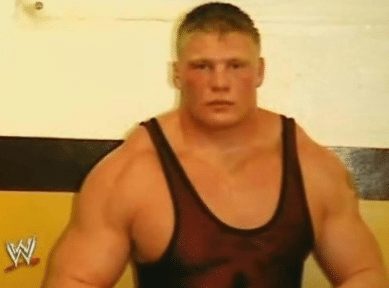
WWE signed him in 2000. He reached the main roster in 2002 and beat The Rock at SummerSlam that August to become the youngest WWE Champion at the time. In 2004 he left WWE to try out for the Minnesota Vikings despite not having played football since high school. He made it through training camp and into the preseason before being released ahead of the regular season.
Tryout numbers from that period, such as 30 reps on the 225 lb bench press and a 40-yard dash around 4.65 seconds, are still widely repeated, but they were not official NFL Combine results and are hard to verify.
MMA and the UFC Title
Lesnar made his MMA debut in 2007, stopping Min-Soo Kim in the first round. He lost his UFC debut to Frank Mir at UFC 81, then beat Heath Herring and took the heavyweight title from Randy Couture at UFC 91 in November 2008. He beat Mir in their rematch at UFC 100 and, after a serious bout of diverticulitis that later required surgery to remove part of his colon, came back to beat Shane Carwin at UFC 116.
He lost the title to Cain Velasquez at UFC 121 in 2010, lost to Alistair Overeem at UFC 141 in 2011 and retired. Nearly five years later he came back for one more fight, and that fight produced the only failed drug tests of his career.
The 2016 UFC Failed Tests
The UFC 200 Comeback and the Testing Exemption
In June 2016 the UFC announced that Lesnar would face Mark Hunt at UFC 200 on July 9. Under the UFC’s anti-doping policy, run by the U.S. Anti-Doping Agency (USADA) since July 2015, a retired fighter who returns normally has to spend four months in the testing pool before competing. Lesnar had retired in 2011, before the program existed, and the UFC used an exemption to waive that waiting period for him. The decision was criticized at the time and drew much more attention once his results came back.
Two Positive Samples
Lesnar beat Hunt by unanimous decision. Days later, USADA announced a potential violation from an out-of-competition sample collected on June 28, 2016, less than two weeks before the fight. The sample he gave on fight night later came back positive for the same substance. Both contained clomiphene and its metabolite, hydroxyclomiphene.
The publicly reported findings named no anabolic steroid, no growth hormone and no other banned drug. That detail matters: the failed tests prove a doping violation, but on their own they do not show which steroids, if any, were used.
The Penalty
In December 2016 the Nevada State Athletic Commission ruled on the case. Lesnar, who had failed the drugs tests around his bout with Hunt, was fined $250,000, 10% of his disclosed $2.5 million purse, and suspended for one year, backdated to July 15, 2016. His win was overturned to a no contest. USADA issued its own one-year sanction.
| Date | Event |
|---|---|
| June 2016 | Lesnar vs Mark Hunt announced; four-month testing period waived |
| June 28, 2016 | Out-of-competition sample collected |
| July 9, 2016 | Lesnar beats Hunt; fight-night sample collected |
| July 15, 2016 | USADA announces a potential violation |
| December 2016 | $250,000 fine, one-year suspension, no contest |
Hunt, a vocal critic of doping in the UFC, later sued the UFC, Dana White and Lesnar over the fight. Lesnar went back to WWE and announced his retirement from MMA in early 2017. A heavyweight title fight with Daniel Cormier was discussed in 2018, but it never happened, and UFC 200 remains his last MMA bout.
What Is Clomiphene, and What Does a Positive Test Mean?
Clomiphene citrate, best known by the brand name Clomid, is a selective estrogen receptor modulator (SERM). It is approved to induce ovulation in women. In men it blocks estrogen’s feedback signal at the hypothalamus and pituitary, so the body releases more luteinizing hormone (LH) and follicle-stimulating hormone (FSH), and the testes make more testosterone. Doctors sometimes prescribe it off-label for male hypogonadism and fertility problems.
Because it raises natural testosterone, anti-doping rules, which the UFC program followed through the World Anti-Doping Agency (WADA) prohibited list, ban it for male athletes at all times, in and out of competition.
Why Fans Read It as a Steroid Signal
In bodybuilding, clomiphene is one of the standard drugs for post-cycle therapy (PCT). Anabolic steroids shut down the body’s own testosterone production, and after a cycle users take a SERM such as Clomid or tamoxifen for several weeks to restart it. Our guide to PCT after testosterone explains how that recovery works.
A clomiphene positive in the weeks before a fight is therefore consistent with someone coming off a steroid cycle. That is the most common reason athletes are caught with it, and why many observers treated Lesnar’s result as strong circumstantial evidence.
What It Does Not Prove
- It is not a steroid: Clomiphene does not build muscle directly. It raises the body’s own testosterone, a far milder effect than exogenous anabolics.
- It does not identify a cycle: No steroid was named in the public findings, so any claim about which compounds he might have used before the tests is speculation.
- It has medical uses: Clomiphene is prescribed for low testosterone and male fertility. A prescription does not excuse a positive result without an approved exemption, but it is one reason a positive is not proof of steroid use.
The fair summary is that Lesnar committed an anti-doping violation with a drug strongly associated with steroid cycles. That is more than physique speculation, but less than a positive test for a steroid.
The 2001 Arrest
In January 2001, while he was working in WWE’s developmental system, Lesnar was arrested on suspicion of possessing anabolic steroids. According to reports at the time, his lawyer said the substance was a growth hormone rather than a steroid, and the charge was later dropped. There was no conviction.
Growth hormone is not an anabolic steroid. The episode is often cited as part of a pattern, but on its own it shows only that he was arrested and the case went no further.
WWE does not publish individual drug test results, so there is no public WWE testing record for Lesnar either way. The 2016 UFC results remain the only official findings.
The Physique Case: What Photos Can and Cannot Show
Most steroid claims about Lesnar are based on how he looks. Some of these points are reasonable questions; others do not hold up. For a general guide to the signs people look for, see how to spot a fake natty.
Size and FFMI
The Fat-Free Mass Index (FFMI) compares lean mass to height. A widely cited 1995 study by Kouri and colleagues found that drug-free lifters rarely exceeded an FFMI of about 25, while steroid users often did.
At 6’3″ and around 285 lbs, with an estimated 12-15% body fat, Lesnar’s FFMI works out at roughly 29-31. Even at his UFC fighting weight of 265 lbs and leaner, it stays near 29. Body fat here is an estimate from photos, so these numbers are approximate, but they sit well above the range the study found in natural lifters.
FFMI is a flag, not a test. The 25 cutoff came from a fairly small sample of male lifters, and very large, heavy-boned athletes are outliers it was not designed for.
Traps, Skin Tone and the “Full” Midsection
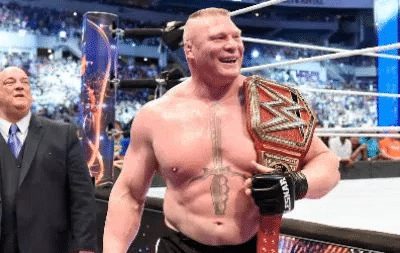
Lesnar’s oversized traps, thick midsection and often flushed skin are frequently presented as proof. None of them is diagnostic:
- Traps: Androgens do respond strongly in the traps and shoulders, but trap size also depends on genetics and training. Wrestlers train the neck and upper back intensively for years.
- Midsection: A full waist at close to 290 lbs reflects a huge frame and a very large food intake as much as anything. An “HGH gut” cannot be diagnosed from a photo.
- Flushed skin: A red face and chest are common in fair-skinned people during exertion, in hot arenas or under stage lights. Some drugs cause flushing too, but so do many ordinary things.
Facial Changes and the HGH Theory
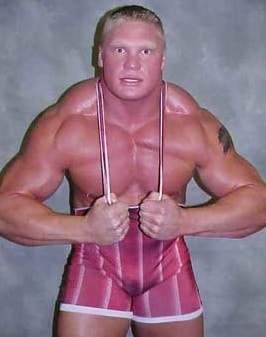
Side-by-side photos of Lesnar’s face over the years are often used to argue for growth hormone use. Long-term excess growth hormone does stimulate growth of bone and soft tissue, and in adults it can coarsen facial features. Our guide to HGH for men covers those effects.
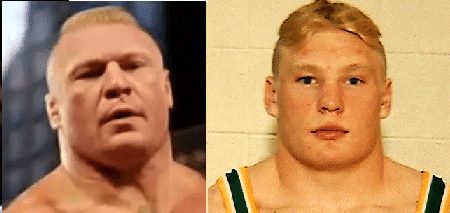
Faces also change with age, body weight and years of contact sport, and different lenses and lighting exaggerate small differences. No growth hormone was named in his 2016 results, so this remains speculation.
The Gains Timeline
A physique timeline is usually the most useful tool in a natty-or-not analysis, but in Lesnar’s case it is weak evidence. Claims about his early years rest on undated photos of a teenager going through puberty, when fast growth is normal and hard to judge from pictures. He was already very large in college, and his size from WWE through the UFC stayed broadly consistent, apart from the weight he lost during his illness and the weight he cut to make 265 lbs.
That consistency does not prove he is natural, but it also lacks the sudden late “blow-up” that is one of the stronger warning signs in other athletes.
Is Brock Lesnar on Steroids? Our Assessment
Separating the record from inference gives a clearer picture than any photo.
| Claim | Status | Basis |
|---|---|---|
| Failed two UFC drug tests in 2016 | Confirmed | USADA findings and the Nevada State Athletic Commission ruling |
| The substance was clomiphene | Confirmed | Clomiphene and its metabolite in both samples |
| Tested positive for an anabolic steroid | Not confirmed | No steroid was named in any public finding |
| Convicted over the 2001 arrest | No | The charge was dropped |
| Used steroids as a teenager | No evidence | Based only on undated photos |
| Used a steroid cycle before UFC 200 | Open to debate | Clomiphene is a common PCT drug, but it does not identify a cycle |
| Size beyond natural limits | Open to debate | Estimated FFMI of about 29-31, an imperfect measure for very large athletes |
On the evidence, Lesnar cannot be called a proven steroid user, and he cannot be called a clean athlete either: he was sanctioned for a doping violation in 2016. The clomiphene positives, his extreme size and the waived testing window explain why many people believe he used steroids, but only testing can give a definitive answer.
The Bottom Line
Brock Lesnar’s 2016 failed tests for clomiphene are the only hard evidence in the steroid debate: a real doping violation, but not a positive test for a steroid.
- Both UFC 200 samples were positive for clomiphene, a banned SERM widely used for post-cycle therapy, which led to a $250,000 fine, a one-year suspension and a no contest.
- The 2001 arrest ended with the charge dropped, and no anabolic steroid or growth hormone appears in any public test result.
- His size and estimated FFMI raise fair questions, but traps, skin tone and facial changes are not proof either way.
Frequently Asked Questions
To learn more about the drugs discussed in this article, read our guide to Clomid for PCT, which covers PCT protocols, dosage and testosterone recovery.
Disclaimer
Please read carefully
The information on this site is for educational and informational purposes only, and is not medical advice. Always consult a qualified healthcare professional before using any supplement or medication, or making changes to your health, fitness, or nutrition routine.
Not medical advice
Content here is not a substitute for professional medical advice.
Consult your doctor
Talk to your doctor before starting any supplement or new routine.
Use at your own risk
We are not responsible for adverse effects from acting on this.
Do your research
Make informed decisions about your own health.
No guarantees
Individual results vary. No claims about outcomes.
Important — Never disregard professional medical advice or delay seeking it because of something you read here. If you think you may have a medical emergency, call your doctor or your local emergency number right away.